
You’ve likely heard the phrase “will do” in emails, text messages, or quick office conversations. It serves as a concise, affirmative response to a request, signaling that you have received an instruction and intend to carry it out. While it is short, its impact on your professional reputation is significant because it projects reliability and efficiency.
Understanding how to use this phrase correctly helps you communicate clearly without unnecessary fluff. Whether you are responding to a supervisor or coordinating with a peer, using these two simple words effectively shows you are ready to get the job done. Let’s look at how to master its usage.
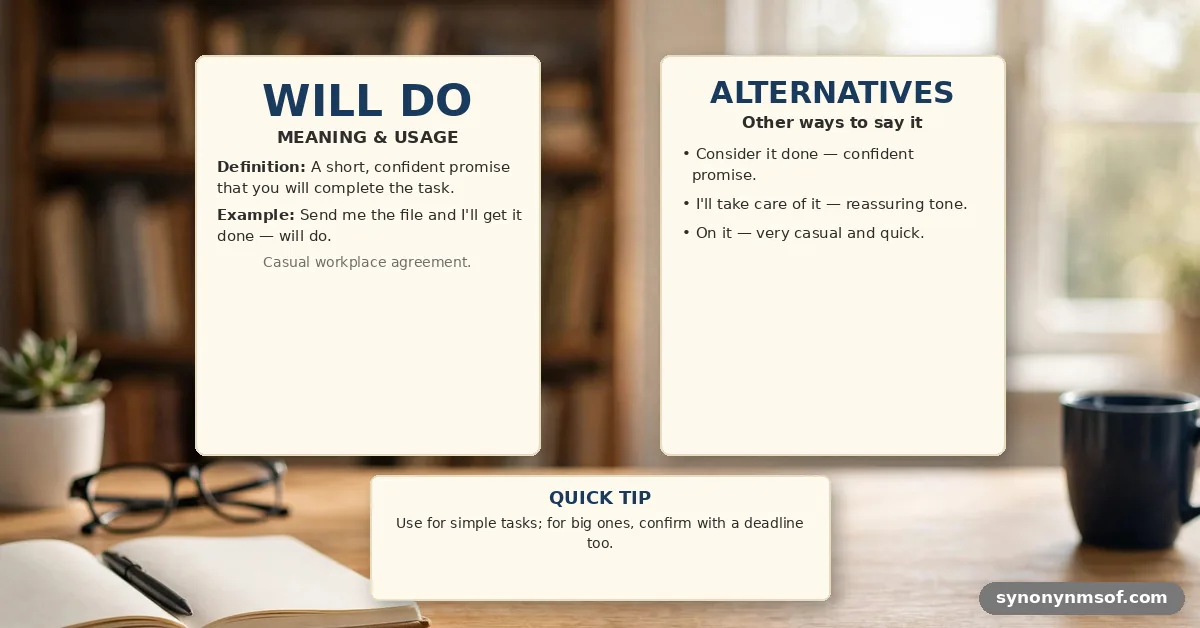
At its core, stating “will do” is a shorthand way of saying, “I will perform the action you have requested.” It functions as an acknowledgment and a commitment wrapped into one. In English, the phrase relies on the future tense of the modal verb “will,” which expresses intention or certainty about a coming event.
When you say “will do,” you are cutting out the subject “I,” which makes the response sound punchy and direct. It is the verbal equivalent of a firm nod or a quick thumbs-up. In the modern workplace, where brevity is often valued, this phrase is a go-to for confirming that a task has been added to your queue.
However, the brevity of the phrase is a double-edged sword. Because it lacks a specific timeline or detail, it is best used when the request itself is clear and the deadline is understood. If you use it for complex or ambiguous requests, you might leave the sender wondering if you truly grasped the scope of the assignment.
When to Use This Phrase Appropriately

The best time to use “will do” is during quick, transactional exchanges. If a colleague asks you to send a file, update a spreadsheet, or check a meeting time, this phrase is perfectly acceptable. It conveys that you have heard them and are moving forward immediately.
It is particularly effective in fast-paced environments like Slack, Microsoft Teams, or quick email threads. In these settings, people appreciate speed. They don’t need a formal, long-winded confirmation; they just need to know the ball is in your court.
Avoid using it when the request requires a more formal or detailed response. For instance, if a client asks for a comprehensive project proposal or a detailed explanation of a budget variance, “will do” feels dismissive. In those cases, you should provide a more substantial reply that outlines your next steps or asks clarifying questions.
How It Differs from Other Affirmations
Language is full of ways to say yes, but each carries a slightly different weight. Understanding these nuances helps you choose the right tone for the situation.
- Will do: Casual, direct, and action-oriented. Best for peers and quick tasks.
- I will certainly do that: More formal and polite. Best for clients or senior management.
- Consider it done: Implies the task is already finished or will be completed without further input.
- Understood: Acknowledges receipt of information but does not necessarily commit to a specific action.
- I am on it: Similar to “will do” but emphasizes that you are starting the work right now.
As you can see, the choice depends on your relationship with the person and the nature of the request. “Will do” sits in the middle of the spectrum—it isn’t overly formal, but it isn’t rude either. It represents a functional, efficient style of communication.
The Mechanics of Professional Usage
Using “will do” correctly requires a degree of situational awareness. You must be sure that your verbal commitment is backed by actual follow-through. If you say you will do something but then forget, the phrase loses its power and makes you seem unreliable.
In a professional setting, consider adding a tiny bit of context if the task isn’t immediate. For example, instead of just saying “will do,” try “will do—I’ll have that to you by 3 p.m.” This adds a layer of accountability that the simple two-word phrase lacks.
This combination of the initial confirmation and a specific timeline is the gold standard for office communication. It saves you from having to send a follow-up email later, and it saves the requester from having to ask for a status update. It essentially manages expectations from the very start.
Comparing Response Styles
Different situations call for different levels of formality. The following table illustrates how various ways of confirming a task might be perceived in a workplace environment.
| Response | Formality Level | Best Used With |
|---|---|---|
| Will do | Casual | Peers, close teammates |
| Certainly, I will handle that | Formal | Clients, senior executives |
| I’ll get right on that | Polite/Urgent | Direct managers |
| Understood, thanks | Professional | General correspondence |
| Consider it handled | Confident | Project stakeholders |
Use this table as a quick reference guide. If you are ever unsure about whether “will do” is too informal, it is always safer to lean toward a more complete sentence. You can rarely go wrong by being slightly more polite than the situation demands.
Common Pitfalls and How to Avoid Them
One major mistake people make is using “will do” when they don’t actually intend to do the task right away. If you say it, the other person expects results. If you need more time, be honest about it.
Another pitfall is using it with people who value formal, traditional communication. Some managers view short, clipped responses as unprofessional. If you are new to a company, observe how others communicate before defaulting to short phrases.
Finally, do not rely on it as your only form of communication. If you only ever reply with “will do,” you might come across as robotic or uninterested. Mix up your responses to show that you are an engaged, thoughtful communicator who cares about the quality of the interaction.
The Role of Tone in Written Communication
Because written words lack facial expressions and vocal inflection, they can often be misinterpreted. “Will do” can sound snappy or even annoyed if the recipient is already feeling stressed. Always consider the context of the email chain before hitting send.
If you are responding to an email that contains a long list of instructions, “will do” might feel like you are brushing off the complexity of the request. In these instances, try “I will take care of these items and update you shortly.”
This shows that you have read and understood the entire message. It confirms that you are not just acknowledging the email, but that you are actively engaging with the content provided. This distinction is vital for maintaining positive professional relationships.
Expanding Your Professional Vocabulary
While “will do” is a great tool, it shouldn’t be the only one in your kit. Expanding your range of responses will make you a more versatile communicator. Practice using different phrases to see how they affect the flow of your conversations.
If you find yourself using the same phrase every day, try to rotate through a few alternatives. Using varied language keeps your emails feeling fresh and prevents you from sounding like a template. You will find that different people respond better to different styles.
Ultimately, your goal is to be clear, concise, and helpful. Whether you choose to say “will do” or a more elaborate phrase, the most important factor is that you provide value and follow through on your commitments.
FAQ
Is it okay to use will do in a professional email?
Yes, it is generally acceptable for quick, internal communications with colleagues or teammates you know well. However, avoid using it with external clients or senior leadership unless you have a very established, casual working relationship with them.
What is the best way to express urgency politely?
To express urgency, combine your confirmation with a specific timeframe. Instead of just saying “will do,” try “will do—I will prioritize this and have it sent over by the end of the day.” This provides the requester with peace of mind.
How does will do differ from saying yes?
Saying “yes” is a simple agreement, while “will do” is a commitment to an action. “Yes” can be an answer to a question, whereas “will do” is specifically a response to a request for work or a task.
Can this phrase sound rude?
It can sound rude if it is used to dismiss a complex request or if it is sent to someone who expects a more formal tone. If you are unsure, it is better to provide a slightly longer, more complete sentence.
Mastering Your Communication
Choosing the right words is a subtle but essential part of building a strong professional reputation. By knowing when to use “will do” and when to opt for a more formal alternative, you demonstrate that you understand the nuances of workplace dynamics. This simple phrase is a powerful tool for showing you are reliable, efficient, and ready to contribute to your team’s success.
As you continue to refine your communication style, remember that the goal is always to provide clarity and build trust with those you interact with daily. Take these lessons into your next conversation, and you will find that your professional interactions become much more effective. If you have any other questions about workplace language, feel free to reach out and keep the conversation going.
SEO Title: Will Do: Meaning, Usage, and Professional Examples
Meta Description: Learn the meaning and proper usage of the phrase “will do.” Discover when it’s professional to use and when you should choose a more formal alternative.
Suggested URL Slug: will-do-meaning-usage-examples
Primary Keyword: Will do
Secondary Keywords: professional ways to say, workplace communication, email etiquette, modal verbs, English usage