
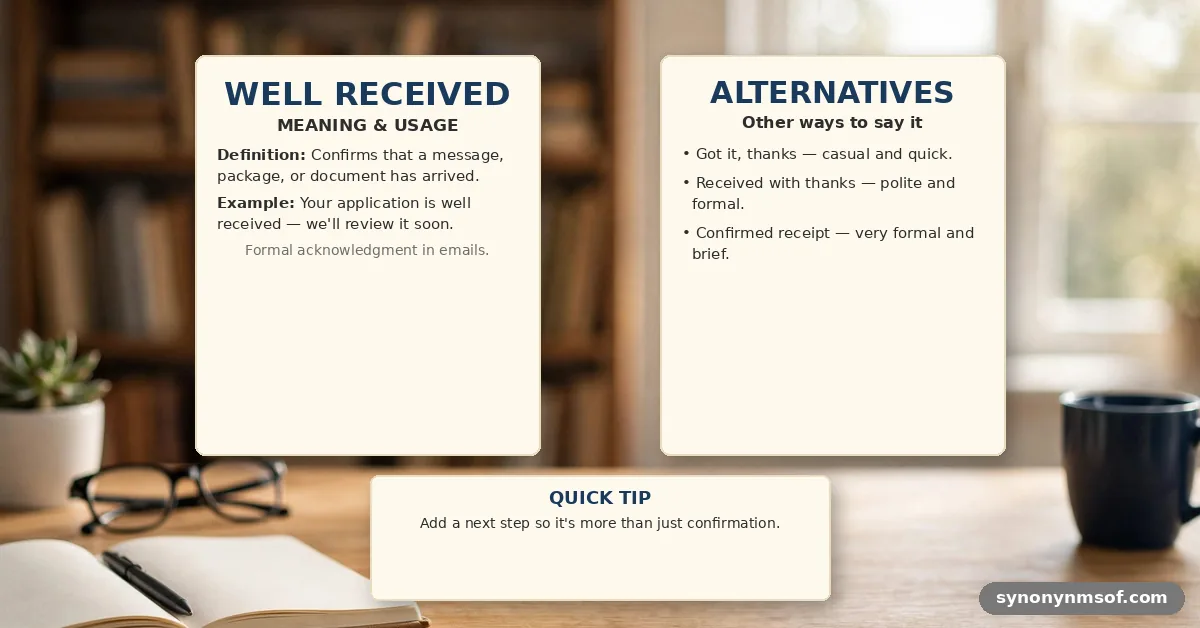

Understanding the nuances of well received: meaning, examples, and alternatives is essential for anyone aiming to maintain a polished, professional communication style in a digital workplace. When you describe an item, a suggestion, or a document as “well received,” you are signaling that the audience has acknowledged, understood, and reacted positively to the information provided.
Mastering this phrase helps you navigate corporate correspondence with confidence, ensuring your tone remains both respectful and efficient. By exploring the practical applications of this term and its various substitutes, you will improve your ability to confirm receipt while fostering strong professional relationships through clear, intentional language.
The term “well received” is a standard idiomatic expression used to confirm that a piece of information or an item has arrived and met with a favorable reaction. It functions as a concise way to acknowledge that a message was not just delivered, but also reviewed and accepted in the spirit it was intended.
At its core, the phrase combines two distinct functions: confirmation of receipt and validation of quality. When a manager tells a team that a new policy was “well received,” they mean the staff understood the document and generally agreed with its contents. It implies a lack of friction or negative feedback during the initial assessment.
When to Use the Phrase
You should deploy this phrase primarily in formal or semi-formal business contexts where you need to provide a professional update. It is particularly effective in status reports, performance reviews, or project summaries where you are summarizing the sentiment of a larger group.
Avoid using it in overly casual settings, such as text messages to close friends or quick internal chats. Over-using it in informal scenarios can make your communication sound rigid or robotic, which may distance you from your peers. Reserve it for moments where you need to convey objective success or consensus.
Examples in Professional Correspondence
To see the phrase in action, consider how it functions in common workplace scenarios. It is most helpful when you are delivering a report to a client or summarizing a meeting outcome for your leadership team.
- “The proposal you submitted last week was well received by the board of directors.”
- “We are pleased to report that the new training module was well received by the engineering department.”
- “Your feedback on the quarterly audit was well received and has been incorporated into the final draft.”
- “The keynote presentation was well received, with many attendees requesting copies of the slide deck.”
Alternatives for Email Etiquette
Sometimes, “well received” feels too stiff or bureaucratic for a standard email exchange. If you want to sound more approachable or specific, you have several high-quality alternatives that convey the same message with a different flavor.
Consider using these substitutes depending on the specific reaction you are describing. If the reception was enthusiastic, choose a word that reflects that energy. If the reception was merely functional, choose a word that focuses on utility.
| Context | Professional Alternative |
|---|---|
| Seeking enthusiasm | “Met with great success” |
| Confirming agreement | “Garnered broad support” |
| Noting simple acceptance | “Acknowledged and approved” |
| Describing early interest | “Generated positive feedback” |
Addressing Common Misconceptions
A frequent error is assuming that “well received” implies a universal consensus. It does not mean that every single person agreed with the content, but rather that the overall sentiment was positive and constructive.
Another misconception is that it must be used as a standalone update. You should always provide context so the recipient knows exactly what you are referring to. A vague “this was well received” creates confusion rather than clarity.
Maintaining Professional Tone
Your tone in emails should balance efficiency with warmth. Using phrases like “well received” helps you maintain that balance by remaining neutral yet polite. It avoids the excessive informality of “everyone loved it” while steering clear of overly technical jargon.
If you find yourself writing “well received” in every single email, your writing may start to feel repetitive. Try varying your vocabulary to keep your correspondence fresh and engaging for your colleagues. Use the alternatives listed above to add nuance to your updates.
Contextual Appropriateness

Context determines whether you use the term as a noun phrase or a verb phrase. You might say, “The idea was well received,” which is a standard passive construction. You rarely use it as an active verb, such as “They well received the news,” which is grammatically incorrect.
Always ensure the subject of your sentence is clear before you attach the phrase. If you are describing an abstract concept, like a “strategy” or a “vision,” ensure the reader understands what that strategy entails before you claim it was successful. Clarity is the ultimate goal of professional writing.
Communicating Success to Stakeholders
When reporting to stakeholders, you need to be precise about how information was received. Stakeholders look for indicators of progress, and using the right terminology helps you frame that progress effectively. It shows you are paying attention to the temperature of the room.
If a project was “well received” by a client, it suggests that the project is on the right track. This brief phrase can reassure investors or upper management that their resources are being utilized effectively. It acts as a shorthand for “we are in a good position.”
Biblical Perspectives on Reception
The concept of receiving information or wisdom well is found throughout historical texts. In the book of Proverbs 19:20, the text encourages readers to listen to counsel and receive instruction so they may be wise in their latter end. This suggests that the quality of our reception directly impacts our future growth.
Similarly, James 1:21 encourages the reception of truth with meekness. The idea here is that how we take in information—whether it is feedback or new knowledge—requires an open and humble spirit. Whether in modern business or ancient wisdom, the act of “receiving” is an active, not passive, process.
Refining Your Email Style
If you want to improve your email style, start by auditing your sent folder. Look for instances where you use repetitive phrases and challenge yourself to find more descriptive alternatives. You will find that your communication becomes more impactful as a result.
Focus on being specific about who provided the reception. Instead of saying “it was well received,” try “the department heads expressed strong support for the initiative.” Specificity builds trust, whereas vague phrases can sometimes be interpreted as insincere or deflective.
Managing Feedback Loops
Using “well received” is particularly useful when you are closing a feedback loop. When you have asked for opinions and received them, confirming that you have processed those opinions shows you are a good listener. It signals that you value the time others took to respond.
Always pair this phrase with a call to action or a next step. If a proposal was well received, immediately follow it with what happens next. This keeps the momentum going and ensures your professional communication is always driving toward a specific outcome.
Avoiding Passive Voice Traps
While “well received” is a passive construction, you can minimize its impact by surrounding it with active sentences. Use it as a brief acknowledgment, then move quickly into what you are doing with that information. This prevents your writing from feeling stagnant.
If you find that your entire email is composed of passive phrases, rewrite it. Start with the action you are taking, then mention the reception as a supporting detail. This shift in structure makes your emails feel more dynamic and authoritative.
Frequently Asked Questions
Is it ever wrong to use the phrase “well received”?
It is rarely “wrong,” but it can be contextually inappropriate if used too often or in very casual settings. If you are speaking with a close colleague, it may sound overly formal and stiff.
What is a more enthusiastic way to say something was well received?
If you want to express high enthusiasm, use phrases like “met with great acclaim,” “received with overwhelming support,” or “garnered highly positive feedback.” These options convey more energy than the standard phrase.
Can I use this phrase for a person?
You generally use it for ideas, documents, presentations, or projects rather than people. If you are describing a person, it is better to say they were “well-liked” or “made a positive impression” to avoid sounding objectifying.
How do I respond if someone tells me my work was well received?
A simple, professional response is best. You might say, “Thank you, I am glad to hear that,” or “I appreciate the positive feedback, and I look forward to the next steps.”
Does “well received” imply the work is finished?
Not necessarily. It simply means the initial assessment was positive. You can have a “well received” draft that still requires further editing or refinement.
Conclusion
Mastering the nuances of well received: meaning, examples, and alternatives is a simple yet powerful way to elevate your professional communication. By knowing when to use the phrase and when to opt for a more descriptive alternative, you ensure your messages are always clear, appropriate, and effective. Whether you are reporting on a project’s success or acknowledging feedback from a team, the goal remains the same: to foster understanding and maintain a positive, collaborative environment.
Start incorporating these variations into your daily correspondence to see how much more precise your emails become. If you have questions about specific contexts or need help refining your professional tone, continue to practice these habits and observe how your colleagues respond to your newfound clarity.
Plural forms trip up many writers, so learning heros or heroes will sharpen your spelling. Subject-verb agreement matters too — mastering is or are makes your sentences read smoothly. Watch out for tricky spellings like journies or journeys to keep your writing polished. And double-checking easily confused words such as lable or label shows real attention to detail.