
Understanding the nuance of Thank You Too: Meaning, Replies, and Alternative Phrases is essential for keeping your daily interactions smooth and polite. While it often feels like a standard response, the phrase can sometimes land awkwardly depending on the context of the conversation. Mastering these social cues helps you project confidence and warmth in both professional emails and casual text messages.
You’ll find that while saying “thank you too” is grammatically acceptable in some scenarios, it is frequently redundant. Most people use it when they feel they should return a sentiment of gratitude, even if the other person hasn’t done them a specific favor. This guide breaks down exactly when to use it and, more importantly, what to say when you want to sound more natural or precise.
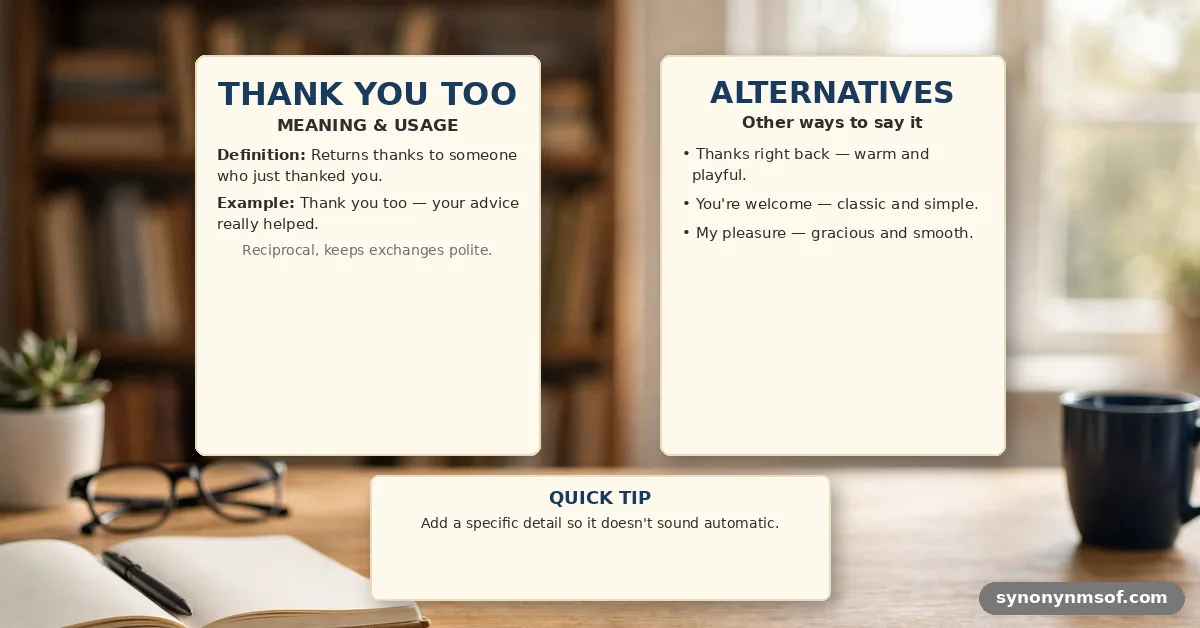
The short answer is that “thank you too” is often grammatically awkward and usually unnecessary. You should generally avoid it because “thank you” is a standalone expression of gratitude, not a reciprocal action like “I love you too.” If someone says “thank you” to you, they are acknowledging a service or kindness you provided, not stating a feeling that needs to be mirrored.
When you reply with “thank you too,” it implies that the other person also performed a service that you are now acknowledging. If they didn’t do anything for you, the phrase creates confusion. It’s much better to use a standard acknowledgement like “you’re welcome” or “my pleasure.”
The only time “thank you too” works is if you are both thanking each other for specific reasons. For example, if a colleague says, “Thanks for the report,” and you respond, “Thank you too for the data you provided,” it makes perfect sense. Otherwise, stick to responses that accept the gratitude rather than trying to deflect it back.
Professional Responses to Gratitude

In a workplace setting, your response should be polished and concise. You want to acknowledge the appreciation without sounding like you are downplaying your own work. Using professional alternatives demonstrates that you are confident in your contributions.
The best approach is to match the level of formality of the person thanking you. If your manager sends a formal email, keep your reply brief and standard. If you are chatting with a close teammate, you can be slightly more relaxed.
- “You are very welcome.”
- “I am happy to help.”
- “It was my pleasure to assist with this project.”
- “I’m glad I could contribute to the success of this.”
- “Don’t mention it; I’m glad it worked out.”
Casual Alternatives for Friends
When you are texting friends or talking to family, you have much more freedom. You can be funny, brief, or even use emojis to get the point across. The goal here is to keep the connection warm and lighthearted.
| Style | Phrase | Best Used For |
|---|---|---|
| Casual | “No problem at all.” | Everyday favors. |
| Enthusiastic | “Anytime!” | Close friends. |
| Humorous | “Just doing my part!” | Light situations. |
| Polite | “Happy to do it.” | Acquaintances. |
Avoid overthinking these replies when you are with people you know well. Most friends aren’t analyzing your grammar; they are simply acknowledging the help you provided. A simple “no worries” or “anytime” is usually more than enough.
Understanding Social Reciprocity
Social interactions rely on a balance of give and take. When someone says “thank you,” they are closing a loop in a social transaction. By saying “you’re welcome,” you are acknowledging that the transaction is complete and that you were happy to provide the service.
Attempting to force a “thank you too” often disrupts this balance. It creates a feeling that the conversation is stuck in a loop.
Think of it like a handshake; if you both keep trying to adjust your grip, the moment becomes uncomfortable. A clean, simple response allows the conversation to move forward naturally.
The etymology of thanks suggests a deep history of expressing appreciation for a favor or a boon. When you accept that gratitude, you validate the other person’s experience. You don’t need to return the favor with a mirror-image phrase to show that you are a polite person.
When You Should Actually Say Thank You Too
There are specific moments where “thank you too” is the perfect thing to say. These moments usually involve mutual appreciation or shared experiences. If someone tells you, “Thank you for being such a great friend,” you can absolutely respond with, “Thank you too for everything you do.”
In this context, you aren’t responding to a transaction; you are responding to a sentiment. You are acknowledging that the relationship is reciprocal and that you value them as much as they value you. It moves from being a response to a service to being a response to a feeling.
Consider the biblical perspective on gratitude, which often emphasizes mutual encouragement. In 1 Thessalonians 5:11, the text advises believers to comfort and edify one another. When you and another person are actively building each other up, expressing mutual thanks is a way to acknowledge that shared effort.
Funny and Witty Replies
Sometimes a formal “you are welcome” feels too stiff. If you want to break the ice or make someone smile, you can opt for something a bit more playful. Just make sure you know the person well enough to know they will appreciate the humor.
Try saying, “I’ll add it to your tab!” or “Your check is in the mail.” These phrases are classic ways to deflect thanks in a lighthearted way. They take the pressure off the interaction and turn a mundane moment into something slightly more memorable.
Be careful not to use these in high-stakes professional environments. A client who just thanked you for a major report might not find “I’ll send you the bill” particularly amusing. Save the wit for your peers and those with whom you share a genuine rapport.
Handling Thanks for Service

When you are in a customer service role, the dynamic changes. The person thanking you is often a client, and your response should reflect that hierarchy. You want to remain helpful while ensuring you don’t sound like a robot.
“It is a pleasure to assist you” is a gold standard for these interactions. It sounds professional, warm, and highly respectful. It acknowledges that you are there to provide a service and that you take pride in doing it well.
Avoid being too casual in these moments. Even if you feel like you’ve built a friendship with the client, keep your responses grounded. “Happy to help” is usually the limit of how casual you should get in a professional service setting.
Why We Feel the Need to Mirror
Many of us feel an internal pressure to mirror the language others use. This is called linguistic mirroring, and it’s a natural part of human communication. We want to show the other person that we are on the same page and that we share their energy.
When someone says “thank you,” your brain might quickly look for a similar structure. “Thank you too” is the easiest, most accessible mirror, even if it isn’t the most logical one. Recognizing this impulse is the first step toward choosing more effective responses.
Instead of mirroring the words, try mirroring the intent. If they are sincere, be sincere in your “you’re welcome.”
If they are casual, be casual in your “no problem.” Matching the intent is far more effective than matching the syntax.
Cultural Nuances in Gratitude
Different cultures handle gratitude in very different ways. In some societies, expressing excessive thanks can be seen as creating a debt that needs to be repaid. In others, saying “thank you” is a mandatory social lubricant that is used constantly throughout the day.
If you are interacting with someone from a different background, observe how they respond to your favors. You might find that they prefer a more formal or a less formal approach. Being adaptable is a sign of high social intelligence.
Don’t be afraid to ask if you aren’t sure. If you find yourself in a new social circle, pay attention to how others respond to “thank you.” You will quickly pick up the patterns that are considered polite and natural in that specific environment.
The Power of a Simple Smile
Sometimes, you don’t need words at all. A genuine smile or a nod can convey exactly as much as a well-crafted sentence. In a busy office or a loud room, a non-verbal acknowledgment is often the most efficient way to handle a “thank you.”
Pairing a smile with a simple, quiet “of course” works wonders. It shows that you aren’t just reciting a script.
You are present in the moment and you genuinely appreciate the interaction. People value authenticity far more than they value perfect grammar.
Remember that the words you choose are secondary to the warmth you project. If you feel awkward using certain phrases, drop them. Your comfort level will show through in your body language, which is often what people remember most. Word choice extends to tricky pairs, so check scrapping or scraping when you describe removing or collecting something. Business writing also benefits from nailing sell or sale, two words that are often confused. When addressing officials, confirm sergeant or sargeant to show proper respect. And a quick check of shiney or shiny keeps your adjectives precise.
Common Mistakes to Avoid
One of the biggest mistakes people make is over-explaining their help. When someone says “thank you,” don’t go into a long story about how difficult the task was. It makes the other person feel guilty for asking you for help in the first place.
Another mistake is being too dismissive. Saying “it was nothing” can sometimes make the other person feel like their request was unimportant. It is better to acknowledge that you did something and that you were happy to do it.
Finally, avoid the “no problem” trap if you are in a very formal setting. While it is perfectly acceptable for most people, some traditionalists still prefer “you are welcome.” If you are unsure about the formality of a situation, stick to the classics.
FAQ
Is it okay to say thank you too in a text message?
It is generally acceptable in a casual text, especially if you are both sharing gratitude for something. However, if the person is thanking you for a specific task, a simple “you’re welcome” or “anytime” is usually better.
What is the most professional response to thank you?
The most professional response is “you are very welcome” or “it was my pleasure to assist.” These phrases are clear, polite, and maintain a high standard of workplace decorum.
How do I respond if I feel like I’m being thanked too much?
If you feel like the person is over-thanking you, you can say, “Please, don’t mention it, I was happy to help.” This gently closes the door on the topic of gratitude and allows you both to move on to other subjects.
Can I use emojis instead of words to reply to thanks?
Yes, in casual text conversations, a simple thumbs-up or a smiling face emoji is a perfectly acceptable way to acknowledge thanks. It keeps the tone light and avoids the need for wordy replies.
What should I say if I don’t want to take credit for the help?
If you want to deflect credit, you can say, “It was a team effort” or “I’m glad we could get it done together.” This is a great way to be humble and professional at the same time.
Final Thoughts
Learning the ins and outs of Thank You Too: Meaning, Replies, and Alternative Phrases is a simple way to refine your communication skills. You don’t need to overthink every interaction, but being aware of how your words land can make your daily conversations much more effective. Whether you choose a formal “you are welcome” or a casual “anytime,” the most important thing is to remain authentic and kind.
Start by observing how you respond to gratitude in your own life. You might find that you rely on the same few phrases out of habit.
Experiment with some of the alternatives mentioned here and see how they change the flow of your conversations. If you have any favorite ways to respond that aren’t listed, feel free to share them and keep the dialogue going.