
When you hear someone say that works for me, they are offering a simple, direct way to express agreement or approval. It is a common phrase in English that signals you are on board with a plan, suggestion, or proposed schedule. Whether you are confirming a meeting on Friday or accepting a new project deadline, this expression fits almost any casual or semi-professional situation.
By understanding the nuances of how and when to use it, you can communicate your flexibility and cooperation effectively. This guide helps you navigate the subtle social cues behind this familiar phrase to ensure your responses land exactly as intended.
Understanding the Meaning and Intent
At its core, stating that works for me is a statement of alignment. It confirms that a proposed idea, time, or condition fits within your existing schedule or requirements. The phrase is inherently cooperative, showing the other person that you have considered their request and found it acceptable.
The beauty of this expression lies in its brevity. You do not need to provide lengthy justifications when a simple confirmation suffices. It removes ambiguity, letting the other party know they can proceed with the plan as discussed.
Why the Phrase Is So Effective

Communication often suffers from over-explanation. When you use short, affirmative language, you sound decisive and easy to work with. It is a sign of a low-friction personality, which is highly valued in collaborative environments.
Consider the difference between saying “I have checked my calendar and that time is available for me” and “That works for me.” The former sounds robotic and defensive. The latter is warm, human, and professional.
Common Scenarios for Usage
You will find this phrase most useful when coordinating logistics. If a colleague asks to move a meeting, your response can instantly resolve the scheduling tension. It is also perfect for confirming project timelines or agreeing to a specific set of deliverables.
It is important to remember that this phrase implies you have actually evaluated the suggestion. Using it too quickly without checking your facts can lead to over-committing. Always take a moment to look at your calendar before you send that confirmation.
Examples in Daily Communication
- Scheduling: “Friday works for me; let’s aim for 2:00 PM.”
- Project Planning: “The proposed budget for the Q3 campaign really works for me.”
- Task Delegation: “If you handle the initial draft, that works for me.”
- Logistics: “Meeting at the downtown office works for me.”
Professional Nuances and Formality
While this phrase is widely accepted, the level of formality matters. In a very high-stakes or rigid environment, you might prefer more formal alternatives. However, in most modern offices, it is perfectly acceptable for emails, Slack messages, and face-to-face conversations.
If you are speaking to a supervisor or a client, consider your relationship. If you have a rapport, the phrase is fine. If the situation is highly formal or tense, you might choose a more structured response to show extra consideration.
Refining Your Professional Tone
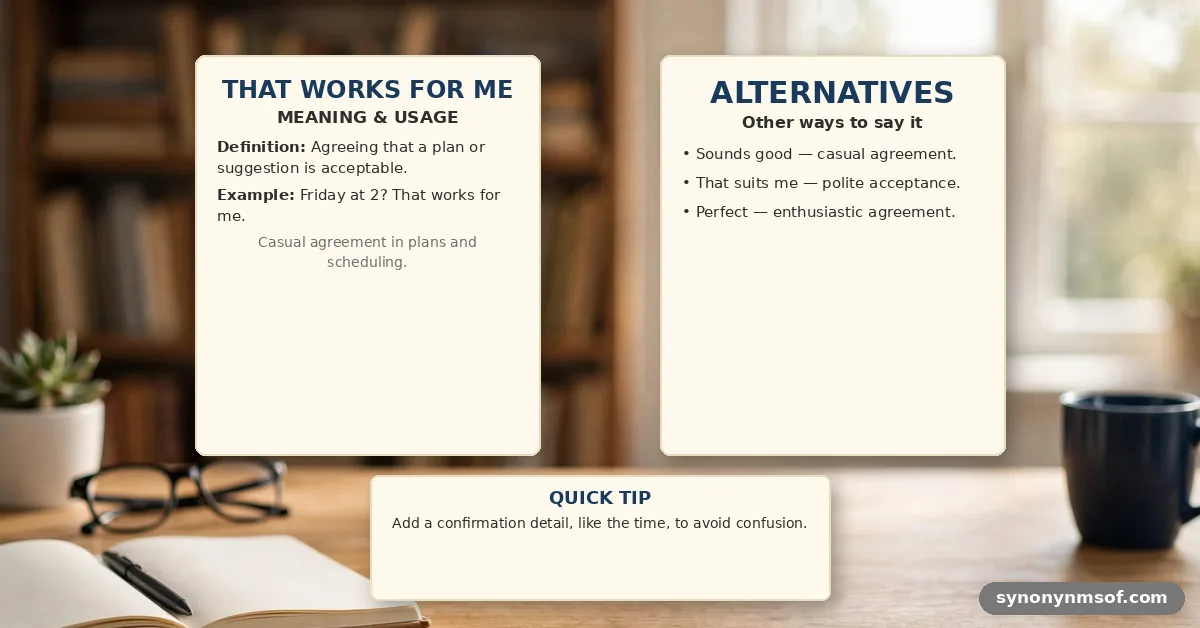
When you want to sound slightly more polished, you can expand the phrase. Adding a small detail shows you are engaged. For example, instead of just saying “That works for me,” try “That time works for me, I have cleared my schedule.”
This subtle addition signals that you are prioritizing the interaction. It turns a simple agreement into a gesture of goodwill. It shows that your time—and theirs—is being managed with care.
Comparing Agreement Expressions
Choosing the right words depends on the specific context of your conversation. Sometimes, you need to sound enthusiastic, while other times, a neutral and efficient response is better. The following table illustrates how different phrases compare in terms of tone and formality.
| Expression | Formality | Best Used For |
|---|---|---|
| That works for me. | Casual/Neutral | Daily tasks, scheduling, quick check-ins. |
| That is acceptable. | Formal | Contractual discussions, rigid timelines. |
| I am agreeable to that. | Formal | High-level negotiations, serious proposals. |
| Sounds good to me. | Very Casual | Close teammates, informal chat. |
When to Avoid the Phrase
There are moments where being too brief can backfire. If you are declining a request or negotiating terms, saying it works for you might sound dismissive. It can imply that you haven’t put much thought into the actual implications of the proposal.
If someone asks for your opinion on a complex matter, do not use this phrase to brush it off. People want to know you have considered their ideas. Use it only when you are truly confirming a plan, not when you are being asked to provide deep insight.
Signs You Need a Different Response
If you feel the need to qualify your agreement, do not use this phrase. If you are saying “That works for me, but…” you are creating a contradiction. Instead, lead with your concern or suggestion first to ensure clarity.
Avoid using it when someone is venting or sharing personal news. It can sound cold or indifferent in those contexts. Empathy requires more than just confirming you are fine with something.
Cultural and Linguistic Variations
In English, this expression is a staple of workplace efficiency. Other languages have their own versions of this agreement, but they rarely pack the same punch in terms of brevity. If you are working with international teams, remember that directness is not always the standard.
Some cultures prefer a preamble before confirming. They might acknowledge the effort made by the other party before agreeing. Being mindful of these cultural differences will help you maintain strong international relationships.
Adapting for Global Teams
When communicating across borders, stick to clear, simple English. Avoid idioms that might confuse the recipient. Since this phrase is globally recognized, it is a safe bet for most international business interactions.
Always verify that your tone matches the regional style. In some regions, a bit more formality is expected even in emails. If in doubt, add a “please” or a “thank you” to soften the message.
The Importance of Context in Meetings
When you are in a meeting, the timing of your response matters. If a moderator asks for input, waiting to say that works for me can show you are listening. However, jumping in too quickly might signal that you are not fully engaged with the details.
Use the phrase to close a loop. Once a plan has been debated and a decision is reached, your confirmation is the final step. It signals to everyone in the room that the discussion is finished and action can begin.
Managing Meeting Dynamics
If you are the one proposing the plan, listen for this phrase from others. It is the green light you need to move forward. If you don’t hear it, you might need to ask for clarification or further feedback.
Pay attention to the body language of the person saying it. If they look hesitant, they might just be trying to be agreeable. Encourage them to share if they have any lingering doubts.
FAQ
Is that works for me professional?
Yes, it is generally considered professional for most workplace communication. It is efficient, clear, and signals cooperation, making it a staple in modern business interactions.
What is the best way to express urgency politely?
If you need something quickly, combine your request with a brief explanation of why. “If possible, could we finalize this by Friday? That would help me meet our internal deadline.”
What is the difference between at your earliest convenience and that works for me?
At your earliest convenience is a request for action, whereas that works for me is a confirmation of a plan. The former asks the other person to prioritize something, while the latter confirms that a proposed time or idea is acceptable to you.
Can I use this phrase with a client?
You can, provided you have an established relationship. If you are dealing with a new or high-profile client, you may want to sound slightly more formal by saying, “That schedule is perfectly fine with me,” instead.
Conclusion
Mastering simple expressions like that works for me is an underrated part of professional communication. By using it in the right context, you demonstrate that you are efficient, easy to work with, and respectful of other people’s time.
It helps remove unnecessary friction from your daily interactions, allowing you to focus on the work that truly matters. Remember that the tone you set with your language shapes how others perceive your reliability and your attitude toward collaboration.
Next time you find yourself needing to confirm a meeting or a plan, consider how this phrase can simplify your message. Keep your responses clear, stay aware of your relationship with the recipient, and always prioritize genuine alignment over mere formality. We hope this look at how to use that works for me helps you communicate with more confidence and ease in your professional life.
SEO Title: That Works for Me: Meaning, Usage, and Examples
Meta Description: Discover the meaning, usage, and examples of saying that works for me. Learn how to use this phrase effectively to confirm plans in professional settings.
Suggested URL Slug: that-works-for-me-meaning-usage-examples
Primary Keyword: That works for me
Primary Keyword: That works for me: Meaning, Usage, and Examples
Secondary Keywords: meaning, english, use, agreement, approval, move meeting, meeting friday, plan suggestion, expression, usage, work, friday works, words, synonyms, good, final, i’m, examples.