
When someone tells you it’s my pleasure to help you, they are expressing genuine willingness and satisfaction in providing assistance. This phrase serves as a bridge between simple politeness and a deeper, more intentional commitment to service. Whether you are working in a fast-paced office or assisting a friend with a personal task, choosing the right words transforms how others perceive your reliability.
Understanding the nuance behind such expressions helps you build stronger professional relationships and leave a lasting positive impression. You will learn how to use these variations effectively to communicate warmth, competence, and a sincere desire to be useful in any social or business environment.
The True Meaning Behind the Phrase

At its core, the statement signifies that the act of helping was not a burden but an opportunity. It shifts the dynamic from a transactional exchange to a collaborative one. When you use this language, you signal that you value the other person’s success as much as your own.
The phrase is a more sophisticated upgrade to the standard “you’re welcome.” While “you’re welcome” is perfectly acceptable, it can occasionally feel robotic or dismissive in high-stakes settings. By contrast, saying it is your pleasure to assist suggests an investment in the relationship that goes beyond basic social etiquette.
When to Use Professional Expressions of Assistance
Context is everything when deciding how to respond to a request or an expression of gratitude. You should aim for a tone that mirrors the relationship you have with the other person. A formal client meeting requires different vocabulary than a quick chat with a close coworker.
In a professional scenario, your goal is to appear helpful without sounding overly subservient or insincere. If you find yourself in a position where you provide regular support, having a variety of responses keeps your communication fresh. Consistency is good, but variety shows you are paying attention to the specific needs of the person you are assisting.
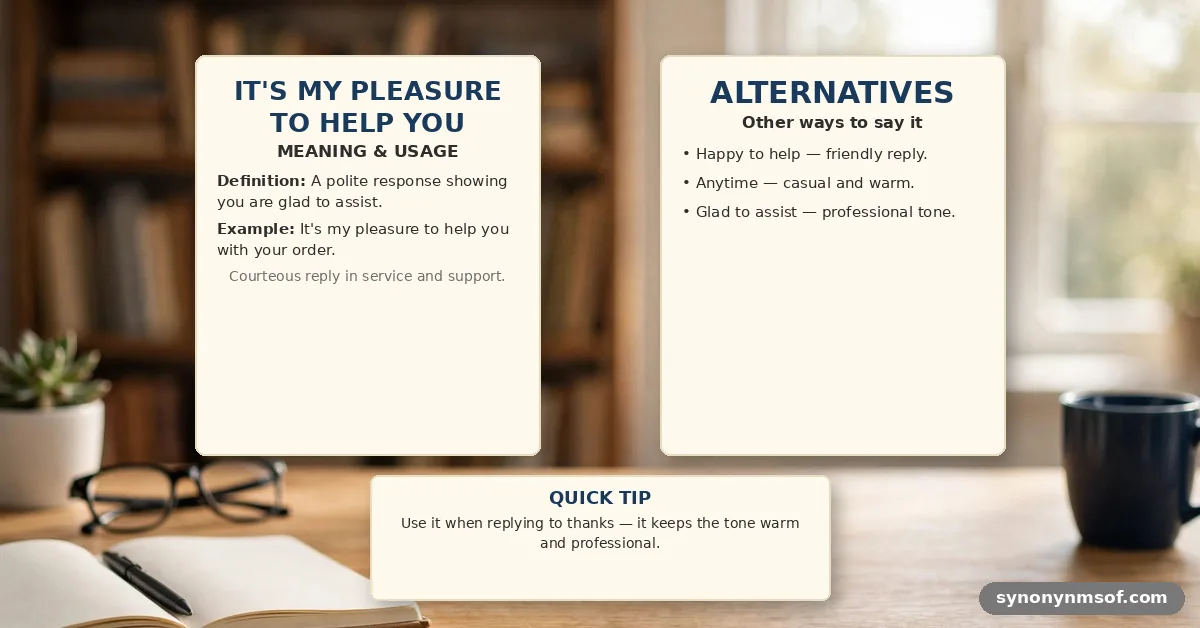
- I am always happy to help — Use this when you want to signal ongoing availability.
- It was a pleasure to assist with this — Ideal for concluding a specific project or task.
- I am glad I could be of service — Best suited for formal client or management interactions.
- It is no trouble at all — Perfect for when someone apologizes for “bothering” you with a request.
- Happy to help — A versatile, casual option for instant messaging or internal team emails.
Comparing Styles of Professional Support
Different situations call for different levels of formality. The following table provides a breakdown of how to choose the right phrase based on the urgency of the request and the closeness of your relationship with the recipient.
| Phrase | Formality Level | Best Scenario |
|---|---|---|
| It’s my pleasure to assist | High | Client-facing or executive communication |
| I’m happy to help | Medium | Standard email or project collaboration |
| No problem at all | Low | Informal chat with a close colleague |
| Glad I could support you | Medium | Providing feedback or technical guidance |
Grammar and Nuance in Customer Service
Many people wonder if “my pleasure to help you” is grammatically sound. The answer is yes, though it is usually part of a larger sentence like “It is my pleasure to help you.” Dropping the “It is” makes the phrase more conversational and immediate.
In customer service, these phrases act as a psychological tool. They remove the feeling of indebtedness from the customer. When you frame your work as a pleasure, you validate the customer’s decision to ask for help, which builds trust and encourages future engagement.
Avoiding Overused or Insincere Language
The danger with any standard phrase is that it can eventually sound scripted. If you repeat the same line to every person you assist, you risk losing the personal connection. Avoid using these phrases if you haven’t actually put any effort into the task at hand.
If you have spent hours on a project, a simple “happy to help” might feel like an understatement. Conversely, if you just sent a quick link, being overly flowery can sound sarcastic. Always calibrate your language to match the energy and time you invested in the assistance provided.
Building Rapport Through Verbal Habits
Your choice of words acts as a signature for your professional brand. People notice whether you are someone who acts like they are doing the world a favor or someone who genuinely enjoys problem-solving. By consistently using phrases that highlight your willingness to assist, you position yourself as a team player.
Consider the difference between saying “I’ll do it” and “I would be happy to assist with that.” The former is functional, while the latter is relational. Over time, these small linguistic choices compound, making you the person people prefer to work with on difficult projects.
The Role of Tone in Virtual Communication
Without body language or tone of voice, written communication relies entirely on word choice. In an email or a Slack message, “it is a pleasure to help” provides the warmth that is often missing from digital text. It prevents your message from being misinterpreted as cold or abrupt.
When you are uncertain about the tone of an email, erring on the side of politeness is usually the safest path. However, don’t overcompensate with too many modifiers. A clear, direct, and kind sentence is always more effective than a long, winding explanation of how much you enjoyed helping.
FAQ
Is saying “it’s my pleasure to help you” professional?
Yes, it is highly professional. It conveys a positive attitude and a commitment to service, which are valued traits in any workplace.
What is the best way to express urgency while remaining polite?
Combine your offer of help with a clear timeline. For example, “I would be happy to assist with this by end-of-day” balances helpfulness with professional boundaries.
What is the difference between “at your earliest convenience” and “it’s my pleasure to help”?
The former is a request for action, while the latter is a response to gratitude. They serve entirely different functions in a conversation.
How do I respond if someone says it was a pleasure to help me?
A simple “Thank you, I really appreciate your time” or “That means a lot, thank you for the support” is perfectly appropriate.
Conclusion
Mastering the art of professional communication involves more than just being correct; it requires being intentional. When you incorporate phrases that reflect genuine satisfaction in your work, you elevate the quality of your interactions. Whether you are writing a formal email to a stakeholder or sending a quick message to a teammate, knowing that it’s my pleasure to help you is a powerful way to frame your contribution.
By selecting the right words for the right scenario, you build lasting trust and demonstrate a high level of emotional intelligence. Start by observing how others respond to these variations in your daily life, and you will quickly find the style that best fits your unique professional voice.
SEO Title: It’s My Pleasure to Help You: Meaning & Examples Meta Description: Learn the professional meaning of “it’s my pleasure to help you” and how to use it effectively in emails, customer service, and workplace scenarios. Suggested URL Slug: its-my-pleasure-to-help-you-meaning-examples Primary Keyword: It’s My Pleasure to Help You Secondary Keywords: pleasure assist, happy help, customer service, support, professional, scenario, assistance, formal, pleasure help