
Understanding the core components of a team player: meaning, examples, and workplace tips is essential for anyone looking to advance their career in a collaborative environment. Being a team player is not about suppressing your individuality; it is about aligning your personal strengths with the collective goals of your organization. By focusing on communication, accountability, and mutual support, you position yourself as a vital asset to any group project.
This article provides a clear breakdown of what it means to operate effectively within a team, offering actionable strategies to enhance your professional reputation. Mastering these dynamics will help you build stronger relationships and drive more successful project outcomes.
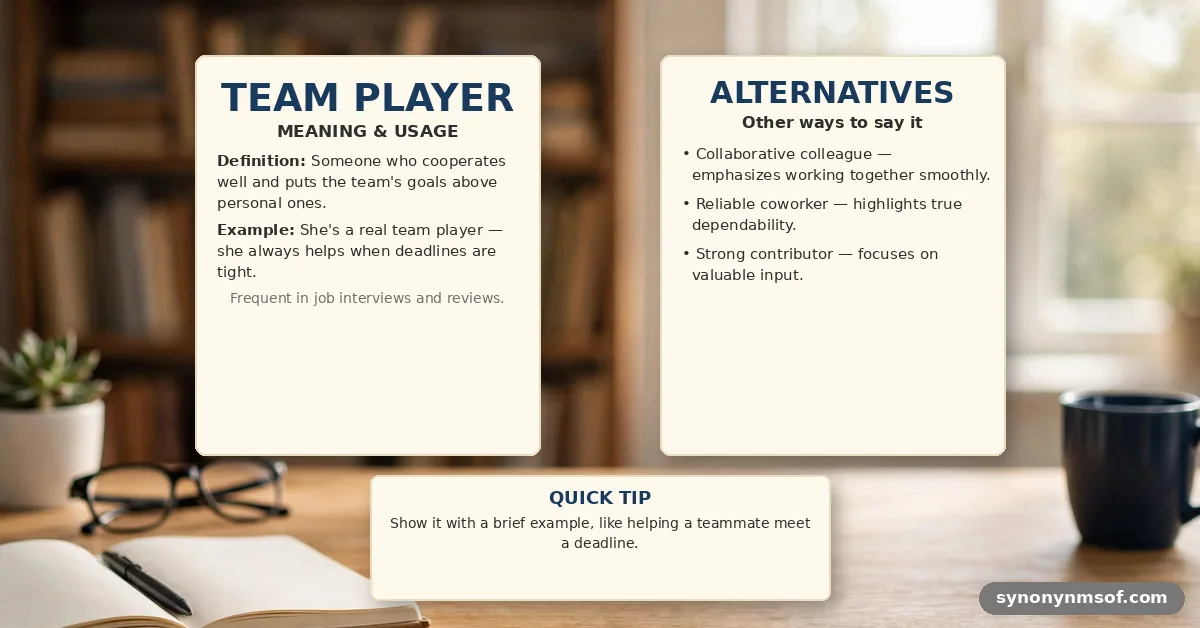
A team player is an individual who prioritizes the success of the group over personal recognition. They actively contribute to shared objectives while maintaining a supportive demeanor toward colleagues. You can identify these people by their willingness to assist others, even when the task falls outside their formal job description.
The definition of a team player centers on three primary pillars: reliability, adaptability, and emotional intelligence. A reliable worker consistently meets deadlines, ensuring that the rest of the team isn’t left waiting on their output. Adaptability allows these individuals to shift gears when project requirements change suddenly, preventing bottlenecks during high-pressure cycles.
Emotional intelligence serves as the glue that holds these behaviors together. It enables a person to read the room, understand the stress levels of their coworkers, and offer help before it is explicitly requested.
In the book of Ecclesiastes, the wisdom of scripture suggests that two are better than one, because they have a good reward for their labor (Ecclesiastes 4:9). This principle remains the foundation of modern organizational success.
Core Qualities of Effective Team Members
Effective team members share a specific set of traits that distinguish them from those who only work in isolation. These qualities are not inherent personality quirks; they are learned behaviors that can be refined over time. Organizations that cultivate these traits often see higher rates of employee retention and faster project completion.
Active Listening

Active listening involves more than just hearing words; it requires processing intent and context. When a team member listens effectively, they ask clarifying questions that prevent errors later in the workflow. This practice reduces the need for rework and demonstrates respect for the speaker’s time and expertise.
Conflict Resolution

Conflict is inevitable in any group setting, but effective members treat it as a tool for innovation. They focus on the issue rather than the person, seeking solutions that address the root cause of the disagreement. This approach keeps the team moving forward instead of stalling over interpersonal friction.
Shared Accountability

Accountability isn’t just about owning your own mistakes. It involves stepping up when a colleague is struggling to ensure the project meets its final deadline. A true team player views the success of the project as a collective responsibility, not just an individual task.
Concrete Examples of Teamwork
Seeing these concepts in action helps clarify the abstract definition of a team player. Consider the following scenarios that frequently occur in professional environments. These examples demonstrate how specific actions lead to tangible results for the organization.
- Volunteering for a lower-profile task to ensure a critical deadline is met for the entire department.
- Sharing knowledge during onboarding to help a new hire get up to speed faster.
- Providing constructive feedback in private rather than calling out a peer during a meeting.
- Documenting workflows so that other team members can cover your responsibilities during planned absences.
- Publicly acknowledging the contributions of others during project presentations to ensure credit is shared fairly.
Comparing Individual vs. Team-Oriented Behaviors
Understanding the difference between individual-focused and team-oriented behaviors is crucial for growth. While individual excellence is necessary, it must be balanced with the needs of the wider group. The following table highlights common behaviors and their impact on the workplace.
| Behavior Category | Individual-Focused Action | Team-Oriented Action |
|---|---|---|
| Goal Setting | Focuses only on personal KPIs | Aligns personal tasks with team goals |
| Communication | Hoards information to gain leverage | Shares updates to improve transparency |
| Problem Solving | Complains about issues to management | Proposes solutions to the team |
| Feedback | Defensive when critiqued | Views critique as a chance to improve |
| Resource Use | Uses resources solely for self | Equitably shares tools and time |
How to Demonstrate Teamwork in Interviews
Employers often look for specific evidence of your ability to play well with others. When asked about your teamwork experience, avoid generic statements about being a “people person.” Instead, focus on a specific project where your contribution directly influenced the group’s success.
Use the STAR method: Situation, Task, Action, and Result. Describe a specific challenge, the role you played, the actions you took to support your colleagues, and the final outcome of the project. This structure provides a clear, evidence-based answer that hiring managers can verify.
Highlight moments where you had to bridge a gap between departments. For example, if you worked in marketing and helped the sales team understand a new product feature, emphasize how that collaboration improved the bottom line. Concrete examples of cross-functional cooperation carry much more weight than abstract claims.
The Impact of Teamwork on Project Deadlines
Project management relies heavily on the synchronicity of team members. When one person fails to communicate a delay, the impact ripples through the entire timeline. High-performing teams mitigate this risk through daily stand-ups and transparent project tracking software.
Deadlines are rarely missed because of a lack of individual talent. They are more often missed because of silos that prevent information from flowing. A team player breaks down these silos by proactively checking in with stakeholders, even if they aren’t the project lead.
Consider the cost of a delayed launch. If a product release is pushed back by two weeks due to a communication breakdown, the company may lose market share or miss revenue targets. Your role as a team player is to act as a buffer against these avoidable delays through consistent, clear communication.
Developing Emotional Intelligence
Emotional intelligence, or EQ, is the ability to manage your own emotions while recognizing the emotions of others. In a team setting, this means knowing when to push for a result and when to back off to allow for consensus. It prevents the burnout that often plagues high-output teams.
Practice empathy by considering the pressures your colleagues are under. If a coworker is consistently missing deadlines, they might be dealing with an unmanageable workload rather than laziness. A quick conversation can often uncover the issue, allowing you to suggest a change in the process or offer help.
Self-regulation is the other half of the coin. Even when you are frustrated with a team decision, maintaining a professional tone is vital for long-term trust. When you disagree, do so in a way that respects the process and the people involved, focusing on data rather than feelings.
The Role of Mentorship in Team Dynamics
Mentorship is a powerful way to foster a culture of teamwork. When senior employees invest time in junior staff, they create a stronger, more capable unit. This process isn’t just about teaching skills; it’s about modeling the behavior you want to see in the workplace.
As a mentor, you should emphasize that asking for help is a sign of strength, not weakness. This simple shift in perspective can change how a team operates. When people feel safe asking questions, errors are caught earlier and innovation happens faster.
Conversely, being a good mentee is also a form of teamwork. It involves being open to feedback and applying the lessons you learn to your daily tasks. By showing gratitude for the guidance you receive, you reinforce the bond between team members and create a cycle of continuous improvement.
Navigating Difficult Team Dynamics
Not every team member will have the same work ethic or communication style. Navigating these differences requires patience and a focus on common objectives. When you encounter a difficult teammate, avoid taking their behavior personally.
Instead, focus on how you can change your own communication to improve the interaction. Sometimes, a person who seems difficult is simply misaligned with the current project goals. A brief, private meeting to clarify roles and expectations can often resolve the tension.
If the issue persists, document the impact on the project without resorting to gossip. Present your concerns to a manager in terms of project health and productivity. By framing the issue as an obstacle to the team’s success, you demonstrate that your primary motivation is the company’s output.
Building Trust Through Transparency
Trust is the foundation of any high-performing team. Without it, team members spend more time protecting themselves than they do working on the project. You build trust by being transparent about your progress, your mistakes, and your needs.
Admit when you have reached your capacity before you crash. It is far better to tell your team that you need help on Thursday than to miss a Friday deadline. This level of honesty allows the team to reallocate resources in time to save the project.
Transparency also means sharing your successes without vanity. When you achieve a milestone, acknowledge the help you received from others. This reinforces the idea that success is a team effort and encourages others to be equally open about their own contributions.
Leveraging Diversity for Better Results
Diverse teams consistently outperform homogenous ones because they bring a wider range of perspectives to problem-solving. As a team player, your job is to seek out those diverse viewpoints. You should actively listen to those who have different backgrounds, experiences, or professional roles.
Challenge yourself to ask for input from the quietest person in the room. Often, the most insightful solutions come from those who have been observing the process from the sidelines. By inviting them into the conversation, you strengthen the team’s overall output.
Diversity also extends to working styles. Some people thrive in chaotic brainstorming sessions, while others prefer structured, solo research. A strong team respects these differences and allows each member to contribute in the way that best suits their strengths.
Balancing Individual Autonomy with Team Goals
Being a team player does not mean you lose your individual voice. You should still take ownership of your tasks and strive for excellence. The goal is to ensure that your individual ambition contributes to the team’s success rather than distracting from it.
Set clear boundaries so that you remain productive. If you are constantly answering non-urgent requests, you won’t have time to complete your own core responsibilities. Communicate your availability to the team so they know when to reach out and when you are in deep-work mode.
Finally, remember that the most valuable team players are those who can lead when necessary and follow when appropriate. Recognizing the right moment to step back and let others shine is a hallmark of professional maturity. It shows that you care more about the result than the spotlight.
Frequently Asked Questions
What is the most important trait of a team player?
Reliability is arguably the most critical trait. If your teammates cannot count on you to complete your tasks or show up to meetings, it doesn’t matter how talented you are. Consistency builds the trust required for a team to function at a high level.
How do I handle a team member who isn’t contributing?
Start by having a private conversation to understand if there is an underlying issue, such as a lack of clarity or an unmanageable workload. Focus on the project goals and ask how you can help them succeed. If the behavior continues to impact the project, escalate the issue to your manager using objective data.
Is it possible to be too much of a team player?
Yes, it is possible to overextend yourself. If you are constantly taking on the work of others, you may experience burnout and neglect your own primary responsibilities. Learn to set boundaries by clearly communicating your current capacity to your team and manager.
How can I show I am a team player during a job interview?
Use the STAR method to provide specific examples of times you supported a group project. Focus on the actions you took to help others succeed and the final result of your collaboration. Avoid vague statements and instead describe the tangible impact your teamwork had on the project outcome.
What if my team doesn’t value collaboration?
You can still model the behavior you want to see. Start by being the person who shares information, offers help, and gives credit to others. Often, this creates a positive feedback loop that encourages others to adopt a more collaborative approach over time.
Conclusion
Mastering the dynamics of a team player: meaning, examples, and workplace tips is a long-term investment in your professional growth. By focusing on reliable communication, active listening, and shared accountability, you create an environment where everyone can produce their best work.
Remember that these skills are not static; they require constant practice and a willingness to adapt to the needs of your colleagues. As you move forward, look for opportunities to mentor others and bridge the gaps between different functions within your organization.
Start by identifying one area where you can improve your collaborative approach this week. Whether it is offering to help a teammate with a deadline or simply being more transparent about your own progress, small changes can yield significant results.
Being a dedicated team player is one of the most effective ways to ensure both your personal success and the long-term health of your company. Keep refining these habits, and you will find that your reputation as a dependable, collaborative professional will open doors throughout your career.