
When someone says “take care” as you part ways, it is more than just a polite filler or a standard sign-off. This common English expression serves as a bridge between a casual goodbye and a genuine expression of concern for another person’s well-being. Understanding the nuance behind these words allows you to use them effectively in both professional and personal contexts.
Whether you are sending an email to a colleague or saying goodbye to a close friend, the phrase carries weight. It implies a wish for safety and health, making it one of the most versatile greetings in the modern lexicon. By exploring its history, tone, and practical application, you will gain a better grasp of how to communicate warmth and professional respect simultaneously.
The Core Meaning and Intent

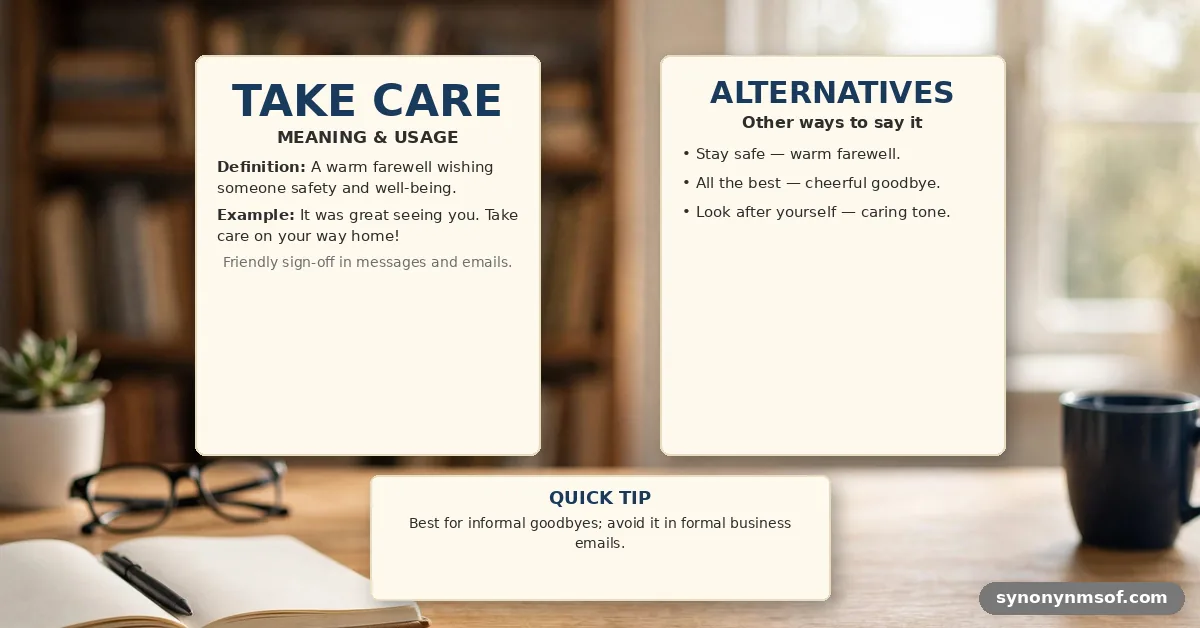
At its heart, the phrase is a concise way of saying, “I wish for you to remain safe and healthy.” While it is often used as a conventional closing, it retains a level of sincerity that “goodbye” lacks. It functions as a soft, protective blanket for the person receiving the message.
In many cases, the speaker is acknowledging that life involves risks or challenges. By wishing that you take care, they are implicitly hoping you avoid those pitfalls. It is a subtle shift from a simple farewell to an active, positive wish for the recipient’s future state.
Variations in Tone
The tone of the phrase is highly dependent on the relationship between the two speakers. When used between friends, it can feel intimate and protective, sometimes implying a deeper bond. In a professional setting, it acts as a polite, balanced way to end a conversation without crossing personal boundaries.
Context also plays a massive role in how these words are received. If a friend says it before you head out on a long trip, the meaning is literal and focused on your physical safety. If a coworker writes it at the end of an email, it is a standard, respectful way to maintain a positive rapport.
Historical Context of the Expression
The roots of this phrase go deep into the English language, evolving from older, more verbose warnings. Historically, people used more descriptive commands to ensure the safety of others, such as “take care of yourself” or “be careful on your journey.” Over centuries, these phrases were pruned down for efficiency.
As communication became faster, the need for shorter, punchy expressions grew. The transition from a full sentence to the two-word shorthand we use now represents a broader trend in linguistics. We value brevity, yet we still want to maintain the social warmth that these words provide.
Usage in Professional Settings
Using this expression in a work environment is a delicate balance. It is perfectly acceptable for most business correspondence, but it should be reserved for situations where you have already established some level of interaction. It is generally not the first thing you say to a stranger.
For official documentation or very cold outreach, standard closings like “Sincerely” or “Best regards” remain the gold standard. However, once you have exchanged a few emails with a client or partner, transitioning to “take care” signals a move toward a more humanized, collaborative relationship.
Email Best Practices
- Use it after a successful project to signal warmth.
- Avoid it in highly formal legal or disciplinary communications.
- Pair it with a professional sign-off like “Best” or “Regards.”
- Consider the recipient’s culture if communicating internationally.
Comparing Farewell Phrases
Choosing the right closing depends entirely on the level of intimacy and the environment of the conversation. The table below highlights how different expressions compare in terms of tone and professional suitability.
| Phrase | Tone | Recommended Context |
|---|---|---|
| Take care | Warm and polite | Professional or personal |
| Sincerely | Formal | Official letters |
| Talk soon | Casual | Close colleagues |
| Goodbye | Neutral | General use |
Cultural Nuances and Translation
Translating this phrase into other languages is rarely a one-to-one process. Many languages have specific idioms that convey the same sentiment, but they often focus on different aspects of well-being. For instance, in some cultures, the focus is on a safe return, while in others, it is on general health.
When learning English as a second language, students often ask if they should say “care yourself.” This is a common error.
The correct phrasing is “take care of yourself” or simply “take care.” Grammatically, “care yourself” does not function as a standard command or wish in English.
When to Avoid the Phrase
While generally positive, there are times when “take care” might be misinterpreted. If you are ending a very serious or somber conversation, it can occasionally feel dismissive if not paired with other supportive words. A short, abrupt sign-off can sometimes feel like you are rushing away from the situation.
Always gauge the emotional temperature of the room. If someone has just shared bad news, a simple “take care” might feel like you are closing the door on them. In those moments, adding a specific, thoughtful comment about their situation makes the expression feel much more genuine and less like a scripted habit.
Common Misconceptions
Many people worry that saying this phrase implies that they are worried about the other person’s ability to handle themselves. This is rarely the case. It is an expression of goodwill, not a critique of the recipient’s competence or common sense.
Another myth is that it is strictly for romantic interests. While it is certainly used in relationships, its utility is far broader.
It is a standard component of polite social conduct, much like saying “please” or “thank you.” You can read more about linguistic definitions at Merriam-Webster to see how these terms have expanded over time.
FAQ
Is “take care” considered a friendly way to say goodbye?
Yes, it is widely regarded as a warm and friendly way to end a conversation. It conveys more personal interest than a standard “goodbye” while remaining appropriate for a variety of social and professional settings.
Can I use this phrase in a formal email?
It depends on your relationship with the recipient. If you have an established rapport, it is acceptable. For very formal or first-time outreach, more traditional closings like “Sincerely” are usually safer.
What should I say if someone says “take care” to me?
You can respond with “You too,” “Thanks, you too,” or simply “Take care.” All of these responses acknowledge the sentiment and return the well-wish in a natural way.
Is it okay to use this in a text message?
It is very common in text messaging. Because texts are inherently more casual than letters, this phrase fits perfectly to soften the end of a chat or a long-distance conversation.
Final Thoughts
Using this expression effectively is about understanding the balance between warmth and boundaries. Whether you are writing a quick message to a teammate or saying goodbye to a friend, the words carry a simple, powerful message of goodwill. By choosing when to use them, you can foster better connections and ensure your interactions end on a positive note.
Remember that the meaning of “take care” is ultimately determined by the sincerity behind it. It is not just about the words themselves, but about the genuine wish for the other person to be well. Start incorporating it into your routine where it feels natural, and you will find it is one of the most useful tools in your conversational toolkit.