


Among the many pairs of look-alike words in English, few cause as much quiet trouble as quite and quiet. Swap one letter and the meaning changes completely, yet the two words sit side by side in the dictionary and sound similar enough that writers mix them up every day. One describes silence and calm, the other describes degree and intensity, and confusing them can turn a sensible sentence into a puzzling one.
The mix-up is understandable. Both words are short, both start with “qui,” and in some accents they are pronounced so similarly that the difference is easy to miss. Autocorrect and fast typing make the problem worse, since the wrong word still looks like a real word and will not trigger a spelling alert. The result is that “quite or quiet” errors slip into essays, emails, and articles far more often than most writers realize.
This guide explains the difference between quite and quiet in plain, practical terms. You will learn what each word means and how it is used, the simple questions that tell them apart, plenty of example sentences, the mistakes writers make most often, and answers to the questions people ask about this pair. By the end, choosing between quite and quiet will feel like second nature.
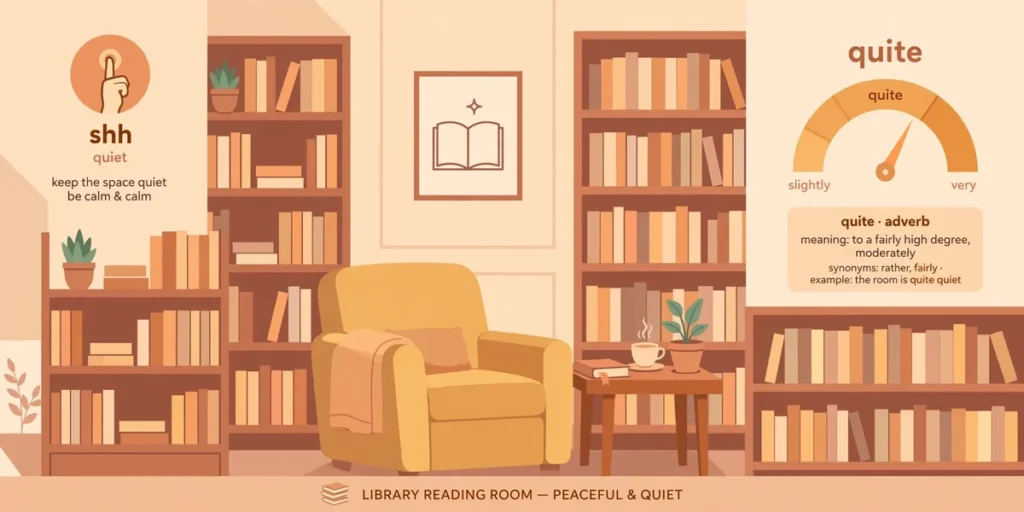
What Does “Quiet” Mean?
Quiet is a word about sound, or more precisely, about the absence of it. At its core it describes a state of little or no noise, of calm and stillness. A quiet room is one where nothing loud is happening. A quiet person is someone who speaks little or keeps a calm presence. A quiet morning is one that begins without commotion. Whenever your sentence is about sound levels, calmness, or peacefulness, quiet is the word you want.
Quiet is a flexible word that can play several grammatical roles. It is most often an adjective, but it can also act as a noun and even as a verb. Each role keeps the same central idea of silence or calm, so once you understand the core meaning, the different uses feel like natural extensions of one another.
Quiet as an Adjective
As an adjective, quiet describes a noun that makes little or no noise or that has a calm, peaceful quality. The library was quiet during the exam. We found a quiet corner of the cafe to talk. He has a quiet confidence that people trust. In each case the word paints a picture of stillness, of something free from loudness or disturbance.
The adjective can also describe people and their temperaments. A quiet child is one who does not make much noise or draw attention. A quiet neighborhood is one without much traffic or nightlife. A quiet color, like a soft gray or a muted blue, is one that does not shout for attention. The thread connecting all these uses is the same: an absence of loudness, whether literal or figurative.
Quiet as a Noun and a Verb
As a noun, quiet refers to the state or quality of being quiet, and it almost always appears in the phrase “peace and quiet.” After a long week, all I wanted was some peace and quiet. The phrase treats quiet as a thing you can have, enjoy, or long for, namely calm and silence. You will also see it in expressions like “the quiet of the countryside” or “the quiet before the storm,” where it names a condition of stillness.
As a verb, quiet means to make something quieter or calmer. She tried to quiet the crying baby. He took a deep breath to quiet his nerves. The verb form can be used with or without an object, and it carries the same gentle sense of bringing calm. If you remember that quiet is always about sound and stillness in every one of their roles, you will never confuse it with quite.
What Does “Quite” Mean?
Quite has nothing to do with sound at all. It is an adverb, which means its job is to modify other words, usually adjectives or adverbs, by describing their degree or intensity. When you say something is quite good, quite difficult, or quite different, you are telling your reader how good, how difficult, or how different it is. Quite is a measuring word, not a describing word for silence.
The exact strength of quite depends on the word it modifies and, interestingly, on where in the world the speaker comes from. With most adjectives it means “very” or “to a considerable degree,” but with certain strong adjectives it means “completely.” Understanding both uses is the key to using quite naturally.
Quite With Gradable Adjectives
With ordinary gradable adjectives, words like good, difficult, cold, interesting, and tired that can exist in degrees, quite usually means “very” or “fairly,” depending on context and emphasis. The exam was quite difficult. She is quite good at chess. It is quite cold outside tonight. In these sentences quite turns up the volume on the adjective, telling us the difficulty, skill, or coldness is significant.
There is a well-known difference between British and American usage here. In American English, quite with a gradable adjective usually means “very,” so “the food was quite good” suggests the food was genuinely impressive. In British English, the same sentence often means only “fairly good” or “reasonably good,” a milder compliment. Context and tone of voice usually make the intended strength clear, but writers should be aware that quite can land differently with different readers.
Quite With Non-Gradable Adjectives
With strong, absolute adjectives, words like perfect, impossible, wrong, certain, and different that describe an all-or-nothing state, quite means “completely” or “entirely.” You are quite right. That is quite impossible. She was quite certain about her answer. Here quite does not mean “fairly right” or “very impossible”; it means totally right and totally impossible. The adverb completes the adjective rather than merely intensifying it.
This “completely” sense also appears in set phrases that English speakers use every day. “Quite the opposite” means completely the opposite. “Quite a lot” means a considerable amount. “Not quite ready” means not completely ready. Once you see the pattern, you will start noticing quite everywhere, quietly doing its job of measuring and completing the words around it.
Key Differences Between Quite and Quiet
Now that each word is clear on its own, the contrast between them is easy to state. Quiet is about the absence of noise and the presence of calm. Quite is about the degree or completeness of something. One answers the question “how loud?” and the other answers the question “how much?” They share letters but they do not share meaning, and they do not share grammatical jobs either.
Sound Versus Degree
The fastest way to tell the words apart is to ask what your sentence is about. If it is about sound, silence, noise, or calm, you need quiet. Please keep quiet during the test. The house was quiet after the children left. If it is about how much, how intense, or how complete something is, you need quite. The test was quite difficult. She is quite sure of herself. Notice that quiet describes the thing itself, while quite describes the strength of another describing word.
A neat demonstration sentence uses both words correctly at once: “It was quite quiet in the library.” Here quite tells us how quiet it was, very quiet, and quiet tells us what the library sounded like. The two words work as a team, each doing its own distinct job. If you can build that sentence and understand why each word sits where it does, you have mastered the pair.
Parts of Speech and Pronunciation
Grammatically, the two words live in different worlds. Quiet can be an adjective, a noun, or a verb, while quite is only ever an adverb. This means quite can never stand alone as the main describing word of a noun the way quiet can. You can say “a quiet evening,” but you cannot say “a quite evening.” Quite always needs another word to lean on, an adjective, an adverb, or occasionally a verb, as in “I quite agree.”
Pronunciation gives you another clue. Quiet has two syllables, pronounced “kwy-et,” while quite has one syllable, pronounced “kwyte.” Saying the words slowly and counting the syllables is a classic classroom trick, and it works. Two syllables, like “silent,” points to quiet. One syllable, like “quite,” points to quite. In writing the difference is a single letter, but in speech the rhythm of the word gives it away.
| Quiet | Quite | |
|---|---|---|
| Core meaning | little or no noise; calm | very, fairly, or completely |
| Parts of speech | adjective, noun, verb | adverb only |
| Answers the question | How loud? How calm? | How much? To what degree? |
| Pronunciation | two syllables: kwy-et | one syllable: kwyte |
| Example | The classroom was quiet. | The classroom was quite large. |
| Substitute test | replace with “silent” | replace with “very” |
Usage Rules for Quite and Quiet
A few simple rules will keep you on the right track every time you face this pair.
Rule 1: If the sentence is about sound or silence, use quiet. Commands like “be quiet” and descriptions like “a quiet street” are always about noise levels. When in doubt, try replacing the word with “silent.” If the sentence still makes sense, quiet is correct.
Rule 2: If the word modifies an adjective or adverb to show degree, use quite. Quite difficult, quite quickly, quite sure, quite different, these are all measurements of intensity. Try replacing the word with “very.” If the sentence still makes sense, quite is correct.
Rule 3: Check the grammar of the sentence. If the word sits directly before a noun, it must be quiet, because quite is an adverb and cannot modify a noun. “A quiet morning” is correct; “a quite morning” is not. If the word sits directly before an adjective, it is almost always quite.
Rule 4: Watch out for “quite a” before nouns. English allows phrases like “quite a surprise” and “quite a few people.” These look like quite is modifying a noun, but the phrase is a fixed idiom where quite intensifies the whole noun phrase. Do not let these idioms confuse you about the general rule.
Rule 5: Read the sentence aloud when editing. Because quiet has two syllables and quite has one, reading aloud often exposes the wrong word immediately. If you wrote “please be quite” but meant silence, your ear will catch what your eyes missed.
Quite or Quiet at a Glance
If you want the whole decision in one place, here it is. Ask yourself a single question about your sentence: is it about noise, or is it about amount? If it is about noise, silence, calm, or peacefulness, write quiet. If it is about how strong, how complete, or how intense something is, write quite. That one question resolves the vast majority of cases without any need to memorize grammar terms.
For the remaining tricky cases, lean on the grammar check. Look at the word that comes right after your mystery word. If it is a noun, as in “a quiet street” or “peace and quiet,” the answer is quiet, because quite can never sit directly in front of a noun. If it is an adjective or an adverb, as in “quite difficult” or “quite quickly,” the answer is quite, because quiet cannot do that job. Between the meaning question and the grammar check, you have a complete toolkit.
Example Sentences With Quiet
Each sentence below uses quiet correctly, with a short note explaining its role.
- The library is always quiet in the early morning. Adjective describing the library’s sound level.
- Please be quiet while the baby is sleeping. Adjective describing how people should behave.
- They moved to the countryside for some peace and quiet. Noun naming the state of calm they wanted.
- She tried to quiet her racing thoughts before the interview. Verb meaning to calm.
- It was a quiet wedding with only close family present. Adjective describing the calm, low-key nature.
- The quiet of the forest helped him think clearly. Noun naming the stillness of the place.
- He is a quiet person who prefers listening to talking. Adjective describing temperament.
- The teacher asked the class to keep quiet during the test. Adjective describing the desired behavior.
- We enjoyed a quiet dinner at home after the busy week. Adjective describing the peaceful meal.
- The new engine runs so quiet you can barely hear it. Adjective describing the low noise level.
Example Sentences With Quite
- The exam was quite difficult, harder than anyone expected. Adverb intensifying “difficult.”
- She is quite talented at playing the piano. Adverb measuring the degree of talent.
- That is quite different from what you told me yesterday. Adverb intensifying “different.”
- He was quite certain that he had locked the door. Adverb meaning completely certain.
- We had quite a lot of rain this spring. Idiom meaning a considerable amount.
- I quite agree with your point about the schedule. Adverb modifying the verb “agree.”
- The movie was quite good, though not perfect. Adverb measuring how good it was.
- She finished the marathon quite easily. Adverb intensifying “easily.”
- You are quite right to be cautious about the offer. Adverb meaning completely right.
- It was quite cold outside, so we stayed in. Adverb intensifying “cold.”
Common Mistakes to Avoid With Quite and Quiet
These are the errors that appear again and again in student essays, workplace emails, and published articles. Each one is easy to fix once you see the pattern.
Mistake 1: Writing “quite” when you mean silence
The classic error is typing “please be quite during the meeting” or “the house was quite after everyone left.” In both sentences the writer is talking about noise, so the correct word is quiet: “please be quiet during the meeting,” “the house was quiet after everyone left.” If your sentence is about sound, quiet is always the answer.
Mistake 2: Writing “quiet” when you mean degree
The reverse error is just as common: “the test was quiet difficult” or “she is quiet good at math.” Here the writer is measuring intensity, not describing silence, so the correct word is quite: “the test was quite difficult,” “she is quite good at math.” If your sentence is about how much, quite is the answer.
Mistake 3: Trusting spellcheck to catch the error
Both quite and quiet are correctly spelled English words, so a spellchecker will never flag the wrong one. This is what makes the pair so dangerous for fast typists. The only defense is proofreading with meaning in mind: read the sentence, ask whether it is about sound or degree, and check that the word matches your answer.
Mistake 4: Misusing “quite” with nouns
Because quite is an adverb, it cannot directly modify a noun, yet writers sometimes produce phrases like “a quite day” when they mean “a quiet day.” Remember the grammar: quiet describes nouns, quite describes adjectives, adverbs, and verbs. The fixed idioms “quite a day” and “quite a few” are special cases, not a license to put quite before any noun.
Frequently Asked Questions
What is the difference between quite and quiet?
Quiet is about sound and means little or no noise, or calm and peaceful, while quite is an adverb about degree and means very, fairly, or completely. For example, “the room was quiet” describes the silence of the room, whereas “the room was quite big” describes how big the room was. One answers “how loud” and the other answers “how much.”
Is it “quite quiet” or “quiet quite”?
The correct order is “quite quiet,” as in “it was quite quiet in the library.” Here quite is an adverb modifying the adjective quiet, telling us the library was very silent. The reverse order, “quiet quite,” is never correct in standard English because quite cannot come after the adjective it would need to modify.
Can quite and quiet be used interchangeably?
No, they cannot be interchanged without changing or breaking the meaning of the sentence. “Please be quiet” is a request for silence, while “please be quite” is not a meaningful sentence in standard English. Likewise, “the exam was quite hard” describes the difficulty of the exam, while “the exam was quiet hard” is simply wrong. Always match the word to your meaning.
Why do people confuse quite and quiet so often?
People confuse them because the words look almost identical, differing by only the position of one letter, and because in some accents they sound very similar. Fast typing makes it worse, since the wrong word is still a valid spelling that autocorrect will not flag. The confusion is visual and phonetic, not conceptual, which is why slowing down and checking the meaning usually fixes it.
How can I remember the difference between quite and quiet?
Use two quick tests. First, the substitution test: if “silent” fits, use quiet; if “very” fits, use quite. Second, the syllable test: quiet has two syllables, pronounced “kwy-et,” while quite has one syllable, pronounced “kwyte.” You can also remember that quiet contains the word “quiet” as in “keep it down,” while quite ends in “te” like “complete,” hinting at its “completely” sense.
Conclusion
The difference between quite and quiet is simple once it is stated plainly: quiet is about sound and silence, while quite is about degree and intensity. Quiet can be an adjective, a noun, or a verb, always circling the idea of calm. Quite is only ever an adverb, always measuring how much of something there is. Keep those two jobs separate in your mind and the right word will come naturally.
When you proofread, give this pair a moment of deliberate attention, because your spellchecker never will. Ask whether the sentence is about noise or about degree, try the silent-or-very substitution, and listen to the syllables if you are still unsure. With those small habits, quite or quiet will stop being a trap and become one of the easiest choices in your writing.
Explore more on Synonynmsof.