

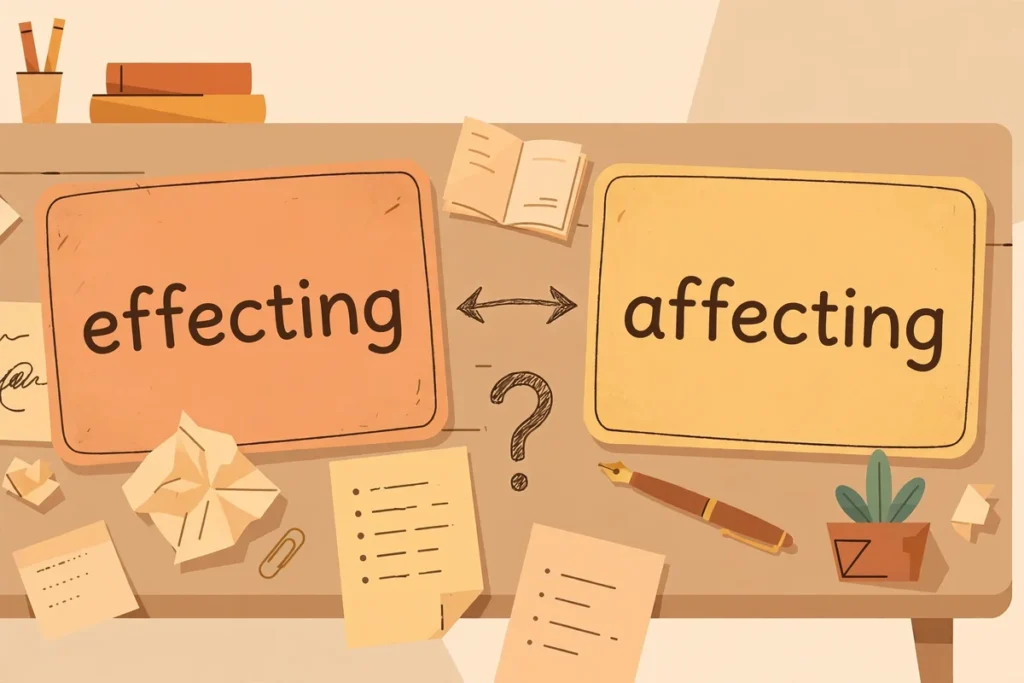
If you have ever paused in the middle of a sentence, unsure whether to type effecting or affecting, you are in very good company. These two words sit at the center of one of the most famous confusions in the English language, and the mix-up does not come from carelessness. It comes from the fact that both words grow out of the notoriously tricky base pair affect and effect, two words that sound nearly identical and both connect to the idea of change. Because effecting and affecting are simply the present-participle forms of effect and affect, the same old puzzle repeats itself every single time you reach for one of them.
Getting this pair right matters more than many writers realize. In everyday conversation the difference is invisible, since the two words are pronounced almost exactly the same, but in writing the wrong choice can quietly change what your sentence claims. A business report that says a manager is “affecting new policies” suggests something very different from one that says the manager is “effecting new policies.” One describes influence, the other describes creation, and in professional, academic, or legal writing that distinction can genuinely matter to your reader.
This guide walks through the difference between effecting and affecting in plain language. You will learn exactly what each word means, the simple substitution test that tells them apart, plenty of example sentences showing each word in natural context, and the most common mistakes writers make with this pair. By the end, you will be able to choose the right word with confidence every time.
What Does “Affecting” Mean?
Affecting is the present participle of the verb affect, which most commonly means to influence, to have an impact on, or to produce a change in something or someone that already exists. When you say that something is affecting you, you are saying it is shaping your thoughts, feelings, decisions, or circumstances in some way. The important detail is that affecting describes influence acting on an existing thing, not the creation of something brand new.
This is by far the more common of the two words. In ordinary writing and speech, when people reach for this sound, they almost always mean affecting. If you remember only one thing from this article, let it be this: nine times out of ten, the word you want is affecting. The situations that call for effecting are much rarer and much more specific.
Affecting as a Verb of Influence
The everyday job of affecting is to describe influence. The drought is affecting this year’s harvest. The new tax rules are affecting small businesses. Her speech deeply affected everyone in the room. In each case, something that already exists, the harvest, the businesses, the audience, is being influenced or changed by an outside force. Nothing is being brought into existence from nothing; instead, an existing situation is being shaped.
Notice how naturally affecting pairs with things like moods, health, behavior, prices, plans, performance, and opinions. These are all things that can be nudged, altered, or swayed. A cold can affect your energy. A rumor can affect a company’s reputation. A teacher’s encouragement can affect a student’s confidence. The pattern is always the same: an influence flows from one thing toward another thing that is already there.
The Emotional Side of Affecting
Affecting also carries an emotional shade of meaning. When we say that a story or a piece of music is affecting, we mean it moves us emotionally, it touches our feelings in a real way. “Her account of the rescue was deeply affecting” does not mean the story influenced the rescue; it means the story stirred the listener’s emotions. This sense of the word is closely related to the idea of influence, because emotions, too, are being acted upon and changed.
There is a useful way to think about this. Affecting always answers the question “what is being influenced?” If you can point to the person, feeling, or situation receiving the influence, you are in affecting territory. The noise is affecting my concentration. The medicine is affecting her appetite. The criticism is affecting his morale. In every sentence, the object of the verb was already present before the influence arrived.
What Does “Effecting” Mean?
Effecting is the present participle of the verb effect, which means to bring about, to cause to come into being, or to accomplish. When someone is effecting a change, they are not merely influencing a situation that already exists; they are actively creating the change itself, making it happen where nothing existed before. That single idea, bringing something into existence, is the entire heart of effecting.
This verb is far less common than affecting, and it carries a noticeably formal tone. You will rarely hear it in casual conversation. It belongs to professional reports, legal documents, political speeches, academic papers, and official statements. A company does not “effect” casual weekend plans; a government effects reforms, a board effects a merger, and a committee effects new regulations.
Effecting as a Verb of Creation
The key test for effecting is creation. The new director is effecting major changes in the department’s structure. The charity is effecting real improvements in rural healthcare. In both sentences, the subject is producing something new: new changes, new improvements. Before the director acted, those changes did not exist. After the action, they do. That is what effecting means, and it is why the word so often appears alongside nouns like change, reform, improvement, repair, payment, and transition.
Think of effecting as the verb version of the noun effect in its “result” sense, except with the emphasis on actively producing the result. An effect is something that has been brought about; effecting is the act of bringing it about. The connection is direct and logical, which is exactly why the word feels so at home in formal writing where precision matters.
Where You Will See Effecting Most Often
Because of its formal flavor, effecting clusters in particular kinds of writing. Legal and contractual language uses it for actions like effecting payment, effecting a transfer, or effecting repairs. Corporate writing uses it for effecting mergers, effecting layoffs, or effecting policy shifts. Political and activist writing uses the famous phrase effecting change, which means bringing real, new change into existence rather than simply influencing what is already there.
You will also notice that effecting frequently appears in the passive or with formal subjects: “The reforms were effected within a year,” or “The committee effected the transition smoothly.” If the sentence sounds like it belongs in an official memo or a press release, and the action involves causing something new to happen, effecting is probably the right word.
Key Differences Between Affecting and Effecting
Once you understand each word on its own, the difference between them becomes much easier to hold in your mind. Affecting is about influence flowing toward something that already exists. Effecting is about causing something new to come into being. Everything else, the formality, the frequency, the typical contexts, follows from that one core contrast.
Influence Versus Creation
The simplest way to frame the difference is this: affecting changes what is there, while effecting creates what is not yet there. The heat is affecting the crops means the heat is influencing crops that already exist. The new irrigation system is effecting a change in the harvest means the system is bringing about a new situation that did not exist before. One verb modifies; the other verb makes.
This is why the two words are not interchangeable, even though they sound alike. Swapping them does not just sound slightly off; it changes the claim your sentence is making. “The policy is affecting employee behavior” says the policy influences how employees act. “The policy is effecting employee behavior” is a strange sentence, because behavior is not something the policy is creating from scratch. Precision here is not pedantry; it is accuracy.
Frequency and Formality
In real-world usage, affecting appears far more often than effecting. Affecting is an everyday word that shows up in conversations, news articles, novels, and casual emails. Effecting is a specialist word that mostly appears in formal writing. This imbalance is actually a practical advantage for you as a writer: when you are unsure, the odds strongly favor affecting.
The formality gap also gives you a second clue. If your sentence sounds like ordinary speech, affecting is almost certainly correct. If your sentence sounds like a legal clause or an official announcement about bringing something new into existence, effecting may be the word you need. Match the word to the register of your writing, and you will rarely go wrong.
| Affecting | Effecting | |
|---|---|---|
| Base verb | affect | effect |
| Core meaning | to influence or impact something | to bring about or cause something |
| Answers the question | What is being influenced? | What is being created? |
| Typical context | everyday writing and speech | formal, legal, professional writing |
| Example | The noise is affecting my focus. | The law is effecting real change. |
| Substitute test | replace with “influencing” | replace with “bringing about” |
Usage Rules for Affecting and Effecting
With the meanings clear, you can reduce the whole decision to a handful of practical rules. Run through them whenever you hesitate, and the right word will usually reveal itself within seconds.
Rule 1: If you can substitute “influencing” or “having an impact on,” use affecting. Try the swap in your sentence. “The weather is affecting our travel plans” becomes “The weather is influencing our travel plans,” which makes perfect sense. Affecting is correct.
Rule 2: If you can substitute “bringing about” or “causing to happen,” use effecting. “The new manager is effecting changes in the schedule” becomes “The new manager is bringing about changes in the schedule,” which sounds natural. Effecting is correct.
Rule 3: In everyday writing, affecting is far more likely to be the right choice. Because effecting is rare and formal, most sentences you write in emails, essays, stories, and articles will call for affecting. If neither substitution test feels clearly better, go with affecting.
Rule 4: Remember the famous phrase as “effecting change.” When the thing being created is change itself, the verb is effect. A campaign is effecting change in the community, not affecting change, because the goal is to bring new change into existence. This single phrase accounts for a large share of real-world mix-ups.
Rule 5: Ask whether the object already exists. If the thing the verb acts on was already there before the action, you are describing influence, so use affecting. If the action is producing something that did not exist before, you are describing creation, so use effecting. The drought affects the crops because the crops exist; the new policy effects reform because the reform is being created.
Example Sentences With Affecting
The best way to internalize a word is to see it working in natural sentences. Each example below uses affecting correctly, followed by a short note on why it fits.
- The constant noise from the construction site is affecting my ability to concentrate. The ability to concentrate already exists and is being influenced.
- Rising fuel prices are affecting delivery costs across the country. Costs exist and are being pushed upward.
- Her encouraging words deeply affected the young athlete’s confidence. The confidence was there and was strengthened.
- Lack of sleep is affecting his performance at work. His performance exists and is declining under the influence.
- The documentary was so affecting that half the audience was in tears. Here the word means emotionally moving.
- Social media trends are affecting the way teenagers communicate. Communication patterns exist and are being reshaped.
- The new medication is affecting her appetite, so the doctor adjusted the dose. An existing appetite is being altered.
- Drought conditions are affecting farmers throughout the region. The farmers and their livelihoods are being impacted.
- His calm tone was affecting the mood of the entire meeting. The mood existed and was being steered.
- Stress is affecting her health, and she has decided to slow down. Her health is being influenced negatively.
Example Sentences With Effecting
Effecting is rarer, so these examples deliberately use the formal contexts where the word feels at home.
- The new chief executive is effecting sweeping changes across the organization. The changes are being brought into existence.
- The government is effecting reforms in the education system. The reforms are being created, not merely influenced.
- After months of negotiation, the two companies effected a merger. The merger came into being through their action.
- The charity is effecting real improvements in rural healthcare. New improvements are being produced.
- The board effected the policy shift within a single quarter. The shift was caused to happen.
- Activists marched through the capital, hoping to effect change in the new legislation. Their goal was to bring change about.
- The contractor effected the necessary repairs before the inspection. The repairs were accomplished.
- She enrolled in therapy, determined to effect positive change in her habits. The change was to be created.
- The committee is effecting a transition to the new software platform. The transition is being brought about.
- The treaty effected a lasting peace between the two regions. The peace was caused to come into being.
Common Mistakes to Avoid With Affecting and Effecting
Even writers who know the rule can slip up under the pressure of a deadline. Here are the four mistakes that show up most often, with corrections that show exactly what went wrong.
Mistake 1: Writing “affecting change” instead of “effecting change”
This is the single most common error with this pair. Writers type “the campaign is affecting change” because affecting feels like the natural verb for causing change. But change, in this construction, is the thing being brought into existence, so the correct verb is effect: “the campaign is effecting change.” Whenever your sentence is about creating or producing change itself, reach for effecting.
Mistake 2: Using “effecting” where only influence is meant
The reverse error happens when writers overreach for the fancier word. “The storm is effecting our travel plans” sounds impressive but is wrong, because the storm is not creating the travel plans; it is disrupting plans that already exist. The correct sentence is “the storm is affecting our travel plans.” Reserve effecting for genuine acts of creation.
Mistake 3: Letting the noun confusion infect the verb
Many people learn the rough rule “affect is the verb, effect is the noun,” which is a decent shortcut but not the whole story. The trouble starts when they apply it too rigidly and conclude that effect can never be a verb at all. It can. Effect as a verb means to bring about, and its present participle is effecting. Knowing that both words can be verbs, with different meanings, is what unlocks the whole pair.
Mistake 4: Overcorrecting every “affect” into “effect”
Once writers learn that effecting exists, some begin swapping it in everywhere, assuming the less common word must be the more correct one. It is not. The vast majority of everyday sentences need affecting. “The delay is effecting our schedule” is still wrong no matter how formal it sounds. Run the substitution test every time instead of trusting your instincts about which word sounds smarter.
Frequently Asked Questions
What is the difference between affecting and effecting?
Affecting means influencing or having an impact on something that already exists, while effecting means bringing something new into being or causing it to happen. For example, “the rain is affecting the game” means the rain is influencing a game that is already underway, whereas “the committee is effecting a rule change” means the committee is creating a change that did not exist before. The core contrast is influence versus creation.
Is it “affecting change” or “effecting change”?
The correct phrase is “effecting change.” This is because the verb effect means to bring about, so effecting change means bringing change into existence. Writing “affecting change” suggests influencing a change that already exists, which is rarely what the writer intends. If your sentence is about creating or producing change, use effecting.
Can affecting and effecting ever be used interchangeably?
No, they cannot be used interchangeably without changing the meaning of the sentence. Swapping them changes the claim from influence to creation or the reverse. “The policy is affecting behavior” and “the policy is effecting behavior” say different things, and only the first one makes normal sense. Always choose the word that matches what you actually mean.
Why do so many people confuse affecting and effecting?
People confuse them for three reasons. First, the two words are pronounced almost identically, so the difference is invisible in speech. Second, both words relate to the idea of change, so their meanings feel close even though they are distinct. Third, most people learn the shortcut “affect is a verb, effect is a noun” and never learn that effect can also be a verb meaning to bring about, which is where effecting comes from.
What is the easiest trick to remember the difference between affecting and effecting?
Use the substitution test. If you can replace the word with “influencing,” use affecting; if you can replace it with “bringing about,” use effecting. “The news is affecting the markets” becomes “the news is influencing the markets,” so affecting is correct. “The board is effecting a merger” becomes “the board is bringing about a merger,” so effecting is correct. This one test resolves nearly every case.
Conclusion
The difference between effecting and affecting comes down to one clear idea: affecting influences what already exists, while effecting brings something new into existence. Keep the substitution test close at hand, influencing points to affecting and bringing about points to effecting, and remember that in ordinary writing the answer is affecting far more often than not. These two habits alone will carry you through almost every sentence you write.
Like many confusing pairs in English, this one rewards a moment of attention rather than a feat of memory. Pause, ask yourself whether your sentence is about influence or creation, and choose accordingly. Do that consistently, and effecting or affecting will stop being a source of doubt and become one more small proof of your command of the language.
Explore more on Synonynmsof.