
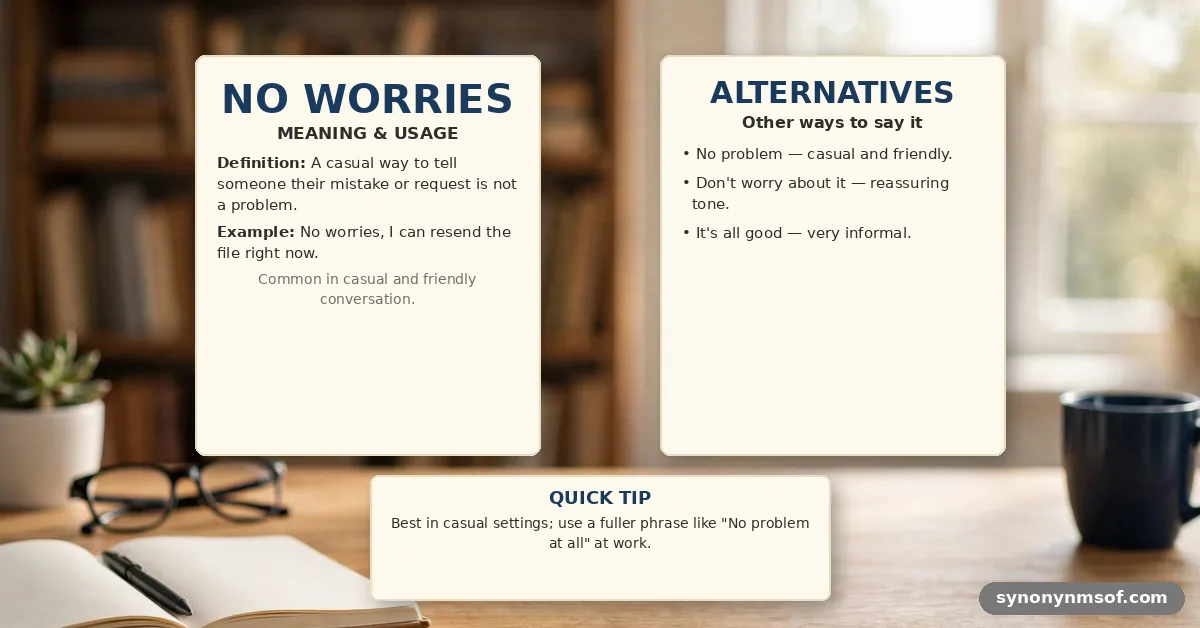

You have likely heard the phrase no worries thrown around in casual conversation, especially when someone is responding to an apology or a request. It has become a staple of modern parlance, functioning as a friendly, low-pressure way to signal that everything is fine.
Understanding exactly when this expression fits and when you might want to choose something more formal is the key to effective communication. Whether you are navigating a text thread with a friend or responding to a client, knowing the nuances of this popular term helps you strike the right balance between warmth and professionalism.
Defining the Phrase

At its core, the expression no worries is an Australian-born idiom that has traveled across the globe. It functions primarily as a synonym for you are welcome or it is fine.
When someone tells you they are sorry for a minor mistake, saying this phrase immediately lowers the tension in the room. It suggests that the error was not a big deal and that no further apology is necessary.
The term is deeply rooted in American English and global vernacular, though its origins are firmly tied to the laid-back culture of the Southern Hemisphere. It serves as a social lubricant, allowing people to move past awkward moments without lingering on guilt. While some older generations may view it as overly casual, it has become standard in many workplaces that prioritize a collaborative and relaxed environment.
When to Use No Worries
Choosing the right moment to use this phrase depends largely on your relationship with the listener. It works best in informal settings where the stakes are low. If a colleague misses a small deadline by an hour, using this phrase shows that you value your working relationship more than enforcing strict procedural perfection.
However, you should exercise caution in high-stakes environments. If a client is expressing serious concern about a project failure, replying with no worries might inadvertently signal that you are not taking the issue seriously. In such cases, a more empathetic or professional response is usually the better path to maintain trust.
Casual vs. Professional Contexts
- Casual: Responding to a friend who is late for coffee.
- Professional: Acknowledging a minor administrative error with a close teammate.
- Inappropriate: Dismissing a significant complaint from a supervisor or major stakeholder.
Alternatives for Different Situations
Because language is flexible, you have many options depending on the tone you want to project. If you feel that no worries might be misinterpreted as dismissive, you can swap it for a phrase that carries a bit more weight. These alternatives help you maintain a positive rapport while ensuring your professionalism remains intact.
For instance, if you are speaking to someone you do not know well, you might opt for not a problem or you are very welcome. These options keep the conversation polite without straying into overly familiar territory. Using variety in your speech shows that you are conscious of your audience and the specific emotional needs of the conversation.
| Phrase | Formality Level | Best Used When |
|---|---|---|
| No worries | Casual | Friends, close colleagues |
| Not a problem | Neutral | General workplace interactions |
| You are welcome | Formal | Clients, formal correspondence |
| Happy to help | Professional | Service-oriented roles |
The Psychology of the Expression
Why do people gravitate toward this specific word combination? It effectively shifts the focus from the mistake to the solution.
By explicitly stating that there is no need to worry, you are actively inviting the other person to relax. This creates a sense of psychological safety, which is essential for creative and collaborative teams.
There is also a sense of shared humanity in the phrase. It acknowledges that everyone makes mistakes and that life is too short to dwell on the small things. When you use it, you are signaling that you are an easy person to work with, which is a highly valued trait in any career path.
Common Mistakes to Avoid
One common error is using the phrase when a genuine apology is required. If someone has suffered a significant loss or a major professional setback, no worries can sound cold or indifferent. It is important to match your verbal response to the gravity of the situation at hand.
Another mistake is overusing it to the point where it loses its meaning. If you reply to every single interaction with the same two words, you may appear disengaged or robotic. Try to mix in other phrases to show that you are truly listening to the person you are communicating with.
Frequently Asked Questions
Is no worries professional?
It depends on your company culture. In creative or tech-focused environments, it is perfectly acceptable. In more traditional industries like law or finance, you might want to stick to more formal alternatives.
What is the best way to express urgency politely?
If you need something done quickly, avoid dismissing the task as if it were nothing. Instead, try saying, I would appreciate your help with this as soon as you have a moment.
What is the difference between at your earliest convenience and no worries?
The former is a formal request for action, while the latter is a response to an apology or a way to dismiss a minor issue. They serve entirely different purposes in a conversation.
Can I say no worries instead of it is okay?
Yes, they are essentially interchangeable in casual conversation. However, it is okay can sometimes sound slightly more patronizing depending on the tone of your voice, whereas no worries tends to sound more genuinely lighthearted.
Final Thoughts on Usage
Mastering the art of casual communication is a process of trial and error. While there is no single meaning that fits every scenario, developing a repertoire of responses allows you to navigate social interactions with greater ease. By understanding the impact of your words, you can foster stronger, more authentic connections with those around you.
Remember that the goal is always to make the other person feel heard and respected. If you find yourself in doubt about whether a phrase is appropriate, choose the more conservative option.
Incorporating a variety of expressions into your daily life ensures that you are never caught without the right thing to say. Continue observing how others use no worries in your own environment to refine your personal style.
SEO Title: No Worries: Meaning, Usage, and Examples
Meta Description: Discover the meaning, usage, and examples of the phrase no worries. Learn when to use this popular expression and explore professional alternatives.
Suggested URL Slug: no-worries-meaning-usage-examples
Primary Keyword: No Worries: Meaning, Usage
Primary Keyword: No Worries: Meaning, Usage, and Examples
Secondary Keywords: worries, worry, phrase, american english, meaning, used, word, one