
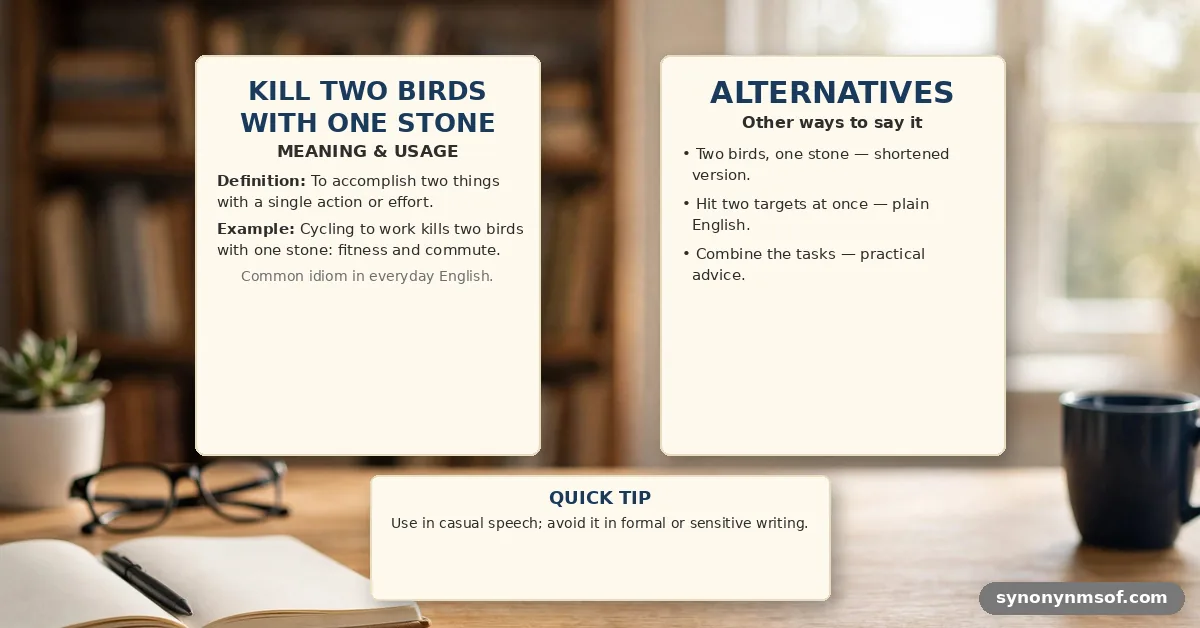

When you find a way to accomplish two separate tasks through one single action, you are practicing the efficiency described by the classic idiom to kill two birds with one stone. This phrase is a staple of the English language, used to highlight productivity and the clever consolidation of efforts. Understanding how to apply this concept effectively can help you streamline your daily routine and minimize wasted movement.
Whether you are managing a busy project schedule or simply looking for ways to optimize your personal time, recognizing these opportunities is a valuable skill. Let’s look at how this expression functions and where it fits into your communication.
At its heart, the phrase describes a situation where a person manages to achieve two distinct goals using only one process or strategy. It is not about doing two things poorly, but rather about finding an intersection where one effort yields multiple rewards. This is the ultimate expression of resourcefulness in both professional and personal life.
The idiom focuses on the economy of action. If you are preparing a meal for guests and decide to prep the ingredients for your own lunches for the week, you are effectively hitting two targets.
You save time and energy by bundling these tasks together. The beauty of this approach lies in the reduction of overhead—the time, focus, and energy required to start and finish a specific job.
Tracing the Historical Roots

While the exact origin is debated, the sentiment appears in various forms throughout history. Many scholars point to the 17th century, specifically Thomas Hobbes, who used similar imagery in his political writings. The idea of using one projectile for two targets was a common metaphor for efficiency in pre-industrial societies.
It evolved through the centuries to become the standard English idiom we recognize today. It moved from a literal hunting metaphor to a figurative tool for describing productivity.
Today, you will hear it used in boardrooms and kitchens alike. It has transcended its origins to become a universal shorthand for clever, multi-purpose labor.
Practical Examples of Efficiency
To see how this works in real life, consider how people integrate these habits into their schedules. You might listen to an educational podcast while commuting, thereby learning a new skill while traveling to work. Another common example involves exercise and socialization, such as meeting a friend for a hike instead of just sitting at a coffee shop.
- Running errands on your way home from work to avoid a second trip.
- Writing a single report that serves both as a client update and a team summary.
- Using a workout session to practice a speech or presentation out loud.
- Cooking large batches of food to cover dinner and next day’s lunch.
- Combining a networking event with a lunch meeting to save time.
Comparing Methods of Productivity
Efficiency is often a matter of perspective and planning. The table below illustrates how different approaches to tasks can yield varying levels of output. By choosing to combine actions, you often reduce the total time spent on maintenance tasks.
| Strategy | Time Investment | Outcome |
|---|---|---|
| Siloed Tasks | High (Multiple Starts) | Single Result per Task |
| Combined Effort | Low (Single Start) | Dual Results |
| Delegated Work | Variable | Shared Output |
The Psychology of Multi-Tasking
There is a subtle difference between healthy consolidation and harmful multi-tasking. When you kill two birds with one stone, you are usually performing complementary tasks that don’t fight for your attention. You are not trying to write a complex report while answering emails, which would lead to errors.
Instead, you are looking for natural synergies. The brain finds it easier to handle tasks that share a context or a physical location.
By grouping these, you reduce the cognitive load of switching contexts. This makes your work feel less fragmented and more purposeful throughout the day.
Common Variations and Similar Phrases
Language is rarely static, and you will encounter variations of this concept in other cultures and dialects. While the English version is widely understood, synonyms often capture the same spirit of resourcefulness. Phrases like “getting two for the price of one” or “killing two birds” emphasize the same result.
In a professional setting, you might prefer to use more formal language, such as “leveraging synergies” or “optimizing workflow.” While these sound more corporate, they represent the exact same principle. The goal remains to maximize the impact of your individual actions.
Applying the Concept in Your Career
Managers and entrepreneurs often look for these opportunities to keep overhead low. If you can design a product that solves two customer pain points, you have essentially mastered the strategy. It is about finding the point where the needs of the business and the needs of the client align perfectly.
You should practice identifying these moments during your weekly planning sessions. Look at your to-do list and ask yourself if any of these items are related.
If you have two meetings that cover similar ground, can you combine them into one? This simple shift can clear hours from your calendar.
Addressing Common Questions
Is this phrase always appropriate?
While the idiom is common, it can sound a bit informal or even aggressive due to the imagery. In very formal or sensitive environments, you might want to use “accomplishing two goals at once” instead.
Where did the phrase originate?
Most historians agree it emerged in the 1600s, with early recorded versions appearing in English literature. It reflects the practical, survival-oriented mindset of that era.
What is the difference between this and multi-tasking?
Multi-tasking often implies doing two things simultaneously, which can lower quality. Using this strategy implies finding a way to make one action count for two outcomes, which usually improves efficiency without sacrificing quality.
Can you give a simple example from daily life?
If you walk to the store to pick up groceries while also getting your daily exercise, you are using one trip for two purposes.
Refining Your Approach
Mastering the art of efficiency is a lifelong process of observation and adjustment. Once you start looking for ways to combine your efforts, you will be surprised at how much time you recover.
Remember that the goal is not to rush through life, but to ensure your energy is spent where it matters most. By thoughtfully choosing when to combine your actions, you can achieve more with less friction.
If you find yourself constantly overwhelmed by a growing list of responsibilities, start by looking for small, easy wins. Find two things you do every day that could share a single block of time.
When you successfully manage to hit two targets with one effort, you’ll find that your day becomes significantly more manageable. Stay observant, keep your goals in sight, and enjoy the extra time you create for yourself.
SEO Title: Kill Two Birds With One Stone: Meaning & Examples
Meta Description: Learn the meaning, history, and practical usage of the phrase “kill two birds with one stone” to boost your daily efficiency and productivity.
Suggested URL Slug: kill-two-birds-with-one-stone-meaning-examples
Primary Keyword: Kill two birds with one stone
Secondary Keywords: two birds, birds one, one stone, kill two, single action, idiom, example, efficiency