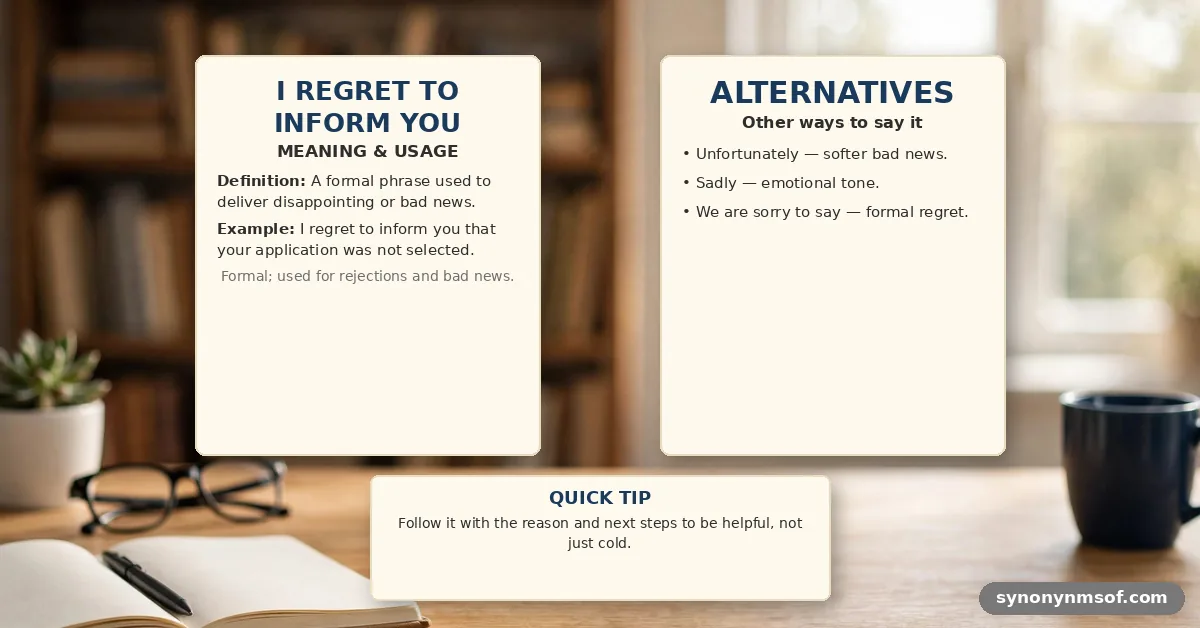

When you hear the phrase I regret to inform you, it usually signals that difficult news is coming your way. This formal expression serves as a linguistic buffer, designed to soften the blow of a rejection, a cancellation, or a professional disappointment.
Using these words correctly requires a delicate balance of empathy and clarity to ensure your message remains respectful. Understanding the nuances behind this construction will help you maintain your professional reputation even when you have to deliver an unfavorable outcome to a client, colleague, or applicant.
The Purpose of Formal Communication

The primary function of this phrase is to establish a serious and respectful tone. By using the word regret, you signal to the recipient that you recognize the weight of the news you are delivering. This is not a casual conversational filler but a deliberate choice for high-stakes interactions where professionalism is paramount.
In corporate environments, clarity often conflicts with kindness. If you simply state a rejection, it can sound cold or dismissive.
By leading with this specific construction, you provide the recipient with a moment to prepare for the negative information that follows. It frames the communication as a professional duty rather than a personal attack.
When to Use This Phrase
You should reserve this language for situations that carry genuine gravity. It is not appropriate for minor inconveniences like a delayed lunch or a simple schedule shift. Use it when the outcome is final and cannot be negotiated, such as a denied promotion or a project cancellation.
Common Professional Scenarios
- Delivering a rejection letter for a job or internship application.
- Notifying a client that a product or service is no longer available.
- Informing a team that a budget request has been declined.
- Announcing the termination of a contract or professional partnership.
- Communicating that an event or meeting has been permanently canceled.
Analyzing the Tone and Impact
The tone of this phrase is inherently detached and distant. While it is polite, it creates a clear boundary between the sender and the recipient. This distance is often necessary in legal or administrative contexts where you must maintain a neutral stance.
If you use this with a close colleague, it may sound stiff or overly robotic. People generally prefer directness when they have an established working relationship. Save this for formal correspondence where the recipient expects a standard, objective delivery of bad news.
Alternatives for Different Situations
Sometimes, this phrase feels too heavy for the specific news you need to share. You might want to pivot to something that feels more collaborative or less final. Consider these variations based on your intended message and the relationship you hold with the reader.
| Alternative Phrase | Best Context | Tone |
|---|---|---|
| I am sorry to share that | Team updates | Empathetic |
| Unfortunately, we cannot | Client requests | Direct |
| We are unable to proceed | Applications | Formal/Neutral |
| I must report that | Reporting errors | Objective |
Writing Clear and Effective Emails
When writing an email that includes this expression, keep your message concise. Do not bury the bad news in a long, rambling paragraph. State the purpose of the email early, explain the decision briefly, and then offer a path forward if one exists.
Structuring Your Message
Start with a professional greeting that acknowledges the recipient by name. Clearly state that you have reviewed the request or the situation. Use the phrase early in the second paragraph to ensure the reader understands the decision immediately.
Avoid over-explaining your reasoning. Lengthy justifications often sound like excuses and can lead to unnecessary follow-up questions. Maintain a tone of finality that respects the recipient’s time and your own professional boundaries.
Common Mistakes to Avoid
One frequent error is using this language when you are actually seeking a compromise. If you use this phrase, the recipient will assume the matter is closed. Do not use it if you are still open to negotiation or feedback.
Another mistake is using it for trivial matters. If a colleague asks to borrow a stapler and you say you regret to inform them it is unavailable, you will sound sarcastic. Reserve this level of formality for significant professional developments only.
Impact on Professional Relationships
Delivering bad news is an inevitable part of any career. How you communicate that news defines your leadership style and your level of professional maturity. Using standard, respectful phrases shows that you can handle difficult tasks with composure.
Remember that the goal is not to avoid the discomfort of the news but to deliver it with integrity. Even when you have to say you cannot fulfill a request, doing so with clear, formal language preserves the dignity of the recipient. This approach often prevents bridges from being burned during a challenging interaction.
Frequently Asked Questions
Is this phrase always professional?
Yes, it is considered highly professional, but it is also very formal. It is ideal for official letters or high-level corporate communications but might be overkill for quick internal messages.
Can I use this for personal news?
You can, though it often sounds intentionally humorous or overly dramatic in personal settings. In a strictly professional context, it is a standard way to signal that the news is serious and final.
What is the difference between this and saying unfortunately?
Unfortunately is more versatile and can be used in both casual and formal settings. The phrase I regret to inform you is a heavier, more structured opening that prepares the reader for a formal denial or negative update.
How do I follow up after using this phrase?
The best follow-up is to provide clear next steps or a brief explanation of why the decision was made. If there is no path forward, it is best to offer a polite closing that wishes the recipient success in their future endeavors.
Final Thoughts on Professional Communication
Choosing the right words when delivering difficult news is an essential skill for any professional. While the phrase I regret to inform you carries a weight that should not be used lightly, it remains an effective tool for maintaining clarity and respect in corporate environments. By understanding when and how to use it, you ensure that your communication remains consistent with your company’s standards and your own professional ethics.
Practice using these alternatives in your daily correspondence to find the balance that works best for your specific industry. If you remain direct, empathetic, and professional, you will find that even the most difficult messages are received with understanding. Feel free to reach out if you would like more examples on how to handle specific workplace communication challenges.
SEO Title: I Regret to Inform You: Meaning, Examples & Usage
Meta Description: Learn the professional meaning of I regret to inform you. Explore examples, when to use it, and how to maintain a professional tone in emails.
Suggested URL Slug: i-regret-to-inform-you-meaning-examples
Primary Keyword: I regret to inform
Primary Keyword: I regret to inform you
Secondary Keywords: formal, professional, tone, communication, emails, news, cannot, regret inform