
If you have ever paused in the middle of a sentence, unsure whether to type “chose” or “choose,” you are in good company. These two words are only one letter apart, they come from the very same verb, and they trip up native speakers and English learners alike. The confusion is completely understandable: English rarely lets a single letter carry this much meaning, yet here it decides whether your action happened yesterday or is happening right now.
The good news is that the rule behind these two words is short, logical, and easy to master. “Choose” and “chose” do not have different meanings at all — they are simply different tenses of the same verb. Once you learn which tense each spelling belongs to, along with a small memory trick for the pronunciation, you will be able to pick the right one every time without a second thought.
In this guide, we will break down exactly when to use “choose” and when to use “chose,” look at the full conjugation including the often-confused “chosen,” compare their pronunciation, and walk through plenty of real examples from everyday conversation, business emails, and academic writing. By the end, the distinction will feel automatic.
What Does “Choose” Mean? (Present Tense)
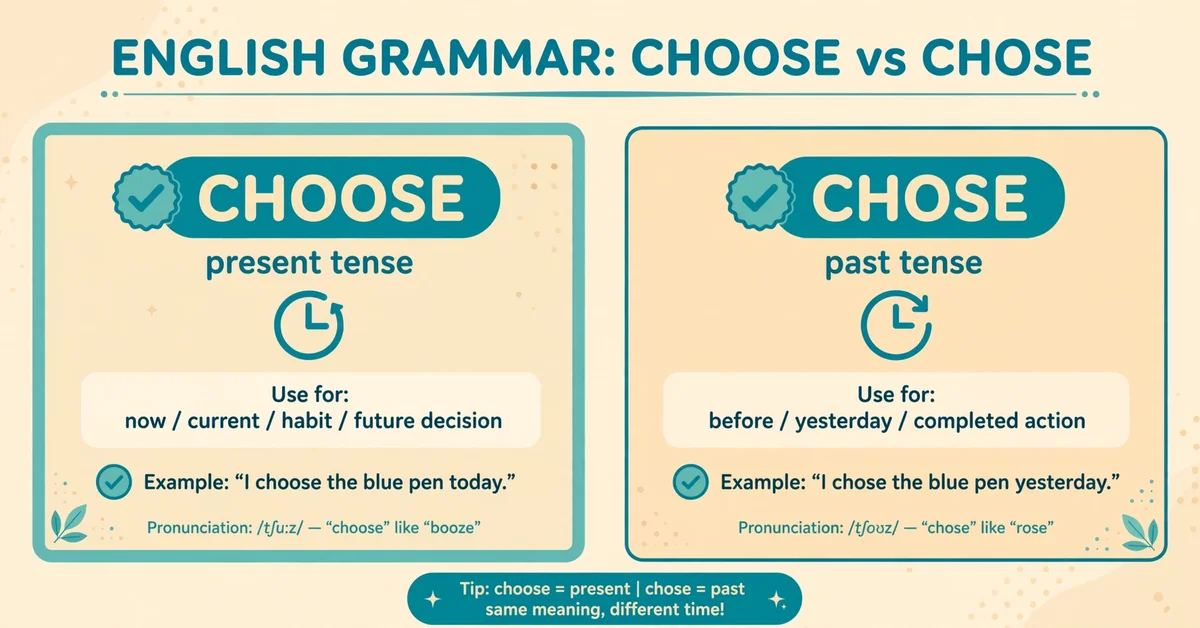
“Choose” is the base form and present tense of an irregular English verb that means to select, pick, or decide between two or more options. Whenever you make a decision in the present moment, describe a habit, state a general truth, or talk about the future, “choose” — with two o’s — is the correct spelling.
Everyday Uses of “Choose”
In daily life, “choose” appears wherever a decision is happening now or repeats regularly. You might tell a friend, “I always choose the window seat,” or ask your family, “Which movie should we choose tonight?” The word also shows up in common phrases like “choose wisely,” “choose your words carefully,” and “the lesser of two evils — choose.” Notice that in every one of these cases, the choosing is current or ongoing, not finished in the past.
“Choose” in Questions and Conditionals
Questions and conditional sentences rely on “choose” more than you might expect. “What would you choose if you could live anywhere?” puts the decision in the realm of imagination, so the base form applies. The same goes for polite requests: “Could you choose a time that works for everyone?” or “Would you mind choosing a different seat?” — here the present participle “choosing” turns the verb into a gerund. A useful habit is to check the first verb in the sentence: if a modal like “would” or “could” already sets the mood, the main verb stays as “choose.”
“Choose” for the Future
English also uses the base form “choose” after helper words like “will,” “shall,” “must,” “can,” and “going to” when the decision lies in the future. For example: “Tomorrow I will choose a new phone,” or “You must choose your courses before Friday.” The auxiliary verb carries the future meaning, while “choose” stays in its base form. A common beginner mistake is writing “will chose” — remember that helper verbs are always followed by the base form, never the past tense.
Third-Person Singular: “Chooses”
One small detail worth noting: when the subject is third-person singular (he, she, it, or a single person or thing), present tense adds an -s, giving us “chooses.” So “I choose,” “you choose,” and “they choose” all stay the same, but “she chooses,” “he chooses,” and “the committee chooses” take the extra letter. This follows the normal present-tense pattern in English and has nothing to do with the choose/chose confusion, but learners often appreciate having it spelled out.
What Does “Chose” Mean? (Past Tense)
“Chose” is the simple past tense of “choose.” It describes a decision that is already complete — something you decided at a specific moment in the past. If the choosing is over and done with, “chose” with one o is your word: “She chose the red dress yesterday,” “We chose a different hotel last summer,” or “He chose to stay silent during the meeting.”
Recognizing Past-Tense Contexts
The signal words around the verb usually give the tense away. Words like “yesterday,” “last week,” “in 2020,” “earlier,” and “when I was younger” point to completed time, and they pair with “chose.” For instance: “Last year, I chose a career in teaching,” or “They chose the winner on Friday.” If you can mentally add “already happened” to the sentence and it still makes sense, “chose” is almost certainly right.
“Chose” With Time Markers You Might Miss
Not every past-tense signal is as obvious as “yesterday.” Phrases like “back then,” “at the time,” “in the end,” and “after much debate” also anchor a decision in the past: “After much debate, the board chose the bolder design,” or “In the end, she chose simplicity over style.” Even without an explicit time word, a narrative in the past tense keeps “chose” consistent: “He walked into the store, compared the two models, and chose the cheaper one.” Once a story is set in the past, every completed decision inside it takes the past form.
“Chose” in Reported Decisions
You will also see “chose” when people report or explain decisions after the fact. “She told me she chose the blue one,” or “The jury chose the youngest candidate.” In storytelling and news reporting, this form dominates because the events being described have concluded. A quick test: if you could replace “chose” with “selected” or “picked” without changing the meaning, the past tense is correct.
The Key Difference: Chose or Choose?
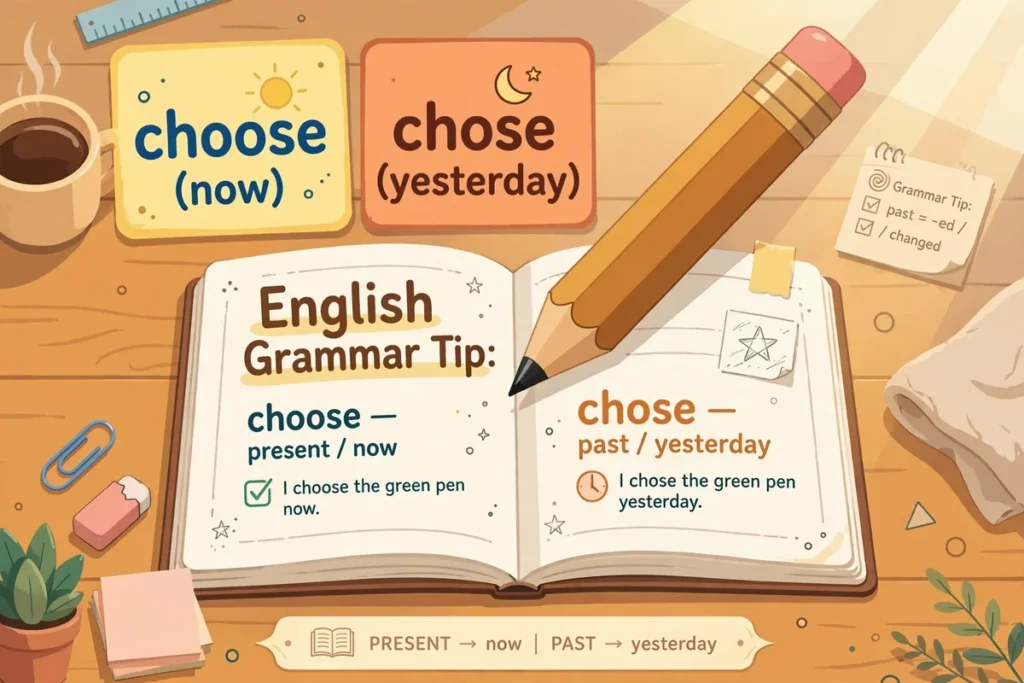
Strip away everything else, and the difference between “chose” and “choose” comes down to a single question: when did the choosing happen? Use “choose” for now, for habits, and for the future; use “chose” for finished actions in the past. Compare these pairs and notice how the time frame decides the spelling:
- “Every morning, I choose the fastest route to work.” (habit, present)
- “Yesterday morning, I chose the scenic route instead.” (completed, past)
- “We always choose organic vegetables.” (general truth)
- “At the market, we chose the ripest tomatoes.” (specific past event)
- “You need to choose a password today.” (present obligation)
- “She chose her password last week.” (completed action)
Pronunciation: “Chooz” vs. “Chohz”
The pronunciation difference is just as reliable as the spelling rule, and it is a great memory aid. “Choose” is pronounced “chooz” — with a long “oo” sound, rhyming with “shoes,” “blues,” and “goose.” “Chose” is pronounced “chohz” — with a long “o” sound, rhyming with “nose,” “goes,” and “toes.” So the vowel you hear tells you the tense: hear the “oo,” and you are in the present; hear the “oh,” and you are in the past. Saying the sentence out loud is one of the fastest ways to catch a mistake before you publish it.
A Memory Trick That Sticks
Here is a simple mnemonic used by many English teachers: “choose” is for now — two o’s for “today”; “chose” is for those days in the past — one o is gone, just like the moment is gone. Another handy one: the past tense “lost” an o the way the opportunity is “lost” to the past. Pick whichever image sticks in your head, and the rule will follow you.
Full Conjugation: Choose, Chose, Chosen
Like many old English verbs, “choose” is irregular — it does not take a simple -ed ending in the past tense. Instead, its vowel shifts, the same pattern you see in pairs like “freeze/froze/frozen” and “speak/spoke/spoken.” Here is the complete picture:
| Form | Word | Example Sentence |
|---|---|---|
| Infinitive | choose | “It is hard to choose between them.” |
| Present (I/you/we/they) | choose | “They choose a new theme each year.” |
| Present (he/she/it) | chooses | “She chooses her words carefully.” |
| Simple past | chose | “He chose the later flight.” |
| Past participle | chosen | “They have chosen their captain.” |
| Present participle | choosing | “We are choosing a venue now.” |
The past participle, “chosen,” deserves special attention because it causes its own share of mix-ups. It appears after “have,” “has,” or “had” in perfect tenses (“I have chosen,” “she had chosen”) and in passive constructions (“the winner was chosen”). It is never “have chose” or “has chose” — the helper verb demands the participle, not the simple past.
Usage Examples Across Contexts
Everyday Conversation
In casual speech, “choose” and “chose” come up constantly, often when people are comparing options out loud. Imagine you are texting a friend about dinner plans: you might write, “You choose the restaurant this time — I chose last time.” One message, both forms, each doing its job. On the other hand, when you are talking about a decision you have not made yet, “choose” stays in the present: “I still need to choose a birthday gift for Dad.”
Everyday speech also loves the phrase “I was wondering which one to choose” when asking for advice politely — the choosing is still ahead of you, so the base form fits. And when friends tease each other about past decisions, “chose” gets its moment: “You chose the spicy noodles, remember? No complaining now!”
Work and Business Writing
Professional writing rewards precision, and using the right tense form of “choose” signals attention to detail. In a proposal, you might write: “We recommend you choose the annual plan for better value.” In a follow-up email after a decision: “The client chose the annual plan on Monday.” Notice how the first sentence advises (present/future) while the second reports (past).
Job applications and performance reviews use these forms often. “I chose this company because of its values” anchors your motivation in the past, while “I choose to take on challenging projects” describes your ongoing attitude. Mixing them up in a cover letter — “I chose to take on challenging projects” when you mean it as a current trait — can subtly confuse the reader about your timeline. This shows how much weight a single letter can carry in formal writing.
Formal and Academic Writing
Academic writing leans heavily on the past tense when describing completed research, so “chose” appears frequently: “The researchers chose a qualitative method for this study,” or “Participants chose between two scenarios.” When the text shifts to recommendations or general principles, “choose” takes over: “Future studies should choose larger samples,” or “Readers may choose whichever interpretation fits the evidence.”
Style guides also care about the participle. A thesis might state, “The method chosen for analysis was regression,” using “chosen” as an adjective-like participle. The key academic habit is consistency: once you establish a time frame for a paragraph, keep the verb forms aligned with it. First choose your topic, then describe how earlier scholars chose theirs — moving from present guidance to past literature in a clean, logical sequence.
Common Mistakes to Avoid
1. Using “chose” for a present habit. This is the single most frequent error. “I always chose the same café” sounds like you are describing a routine, but “chose” plants it firmly in the past. If the habit continues today, write “I always choose the same café.” Read the sentence with “right now” tacked on the end — if it still makes sense, you need “choose.”
2. Using “choose” for a completed action. The mirror-image mistake: “She choose the winner yesterday” should be “She chose the winner yesterday.” The word “yesterday” is a dead giveaway that the past tense is required. When you spot time markers like “last night,” “in 2019,” or “ago,” double-check that your verb is in the past form.
3. Writing “have chose” instead of “have chosen.” Perfect tenses always take the past participle. “They have chose a new logo” is incorrect; the right version is “They have chosen a new logo.” The same applies after “has” and “had”: “She has chosen wisely,” “We had chosen our seats early.”
4. Writing “choosed.” This one is never correct. Because “choose” is irregular, adding -ed does not work — there is no such word as “choosed” in standard English. If your fingers type it automatically, train them toward the vowel-shift pattern instead: choose → chose → chosen.
5. Adding “did” before “chose.” “Did chose” is redundant because “did” already carries the past meaning. The correct construction pairs “did” with the base form: “Did you choose the red one?” not “Did you chose the red one?” Use “chose” only when it stands alone as the past-tense verb: “Yes, I chose the red one.”
6. Confusing “choosing” with a tense form. “Choosing” is the present participle, used for continuous tenses (“I am choosing now”) or as a gerund (“Choosing is hard”). It is not a substitute for either “choose” or “chose.” “Yesterday I was choosing a gift” is fine for an ongoing past action, but “Yesterday I choosing a gift” drops the helper verb and breaks the sentence. Keep the participle paired with its helper.
Tricky Cases and Edge Cases
“Chosen” vs. “Chose”: Which Participle Moment Is It?
The hardest calls involve deciding between “chose” and “chosen.” The rule is mechanical: if “have,” “has,” or “had” comes right before it (or a form of “be” in passive voice), use “chosen.” In every other past-tense slot, use “chose.” Compare “She chose the painting” (simple past, no helper) with “She has chosen the painting” (present perfect, helper present). When in doubt, look left — a helper verb means “chosen.”
The Present-Tense “Chose” Slip in Fast Writing
Even experienced writers sometimes type “chose” when they mean “choose,” especially when typing quickly, because the fingers remember the shorter word. This slip is most common in sentences about routines and preferences: “Customers chose us for our reliability” accidentally suggests those customers are gone. A proofreading pass that reads sentences aloud catches this instantly, because “chohz” sounds wrong where “chooz” belongs.
“Choose” After Modals and Infinitives
Modal verbs (can, should, must, will, would) and the infinitive marker “to” always take the base form “choose,” never “chose.” Correct: “You should choose the smaller size,” “They decided to choose a new vendor,” “We can choose together.” Incorrect: “You should chose,” “decided to chose.” If a modal or “to” precedes the verb, the tense is already handled — the verb itself stays in base form.
“Choice” — The Noun That Causes Collateral Confusion
Part of the choose/chose fog comes from the related noun “choice” (a selection or decision). “Make a good choice” uses the noun, while “choose well” uses the verb. They are not interchangeable: “Take your choice” is fine, but “Take your choose” is not. Keeping the noun and verb in separate mental boxes prevents a whole family of errors.
When Both Forms Appear in One Sentence
Some sentences legitimately need both “choose” and “chose” side by side, and they are a great final test of your understanding. “You may choose any dessert you like — I already chose mine,” or “Students choose their electives in spring, but last year’s class chose theirs in winter.” In each case, the present-tense clause describes a general rule or open possibility while the past-tense clause reports a completed event. If you can label each clause as “now” or “then,” assigning the right spelling becomes straightforward.
Regional and Informal Variations
In very informal speech, some dialects blur these forms, and you may occasionally hear “I done chose” or similar non-standard constructions. These are fine in casual conversation among friends, but they do not belong in writing, exams, or professional communication. Stick to the standard forms in any context where correctness matters.
Frequently Asked Questions
Is “chose” the past tense of “choose”?
Yes. “Chose” is the simple past tense of the verb “choose.” Use “chose” for decisions that are already complete, such as “She chose the blue folder this morning,” and “choose” for present or future decisions, such as “She will choose a folder tomorrow.” The third form of the verb, the past participle, is “chosen.”
How do you pronounce “chose” vs. “choose”?
“Choose” is pronounced “chooz,” rhyming with “shoes” and “blues” — it has a long “oo” vowel sound. “Chose” is pronounced “chohz,” rhyming with “nose” and “goes” — it has a long “o” vowel sound. The vowel sound is a reliable clue: if you hear the “oo,” the word refers to the present; if you hear the “oh,” it refers to the past.
What is the difference between “chose” and “chosen”?
“Chose” is the simple past tense and stands alone: “They chose a new captain.” “Chosen” is the past participle and follows helper verbs like “have,” “has,” “had,” or forms of “be”: “They have chosen a new captain,” or “The captain was chosen by vote.” You cannot swap them — “They have chose” is always incorrect.
Is “choosed” a correct word?
No. “Choosed” is never correct in standard English because “choose” is an irregular verb. Its past tense is “chose” and its past participle is “chosen.” If you catch yourself writing “choosed,” replace it with “chose” for simple past (“I choosed” → “I chose”) or “chosen” after a helper verb (“have choosed” → “have chosen”).
Can “choose” be used for the future tense?
Yes. The base form “choose” appears in future constructions after helper verbs like “will” and “going to”: “I will choose a major next semester,” or “She is going to choose the catering herself.” The helper verb carries the future meaning while “choose” stays in its base form. Never use “chose” after “will” — “will chose” is always wrong.
Conclusion
The chose-or-choose question has one of the simplest answers in English grammar: “choose” belongs to the present and the future, “chose” belongs to the past, and “chosen” steps in whenever a helper verb like “have” or “has” appears. Add the pronunciation cue — “chooz” for now, “chohz” for then — and you have everything you need to get it right without memorizing long lists of rules.
With these distinctions in place, the most common errors become easy to spot and fix: the present-tense “chose,” the missing participle in “have chose,” and the phantom word “choosed” all stand out once you know what to look for. Practice by reading your own sentences aloud, checking the time frame of each decision, and letting the single-letter difference do its quiet, precise work.
Explore more on Synonynmsof.