
Understanding the nuance of as soon as possible: meaning, usage, and alternatives is essential for anyone aiming to communicate clearly in a professional environment. While the phrase is common, it often carries a tone of urgency or demand that can strain workplace relationships if used improperly. By exploring the history, psychological impact, and superior linguistic substitutes, you will gain the tools to manage expectations without sounding pushy.
This guide provides a deep look at how to refine your professional correspondence by choosing precise deadlines over vague, high-pressure directives. Mastering these subtle shifts in language will help you maintain professional decorum while keeping your projects moving forward at an appropriate, agreed-upon pace.
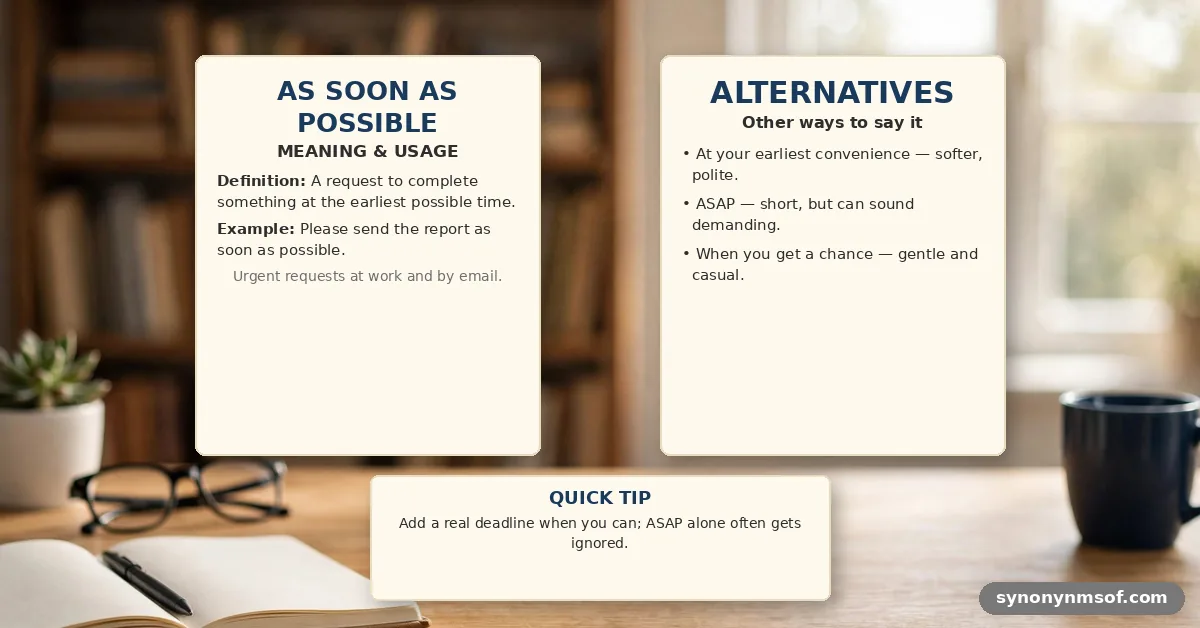
The literal meaning of “as soon as possible” is that a task should be completed at the earliest moment that is physically or logically feasible. In practice, however, it rarely functions as a neutral statement of fact. It often acts as a command, implicitly stripping the recipient of their ability to prioritize their own workload.
When you use this phrase, you are shifting the burden of priority entirely onto the person receiving your request. Because it lacks a specific time frame, it creates ambiguity. The sender expects an immediate response, but the recipient must guess whether “possible” means within an hour, by the end of the day, or by the end of the week.
The Psychological Impact
Research into workplace communication suggests that vague urgency triggers stress responses. When a manager sends an email labeled “ASAP,” the recipient often experiences a spike in cortisol, leading to rushed work and potential errors. This is a well-documented phenomenon in organizational psychology.
The phrase can also be perceived as dismissive of the recipient’s current responsibilities. It implies that your request is the only one that matters, regardless of what else is on their plate. Overusing this language can erode trust and reduce team cohesion over time.
Professional Alternatives
Instead of relying on a catch-all phrase, you should aim for specificity. Providing a concrete deadline allows the other person to plan their day effectively. If you are unsure of a timeline, ask for one instead of demanding it.
Consider these alternatives when you need to convey urgency without the baggage of the original phrase:
- By the close of business today.
- Could you provide this by 2:00 PM on Tuesday?
- Please let me know when you think this might be finished.
- This is a high priority for the Friday project meeting.
- I would appreciate a status update by end-of-day Wednesday.
The Problem with Ambiguity
Ambiguity is the primary enemy of efficient project management. When you use a phrase that lacks a defined end point, you invite miscommunication. The sender and the recipient are effectively operating on two different timelines.
If you tell a colleague to complete a report “as soon as possible,” you might expect it in two hours. They, however, might interpret it as “before you leave today.” This misalignment leads to frustration when the report doesn’t arrive when you expected it.
Comparing Urgency Levels
To better understand how to communicate deadlines, look at how different phrases impact the recipient’s sense of priority. Certain terms carry specific expectations that are universally understood in a professional setting.
| Term | Typical Expectation | Professional Tone |
|---|---|---|
| As soon as possible | Immediate/Undefined | High Pressure |
| By EOD (End of Day) | Before 5:00 PM | Clear/Expected |
| By COB (Close of Business) | Before 5:00 PM | Standard Formal |
| Within 24 hours | Next business day | Measured/Fair |
Using Specific Deadlines
Specific deadlines act as a roadmap for your team. When you provide a date and time, you eliminate the need for follow-up emails asking for status updates. This saves time for both the sender and the recipient.
If a task is genuinely urgent, state the reason. People are far more likely to prioritize a task when they understand the “why” behind the “when.” For example, noting that you need a document to prepare for a board meeting provides essential context.
The Role of Context
Context is the missing ingredient in many failed communications. If you are working in a fast-paced environment like a newsroom or an emergency response team, urgency is understood. In these settings, shorthand is often necessary for survival.
However, in a standard office environment, context must be provided explicitly. If you find yourself frequently needing things “right now,” you may have a process issue rather than a communication issue. Reviewing your internal workflows can often solve the problem of constant, last-minute emergencies.
How to Ask for Estimates
Sometimes, you truly do not know how long a task should take. In these cases, asking for an estimate is the most professional approach. This puts the professional expertise back in the hands of the person doing the work.
Try asking, “What is a realistic timeline for this?” or “When do you think you can realistically fit this in?” This approach respects their time and fosters a collaborative relationship. It also ensures that the deadline you eventually set is actually achievable.
Communicating Through Email
Email is where the phrase is most frequently abused. Because email lacks the tone of voice and body language, the “ASAP” tag can come across as aggressive. It is better to use the subject line to indicate the nature of the request.
For instance, use “[Action Required]” or “[Priority]” followed by the date. This helps the recipient triage their inbox more effectively. You can learn more about writing emails with clarity to improve your professional reputation.
When to Use Urgency
There are times when genuine emergencies arise. In those cases, using strong, clear language is appropriate and necessary. However, you must reserve this for situations where it is truly warranted.
If you label everything as a high-priority emergency, nothing becomes a priority. Your team will eventually become desensitized to your requests. By reserving urgent language for actual crises, you ensure that your voice carries weight when it really counts.
The Biblical Perspective on Patience
Proverbs 14:29 notes that a person who is slow to wrath has great understanding, but a hasty spirit exalts folly. This wisdom applies to how we manage our expectations of others in the workplace. Acting with a “hasty spirit” often leads to poor decisions and damaged relationships.
Patience is not just a personal virtue; it is a professional asset. Taking the time to craft clear, reasonable requests shows that you value your colleagues’ contributions. It also suggests that you are a thoughtful leader who understands the value of long-term stability over short-term chaos.
Developing a Professional Tone
Developing a professional tone requires a shift in how you view your coworkers. They are not merely resources to be activated; they are partners in a shared objective. Your language should reflect this sense of partnership.
Focus on being helpful rather than demanding. When you frame your requests around the goals you share, you build a foundation of mutual respect. This makes it much easier to get things done when you truly need them completed on a tight schedule.
FAQ
Is it ever okay to use ASAP in an email?
It is generally best to avoid it, as it can sound demanding or unprofessional. If you must use it, keep it for internal communications with close colleagues who already understand your communication style.
What is the most professional way to ask for a rush job?
State the specific time you need it and the reason for the urgency. For example, “Could you please prioritize this by 3:00 PM so I have time to review it before the client call?”
How do I handle a boss who always asks for things ASAP?
Clarify the priority of the new task against your existing workload. Ask, “I am currently working on the budget report; should I pause that to focus on this new request?”
Does “as soon as possible” mean today?
It is ambiguous, which is why it should be avoided. If you need it today, explicitly state, “Please provide this by the end of the day.”
Why do people dislike the phrase ASAP?
It often feels like a demand that ignores the recipient’s current workload and creates unnecessary pressure. It is seen as a lazy way to assign a deadline.
Conclusion
Improving your professional communication starts with being intentional about the words you choose. Moving away from vague directives like as soon as possible: meaning, usage, and alternatives, you demonstrate respect for your colleagues’ time and expertise. By replacing high-pressure shorthand with specific deadlines and clear expectations, you build a more efficient and collaborative work environment.
Next time you need to make a request, pause and ask yourself if you have provided a clear, actionable timeline. If you haven’t, take the extra thirty seconds to specify exactly what you need and when you need it.
This small change will distinguish you as a thoughtful and effective communicator. I encourage you to test these alternatives in your next few emails and observe how much more smoothly your projects proceed.