
When you receive an invitation for a job meeting, the phrase I look forward to the interview often appears in your response. This simple expression serves as a formal confirmation of your attendance while demonstrating enthusiasm for the role.
It signals to the employer that you are prepared, professional, and genuinely interested in the opportunity ahead. Understanding the nuance behind these words helps you set a positive tone before the conversation even begins.
By mastering this standard professional closing, you create a bridge between your application and the actual discussion. This article explores why this specific phrasing carries weight, how to adapt it for different communication styles, and how it impacts your overall candidacy.
The Core Meaning of Looking Forward

At its heart, the phrase conveys anticipation and readiness. When you tell a recruiter you look forward to the interview, you are essentially saying that you value their time and the prospect of the role. It is a polite, conventional way to acknowledge receipt of an invitation while reinforcing your commitment to the hiring process.
This expression functions as a social lubricant in professional correspondence. It removes the coldness of a purely logistical confirmation, such as simply stating, “I will be there at 2:00 PM.” Instead, it adds a layer of warmth that suggests you are a proactive communicator who understands professional etiquette.
Why Employers Value This Sentiment
Companies look for candidates who show genuine interest in their mission. When you use this phrase, you communicate that you are not just checking a box but are actively engaged in the job search. It helps the hiring manager feel that the time they spend interviewing you will be productive and welcomed.
A candidate who expresses enthusiasm is often seen as a better cultural fit. Employers want to hire people who actually want to be there. By explicitly stating your anticipation, you provide a subtle, positive nudge that distinguishes your email from more transactional responses.
Grammar and Professional Etiquette
The grammatical structure is straightforward, yet people often overthink it. “I look forward to” is a standard present tense construction.
It implies a state of mind that exists right now regarding a future event. You do not need to use “am looking forward to,” although that is also grammatically correct and widely accepted in modern business.
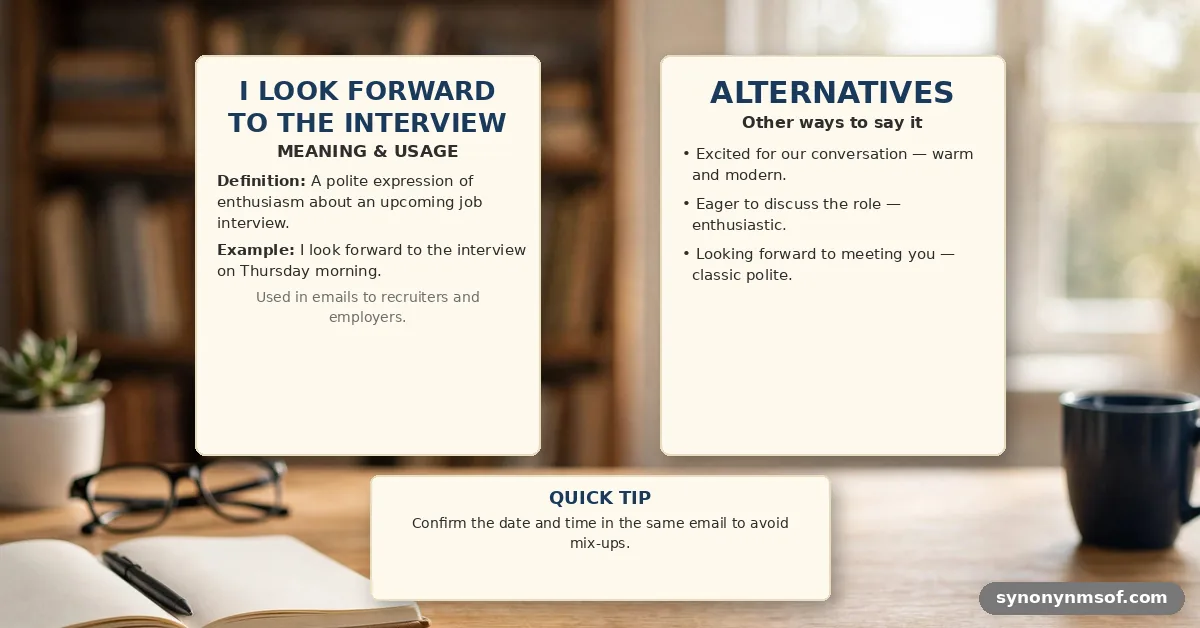
If you prefer to vary your language, you have several options that convey the same professional tone. The key is to maintain a balance between formal politeness and authentic communication. Avoid being overly flowery, which can sometimes come across as insincere or desperate.
- I appreciate the invitation and look forward to our conversation.
- Thank you for the opportunity; I look forward to meeting the team.
- I am eager to discuss how my background aligns with your needs.
- I look forward to learning more about the role during our meeting.
Comparing Professional Responses
Not every response needs to be identical. Depending on the company culture or the stage of the hiring process, you might choose a more or less formal approach. The following table illustrates how to adapt your language based on the context of the communication.
| Context | Recommended Phrasing | Tone |
|---|---|---|
| Initial Email Invitation | “I look forward to the interview and learning more.” | Standard/Professional |
| Formal Executive Search | “I appreciate the opportunity and look forward to our discussion.” | Highly Formal |
| Startup/Casual Culture | “Thanks for the invite! I’m looking forward to it.” | Conversational |
| Rescheduling Request | “I remain very interested and look forward to connecting soon.” | Polite/Reassuring |
Timing Your Professional Correspondence
When you get an invitation for an interview, timing is everything. You should respond as soon as you have verified your availability. A quick reply shows that you are organized and attentive to your inbox, which are traits all employers value.
If you need to check your calendar before confirming, it is better to send a brief “received” note than to leave the recruiter waiting for hours. You can say, “Thank you for the invite.
I am checking my calendar now and will confirm shortly.” This keeps the lines of communication open while you finalize your plans.
Avoiding Common Communication Pitfalls

One common mistake is over-explaining your excitement. While enthusiasm is good, writing three paragraphs about how much you love the company in a simple confirmation email can be distracting. Keep your response concise so the recruiter can quickly verify your availability.
Another pitfall is using overly casual slang. Even if the company culture seems laid back, remember that you are still in the evaluation phase. Stick to clear, professional language until you have established a more personal rapport with the hiring manager.
Staying Authentic to Your Voice
If you find that “I look forward to” sounds robotic to you, consider why. It might be because you are using it in a template you found online. To make it your own, simply pair it with a specific detail about the role or the company.
For example, you might write, “I look forward to the interview, especially to learn more about your upcoming expansion into the European market.” This small addition shows that you have done your research. It transforms a generic phrase into a meaningful contribution to the conversation.
The Role of Preparation
Saying you look forward to the interview is only half the battle. You must actually be ready to perform. Preparation involves researching the company, understanding the job description, and having your own questions ready to ask.
You can find excellent resources on how to prepare for professional meetings through the U.S. Department of Labor job search guide.
When you are prepared, your anticipation will feel natural rather than forced. A candidate who has rehearsed their talking points and understands the company’s pain points will naturally project confidence. This confidence makes your closing statement feel like a genuine promise of a great conversation.
Handling Different Interview Formats
The meaning of your response stays the same regardless of whether the interview is in person, over the phone, or via video. However, you might adjust your logistics in your reply.
If it is a video call, confirm that you have the link. If it is in person, confirm you have the address.
Adding a logistical confirmation shows that you are detail-oriented. It saves the recruiter from having to send a follow-up email. This small act of consideration often goes unnoticed but leaves a strong impression of your reliability.
Frequently Asked Questions
Is it ever inappropriate to say I look forward to the interview?
It is almost never inappropriate, as it is a standard business courtesy. The only time it might feel slightly off is if the context is extremely urgent or if you are responding to a rejection or a negative update. In standard scheduling emails, it is perfectly safe and encouraged.
What is a better way of saying I look forward to?
There isn’t necessarily a “better” way, but there are more specific ways. You can use phrases like “I am excited to discuss the role,” or “I am eager to learn more about your team’s goals.” These alternatives convey the same positive intent with slightly different energy.
Does the phrasing affect my chances of getting the job?
While the phrase itself won’t get you hired, it contributes to the overall impression you make. Recruiters look for cues that you are professional and easy to work with. Using standard, polite communication signals that you have the soft skills necessary for a corporate environment.
How do I respond if I am not sure I want the job?
Even if you are on the fence, it is best to remain professional. You can use a neutral phrase like, “Thank you for the invitation, I am available at that time.” You don’t have to express extreme excitement if you are still evaluating the role, but you should remain polite.
Final Considerations for Your Job Search
Mastering the small details of communication, such as how you handle an invitation, shows that you respect the process and the people involved. Using the phrase I look forward to the interview correctly is a signal of your professional maturity. It shows that you are ready to engage, prepared to contribute, and eager to connect with potential employers.
As you continue your career search, remember that every email is an opportunity to reinforce your personal brand. Keep your tone consistent, your grammar sharp, and your focus on the value you bring to the table.
By treating every interaction with care, you will find that the path to your next role becomes much clearer. We hope this insight into professional etiquette helps you feel more confident as you move forward in your career journey.