
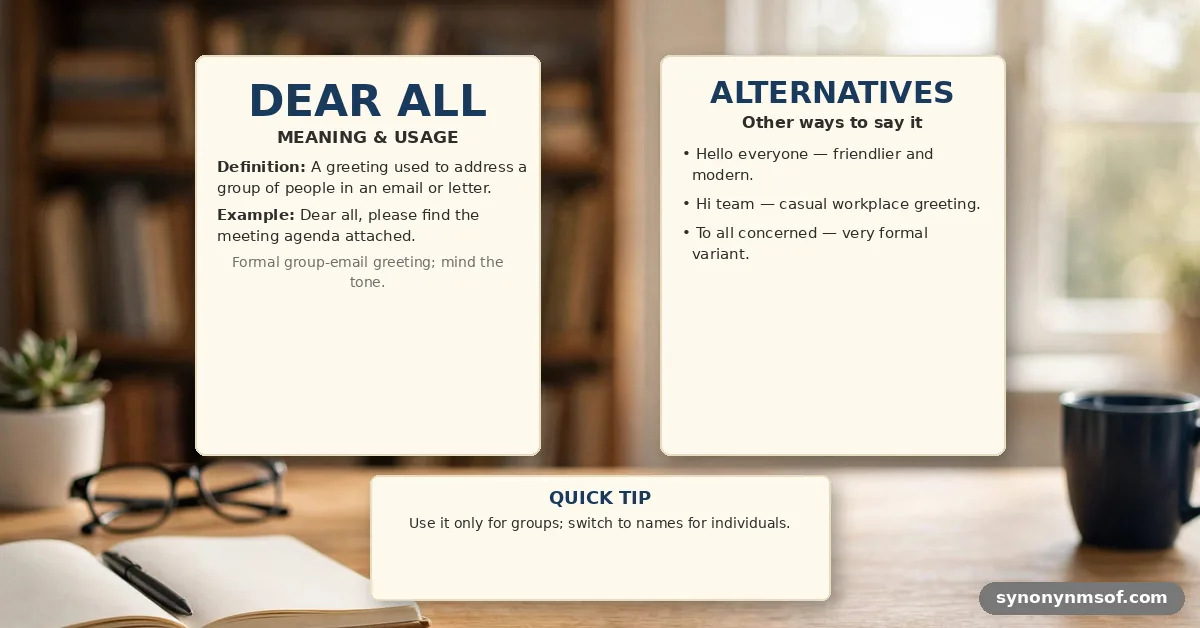

Using Dear All as a salutation in a professional email is a common practice, yet it often sparks debate regarding its tone and appropriateness. This opening addresses a group of recipients collectively, serving as a neutral placeholder when you don’t want to list individual names or use a highly formal title. Understanding when this greeting works and when it falls flat is essential for effective workplace communication.
You will learn how to balance efficiency with politeness, ensuring your correspondence reflects the right level of respect for your audience. By mastering these nuances, you can avoid common pitfalls that might make your emails seem impersonal or overly casual in high-stakes environments.
What Dear All Actually Means
At its core, the phrase functions as a collective noun for your recipients. It signals that the information contained within the message is intended for every person included in the address field. Unlike a specific name, it doesn’t build a personal rapport, but it provides a clean, functional start to a group notification.
The word dear in this context is an adjective of address, meant to convey courtesy rather than genuine affection. When you use it, you are following a standard convention of business correspondence. It signals that you are addressing a professional group, effectively replacing the need to type out dozens of individual names.
The Role of Collective Greetings

Collective greetings are designed to save time while maintaining a baseline of professional decorum. In high-volume environments, efficiency is often a primary goal of written communication. However, relying too heavily on generic openings can sometimes strip a message of its human element.
Think of it as a tool for mass distribution. When you need to update an entire department or project team, the speed of delivery matters. You aren’t necessarily aiming for intimacy; you are aiming for clarity and inclusion so that every recipient knows they are being addressed.
When to Use This Salutation
Choosing the right greeting depends entirely on your company culture and the specific project at hand. In fast-paced, internal environments where quick updates are the norm, this phrase is widely accepted. It works best for routine announcements, meeting reminders, or project status updates that require broad visibility.
Consider the hierarchy and the nature of the relationship before hitting send. If you are writing to a client you haven’t met, or to a senior executive, you might want to opt for something more specific or formal. The goal is to match the tone of your message to the expectations of your audience.
- Internal team status reports where everyone already knows the sender.
- Broad company-wide announcements regarding policy changes or events.
- Quick updates sent to established, familiar project groups.
- Instances where the list of recipients is too long for individual salutations.
Comparing Professional Email Greetings
Different situations call for different levels of formality. While some people find the term convenient, others prefer alternatives that sound less detached or more inclusive. Understanding how these options stack up can help you refine your professional voice.
| Greeting | Formality Level | Best Use Case |
|---|---|---|
| Dear All | Moderate | Internal team updates |
| Dear Team | Professional | Project-focused communications |
| Hi Everyone | Casual | Informal office chat |
| Dear [Name] | High | Individual or external emails |
| Greetings | Neutral | Broad, impersonal announcements |
Why Some People Dislike the Phrase
The primary criticism leveled against this specific greeting is that it feels impersonal or lazy. Some recipients feel that grouping them under a broad, generic label diminishes the importance of their individual contribution. If a message is highly sensitive or requires personal accountability, a blanket term can feel dismissive.
Furthermore, some linguists argue that the word dear is inherently affectionate, making it a strange fit for a cold, mass-distributed email. When you use it to address a group of fifty people, the word loses its personal weight. This leads to a perception of “template” communication rather than genuine engagement.
Addressing the Perception Gap
If you are worried about how your email will be received, look at the subject matter. If you are delivering difficult news, a generic group greeting might come across as uncaring. In those cases, taking the extra time to craft a more personal opening shows respect for the recipients’ time and emotional state.
Context is everything. A quick “Hello everyone” or “Hi team” often feels warmer and more natural than “Dear All.” If you want to convey a sense of professional collegiality, these alternatives are often safer bets in modern corporate culture.
Alternatives for Better Communication
If you feel that the phrase isn’t quite right for your audience, you have several excellent alternatives. The best replacement is usually one that reinforces the identity of the group. For instance, addressing a project group as “Dear Project Team” creates an immediate sense of shared purpose.
Another option is to drop the salutation entirely if the email is part of an ongoing thread. Once a conversation is established, jumping straight into the content is often preferred. This keeps the thread moving quickly and avoids the repetitive nature of adding a greeting to every single reply.
Refining Your Tone

You can also use a simple “Hello” or “Good morning” to start your email. These are neutral, professional, and lack the baggage associated with more traditional, rigid phrases. They allow you to sound like a person communicating with other people, rather than a system sending out a broadcast.
According to research on communication etiquette from the Grammarly writing guide, clarity and audience awareness are the two most important factors in professional emails. Always prioritize the recipient’s experience over the convenience of a standardized greeting.
Common Pitfalls in Group Emails
One major mistake is using a group greeting when the message is only relevant to one or two people on the list. This creates “email clutter” and can lead to people ignoring your messages in the future. Always ensure that your recipient list matches the scope of your message.
Another pitfall is using a formal greeting like “Dear All” alongside a very casual or sloppy body text. The mismatch in tone can be jarring for the reader. If you want to use a formal opening, ensure the rest of the email maintains a similar level of professionalism and care.
Managing Large Distribution Lists
When you are sending to a large group, the greeting is only one part of the equation. You should also consider using the BCC field if the recipients don’t need to see each other’s email addresses. Protecting privacy is a key aspect of professional digital communication.
If the group is large, you might also consider whether an email is the right medium at all. Sometimes a shared document, a message on a project management platform, or a brief meeting is more effective than a long, mass-distributed email thread that nobody reads.
When to Avoid Formal Greetings Entirely
In modern, flat-hierarchy organizations, overly formal language can sometimes create unnecessary distance. If your company culture emphasizes collaboration and transparency, you might find that “Dear All” feels stuffy or outdated. In these environments, simple greetings are often preferred.
Consider the urgency of your message as well. When you need someone to act immediately, a long-winded or overly formal greeting can delay the point of the email. Keep it brief, get to the request, and make sure your call to action is clear and easy to find.
Cultural Nuances in Global Communication
If you are working with international teams, the perception of “Dear All” can shift significantly. In some cultures, formal address is expected and omitting it is considered rude. In others, being too formal can be seen as an attempt to create social distance or hierarchy.
When in doubt, observe how your colleagues communicate with one another. If your manager or peers use a specific style, adopting a similar tone helps you fit into the existing team dynamic. Flexibility is a key trait of a skilled communicator in any global organization.
FAQ
Is it considered impolite to use Dear All?
It is generally not considered impolite, but it is often viewed as generic or impersonal. In very formal settings or when addressing high-level stakeholders, it is usually better to use a more specific or tailored greeting to show you value the individual recipients.
What is a better alternative for a project team?
Addressing the group by their specific role or project name, such as “Dear Project Alpha Team” or “Hello Team,” is almost always superior. It reinforces the purpose of the email and acknowledges the specific relationship you have with those people.
Can I use Dear All in an email to a client?
It is generally advised to avoid this in client-facing communications. Clients usually prefer to be addressed by name, or if you must address a group, use something that sounds more collaborative and less like a mass-distributed broadcast.
How do I handle the greeting in an ongoing email thread?
In an active, ongoing thread, you can often skip the salutation entirely after the first message. If you feel you must include one, a simple “Hi everyone” or even just “Hello” is sufficient to acknowledge the participants without being overly repetitive.
Conclusion
Mastering the use of professional greetings is about understanding your audience and the context of your message. While phrases like Dear All are a common, functional choice for quick internal updates, they should not be your default for every situation.
You should always strive to balance the efficiency of your communication with the need to show respect for your colleagues and clients. By choosing more specific or warmer alternatives when the situation allows, you demonstrate a higher level of awareness and professionalism in your daily work.
Take a moment before you send your next group message to consider who is reading it and what tone you want to set. Whether you stick with a standard greeting or switch to something more personal, your attention to detail will be noticed. Keep experimenting with different expressions to find the balance that best suits your unique professional voice and team culture.