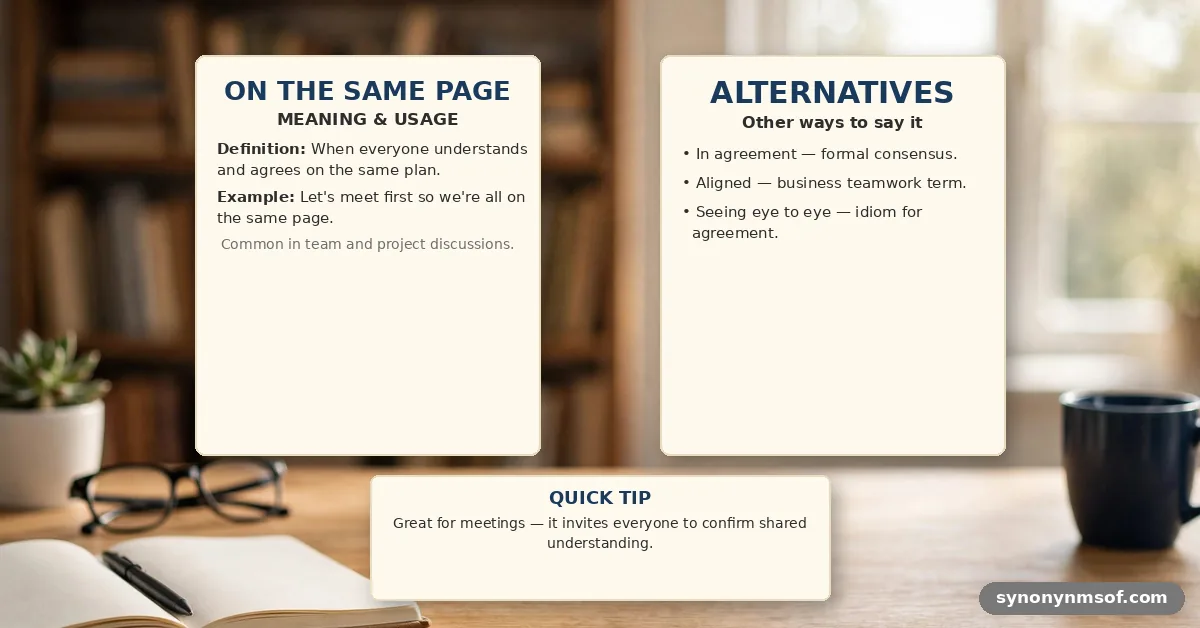

Being on the same page means that everyone involved in a discussion or project shares an identical understanding of the goals, expectations, and facts. When you find yourself in a meeting where colleagues have conflicting interpretations of a deadline, you realize immediately that the team is not on the same page.
Achieving this alignment is essential for smooth collaboration and avoiding the frustration of miscommunication. Whether you are managing a complex project or simply trying to coordinate plans with a friend, knowing how to express this concept effectively helps you ensure that everyone is working from the same source of truth.
The phrase originates from the practice of using a shared document or script. If everyone in a room holds a copy of the same text—the same page—they can follow the speaker or the instructions without ambiguity. While it is a common metaphor in modern business, its roots reflect the simple reality of needing a common reference point.
When people say they want to get on the same page, they are signaling a desire for clarity. It is a request to pause, confirm facts, and align perspectives before moving forward. Without this alignment, organizations often waste time correcting errors that stemmed from a simple misunderstanding of the initial directive.
Contexts for Use

You will hear this expression in almost every professional setting. It is particularly valuable during the kickoff phase of a project, where establishing clear boundaries and deliverables is paramount. If you are leading a team, asking if everyone is on the same page is a polite way to solicit questions or concerns before the work begins.
Beyond the office, the phrase works well in personal relationships. If two people planning a vacation have different expectations about the budget or the itinerary, they are clearly not on the same page. Using this language can de-escalate tension by framing the disagreement as a lack of information rather than a personal conflict.
Common Synonyms
English is rich with ways to express the need for consensus. Depending on your audience, you might choose a phrase that sounds more formal or one that feels more casual.
- In sync: Useful for describing a team that is working together effortlessly.
- Aligned: A more corporate term that emphasizes strategic agreement.
- On the same wavelength: Implies a deeper, almost intuitive level of understanding.
- Of the same mind: Suggests that people have reached a similar conclusion through thought.
- In agreement: A direct, no-nonsense way to state that everyone is satisfied.
Examples in Conversation
Seeing the phrase in action helps you understand its versatility. You can use it as a question to check for understanding or as a statement to confirm existing solidarity.
In a Professional Setting
If you are a manager, you might say: “Before we finalize the budget for the summer quarter, I want to make sure we are all on the same page regarding our primary goals.” This invites feedback and ensures no one feels left out of the decision-making process.
In a Relationship Context
When discussing long-term plans with a partner, you might say: “I think it is important that we get on the same page about where we want to live next year.” This creates a safe space for both parties to share their desires without the pressure of an immediate argument.
Comparison of Alignment Terms
Choosing the right expression depends on the level of formality you need. The following table provides a quick guide for selecting the most appropriate term for your situation.
| Phrase | Tone | Best Used For |
|---|---|---|
| On the same page | Casual/Professional | General check-ins |
| Fully aligned | Formal | Strategy meetings |
| In lockstep | Formal | Rigid procedures |
| On the same wavelength | Casual | Creative collaboration |
Why Misalignment Happens
Misalignment often occurs because people process information through different lenses. One person might focus on the deadline, while another focuses on the quality of the output. When these two people start a conversation, they are already working from different priorities.
Language barriers or differences in industry jargon can also create distance. If you are learning English, you might find that idioms like this one are confusing at first because they do not translate literally. Taking the time to define terms at the start of a project prevents these small gaps from becoming massive obstacles later on.
Strategies for Alignment
If you realize that your team is drifting apart, you need to take active steps to bring them back together. Start by summarizing the core objective in a few simple words. Ask each person to explain their understanding of the next steps.
Documenting these agreements is just as important as speaking them. Sending a follow-up email that outlines the points of consensus ensures that everyone has a physical record to check. When you have a written reference, it is much harder for a project to veer off course.
FAQ
Is it on the same page or in the same page?
The correct idiom is always “on the same page.” Using “in” is a common error, likely caused by the fact that we read things “in” a book. However, the metaphor refers to the page as a surface upon which the information is printed, making “on” the natural choice.
What does it mean if someone says we are not on the same page?
This is a polite way of saying that you have a misunderstanding or a fundamental disagreement. It is not necessarily an accusation of incompetence. Instead, it serves as a prompt to stop and clarify the situation before moving forward.
How do I ask if someone agrees without using the idiom?
If you want to vary your vocabulary, you can ask, “Do we have a shared understanding of this?” or “Are we in agreement on these points?” These alternatives are just as effective and help you avoid repetitive language in your daily conversations.
Can this phrase be used in formal writing?
Yes, it is acceptable in most professional communication, including emails and project reports. While it is an idiom, it is widely recognized and carries a professional tone that emphasizes cooperation and collective focus.
Conclusion
Mastering the use of this idiom allows you to navigate complex social and professional interactions with greater ease. Whether you are trying to get a team to cooperate or seeking clarity in a personal discussion, knowing how to ensure everyone is on the same page acts as a foundation for success. By choosing the right words and checking in with others, you minimize the risk of confusion.
Remember that clear communication is a skill that requires constant practice. As you learn English or refine your existing speaking habits, focus on how these small phrases help connect people.
Try using these alternatives in your next meeting to see how they impact your team’s efficiency. You will likely find that being proactive about alignment saves you significant time in the long run.
SEO Title: On the Same Page: Meaning & Usage Examples
Meta Description: Learn the true meaning of being on the same page. Explore examples, synonyms, and tips for using this common idiom in professional and personal settings.
Suggested URL Slug: on-the-same-page-meaning-examples
Primary Keyword: On the same page
Secondary Keywords: idioms, learn english, english language, conversations, professional communication