
Receiving an expression of empathy or interest from a colleague, client, or friend often leaves people searching for the right words to respond. When you hear or read the phrase thank you for your concern, it is usually a sign that someone is acknowledging a difficult situation you have faced or a challenge you are currently navigating.
Understanding how to handle this interaction helps you maintain professional boundaries while showing genuine appreciation for the other person’s kindness. This guide provides the clarity you need to craft thoughtful responses in any setting.
Knowing exactly how to react to this sentiment ensures you don’t come across as dismissive or overly formal when someone reaches out. Whether the message arrives via email during a project delay or in person after a personal setback, your response defines the quality of your connection. You will learn how to balance professional distance with personal gratitude using the examples provided below.
Understanding the Meaning and Context

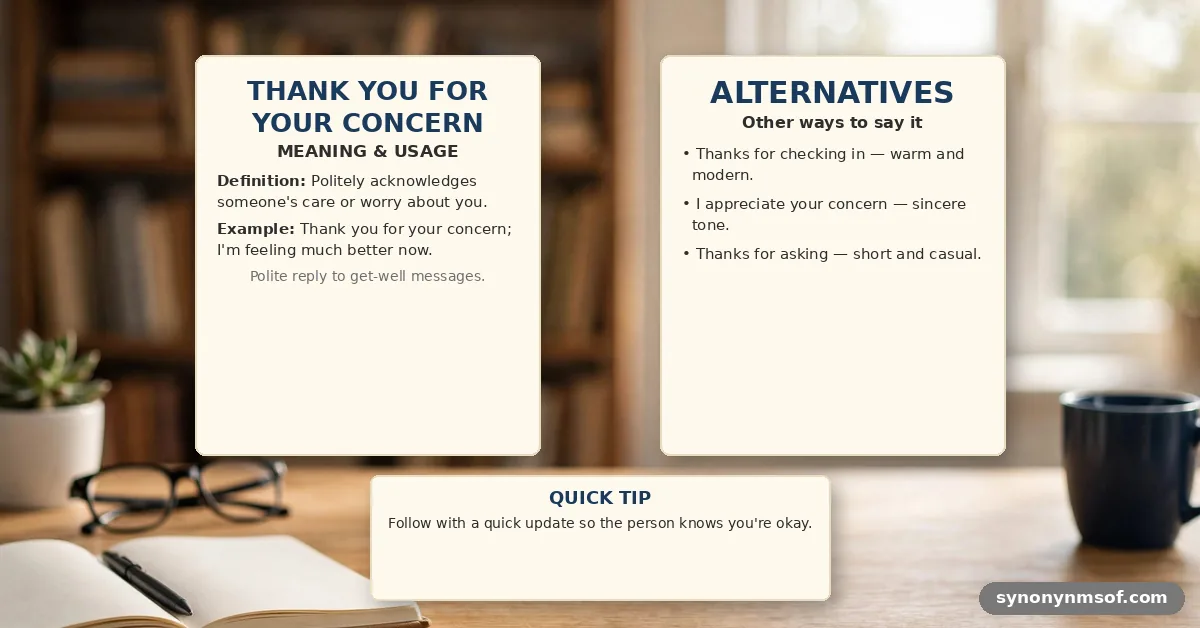
The core meaning of this phrase is an acknowledgment of your well-being or the status of a situation that caused worry. It is not always a formal corporate statement; it is often a human-centric way to signal that someone is watching out for you. When a colleague says this, they are validating that your current struggle is visible and that they recognize its impact on you.
When to use this expression
You should use this phrase when you want to show that you have heard someone’s inquiry about a problem. It serves as a bridge between the acknowledgment of a negative event and the transition back to standard business or personal topics. By using it, you show that you are receptive to their empathy without necessarily needing to disclose more details.
In a professional environment, the phrase acts as a buffer. It prevents the conversation from becoming too heavy while still allowing for a brief moment of shared human experience. It is particularly useful when you want to signal that you are handling the issue and prefer to move forward with the task at hand.
The Nuance of Tone and Intent
The tone of your response is just as important as the words themselves. If you are replying to a supervisor, your response should lean toward the professional and brief. If you are replying to a close mentor or friend, you have more room to express your feelings and explain your current state.
Why gratitude matters
Expressing that you appreciate the sentiment is the most vital part of the exchange. Even if you do not want to discuss the details of your situation, acknowledging that the person took the time to care strengthens your relationship. A simple, sincere thank you is often enough to satisfy the social contract of the interaction.
Sometimes, the concern might feel intrusive if it comes from someone you do not know well. In these instances, keeping your response short and neutral is the best use of your words. You can acknowledge the kindness without inviting further questioning, which keeps your personal life private while remaining polite.
Categorized Examples for Professional Use
Depending on the situation, you may need to vary your response. Below are several ways to acknowledge someone’s care while maintaining the right level of formality for the workplace.
- Direct and Professional: “Thank you for your concern regarding the project delay; I am working to resolve it by tomorrow.”
- Warm and Appreciative: “I truly appreciate you reaching out and checking in on me during this busy week.”
- Brief and Neutral: “Thank you for the kind words; I am managing the situation and will keep you updated.”
- Collaborative: “Your support means a lot to me right now, and I am grateful for your understanding.”
Comparing Response Styles
Choosing the right response depends largely on your relationship with the sender and the urgency of the situation. This table helps you identify which response style fits your current needs.
| Recipient | Tone | Recommended Focus |
|---|---|---|
| Senior Management | Formal/Concise | Status updates and progress |
| Direct Coworker | Friendly/Open | Mutual support and clarity |
| Client | Professional/Reassuring | Resolution and confidence |
| Close Peer | Personal/Sincere | Gratitude and connection |
Common Mistakes to Avoid
One common error is over-explaining your situation in a professional email. When someone expresses concern, they are often performing a polite gesture rather than asking for a full report on your personal life. Keep your response focused on the professional impact, not the emotional details, unless you are speaking with a trusted confidant.
Another mistake is failing to respond at all. Even if you are busy, a quick sentence acknowledging the message prevents the sender from feeling ignored. Silence in response to a kind inquiry can be perceived as coldness, which might damage your working relationship over time.
How to Pivot Back to Business
After acknowledging the concern, you should naturally transition back to the main topic. This shows that while you value the person’s care, you are also focused on your responsibilities. Using a bridge phrase like “moving forward” or “regarding the next steps” helps you shift the conversation without feeling abrupt.
For instance, if a colleague asks about a mistake you made, you might say, “Thank you for your concern about the error. I have identified the cause and am implementing a fix now.
Let’s look at the revised timeline.” This approach addresses their input while signaling that you are in control of the situation.
FAQ
Is it proper to say thank you for your concern?
Yes, it is a standard and polite way to acknowledge someone’s empathy. It is widely accepted in both verbal and written communication as a respectful way to close a topic that involves a problem or challenge.
What is the best way to express urgency politely?
If you need to show that a situation is serious, pair your gratitude with a brief status update. For example, “I appreciate your concern; I am currently prioritizing this issue to ensure it is resolved by the end of the day.”
What is the difference between at your earliest convenience and as soon as possible?
While often used interchangeably, “at your earliest convenience” is softer and more polite, whereas “as soon as possible” carries a sense of immediate demand. In the context of responding to concern, you rarely need to use these; instead, focus on clear, appreciative language.
Should I explain why I am struggling when someone expresses concern?
You are not obligated to provide a detailed explanation. If you feel comfortable, a brief summary is fine, but in a professional setting, keeping your response focused on the work is usually the safest and most effective strategy.
Maintaining Professional Connections
Mastering how to respond when someone offers thank you for your concern allows you to navigate the workplace with grace and clarity. By choosing words that reflect your appreciation while maintaining appropriate boundaries, you foster a culture of mutual respect and support. Remember that these small interactions are the foundation of healthy professional relationships, so take a moment to be thoughtful in your reply.
As you move forward, consider how you can use these expressions to build stronger ties with your team. Whether you are providing a quick update or simply acknowledging a kind gesture, your ability to communicate effectively will always be an asset. Stay mindful of your tone, keep your focus on the professional context, and you will find that these exchanges become a natural part of your daily communication.
SEO Title: Thank You for Your Concern: Meaning & Examples
Meta Description: Learn the meaning of thank you for your concern and how to use it properly. Get examples of professional responses for emails and workplace conversations.
Suggested URL Slug: thank-you-for-your-concern-meaning-examples
Primary Keyword: Thank You for Your
Primary Keyword: Thank You for Your Concern
Secondary Keywords: meaning, example, professional, appreciate, tone, gratitude, formal