
Understanding the phrase “this is to inform you”—its meaning and email examples—is essential for anyone aiming to project authority and clarity in a corporate setting. Many people rely on this opening to signal that an official update or a formal notification is forthcoming.
While it remains a staple in business correspondence, its effectiveness depends heavily on the context of the message and the relationship between the sender and the recipient. By mastering these nuances, you will avoid sounding overly robotic while maintaining the gravity required for important professional announcements.
This guide breaks down exactly when to use this phrasing and provides concrete templates to ensure your communication lands correctly. We will look at why specific word choices change the tone of your message, helping you write emails that are both respectful and efficient.
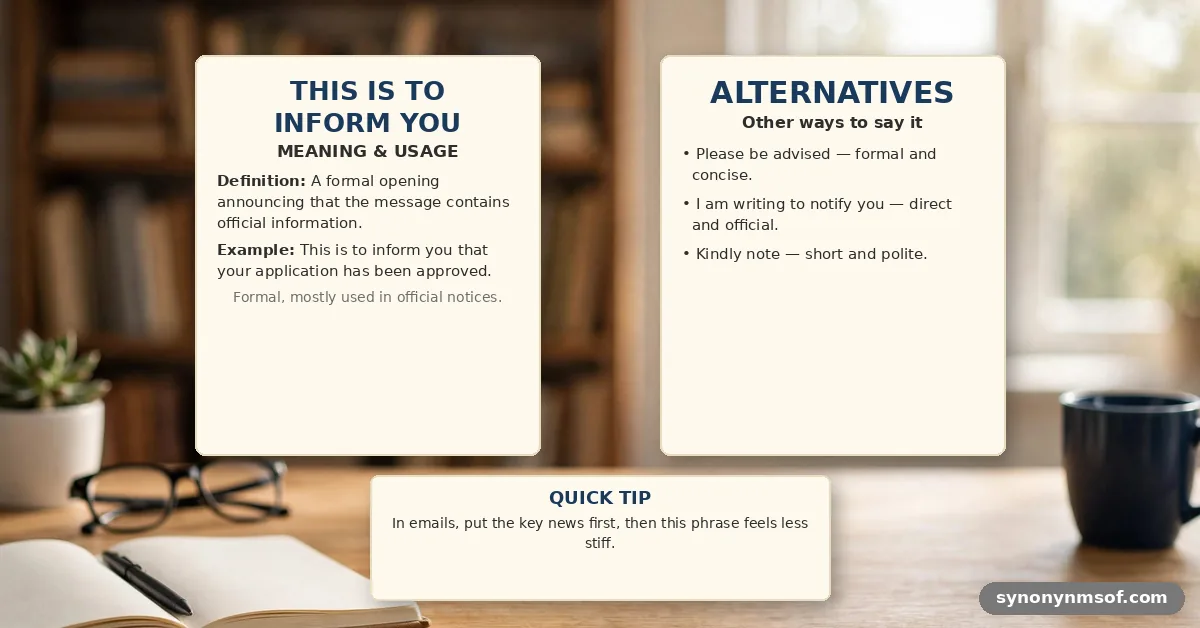
At its core, the phrase “this is to inform you” serves as a formal signpost. It tells the reader that the content following the opening is factual, objective, and typically non-negotiable. It lacks the conversational warmth of an invitation or a request, making it ideal for policy changes, status updates, or administrative notices.
Using this phrasing creates a buffer between the sender and the news. It is a way to depersonalize information, which is particularly useful when delivering news that might be perceived as neutral or slightly negative. It signals that the sender is acting as a conduit for information rather than expressing a personal opinion.
However, you should exercise caution. Overusing this opening can make your emails feel cold or excessively bureaucratic.
If you are writing to a close colleague or a long-term client, the formality might create an unnecessary distance. Use it when the primary goal is to ensure the reader understands that an event has occurred or a decision has been finalized.
When to Use This Formal Opening

You should reach for this specific phrasing when the stakes are high or the subject matter is strictly professional. It is most effective in scenarios involving compliance, legal updates, or official company-wide announcements. In these instances, clarity and a lack of ambiguity are far more important than building rapport.
Consider the following situations where this formal structure adds value:
- Policy Changes: Announcing new HR guidelines or updated office safety protocols.
- Contractual Notifications: Reminding a client of an upcoming renewal date or a change in service terms.
- Project Milestones: Informing stakeholders that a specific phase of a project has reached completion.
- Regulatory Compliance: Notifying authorities or partners of required filings or audit results.
If you are simply asking for a favor or checking in on a project, avoid this opening. It can sound stiff or even intimidating in a casual setting. Reserve it for times when you need the reader to take your message seriously and treat the information as a matter of record.
Email Examples for Different Scenarios
The following table demonstrates how to adapt the opening depending on the nature of the information being shared. Notice how the surrounding context shifts to accommodate the formality of the initial statement.
| Scenario | Recommended Opening | Contextual Tone |
|---|---|---|
| Policy Update | “This is to inform you of a change in our remote work policy.” | Authoritative and direct |
| Deadline Extension | “This is to inform you that the submission deadline has been moved.” | Helpful and informative |
| Service Disruption | “This is to inform you of scheduled maintenance on our servers.” | Apologetic but professional |
| Meeting Confirmation | “This is to inform you that your registration for the summit is confirmed.” | Transactional and clear |
Alternatives to “This Is to Inform You”
Sometimes, the phrase sounds too rigid for the desired outcome. If you want to maintain professionalism while appearing more approachable, consider using variations that soften the delivery. Language is flexible, and your choice of words can dictate how the recipient reacts to your news.
Try these alternatives when you want to sound more collaborative:
- “I am writing to update you on…” – This implies a ongoing relationship and suggests you are keeping them in the loop.
- “I wanted to let you know that…” – This is the most versatile option; it works in almost every professional context without being cold.
- “We are pleased to inform you…” – Use this only for positive news, such as a promotion or a successful application.
- “Please be advised that…” – This is a direct, slightly more legalistic alternative often used in finance or real estate.
Each of these options serves a different purpose. If you are delivering difficult news, “I regret to inform you” remains the standard, though it is often better to lead with empathy. Always consider the recipient’s perspective before hitting send.
The Importance of Conciseness

One of the main reasons people use “this is to inform you” is that it gets straight to the point. In a busy office, clarity is a form of respect. By stating your purpose immediately, you allow the reader to prioritize your email correctly.
Avoid burying the lead after your opening sentence. If you start with a formal announcement, follow it immediately with the “what,” “when,” and “how” of the situation. Extra fluff or long-winded explanations can dilute the impact of your message.
Consider the biblical principle of brevity found in the book of Ecclesiastes. In Ecclesiastes 5:2, it is noted that one should not be hasty with words, for God is in heaven and you are on earth; therefore, let your words be few.
This wisdom applies perfectly to modern email communication. Keep your message focused, relevant, and brief.
Addressing Negative News
Delivering negative news requires a delicate touch. While “this is to inform you” is a standard way to start such an email, it can feel like a cold slap in the face if not handled correctly. When you must use this opening for bad news, ensure the rest of the email provides context or a path forward.
If you are informing a candidate they didn’t get a job, for example, the opening might be: “This is to inform you that we have decided to move forward with another candidate.” Immediately follow this with a sentence of genuine appreciation for their time. Do not leave the reader hanging in a state of cold, clinical rejection.
Always offer a reason, if possible, or a next step. If the news is final and non-negotiable, be clear but kind.
Transparency is usually better than ambiguity, even when the news is disappointing. The goal is to inform without being unnecessarily harsh.
Refining Your Email Tone
Tone is the invisible layer of your writing. Even when using formal language, you can signal whether you are helpful, neutral, or firm. Using “this is to inform you” automatically sets a serious tone, so you must balance that with the rest of your message.
If your goal is to be helpful, ensure your email includes a call to action or contact information for questions. If your goal is to be firm, keep the language simple and avoid over-explaining your reasoning. The more you explain, the more room you leave for the reader to argue.
Consider the audience’s level of seniority. When writing to a superior, keep the formality high and the length short.
When writing to a team you manage, you can afford to be more conversational after the initial, necessary formal opening. Adjusting your tone to your audience is a sign of high emotional intelligence in the workplace.
Avoiding Common Mistakes
Many writers fall into the trap of using this phrase when it isn’t necessary. For instance, emailing a coworker to say, “This is to inform you that I am going to lunch,” sounds absurdly stiff. Reserve this language for information that actually requires a formal record.
Another common mistake is mixing formal openings with overly casual slang. If you start with “This is to inform you,” do not follow it up with “Hope you’re doing good, LOL.” The clash in tone will make you appear unprofessional and confused about your own message.
Finally, ensure your subject line matches the formality of your email body. If you are sending an official notification, the subject line should be equally clear and descriptive. A vague subject line combined with a formal opening creates frustration for the recipient.
The Role of Clarity in Correspondence
Clarity is the ultimate goal of any professional email. Using standard, recognizable phrases like “this is to inform you” helps because readers know exactly what to expect. There is no guesswork required to understand that a statement of fact follows.
However, clarity also means avoiding jargon or overly complex sentence structures. Even when being formal, keep your grammar simple and your sentences direct. The best professional communication is transparent and easy to digest.
Think about how your email will be read on a mobile device. Most people skim their inboxes while on the go.
If your opening is formal and your next paragraph is a wall of text, the reader will likely skip the important details. Keep your paragraphs short and your points bulleted whenever possible.
When to Use Passive vs. Active Voice
The phrase “this is to inform you” is inherently passive. It focuses on the act of informing rather than the person doing the informing. In some cases, this is exactly what you want, especially if you are speaking on behalf of a large organization.
If you want to take personal responsibility or show leadership, you might switch to active voice. For example, “I am writing to inform you” clearly identifies you as the sender. This small change makes the email feel more personal and accountable.
Decide whether you want the focus to be on the company’s message or your personal action. For routine updates, passive or semi-passive is often fine. For critical or sensitive issues, taking ownership via the active voice is usually the better, more courageous choice.
Professionalism and Etiquette
Maintaining professional standards does not mean you have to be robotic. You can be polite and formal at the same time. The best emails are those that respect the reader’s time and intelligence.
Always include a professional salutation and sign-off when using formal openings. “Dear [Name]” and “Sincerely” or “Best regards” complement the formal tone of “this is to inform you.” Using an opening that sounds like a legal brief and then signing off with “See ya” creates a jarring experience for the reader.
Consistency is key to building a professional reputation. If you consistently write emails that are clear, formal, and respectful, people will learn to pay attention when they see your name in their inbox. This is a subtle but powerful way to command respect in a corporate environment.
FAQ: Common Questions About Formal Emailing
Is it ever okay to shorten this phrase?
Yes, in many cases, you can simply remove the “This is to” part and start with “I am writing to inform you.” This feels slightly more active and personal while maintaining the same level of professional gravity.
What if the recipient doesn’t respond?
If you have used a formal opening to convey critical information, follow up after a reasonable time. You can say, “Following up on my previous email regarding [Topic], I wanted to ensure you received the information.” This maintains your professionalism while pushing for a necessary response.
Should I use this phrase in a cover letter?
Generally, no. Cover letters are meant to be persuasive and engaging.
Using such a stiff, passive opening can make you sound like a form letter rather than a passionate candidate. Use active, engaging language instead.
Is this phrasing considered outdated?
While some modern startups prefer a very casual tone, this phrasing is not outdated in traditional industries like law, finance, or government. It is a timeless way to signal that you are providing an official update. It will always have a place in professional communication.
Can I use this for internal team updates?
You can, but use it sparingly. If you use it for every minor update, it loses its impact. Save it for significant changes, such as a shift in project direction or a new team structure, to ensure your team knows when to pay extra attention.
Conclusion
Mastering the use of “this is to inform you”—and understanding the meaning and email examples associated with it—is a vital skill for anyone navigating the professional world. It is a powerful tool when used correctly, offering clarity and authority that casual language simply cannot match. By selecting the right moments to employ this formal opening and pairing it with clear, concise follow-up sentences, you demonstrate a high level of professional awareness.
Remember that the ultimate goal of any email is to be understood, so prioritize clarity above all else. Use these templates as a starting point, but always tailor your words to fit the specific situation and the person on the other end of the screen.
Start applying these strategies today by reviewing your recent sent items. See where you could have been more direct or where a formal opening might have improved the clarity of your message.
As you refine your approach, you will find that your communication becomes more efficient and your professional presence more commanding. Keep practicing, and don’t be afraid to keep your emails short, sharp, and focused on the facts at hand.