
Understanding the phrase “I hope” reveals a deep-seated human desire for a positive outcome, though its frequent use often dilutes the strength of your communication. By exploring I hope: meaning, examples, and better alternatives, you can refine how you express your intentions and desires in both personal and professional settings. This article provides a clear breakdown of why this common phrase can sometimes sound passive or uncertain.
You will learn to identify specific contexts where stronger, more assertive language leads to better results. Mastering these nuances allows you to take control of your narrative and ensure your words carry the weight and clarity you intend.
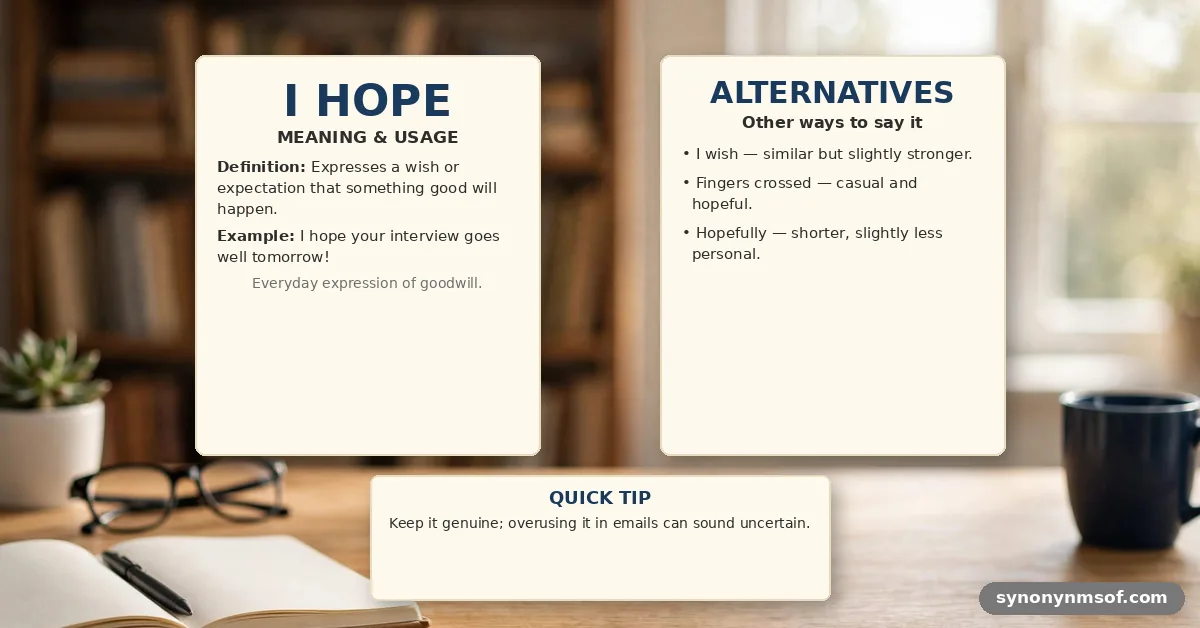
At its core, “I hope” functions as a bridge between the present moment and a desired future state. It expresses a wish for something to happen without a guarantee of control or certainty. Linguistically, it shifts the focus from the speaker’s agency to the whims of circumstance.
When you use this phrase, you are technically stating an emotional preference rather than a commitment. In many social contexts, this is perfectly acceptable and even polite. However, in environments where leadership and reliability are paramount, “I hope” can inadvertently signal a lack of preparation or confidence.
The meaning of the phrase is essentially “I desire a specific outcome.” While it is not inherently negative, it often lacks the structural integrity of a plan or an expectation. Recognizing this distinction is the first step in upgrading your vocabulary to better reflect your true intentions.
Common Examples of Usage
People use “I hope” in a wide variety of daily interactions, ranging from casual check-ins to high-stakes business negotiations. Understanding these patterns helps you spot where you might be underselling your own authority. Consider how these common examples land on the listener.
- “I hope we can finish this project by Friday.”
- “I hope you have a great weekend.”
- “I hope to hear back from you regarding the contract.”
- “I hope the weather holds up for the event.”
In the first example, the speaker is expressing a deadline expectation. By framing it as a hope, they leave the door open for the project to be delayed. The final example is a polite social pleasantry where the phrase is used correctly to show goodwill.
The Case for Better Alternatives
Moving beyond “I hope” requires a shift toward active verbs and direct statements. When you replace a passive wish with a concrete intention, you naturally project more competence. This transition is essential for anyone aiming to improve their communication style.
Consider the difference between “I hope to get this done” and “I am working to complete this.” The second version emphasizes your ongoing effort rather than just your desire for completion. Using stronger language creates a sense of momentum that others can follow.
The following table illustrates how to convert passive hopes into active, professional statements. Each shift moves the focus from a wish to an action or a concrete expectation.
| Passive Expression | Active Alternative |
|---|---|
| I hope we win the account. | I am confident in our proposal. |
| I hope this helps you. | I trust this provides value. |
| I hope to meet with you. | I look forward to meeting you. |
| I hope you can send it soon. | Please send it by Tuesday. |
Professional Communication Standards
In a workplace, clarity is the primary currency of trust. When you use “I hope,” you risk appearing as though you are waiting for things to happen to you. Your colleagues and clients need to know that you are a driver of results.
Instead of hoping, state your plan. If you are waiting on a response, say “I look forward to your update” or “I am waiting for your input.” These phrases are polite, firm, and leave no room for ambiguity.
Professionalism relies on the assumption of competence. By removing tentative language, you signal that you have accounted for variables and are moving toward a defined goal. This shift does not make you sound arrogant; it makes you sound prepared.
The Psychological Effect of Tentative Language
When you speak, your words influence your own internal state as much as they influence your audience. Consistently using “I hope” can reinforce a subconscious belief that your outcomes are beyond your control. This is a subtle but powerful form of self-sabotage.
Language that emphasizes agency, like “I intend to” or “I am planning,” triggers a different neural pathway. It forces your brain to consider the steps required to reach the goal. You move from the abstract realm of wishing to the practical realm of execution.
This is not about ignoring the reality that some things are truly outside your control. It is about choosing to frame your participation in a way that remains grounded in action. You can acknowledge the uncertainty of the world without sounding helpless.
Synonyms and Their Nuances
Finding the right word depends entirely on the context of your message. Sometimes, you truly do want to express a desire without asserting control, such as when you are offering support. In those instances, other words can carry the sentiment more effectively.
Words like “aspire,” “aim,” “anticipate,” or “expect” all carry different weights. “Aspire” implies a long-term goal, while “expect” implies a high degree of confidence in an outcome. Choosing the wrong synonym can change the meaning of your sentence entirely.
For example, saying “I expect a resolution by noon” is much more assertive than saying “I hope for a resolution by noon.” The former sets a standard, while the latter makes a request. Use your vocabulary with intent to shape the reality you want to create.
Biblical Perspectives on Expectation
The concept of hope in classical literature and religious texts often differs from the modern, passive usage of the word. In many ancient contexts, hope was synonymous with a firm, active trust in an outcome. It was not a wish, but a conviction.
For instance, Hebrews 11:1 in the WEB version describes faith as the assurance of things hoped for. This implies that “hoping” should be tethered to a deeper sense of certainty. When your hope is rooted in a solid foundation, it becomes a powerful driver of behavior.
Proverbs 13:12 suggests that hope deferred makes the heart sick. This emphasizes that waiting without a plan or conviction leads to frustration. By replacing passive wishes with active intentions, you align your language with a more disciplined and purposeful way of living.
When to Use “I Hope” Appropriately
Not every instance of “I hope” needs to be purged from your vocabulary. There are moments where vulnerability and shared humanity are the goals. In personal relationships, expressing a genuine wish for someone’s well-being is a sign of affection.
If you are wishing a friend luck before a surgery, “I hope everything goes well” is the perfect thing to say. It acknowledges the complexity of the situation while expressing deep care. Trying to replace this with “I expect everything to go well” would sound clinical and cold.
The key is identifying the difference between professional goal-setting and personal connection. Use active language to lead, and use “I hope” to nurture relationships. Understanding this balance is the hallmark of sophisticated communication.
The Role of Confidence in Leadership
Leaders are often judged by the certainty with which they frame the future. When a team is facing a difficult challenge, they look to their leader for a sense of direction. Saying “I hope we can succeed” often sounds like an admission of doubt.
Instead, a leader says, “We have a strategy to succeed.” The difference is the shift from a desire for the outcome to a belief in the process. People are drawn to those who sound like they have a handle on the situation.
This does not mean a leader must lie about the difficulty of a task. It means they must pivot the conversation toward the actions being taken to overcome obstacles. Confidence is contagious, and it begins with the words you choose during a crisis.
Avoiding Over-Correction
While it is important to be assertive, it is also possible to become overly aggressive. If you never use soft language, you may come across as rigid or demanding. The goal of studying I hope: meaning, examples, and better alternatives is to gain flexibility, not to lose your warmth.
If every sentence you speak is a declarative statement of fact, you will alienate those around you. People need room to breathe and express their own uncertainties. Great communication is a dance between firm leadership and empathetic connection.
Learn to layer your language. You can be firm about a deadline while still being kind about the process. “I need this by Friday, but I am here if you run into any issues” is a much better structure than “I hope you finish this by Friday.”
Strategies for Daily Practice
Changing how you speak is a habit that requires conscious effort. Start by auditing your emails before you hit send. Look for the phrase “I hope” and ask if you can replace it with something more direct.
Keep a list of phrases that feel more natural to your voice. Perhaps you prefer “I am looking forward to” or “I am planning to.” When you have a bank of alternatives ready, it becomes much easier to swap them out in real-time conversations.
You might also ask a trusted colleague to point out when you sound overly tentative. We are often blind to our own linguistic habits. External feedback is the fastest way to identify where your language might be undermining your authority.
Refining Your Personal Brand
Your language is a vital part of your personal brand. It tells people how to treat you and what to expect from your work.
If you sound unsure, people will treat you as if you are unsure. If you sound capable, people will treat you as if you are capable.
By consciously curating your words, you are designing the perception others have of you. This is not about manipulation; it is about alignment. You are ensuring that the way you speak matches the quality of the work you produce.
Consistency is key. The more you practice using active, intentional language, the more it will become your default setting. Eventually, you won’t have to think about it; you will simply speak with the clarity and confidence that your achievements deserve.
FAQ
What can I say instead of “I hope”?
Depending on your goal, you can use “I expect,” “I look forward to,” “I am planning on,” or “I intend to.” These phrases replace a passive wish with a concrete expectation or action.
Is it ever okay to use “I hope” in a professional email?
Yes, it is appropriate when expressing genuine goodwill, such as “I hope you had a restful weekend” or “I hope this email finds you well.” However, avoid using it when discussing project deadlines or deliverables.
Why does “I hope” make me sound unconfident?
It frames your desired outcome as something that might or might not happen, rather than something you are actively working to achieve. It shifts the power away from you and onto the environment.
How do I stop saying “I hope” by habit?
Start by proofreading your written communication for the phrase. In spoken conversation, pause for a second before you speak to see if you can rephrase your intent into an active statement.
What is the difference between “I hope” and “I trust”?
“I trust” implies a sense of confidence in a person or a process, whereas “I hope” implies a wish for a favorable result. “I trust” is generally stronger and more authoritative in a business context.
Conclusion
Mastering the art of direct communication is a lifelong process that pays dividends in every area of your life. By moving past the passive reliance on the phrase “I hope,” you open the door to a more assertive and intentional way of interacting with the world.
Reflecting on I hope: meaning, examples, and better alternatives allows you to reclaim your agency and project the competence that is already present in your actions. Whether you are leading a team or building personal connections, your words serve as the foundation of your influence.
Take the next step by auditing your language this week and identifying just three instances where you could be more direct. Replacing tentative wishes with clear, active intentions will transform how you are perceived and how you see yourself.
Start today by choosing one of the alternatives provided and observing the difference it makes in your results. Clear communication is the most effective tool you have for achieving your goals, so use it with purpose and watch your influence grow.