
Sending a message that says please let me know if I can be of any help is a standard professional gesture, but its effectiveness depends heavily on the context of your relationship with the recipient. While this phrasing is grammatically correct and widely accepted in corporate environments, it often functions as a polite closing rather than a genuine call to action.
You gain the most value by understanding when this phrase signals sincere availability and when it merely serves as a formal sign-off. Mastering this balance ensures your communications remain both courteous and purposeful, preventing your emails from sounding like rote, automated responses.
The short answer is yes, the phrase please let me know if I can be of any help is entirely grammatically correct in both formal and informal English. It follows standard subject-verb agreement and uses the conditional “if” correctly to introduce a hypothetical scenario. You are offering a service contingent upon the recipient’s potential needs.
Some critics argue that the phrase is slightly wordy compared to shorter alternatives like “let me know if you need help.” However, length does not equate to grammatical error in professional correspondence. In fact, the slight formality of the full phrase can signal respect when addressing a supervisor or a new client.
You should prioritize clarity over brevity when the stakes are high. If you are communicating with someone for the first time, the complete, polite version of the sentence is safer than a clipped, abrupt alternative. It establishes a tone of service-oriented professionalism that is rarely misinterpreted.
When to Use This Specific Phrasing

Context determines the weight of your offer. You should use the phrase when you have already provided a deliverable, such as a report, a completed task, or a set of instructions. It acts as a final safety net, confirming that the ball is now in the recipient’s court.
Avoid using this phrase if you haven’t actually provided anything of value yet. If you send an email saying you are available to help without first proving that you have completed your own obligations, the offer can sound performative. It risks coming across as a way to end the conversation rather than a genuine invitation for further dialogue.
Consider the following hierarchy of professional availability when deciding how to phrase your offer:
- High-stakes projects: Use “Please let me know if I can be of any help as you review these findings.”
- Routine status updates: Use “Let me know if you need anything else.”
- Internal team communication: Use “Happy to help if you run into blockers.”
- Client outreach: Use “Please let me know if I can be of any help regarding the transition.”
The Risks of Overusing Polite Fillers
Repetition is the enemy of authentic communication. If every single email you send ends with the same boilerplate offer, the recipient will eventually stop reading the final paragraph entirely. Your message becomes background noise rather than a meaningful gesture of support.
When you offer help in every message, you inadvertently suggest that you are perpetually waiting for tasks. This can diminish your authority, as it makes your time appear less occupied than it likely is. Aim to make your offers of assistance specific rather than generic.
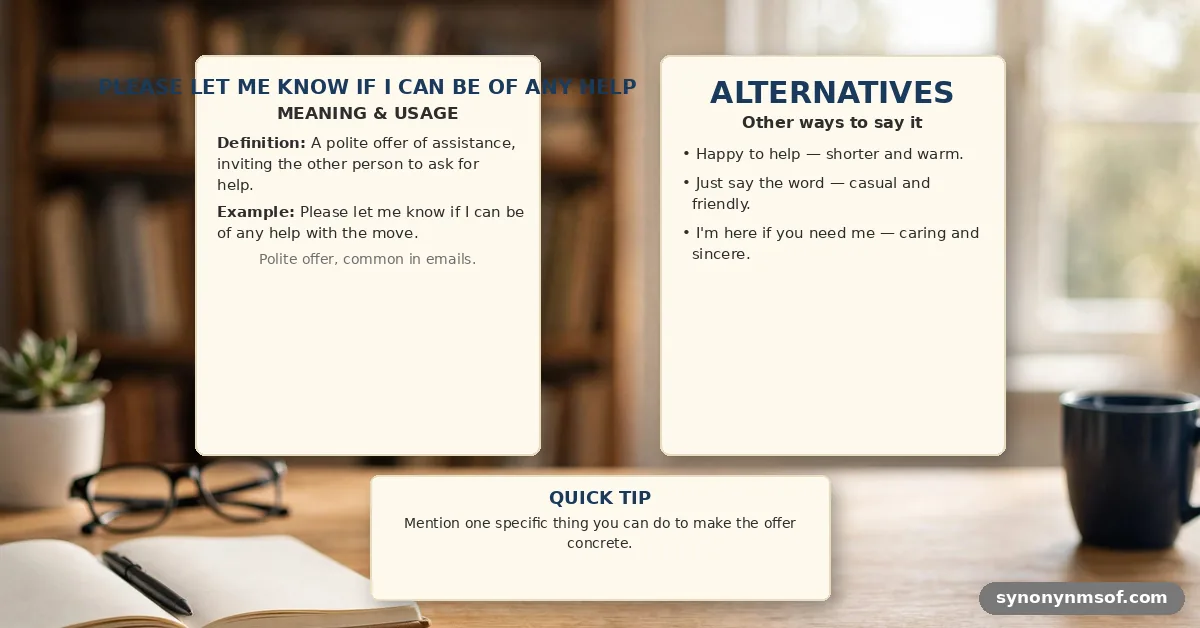
Instead of the broad, please let me know if I can be of any help, try linking the help to a specific outcome. For example, say, “I am available to walk your team through the data visualization if you have questions.” This provides a clear, actionable path for the recipient to engage with you.
Comparing Common Professional Closings
Different phrases carry different levels of urgency and intimacy. Selecting the right closing is a matter of matching your level of expertise with the recipient’s needs. The table below outlines how different phrases are perceived in a corporate setting.
| Phrase | Perceived Tone | Best Use Case |
|---|---|---|
| Please let me know if I can be of any help. | Polite, Formal | Client-facing, Senior Management |
| Let me know if you need anything. | Casual, Direct | Colleagues, Established Partners |
| I am available for further questions. | Neutral, Professional | Technical reports, Documentation |
| Feel free to reach out with updates. | Collaborative | Shared projects, Ongoing tasks |
Why Specificity Trumps General Offers
General offers of help are often ignored because they require the recipient to expend mental energy identifying what they might need. By the time they figure out what to ask you, they may have already moved on to another task. Specificity removes this friction.
If you have identified a potential pain point in a project, address it directly. You might write, “Please let me know if I can be of any help with the budget reconciliation, as I know that process is complex.” This shows that you are paying attention to their workflow.
Proactive assistance builds trust faster than reactive availability. When you anticipate a need, you demonstrate that you are a partner in the project rather than just a service provider. This shifts the dynamic from “I am here to help” to “I am here to solve this problem with you.”
The Cultural Nuance of Professionalism
Not every region or industry views polite, formal language the same way. In some high-paced environments, such as software development or startup culture, phrases like please let me know if I can be of any help may be viewed as unnecessary fluff. These cultures value brevity and directness above traditional etiquette.
Conversely, in industries like law, finance, or academic administration, formal politeness is a requirement. Using short, clipped language in these sectors can be perceived as rude or dismissive. Always assess the communication culture of your audience before defaulting to a specific style.
Research indicates that 70% of professional miscommunications stem from a mismatch in expected tone. If you are unsure, err on the side of formality. It is easier to move toward a casual tone as a relationship develops than it is to recover from an overly casual initial contact.
Biblical Perspectives on Service

The concept of offering help is deeply rooted in historical and moral frameworks. In the book of Colossians, the apostle Paul writes that whatever we do, we should do it heartily, as unto the Lord and not unto men (Colossians 3:23). This principle shifts the focus of offering help from a transactional obligation to a standard of excellence.
Similarly, in the book of Galatians, the writer encourages people to bear one another’s burdens (Galatians 6:2). This suggests that the offer to help should not be a hollow phrase, but a genuine commitment to lighten someone else’s load. When you say please let me know if I can be of any help, you are, in essence, acknowledging the weight of the other person’s task.
These ancient perspectives remind us that the words we use are secondary to the intent behind them. An offer of help is only as valuable as your willingness to follow through. If your heart is not in the service, the words will eventually ring hollow to your colleagues.
How to Follow Up After Offering Help
If you have offered your assistance and received no response, do not assume the recipient didn’t need it. They may be swamped with other priorities or may have forgotten your offer entirely. A gentle, non-intrusive follow-up is often appreciated.
Wait at least 48 hours before sending a follow-up. When you do reach out, focus on the project rather than your initial offer. For example, “I wanted to check if the team had any questions about the Q3 report I sent on Tuesday.”
This approach is more effective than saying, “Did you see my offer to help?” It refocuses the conversation on the work and demonstrates that your concern is for the project’s success. It also gives the recipient an easy opening to ask for the help you previously offered.
Drafting Emails That Get Results
Your email structure should guide the reader toward the action you want them to take. If you end with a generic offer, you are effectively closing the door on the conversation. Instead, use your closing to encourage the next logical step.
If you need feedback, explicitly ask for it. “Please let me know if I can be of any help, and specifically, I would appreciate your thoughts on the pricing section by Friday.” This provides a deadline and a focus area for the recipient.
Structure your email in three distinct parts: the context, the deliverable, and the call to action. By keeping these separate, you make it easy for the reader to scan the message and understand exactly what is required of them. This is the most efficient way to maintain a professional reputation.
Common Mistakes When Offering Assistance
One common mistake is offering help that you are not actually qualified to provide. If you offer to help with a task that requires specialized skills you do not possess, you create a liability for yourself. Be honest about your limitations, even when you want to be helpful.
Another mistake is failing to set boundaries. If you offer to help without qualification, you might find yourself flooded with requests that take you away from your core responsibilities. Always specify the scope of your help when you make the offer.
Consider the following list of common pitfalls to avoid:
- Vagueness: “Let me know if you need anything” is too broad and often leads to confusion.
- Inconsistency: Offering help and then being unreachable is worse than not offering at all.
- Performative politeness: Using formal phrases when your actions don’t match the tone.
- Ignoring urgency: Offering help when the recipient needs an immediate answer can be perceived as passive-aggressive.
The Impact of Tone on Professional Relationships
Your tone acts as a filter through which others interpret your competence. A consistently polite and helpful tone builds long-term equity in your professional relationships. It makes you the person people want to work with, even when the work itself is difficult.
However, you must be careful not to sound subservient. There is a fine line between being helpful and appearing as if you lack your own priorities. Ensure that your communications reflect a partnership rather than a hierarchy of service.
Reflect on your past emails. If you find that you are constantly apologizing or over-explaining your offers of help, you may be undermining your own authority. Confident, concise offers of help are much more effective than apologetic, long-winded ones.
Adapting for Virtual and Remote Teams
In remote work environments, communication is often the only way to establish your presence. When you are not physically present to see when a colleague is struggling, your written offers of help become vital. However, they must be frequent enough to be seen but not so frequent that they become annoying.
Use platforms like Slack or Microsoft Teams for quick, informal offers of help. Use email only for formal, project-related support. This segmentation helps your colleagues understand the urgency and nature of your offer before they even open the message.
Remember that text-based communication lacks non-verbal cues. Your offer of help might be read as sarcastic or impatient if the surrounding text is too brief. Always include enough context to ensure your tone is received as supportive and genuine.
Frequently Asked Questions
Is it ever wrong to use this phrase?
It is rarely “wrong” in a moral sense, but it can be ineffective. If you are emailing someone you have never spoken to, it can feel like a filler phrase. In those cases, a more direct approach is better.
How do I make the phrase sound less robotic?
The easiest way is to add a specific reference to the work. Instead of saying the phrase in isolation, tie it to a project. For instance, “Please let me know if I can be of any help with the final slide deck.”
What if I don’t actually have time to help?
Then do not offer. It is far better to be honest about your capacity than to offer help you cannot provide. You could say, “I am currently at capacity, but I can assist once I finish the current phase next week.”
Should I use this phrase in a text message?
Generally, no. Text messages are typically for immediate, casual communication. A simple “Let me know if you need anything” is usually sufficient and feels more natural in that medium.
Does the phrase sound too submissive?
It can, if you use it too often with a supervisor. If you feel like you are overusing it, try shifting your language to emphasize collaboration. Use “I am happy to assist with X” instead of “Please let me know if I can be of any help.”
Conclusion
Mastering the art of professional communication requires more than just knowing grammar rules; it requires an understanding of intent, context, and timing. While the phrase please let me know if I can be of any help is a reliable standby for many professionals, it should be used with intention rather than habit. By grounding your offers of assistance in specific project details and maintaining a balance between politeness and authority, you ensure that your communications remain impactful.
Take a moment to review your recent sent emails and identify where you might have defaulted to generic phrasing. Start experimenting with more specific, action-oriented offers of support.
You will likely find that your colleagues respond more quickly and with greater clarity when you define exactly how you intend to be of service. Keep your communication purposeful, and your professional relationships will surely benefit from the added precision.