
The common phrase “have a good day” serves as a ubiquitous social lubricant, yet exploring the deeper meaning, alternatives, and examples of this expression reveals much about human connection. Whether you are aiming for professional polish or personal warmth, understanding how to vary your parting words can significantly impact your daily interactions. This article provides a comprehensive look at how we exchange well-wishes and why the language we choose matters in every setting.
By examining the nuances of these social cues, you will gain the confidence to tailor your farewells to any situation. You will find that mastering these small linguistic shifts opens the door to more meaningful communication with everyone you meet.
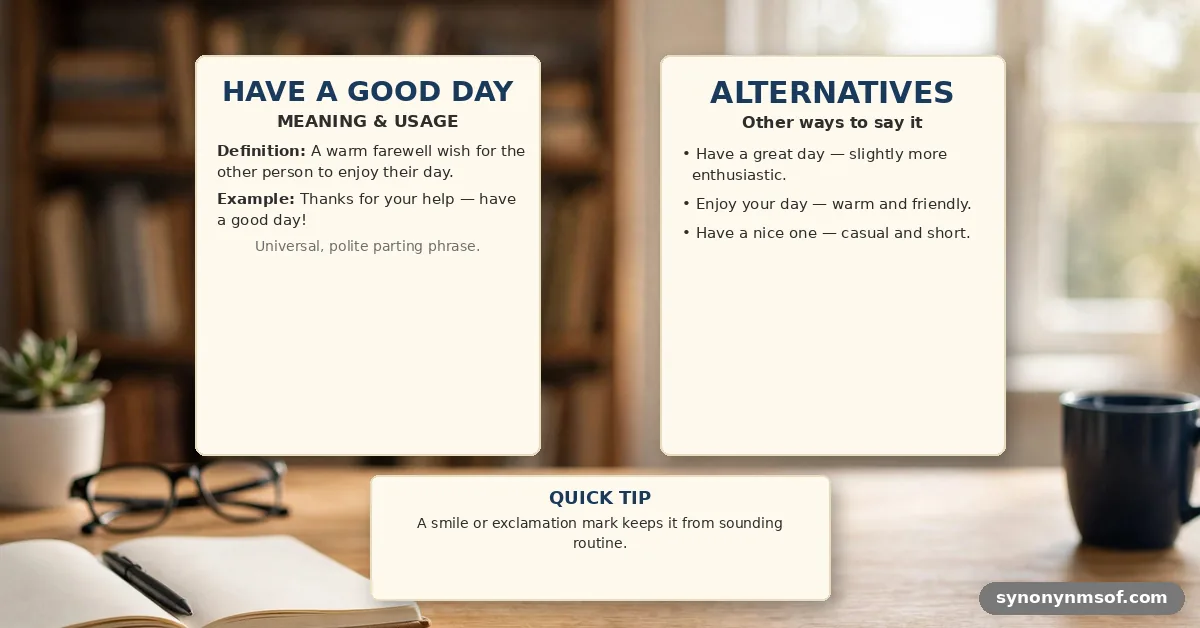
At its base, the phrase “have a good day” is a phatic expression. It functions as a ritualistic way to end a conversation without requiring a deep or detailed response. Linguists classify these remarks as social glue, designed to maintain rapport rather than to exchange specific information.
The primary intent behind the phrase is to signal benevolence. When you say it to a cashier or a colleague, you are essentially offering a brief, non-intrusive wish for the other person’s well-being. It acknowledges the end of an interaction while leaving the door open for future contact.
In many cultures, the specific choice of words acts as a barometer for the intimacy of the relationship. Using the standard version is safe and neutral, making it perfect for transactional settings. However, relying on it exclusively can sometimes signal a lack of genuine engagement or emotional depth.
Professional Alternatives for the Workplace

In a business environment, the goal is to remain polite while sounding competent and attentive. While the standard phrase is rarely offensive, it can sound repetitive if you speak to the same clients or team members daily. Replacing it with more specific language demonstrates that you are paying attention to their schedule.
If you are wrapping up a meeting, try acknowledging the work that lies ahead. Phrases like “I look forward to our next update” or “Enjoy the rest of your afternoon” feel more tailored. These variations show that you value the specific time you spent together.
Consider the following list of professional alternatives that maintain a respectful tone while sounding more intentional:
- “I appreciate your time today; talk soon.”
- “Enjoy the rest of your week.”
- “I look forward to hearing your thoughts on this.”
- “Wishing you a productive afternoon.”
- “Take care until we speak again.”
Romantic and Intimate Variations
When speaking to a partner or a close friend, the standard phrase can feel overly formal or distant. Intimacy thrives on specificity and emotional resonance. Instead of a generic well-wish, focus on the person’s specific day or your shared connection.
A simple shift can make a world of difference. For instance, saying “I can’t wait to see you later” connects the current moment to a future shared experience. This turns a standard goodbye into a promise of reconnection.
Try these approaches to convey warmth without sounding robotic:
Focus on their specific plans by saying, “I hope your presentation goes well today.” This shows you were listening when they mentioned their schedule. It validates their efforts and demonstrates that their concerns are your concerns.
Use affectionate shorthand if the context allows. A simple “Thinking of you today” or “Stay safe out there” carries significantly more weight than the standard alternative. These phrases reinforce the bond you share by prioritizing the other person’s safety and happiness.
The Impact of Tone and Timing
The effectiveness of any well-wish depends entirely on your delivery. A sincere “have a good day” delivered with eye contact is far better than a creative alternative mumbled while checking your phone. Your tone acts as the emotional subtext for your words.
Context also dictates the appropriate level of warmth. A quick goodbye to a delivery driver should be brief and polite, whereas a farewell to a family member should reflect your relationship. Misjudging this dynamic can sometimes lead to awkward social friction.
The following table illustrates how to adjust your language based on the social context of the interaction:
| Context | Recommended Phrase | Vibe |
|---|---|---|
| Retail/Service | “Enjoy the rest of your day.” | Polite/Efficient |
| Work Meeting | “I look forward to our next steps.” | Collaborative |
| Close Friend | “Talk to you later, take care.” | Casual/Warm |
| Partner | “I’ll be thinking of you today.” | Intimate |
Cultural Considerations
Language is deeply tied to cultural expectations regarding formality. In some regions, a direct wish for a good day is standard, while in others, it might be viewed as an intrusion into personal space. Always observe the local customs before defaulting to American-style pleasantries.
In parts of Northern Europe, for example, brevity is often prioritized over flowery well-wishes. A simple “Goodbye” or “See you” is considered perfectly polite and respectful. Attempting to force a “Have a good day” in these settings might feel unnecessary or overly performative.
Conversely, in many parts of the Southern United States, elaborate well-wishes are expected as part of standard social etiquette. Failing to offer a warm closing could be misinterpreted as rudeness or coldness. Adapt your vocabulary to the social climate of the location you are currently inhabiting.
Humorous and Playful Departures
Injecting humor into your goodbyes can be a fantastic way to brighten someone’s mood. However, this approach carries risks and should be reserved for people you know well. A poorly timed joke can come across as sarcastic or dismissive if the other person is having a difficult time.
If you know a colleague appreciates a lighthearted approach, you might say, “Don’t work too hard!” or “Try to stay out of trouble.” These phrases play on the shared reality of a long workday. They acknowledge the difficulty of the situation while keeping the tone light.
Always read the room before choosing a humorous path. If the person seems stressed or in a rush, stick to something supportive and simple. Humor is a tool for connection, not a mandatory requirement for every interaction you have.
Biblical Perspectives on Speech

Scripture often highlights the importance of the words we choose and the impact they have on others. Proverbs 15:23 notes that a word spoken in due season is good. This suggests that the timing and appropriateness of our speech are just as vital as the words themselves.
When we offer someone a kind parting word, we are participating in a small act of grace. Colossians 4:6 advises that our speech should always be with grace, seasoned with salt, so we know how we ought to answer every man. This implies that our interactions should be thoughtful and tailored to the individual.
By considering these ancient principles, we can refine how we communicate daily. It isn’t just about the phrase “have a good day,” but about the heart behind the greeting. Every interaction is an opportunity to practice kindness and intentionality in our speech. Spelling slip ups happen to everyone, so our note on peice or piece makes a handy quick reference.
Digital Communication and Texting
Sending a well-wish over text or email changes the dynamic significantly. You lose the benefit of tone and body language, making your choice of words even more critical. A simple “Have a good day” can sometimes look like a “brush-off” in a text thread.
Add emojis or specific details to clarify your intent. A message like “Hope your meeting goes great today! 😊” is much warmer than a dry statement. It provides the recipient with a clear signal that you are being supportive rather than dismissive.
Be mindful of the medium. An email to a client might require a formal “Best wishes for the day ahead,” while a quick chat message to a friend can be as simple as “Have a great one!” Matching your sign-off to the platform is a key part of digital etiquette.
The Psychology of Positive Parting
Why do we care so much about these small social rituals? Psychologically, they function as a “final impression.” Research in social science suggests that the last thing said in an interaction often carries disproportionate weight in our memory of that event.
Leaving a positive note, even a simple one, can boost the recipient’s mood and strengthen your relationship. It signals that you are ending the interaction on good terms. This is vital in long-term professional and personal associations.
Consistency is key. If you are known for being a person who always wishes others well, you build a reputation for warmth. People will begin to associate your presence with positivity, which makes your future interactions more likely to be successful.
Dealing with Difficult Situations
Sometimes, saying “have a good day” feels hollow, especially if you know the person is going through a hard time. In these moments, it is better to be authentic than to stick to a script. Acknowledge the reality of the situation if it feels appropriate.
If a colleague is struggling with a deadline, saying “I hope the day treats you well” or “Hang in there” is more supportive. It shows empathy rather than just following a social rule. People value authenticity far more than they value perfect etiquette.
If you are unsure, stick to the classics but offer them with genuine eye contact. You don’t need to be a therapist to be kind. A simple, sincere wish for their well-being is often enough to show that you care about their experience.
Building Your Personal Lexicon
You can improve your social interactions by intentionally expanding your vocabulary. Don’t rely on the same phrase for every single person you encounter. Start by keeping a mental list of alternatives that feel natural to your personality. Small word mix ups change meaning fast, so review payed or paid to avoid a common error.
Try rotating through different expressions for a week to see how people respond. You might find that some phrases feel more “you” than others. This experimentation is how you develop a personal style that feels both professional and authentic. Homophones deserve extra attention, and peek or peak is one of the most frequently confused pairs.
Consider these categories for your new lexicon:
- Supportive: “I’m rooting for you today.”
- Casual: “Catch you later.”
- Time-bound: “Have a great afternoon.”
- Gratitude-based: “Thanks for your help; see you soon.”
FAQ
What is the best alternative to “have a good day” in a professional setting?
The best alternative is usually one that references the work context, such as “I look forward to our next update” or “Enjoy the rest of your afternoon.” These options demonstrate that you are engaged with the professional relationship rather than just ending the conversation.
Can saying “have a good day” ever be considered rude?
It is rarely rude, but it can be perceived as dismissive if it is used to cut off someone who is trying to speak. If you are in the middle of a serious conversation, opting for a more thoughtful closing shows you are taking the discussion seriously.
How can I make my parting wishes sound more sincere?
Sincerity is driven by eye contact, tone, and timing. Even the most basic phrase will sound genuine if you stop what you are doing, look the person in the eye, and speak at a measured pace. Your physical presence matters more than the specific words used.
Is it better to avoid these phrases in some cultures?
Yes, some cultures value brevity and directness over standard pleasantries. In these cases, a simple “Goodbye” or “See you later” is perfectly appropriate. It is wise to observe how others in the setting typically end their own conversations.
Why do people use these phrases at all?
These phrases act as social lubricants that maintain rapport and signal the end of an interaction without requiring a complex emotional exchange. They help keep social interactions smooth and predictable, which reduces the mental load of daily communication.
Conclusion
Mastering the nuances of how we part ways is an undervalued social skill that enhances every relationship. While the standard phrase remains a reliable standby, exploring the variety of alternatives allows you to be more intentional with your communication.
By choosing words that reflect the context and the specific person you are addressing, you foster stronger connections and leave a more positive impression. Whether you are in a boardroom or a coffee shop, your well-wishes serve as a reflection of your character. For another pair that sounds identical, see principal or principle to keep the meanings straight.
Take the time to evaluate your own habits and consider which variations best suit your personality. You will likely find that small, thoughtful adjustments to your daily greetings make your interactions feel more authentic and rewarding.
Start by incorporating one or two new phrases into your routine this week. Engaging with the deeper meaning behind “have a good day: meaning, alternatives, and examples” will inevitably improve the quality of your daily exchanges.