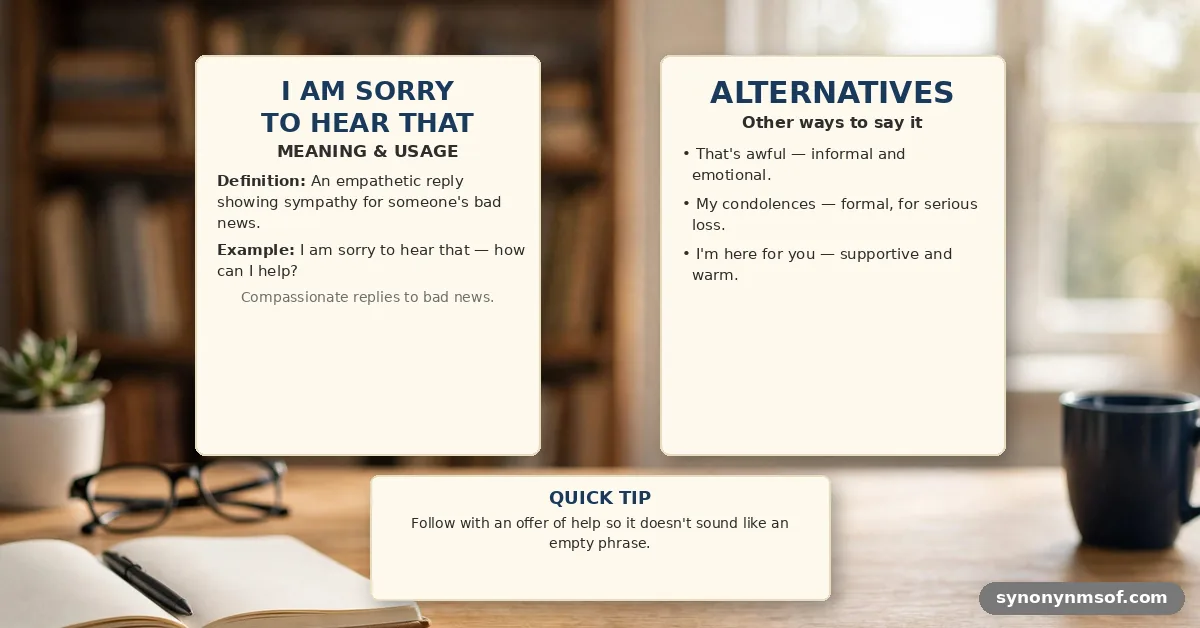

Learning how to use the phrase I am sorry to hear that: meaning and thoughtful replies helps you bridge gaps during difficult conversations. It is a standard expression of empathy used when someone shares news of a loss, illness, or personal struggle.
When you understand the nuance behind these words, you can provide comfort without sounding robotic or dismissive. This guide provides the context you need to offer genuine support in both professional and personal settings.
The phrase is a social shorthand designed to acknowledge someone’s pain without requiring a lengthy explanation. It signals that you have processed the information and are choosing to prioritize the other person’s feelings over your own discomfort. At its heart, the sentiment is about validation rather than a deep, philosophical commentary on their situation.
It acts as a verbal placeholder when you do not know the exact right words to say. By using this, you avoid the trap of offering unsolicited advice or minimizing their experience with toxic positivity. It is a safe, polite, and universally understood way to show that you are paying attention to their life events.
Why We Use It
Humans rely on social scripts to manage emotional interactions. When a colleague mentions a family illness, you do not have the time or the setting to hold a long counseling session. This phrase allows you to express regret for the circumstances while maintaining the boundaries of the workplace or a casual friendship.
It also prevents awkward silences that often follow bad news. Silence can be interpreted as indifference, so providing a verbal anchor ensures the speaker feels heard. The goal is to acknowledge the reality of the situation clearly so the conversation can proceed or conclude with mutual respect.
What to Say Instead
Sometimes, this standard phrase feels too stiff or repetitive. If you want to vary your language, you should match your choice to the depth of your relationship with the person. You want to avoid sounding like you are reading from a script, so pick options that feel authentic to your voice.
- That sounds incredibly difficult for you and your family.
- I am thinking of you during this challenging time.
- Thank you for trusting me enough to share that news.
- I am so saddened to hear about what you are going through.
- Please let me know if there is anything I can take off your plate.
- My heart goes out to you while you navigate this loss.
Professional Communication Standards
In a workplace, the objective is to remain supportive while keeping professional boundaries intact. You want to avoid oversharing or becoming overly emotional in a way that disrupts the workday. Using the phrase is often the safest bet when you are unsure of the office culture regarding personal disclosures.
However, you can elevate the sentiment by offering specific, actionable help if the situation involves a project or a deadline. For instance, you might pair the expression with an offer to cover a specific task. This turns a passive acknowledgement into an active, helpful gesture that supports the team’s stability.
The following table outlines how different responses function in varying degrees of professional intimacy.
| Context | Best Approach | Goal |
|---|---|---|
| Client/External | Formal & Concise | Maintain professional distance |
| Direct Manager | Respectful & Brief | Acknowledge without overstepping |
| Close Coworker | Warm & Supportive | Offer genuine emotional aid |
| Team Meeting | Neutral & Validating | Keep focus on the group |
Appropriate Responses to the Phrase
When someone says this to you, they are likely trying to be kind. You do not owe them a detailed explanation of your situation if you are not ready to share it. A simple, polite acknowledgement is perfectly acceptable and often preferred by both parties.
You can respond with a brief “Thank you,” “I appreciate that,” or “It’s been a tough week, but I’m hanging in there.” These responses close the loop on the interaction without forcing you to relive the trauma. It keeps the power in your hands regarding how much information you disclose.
Avoiding Common Pitfalls
One major mistake people make is following the phrase with the word “but.” For example, saying “I’m sorry to hear that, but at least you have your health” immediately invalidates the person’s current struggle. Comparisons of suffering are rarely helpful and often make the other person feel guilty for complaining.
Another pitfall is trying to fix the problem immediately. Unless the person explicitly asks for advice, assume they are looking for a witness to their pain, not a solution. Listening is a much more powerful tool than offering a quick fix that likely won’t work anyway.
The Role of Body Language
Your delivery matters as much as the words you choose. A flat, robotic delivery will make the recipient feel like you are just checking a box. If you are speaking in person, maintain soft eye contact and keep your posture open and non-defensive.
If you are communicating over text or email, keep the rest of your message brief. Do not clutter the message with emojis or exclamation points that might seem frivolous. A calm, steady tone conveys the seriousness of the situation much better than excessive punctuation.
Biblical Perspectives on Empathy

Scripture emphasizes the importance of walking alongside those who are hurting. In the book of Romans, the command is to “weep with them that weep,” which highlights the need for shared emotional space. It is not about fixing the grief, but simply being present while it exists.
In the book of Job, his friends actually did a decent job at the start by sitting with him in silence for seven days before they started talking. The mistake they made was speaking too much once they finally opened their mouths. Sometimes, the most thoughtful reply is to acknowledge the pain and then simply be there without needing to fill the air with noise.
How to Use It in Writing
When you are sending an email or a card, the structure of your note is important. Start with the acknowledgement, move to a brief sentence of support, and end with a gentle closing. Avoid signing off with something overly cheerful like “Best” or “Cheers.”
Instead, use closings that reflect the tone of the message. “With sympathy,” “Thinking of you,” or “Warmly” are much more appropriate. If you want to learn more about the etiquette of written condolences, you can look at the Emily Post Institute for further guidance on formal communication.
Navigating Grief-Related Conversations
Grief is a non-linear process that affects everyone differently. When you use this phrase after a death, you are acknowledging that things have changed for the person. You do not need to know the deceased to offer your condolences; you are offering support for the loss, not a eulogy.
Be prepared for the person to be quiet or even distant. Their brain is likely occupied with logistics or emotional processing.
Do not take their lack of a lengthy response as a sign of rudeness. Simply providing the space for them to react is a kindness that will be remembered.
Handling Unexpected Disclosures
Sometimes, someone will drop heavy news in the middle of a casual conversation. You might be in line for coffee or waiting for a meeting to start. It is okay to be caught off guard, but do not let your surprise manifest as a dismissive comment.
Take a breath, pause, and use the phrase to ground the conversation. If you are truly in a rush, it is acceptable to say, “I am so sorry to hear that, and I wish I had more time to talk right now.
Can we check in later?” This respects their news while honoring your own time constraints.
The Importance of Follow-Up
Often, the initial sympathy is high, but it drops off quickly. People are surrounded by support immediately after a crisis, but they feel most isolated a few weeks later. A follow-up message a month after the event can be incredibly meaningful.
You don’t need a grand gesture. A simple text saying, “I’ve been thinking about you and hope you are doing okay,” shows that you haven’t forgotten. It proves that your initial expression of sympathy was genuine and not just a social formality.
Recognizing Your Own Limitations
You cannot be the primary support system for everyone in your life. It is okay to acknowledge that you lack the capacity to help someone through a major life crisis. You can still use the phrase as an act of kindness without committing to hours of emotional labor.
If you feel overwhelmed, you can direct them toward professional resources if appropriate. However, do this with extreme care so it does not sound like you are trying to get rid of them. The goal is to provide empathy while maintaining your own mental health.
Frequently Asked Questions
Is it okay to use this phrase in a text message?
Yes, it is perfectly acceptable to use this in a text, especially if you have a casual relationship with the person. Keep the text brief and avoid using distracting emojis. The medium is less important than the sincerity of your intent.
What if I don’t really feel sorry?
You are expressing sympathy for their situation, not necessarily your own internal emotional state. It is a social contract that acknowledges a fellow human’s hardship. Even if you aren’t personally devastated, you can still recognize that the other person is going through a difficult time.
Is this phrase too formal for a friend?
It can sound a bit formal, but it is rarely offensive. If you want to make it warmer, add a personal touch like, “I’m so sorry to hear that, I know how much that job meant to you.” Adding context proves you are listening.
How can I avoid sounding like I am just saying it to be polite?
The best way to avoid sounding hollow is to follow up with a concrete action or a genuine question about how they are coping. When you treat the conversation as a dialogue rather than a one-off statement, the sincerity becomes clear.
Should I apologize if I say it wrong?
If you feel you have misspoken, a quick correction is better than dwelling on it. You might say, “I’m sorry, that came out wrong, I just meant that I’m here for you.” Most people are far more concerned with their own situation than with critiquing your choice of words.
Conclusion
Mastering the use of I am sorry to hear that: meaning and thoughtful replies is a vital part of emotional intelligence. It allows you to acknowledge the challenges others face without needing to have all the answers or the perfect words. By combining this standard expression with genuine empathy, active listening, and appropriate follow-up, you can provide real comfort to those around you.
Remember that your presence and your willingness to witness another person’s experience are often the most valuable gifts you can offer. Use these tools to build stronger, more supportive connections in your daily life. If you have any specific scenarios where you felt unsure of what to say, feel free to reach out and share your experiences so we can continue the conversation together.