
Have you ever caught yourself writing “Please see the email below” in almost every forwarded message?
You’re not alone.
It’s one of the most commonly used phrases in professional emails because it’s simple, polite, and tells the recipient exactly where to look. Whether you’re forwarding a client’s message, sharing an earlier conversation, or providing background information, this expression has become a standard part of workplace communication.
The problem isn’t that the phrase is wrong—it’s that many people use it so often that their emails begin to sound repetitive and impersonal.
Today’s workplace values communication that is not only professional but also clear, natural, and easy to read. Small wording changes can make your emails feel more engaging while still maintaining a polished tone.
In this guide, you’ll learn exactly what “please see the email below” means, when you should use it, when it’s better to choose another expression, and 30 professional alternatives that will help you write more confident, modern business emails.
What Does “Please See the Email Below” Mean?
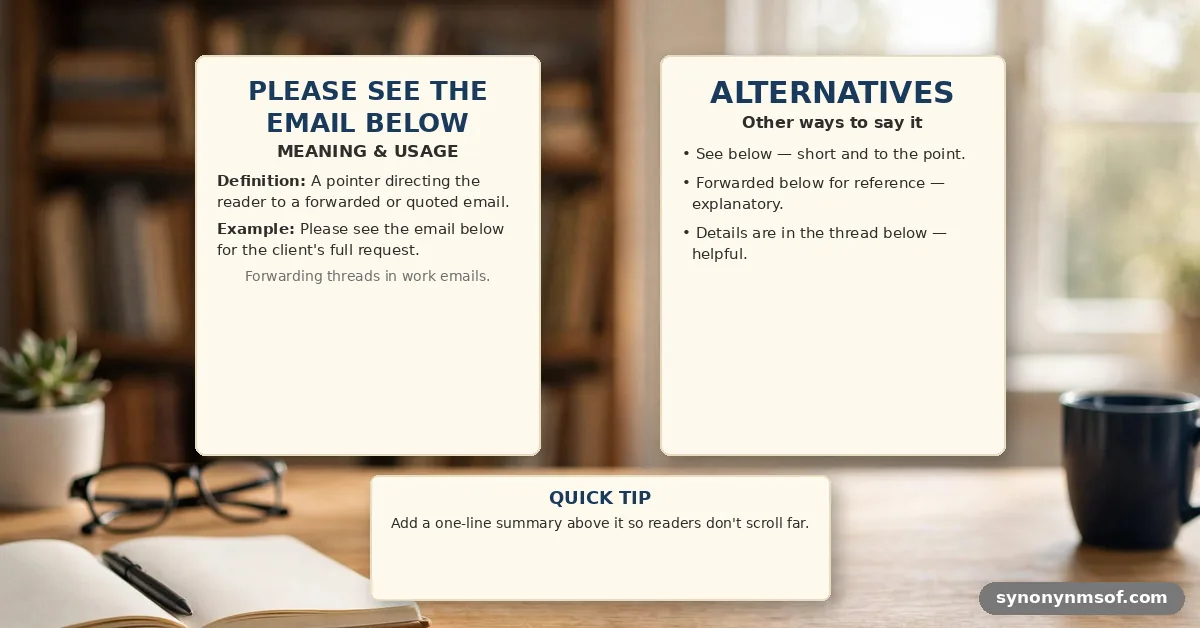
“Please see the email below” is a polite request asking someone to read a previous email or forwarded message that appears beneath your current message.
Instead of repeating the same information, you’re directing the reader to existing content for additional details or context.
For example:
Please see the email below regarding the updated project timeline.
In this example, the sender avoids rewriting the conversation and simply guides the recipient to the original message.
The phrase is commonly used in:
- Forwarded emails
- Project updates
- Customer support conversations
- HR communications
- Client correspondence
- Internal team discussions
- Approval requests
Although it’s widely accepted in professional communication, using the exact same wording repeatedly can make emails feel generic. That’s why many professionals prefer to vary their language depending on the situation.
See Also: Well Noted: Meaning, 30 Professional Alternatives & Email Examples
Is “Please See the Email Below” Professional?
Yes.
“Please see the email below” is grammatically correct, polite, and widely accepted in professional settings. It appears regularly in corporate offices, government organizations, educational institutions, healthcare, legal firms, and customer service teams.
However, professionalism isn’t only about using formal language. It’s also about communicating in a way that’s clear, helpful, and considerate of the reader.
For example, compare these two messages:
Example 1
Please see the email below.
Example 2
I’ve forwarded the original email below so you have the complete project background before tomorrow’s meeting.
Both are correct, but the second version provides context and sounds more natural. Adding a short explanation helps the reader understand why the forwarded email matters.
Quick Comparison Table
| Phrase | Tone | Best Used For |
|---|---|---|
| Please see the email below | Professional | Forwarding emails |
| Please review the email below | Formal | Client communication |
| I’ve forwarded the details below | Friendly Professional | Team collaboration |
| Kindly refer to the email below | Formal | Corporate communication |
| Please check the message below | Neutral | Everyday workplace emails |
| See below for details | Concise | Internal updates |
| I’m sharing the original email below | Warm Professional | Giving context |
| Please review the information below | Professional | Reports and updates |
| Sharing the conversation below | Conversational | Team discussions |
| For your reference, see below | Formal | Documentation |
30 Other Ways to Say “Please See the Email Below”
Choosing the right alternative depends on your audience, the level of formality, and the purpose of your email. Below are 30 professional expressions that can help you sound more natural while keeping your communication clear.
1. Please Review the Email Below
Tone: Professional
Best for: Client emails, approvals, and formal business communication.
This alternative encourages the reader to carefully read the forwarded email rather than simply glance at it. It’s especially useful when you expect feedback or a decision.
Example
Please review the email below and let me know if you’re happy to proceed.
2. Kindly Refer to the Email Below
Tone: Formal
Best for: Administrative, legal, HR, and corporate communication.
“Kindly refer to” has a slightly more formal tone and works well when communicating with external clients or senior stakeholders.
Example
Kindly refer to the email below for the approved project schedule.
3. Please Review the Message Below
Tone: Neutral Professional
Best for: Internal communication and project updates.
This version works well when the content below is a message rather than a complete email thread.
Example
Please review the message below before tomorrow’s planning session.
4. I’ve Forwarded the Details Below
Tone: Friendly Professional
Best for: Team collaboration and everyday workplace communication.
This phrase feels more conversational while still maintaining professionalism. It tells the reader exactly what you’ve done.
Example
I’ve forwarded the details below so everyone has the latest client feedback.
5. See the Message Below for Context
Tone: Helpful
Best for: Long email conversations and ongoing projects.
When someone joins an existing discussion, they may need background information. This phrase clearly explains why you’re including the previous email.
Example
See the message below for context before responding to the client.
See Also: Please Feel Free: Meaning, 30 Professional Alternatives & Examples
6. I’ve Included the Original Email Below
Tone: Warm Professional
Best for: Forwarding previous conversations.
Instead of sounding like a template, this wording feels more personal while remaining polished.
Example
I’ve included the original email below so you can review the client’s initial request.
7. Please Check the Email Below
Tone: Simple and Direct
Best for: Everyday workplace emails.
Sometimes straightforward language is the best choice. This alternative is concise without sounding abrupt.
Example
Please check the email below regarding the revised meeting agenda.
8. Please See the Information Below
Tone: Versatile
Best for: Messages that contain information rather than an email thread.
If you’re introducing notes, instructions, or updates instead of forwarding correspondence, this option is often a better fit.
Example
Please see the information below before completing your registration.
9. For Your Reference, See Below
Tone: Formal and Organized
Best for: Reports, documentation, and policy updates.
This expression signals that the information is being shared as a reference rather than requiring immediate action.
Example
For your reference, see below for the approved budget figures.
10. I’m Sharing the Email Below
Tone: Friendly
Best for: Collaborative teams and informal professional communication.
This alternative sounds more conversational while clearly explaining your purpose.
Example
I’m sharing the email below so everyone has the same information before our meeting.
11. Please Find the Email Below
Tone: Formal
Best for: Client communication, external correspondence, and traditional business emails.
“Please find the email below” is a classic business expression that politely directs the reader to a forwarded message. While it’s still widely accepted, many organizations now prefer more conversational alternatives.
Example
Please find the email below regarding your support request and our proposed solution.
12. Sharing the Conversation Below
Tone: Conversational Professional
Best for: Team collaboration and project discussions.
This phrase sounds friendly and approachable while making it clear that you’re forwarding an existing conversation for context.
Example
Sharing the conversation below so everyone is aligned before tomorrow’s meeting.
13. Please Refer to the Conversation Below
Tone: Professional
Best for: Ongoing email threads and multi-person discussions.
When several people are involved in a conversation, this wording helps recipients locate the relevant information without confusion.
Example
Please refer to the conversation below before preparing your response.
14. I’ve Included the Previous Correspondence Below
Tone: Formal
Best for: Legal, HR, finance, and administrative communication.
This alternative works particularly well when referring to official or documented exchanges that may need to be reviewed later.
Example
I’ve included the previous correspondence below for your records.
15. Here’s the Original Message
Tone: Friendly
Best for: Internal communication and small teams.
This simple phrase feels much more personal than traditional corporate language while remaining perfectly professional.
Example
Here’s the original message in case you’d like to review the client’s comments.
16. See Below for More Details
Tone: Clear and Direct
Best for: Project updates, announcements, and quick explanations.
If your goal is simply to point readers toward additional information, this concise alternative works well.
Example
See below for more details about the updated implementation schedule.
17. I’ve Included the Full Email Thread
Tone: Helpful
Best for: Complex projects and long discussions.
Instead of making readers wonder whether they’re seeing the complete conversation, this phrase clearly explains what you’ve shared.
Example
I’ve included the full email thread below so you have all the background information.
18. Please Read the Email Below
Tone: Direct but Polite
Best for: Important updates that require attention.
This alternative emphasizes that the recipient should carefully read the message instead of simply scanning it.
Example
Please read the email below before submitting your final approval.
19. Please Review the Following Correspondence
Tone: Formal
Best for: Executive communication, contracts, and official business matters.
The word correspondence gives this expression a polished and professional feel, making it suitable for high-level communication.
Example
Please review the following correspondence before making your decision.
20. I’m Forwarding This for Your Reference
Tone: Warm Professional
Best for: Everyday workplace communication.
This phrase explains exactly why you’re forwarding the email, making your message feel more thoughtful and reader-friendly.
Example
I’m forwarding this for your reference in case you need to revisit the original discussion.
When Should You Use “Please See the Email Below”?
Although there are many alternatives, the original phrase is still useful in the right situations. It helps organize conversations and prevents unnecessary repetition.
Here are some of the most common situations where it works well.
When You’re Forwarding an Email
This is the most common use. Rather than copying and pasting the same information, you can direct the recipient to the original message.
Example
Please see the email below regarding the client’s latest feedback on the proposal.
When Someone Needs Additional Context
If you’re adding a colleague to an existing conversation, including the earlier email helps them understand what has already been discussed.
Example
Please see the email below for background information before joining tomorrow’s call.
When Sharing Client Updates
Project managers, account managers, and customer support teams often use this phrase when passing along updates from clients.
Example
Please see the email below regarding the revised delivery timeline.
When Requesting Approval
Managers frequently forward previous discussions before asking for a decision.
Example
Please see the email below and let me know if you’re happy to approve the request.
When Keeping a Record of Communication
Forwarding previous emails creates a clear communication trail, which can be useful for documentation and future reference.
When Should You Avoid This Phrase?
While “please see the email below” is professional, it isn’t always the best choice. In some situations, a more natural or informative expression creates a better experience for the reader.
When a Short Summary Would Help
Imagine receiving an email with twenty replies underneath and nothing more than:
Please see the email below.
Now imagine receiving this instead:
The client has approved the design with two minor revisions. I’ve included the original email below for the complete details.
The second version immediately tells you what to expect, saving time and making the email easier to understand.
When You’re Writing to Close Colleagues
If you work closely with someone, overly formal language can sound distant.
Instead of saying:
Please see the email below.
You could write:
I forwarded the original email below so you can catch up quickly.
The meaning stays the same, but the tone feels much more natural.
When You Use It in Every Email
Many professionals don’t realize how often they rely on this phrase.
If every forwarded email begins with exactly the same words, your writing can start to feel repetitive.
Rotating between several professional alternatives keeps your communication fresh while maintaining clarity.
21. I’m Passing This Along
Tone: Casual Professional
Best for: Internal teams, quick updates, and collaborative environments.
This phrase sounds friendly and natural while clearly indicating that you’re forwarding information. It’s ideal for day-to-day workplace communication where a conversational tone is appropriate.
Example
I’m passing this along so everyone has the latest client feedback.
22. Please See the Conversation Below
Tone: Professional
Best for: Email threads involving multiple people or ongoing discussions.
Instead of referring to a single email, this phrase acknowledges that you’re sharing an entire conversation for context.
Example
Please see the conversation below before preparing your response.
23. Sharing This for Visibility
Tone: Modern Workplace
Best for: Team collaboration, project management, and remote work.
Popular in today’s workplaces, this expression lets recipients know you’re forwarding information to keep everyone informed, even if no immediate action is required.
Example
Sharing this for visibility as the client has updated the project requirements.
24. Looping You Into the Conversation
Tone: Collaborative
Best for: Introducing someone to an existing email thread.
This phrase has become increasingly common in modern workplaces because it feels natural and explains exactly why the recipient is being included.
Example
I’m looping you into the conversation below since you’ll be managing this project moving forward.
25. Please Take a Look at the Email Below
Tone: Friendly Professional
Best for: Review requests and internal communication.
This wording is polite without sounding overly formal, making it a great choice for everyday business emails.
Example
Please take a look at the email below and let me know if you have any suggestions.
26. I’ve Shared the Relevant Email Below
Tone: Professional
Best for: Client communication and project documentation.
This alternative tells the reader that you’ve selected the most important information rather than forwarding unnecessary messages.
Example
I’ve shared the relevant email below for your review.
27. Please Review the Thread Below
Tone: Professional
Best for: Long email chains and project discussions.
When several messages are involved, “thread” is often more accurate than “email.”
Example
Please review the thread below before joining tomorrow’s meeting.
28. The Email Below Provides More Information
Tone: Helpful
Best for: Announcements, updates, and informative emails.
Instead of simply telling someone to read the email, this wording explains why it’s worth reading.
Example
The email below provides more information about the upcoming software release.
29. Please Review the Correspondence Below
Tone: Formal
Best for: Legal, financial, HR, and executive communication.
“Correspondence” sounds polished and works particularly well when referring to official communication.
Example
Please review the correspondence below before signing the agreement.
30. I’ve Included the Relevant Details Below
Tone: Warm Professional
Best for: Almost any workplace situation.
Rather than focusing on the email itself, this phrase emphasizes the useful information you’re sharing. It feels modern, helpful, and reader-focused.
Example
I’ve included the relevant details below to help you prepare for tomorrow’s presentation.
Email Examples Using “Please See the Email Below”
Seeing the phrase in context makes it much easier to decide when and how to use it. Here are a few practical examples.
Example 1: Forwarding Client Feedback
Subject: Client Feedback on Website Design
Hi Sarah,
Please see the email below regarding the client’s feedback on the homepage design. I’ve highlighted the two requested revisions so we can discuss them during tomorrow’s meeting.
Let me know if you have any questions.
Best regards,
David
Example 2: Adding a New Team Member
Subject: Project Background
Hello Emily,
Welcome to the project!
I’ve included the original email thread below so you have the full background before our kickoff meeting. The discussion covers the project goals, timeline, and client expectations.
Feel free to reach out if anything needs clarification.
Best,
Michael
Example 3: Requesting Approval
Subject: Approval Needed
Hi Jennifer,
Please review the email below outlining the final proposal from the vendor. If everything looks good, we’ll move forward with the purchase tomorrow.
Thanks,
Ryan
Example 4: Sharing Information Only
Subject: Updated Training Schedule
Hi Team,
I’m sharing the email below for your reference. It includes the revised training dates and registration instructions.
No action is needed at this time.
Thank you,
Jessica
Email Etiquette Tips
Using the right phrase is important, but how you present the rest of your message matters just as much. Following a few simple email etiquette practices can make your communication clearer and more professional.
Explain Why You’re Forwarding the Email
Avoid sending a forwarded message with no explanation.
Instead of writing:
Please see the email below.
Try:
Please see the email below regarding the updated delivery schedule. The client has approved the revised timeline, but they’ve requested one additional change.
A short explanation immediately tells the reader what to expect.
Summarize Long Email Threads
If you’re forwarding a conversation with multiple replies, don’t expect the recipient to read everything from the beginning.
Start with a brief summary of the key points, then include the original email thread for reference.
This saves time and helps people find the information they need more quickly.
Keep Your Language Natural
Professional doesn’t have to mean robotic.
Instead of relying on the same corporate phrases repeatedly, vary your wording to match the situation.
For example:
- I’ve included the original email below.
- I’m forwarding this for your reference.
- Here’s the conversation for context.
- See below for more details.
Small changes like these make your writing feel more authentic.
Tell the Reader What to Do Next
Whenever possible, end your email with a clear action.
For example:
- Please review the information and let me know your thoughts.
- Could you confirm receipt by Friday?
- Let me know if you have any questions.
- Please share your feedback before tomorrow’s meeting.
Giving readers a clear next step improves response rates and reduces confusion.
Common Mistakes to Avoid
Even experienced professionals make small communication mistakes. Here are some of the most common ones.
Using the Phrase Without Context
Writing only:
Please see the email below.
doesn’t explain why the information matters.
Instead, tell the reader what they’re looking for and why it’s relevant.
Forwarding Long Email Chains Without a Summary
Recipients shouldn’t have to search through dozens of messages to find one important detail.
Summarize first, then provide the full thread if needed.
Overusing Corporate Language
Expressions like:
- Please see below
- Kindly be advised
- As per my last email
- Please be informed
- Kindly note
are all professional, but using too many in the same email can make your writing feel stiff.
Aim for a balance between professionalism and natural conversation.
Choosing the Wrong Level of Formality
Think about who you’re writing to.
A client may appreciate a more formal tone, while a close teammate might prefer something simple like:
I’m forwarding this so you have the latest update.
Adjusting your wording to suit your audience helps build stronger professional relationships.
Forgetting to Proofread
Before sending your email, make sure you’ve:
- Included the forwarded message.
- Added any promised attachments.
- Used a clear subject line.
- Explained why you’re sharing the email.
- Checked spelling and grammar.
A quick review can prevent unnecessary follow-up messages and misunderstandings.
Please See the Email Below vs. Please See Below
These two expressions are often used interchangeably, but they aren’t always the best choice in the same situations. Understanding the difference can help you communicate more clearly.
| Phrase | Best Used For | Tone | Example |
|---|---|---|---|
| Please see the email below | Forwarded or quoted emails | Professional | Please see the email below regarding the client’s approval. |
| Please see below | Information, lists, updates, or instructions | Neutral | Please see below for the meeting agenda. |
When to Use “Please See the Email Below”
Use this phrase when you’re directing someone to an existing email or conversation that’s included beneath your message.
Example
Please see the email below for the client’s latest comments on the proposal.
When to Use “Please See Below”
Choose this version when the information below isn’t an email but rather a list, announcement, explanation, or set of instructions.
Example
Please see below for the revised project schedule.
Which One Is Better?
Neither phrase is universally better. The right choice depends on what you’re referring to.
If you’re forwarding an email, “Please see the email below” is more precise. If you’re introducing information that you’ve written yourself, “Please see below” is usually the better option.
Quick Reference: Choosing the Right Alternative
Here’s a quick guide to help you pick the most suitable expression.
| Situation | Recommended Phrase |
|---|---|
| Forwarding a client email | I’ve forwarded the details below. |
| Sharing project updates | Please review the information below. |
| Adding someone to a conversation | I’m looping you into the conversation below. |
| Providing background information | See the message below for context. |
| Sending official documentation | Kindly refer to the email below. |
| Team collaboration | Sharing the conversation below. |
| Requesting feedback | Please review the email below. |
| Sharing information only | For your reference, see below. |
| Long email thread | I’ve included the full email thread below. |
| Quick internal update | See below for more details. |
Tips for Writing Better Professional Emails
Strong business writing is about more than choosing the right phrase. These habits can make every email more effective.
Start With the Main Point
Busy professionals often skim emails. Tell readers why you’re writing before directing them to a previous message.
Instead of:
Please see the email below.
Try:
The client has approved the proposal with one requested revision. I’ve included the original email below for reference.
Be Specific
Adding context saves your reader time.
Instead of:
Please review the email below.
Write:
Please review the email below outlining the updated implementation timeline.
Keep It Concise
Avoid long introductions or unnecessary corporate language. A few clear sentences are usually enough.
End With a Clear Action
If you need a response, make that clear.
Examples include:
- Let me know your thoughts by Friday.
- Please confirm receipt.
- I’d appreciate your feedback.
- Feel free to reach out if you have any questions.
A simple call to action helps move the conversation forward.
Frequently Asked Questions
Is “please see the email below” grammatically correct?
Yes. It’s a grammatically correct and widely accepted phrase in professional communication. It’s commonly used when forwarding an email or referring to an earlier message.
Is “please see the email below” professional?
Absolutely. The phrase is appropriate for business emails, client communication, academic correspondence, and workplace discussions. However, using it repeatedly can make your writing sound repetitive.
What can I say instead of “please see the email below”?
Some excellent alternatives include:
- Please review the email below
- I’ve forwarded the details below
- See the message below for context
- I’m sharing the original email below
- Please review the information below
- I’ve included the relevant details below
Choose the expression that best fits your audience and purpose.
Is “please see below” the same as “please see the email below”?
Not exactly.
“Please see the email below” refers specifically to a forwarded or quoted email, while “please see below” is broader and can introduce any type of information.
Should I summarize a forwarded email?
Yes. A short summary helps readers understand the purpose of the forwarded message without having to read an entire email thread first.
Is “kindly refer to the email below” too formal?
Not necessarily. It’s appropriate for formal business communication, although more conversational alternatives may feel warmer in everyday workplace interactions.
Can I use this phrase in client emails?
Yes. It’s perfectly acceptable when communicating with clients, especially if you’re forwarding previous correspondence or providing additional context.
Why does this phrase sometimes sound robotic?
Because it’s one of the most overused expressions in workplace communication. Using the same wording in every email can make messages feel repetitive and less personal.
What’s the most natural alternative?
Many professionals prefer:
I’ve forwarded the original email below so you have the full context.
This version sounds more conversational while remaining professional.
Should I always use formal language in business emails?
No. Professional writing should be clear, respectful, and appropriate for your audience. In many workplaces, a warm and natural tone is more effective than overly formal language.
What’s the difference between “see attached” and “please see the email below”?
“See attached” refers to a separate file, such as a PDF or document. “Please see the email below” directs the reader to a previous message included in the same email thread.
How can I make forwarded emails easier to read?
Start with a brief summary, explain why you’re forwarding the message, and clearly state any action you expect from the recipient. This approach saves time and improves clarity.
Final Thoughts
“Please see the email below” remains a professional and useful phrase for forwarding messages, sharing previous conversations, and providing context in business communication. It’s clear, polite, and familiar to readers across many industries.
However, effective communication isn’t just about using the correct phrase—it’s about helping your audience quickly understand your message. Adding context, summarizing key points, and varying your wording can make your emails feel more natural and engaging.
The 30 alternatives in this guide give you the flexibility to match your tone to the situation, whether you’re writing to a client, collaborating with teammates, or sharing important updates with colleagues.
By focusing on clarity, professionalism, and a reader-friendly style, you’ll create emails that are easier to understand, more pleasant to read, and more likely to receive prompt responses.
Whether you choose “Please see the email below” or one of its many alternatives, the goal is the same: communicate clearly, respectfully, and with purpose.