
Few slang words cause as much spelling confusion as bougie and boujee. They sound almost identical, they both describe a fancy or luxurious lifestyle, and they pop up everywhere from hip-hop lyrics to brunch conversations to social media captions. Yet spell them wrong — or use the wrong one for the moment — and your sentence can land very differently than you intended. One spelling carries a sting of criticism, while the other can carry a wink of pride. Knowing which is which matters more than most people realize.
Both words trace back to the same root: the French word bourgeois, which originally described the middle class and later became shorthand for materialism and status-seeking. Somewhere along the way, bourgeois got shortened to bougie, and then hip-hop culture reshaped it into boujee — a spelling that sounds the way many people actually say the word. Today the two spellings live side by side, sometimes as pure variants and sometimes as words with genuinely different connotations. Dictionaries list boujee as a variant spelling of bougie, but in real usage, the choice between them often signals tone, attitude, and cultural context.
This guide untangles bougie and boujee completely. You will learn where each spelling came from, what each one means, and how their connotations differ — when bougie is an insult and when boujee is a compliment. We will cover pronunciation, usage rules, example sentences, the most common mistakes, and answers to the questions readers ask most often. By the end, you will know exactly which spelling fits your sentence and your audience.

What Does “Bougie” Mean?
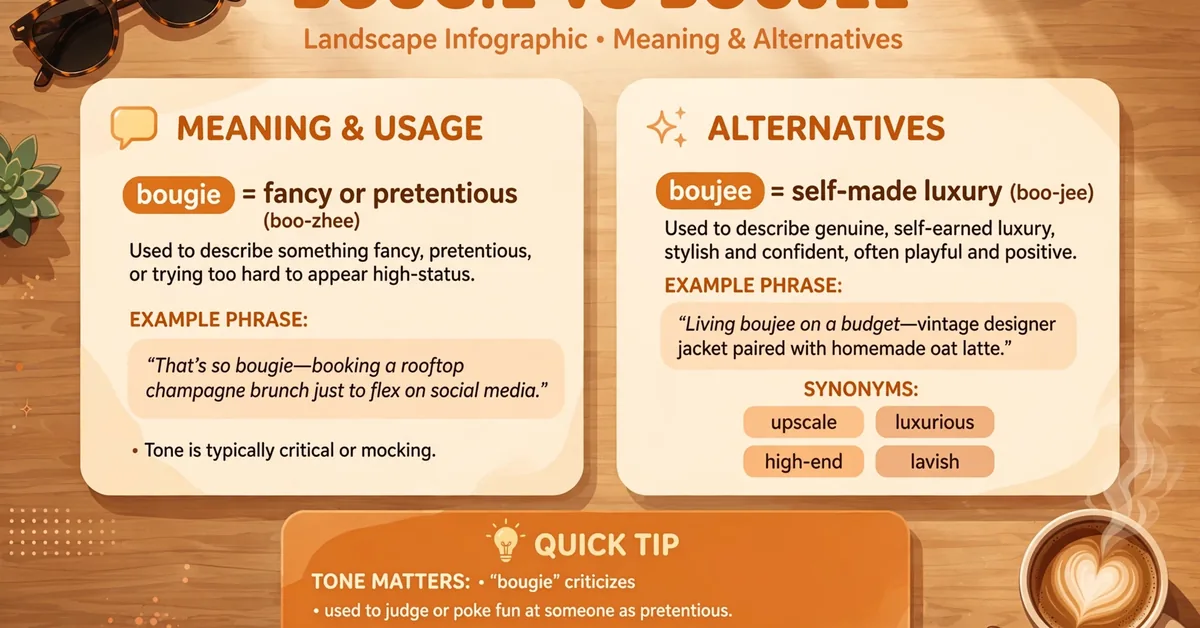
Bougie, pronounced boo-zhee with a soft French j sound (like the s in measure), is an adjective that describes someone or something as fancy, upscale, or pretentious. It is short for bourgeois, the French term for the middle class that, over time, became a criticism of people perceived as materialistic or obsessed with status. When someone says Look at you with your bougie avocado toast, they are teasing — or criticizing — the person for tastes that seem fancier than necessary. The word paints a picture of designer labels, wine tastings, country clubs, and an attitude that looks down on anything ordinary.
The connotation of bougie is usually negative or mocking. It suggests that someone is acting wealthier or more refined than they really are — putting on airs, in other words. She grew up bougie in a gated community implies a sheltered, privileged upbringing. I am not going wine tasting with you and your bougie friends expresses irritation at perceived snobbery. The criticism is similar to what the 1980s word yuppie described: young, urban, professional, and a little too proud of it. When bougie is aimed at a person, it is rarely a compliment.
That said, bougie can also describe things rather than people, and the tone softens considerably. This is a bougie hotel might simply mean the hotel is luxurious, with no insult intended. We had a bougie brunch with mimosas and truffle fries sounds like a fond memory, not a complaint. A rough rule of thumb: things are bougie in a fun way, while people are bougie in a snobby way. Context and tone decide which reading applies, so the same sentence can be playful teasing among friends or a genuine jab, depending on who says it and how.
Bougie also has a completely separate set of technical meanings worth knowing, because they explain some confusing search results. In French, une bougie is a candle — and by extension a spark plug (bougie d’allumage). In English-language medicine, a bougie is a thin, flexible instrument used to guide breathing tubes or widen passages in the body, named for its candle-like shape. These meanings have nothing to do with the slang, but they are the reason the word appears in automotive and medical contexts. If you encountered bougie in a hospital or a garage, you were looking at a different word that happens to share the spelling.
In mainstream media, bougie has become a go-to shorthand for a certain lifestyle aesthetic. Reality shows, lifestyle magazines, and food writers use it to signal upscale tastes with a knowing wink — bougie brunch spots, bougie travel guides, bougie skincare routines. In these commercial contexts the critical edge dulls into playful branding: calling a product bougie flatters the customer by suggesting they have refined taste. This marketing use is a good reminder that the word’s tone is flexible — the same spelling that insults a snob can sell a scented candle, depending entirely on who is speaking and why.
What Does “Boujee” Mean?
Boujee, pronounced boo-jee with a hard j sound, is a newer spelling variant of bougie that grew out of African American Vernacular English and hip-hop culture. It exploded into mainstream awareness with the 2016 Migos song Bad and Boujee, which celebrated a lifestyle of success and luxury. The spelling is phonetic — it captures the way the word sounds when spoken in that cultural context — and it arrived through music, memes, and social media rather than through dictionaries or classrooms.
The connotation of boujee is often positive, playful, or proud — a sharp contrast with the critical edge of bougie. Where bougie suggests someone pretending to be rich, boujee suggests someone who earned their luxury and enjoys it without shame. I grew up broke, and now I drink expensive wine — I am boujee and I earned it is a boast, not a confession. That diamond necklace makes you look so boujee is a compliment about style and success. In hip-hop usage especially, boujee celebrates the hustle: rising from humble beginnings to a better lifestyle while still knowing where you came from.
Boujee also carries a self-aware, humorous tone in everyday use. Friends tease each other with it affectionately: We ordered takeout from three different restaurants — that is so boujee of us. These new sneakers are boujee as hell, but I saved up for them. In these sentences, the speaker is in on the joke, enjoying something fancy while acknowledging the extravagance. This self-awareness is a big part of the word’s charm — it lets people enjoy luxury without taking themselves too seriously. The same sentence with bougie would sound more like an accusation; with boujee, it sounds like a celebration.
It is important to note that boujee is still slang, and it lives mostly in spoken language, lyrics, memes, and casual writing. You will rarely find it in formal documents, news reporting, or academic prose, where bougie — if either word appears at all — is the expected spelling. Dictionaries that include boujee treat it as a variant of bougie, which means the “official” definition is the same even though the street-level connotations differ. Understanding that gap between the dictionary entry and real-world usage is the key to using the word well.
The Key Differences Between Bougie and Boujee
Strictly speaking, bougie and boujee are variant spellings of the same word, and dictionaries define them identically. But language lives in how people actually use words, and in real usage the two spellings have drifted into different territories. The comparison below captures how they differ in practice:
| Feature | Bougie | Boujee |
|---|---|---|
| Pronunciation | Boo-zhee (soft French j, like the s in measure) | Boo-jee (hard j sound) |
| Origin | Shortened directly from French bourgeois | Phonetic respelling from AAVE and hip-hop culture |
| Typical connotation | Negative or mocking — pretentious, snobbish, acting rich | Mixed to positive — celebratory, self-aware, proud |
| Cultural context | General slang, understood everywhere | Rooted in Black culture and hip-hop; spread through music and memes |
| Common settings | Written and spoken; appears in mainstream media | Mostly spoken, lyrics, social media, casual writing |
| Example | She is so bougie — she only drinks imported water. | She is so boujee — she earned that designer bag herself. |
The two example sentences in the table show how the same sentence frame flips meaning with the spelling. She is so bougie — she only drinks imported water reads as criticism: the imported water is evidence of snobbery. She is so boujee — she earned that designer bag herself reads as admiration: the designer bag is evidence of success. The grammar is identical and the dictionary definition is identical, yet the emotional message reverses. That is why this word pair deserves more care than a simple spelling variant usually gets — the spelling you choose tells your reader how you feel about the person you are describing.
Usage Rules: When to Use Bougie or Boujee
The first rule is to match the spelling to the tone you want. If you mean to criticize or tease someone for being pretentious, bougie is the right choice: He is too bougie to eat at a food truck clearly reads as a jab. If you mean to celebrate someone’s success or enjoy something luxurious with self-aware humor, boujee fits better: We went full boujee and booked the rooftop suite reads as proud and playful. Before you write either word, ask yourself whether you are mocking or admiring — the answer picks the spelling.
The second rule is about formality and setting. Both words are slang, so neither belongs in formal writing — academic papers, legal documents, job applications, or serious journalism. In casual and creative writing, bougie is the safer default because it is the established, dictionary-listed spelling that every reader recognizes. Reserve boujee for contexts where its cultural flavor is an asset: song lyrics, social media captions, dialogue in fiction, marketing aimed at a young audience, or any writing that wants to sound current and in-the-know. Using boujee in a formal report would look like a typo; using it in an Instagram caption looks natural.
The third rule concerns pronunciation cues. Because the two spellings suggest different pronunciations — boo-zhee versus boo-jee — your spelling tells the reader how to hear the word. If you are writing dialogue or lyrics, choose the spelling that matches how your character or speaker would say it. A character modeled on French-influenced speech might say bougie with the soft zh sound, while a character rooted in hip-hop culture would say boujee with the hard j. Matching spelling to sound keeps dialogue authentic and avoids confusing the reader.
The fourth rule is about people versus things. Remember the rule of thumb: things can be bougie in a fun, descriptive way — a bougie coffee shop, bougie hotel lobby — while people described as bougie usually receive it as an insult. Boujee softens the personal use: calling a person boujee is far more likely to be taken as a compliment or affectionate teasing. If you are describing a friend’s taste and you want to stay on friendly terms, boujee is the lower-risk choice; bougie aimed at a person should be reserved for moments when you genuinely intend the criticism, or when the teasing relationship is well established.
Common Mistakes With Bougie and Boujee
The most common mistake is treating the two spellings as fully interchangeable without considering tone. A writer who means to compliment a friend’s new apartment might write Your place is so bougie, not realizing the word lands as pretentious rather than stylish. The friend hears criticism where admiration was intended. The reverse happens too: someone aiming for a sharp critique writes boujee, and the target takes it as a compliment about their success. Because the dictionary treats the spellings as variants, spellcheckers will not catch this — only an awareness of the connotation gap saves you.
A second common mistake is misspelling the word in ways that match neither standard. Variants like boujie, bugie, boojie, and bougiee appear constantly in comments and captions. None of these is an accepted spelling. There are exactly two recognized forms: bougie and boujee. If you are unsure which one you want, pick bougie — it is the original and universally understood form — and learn the connotation difference before switching to boujee. A quick dictionary check takes seconds and prevents the most embarrassing version of this error.
A third mistake is using either word in formal or professional contexts where slang does not belong. Describing a client’s preferences as bougie in a business email, or calling a colleague boujee in a performance review, risks offending people who hear the critical sense — or confusing people who do not know the slang at all. In professional writing, neutral alternatives work better: upscale, luxury, high-end, premium, or discerning say what you mean without the slang baggage. Save bougie and boujee for contexts where informality is welcome.
A fourth mistake is mispronouncing the words, which undermines the writer or speaker’s credibility with audiences who know the slang. Bougie is boo-zhee, not boo-gee and not bow-gee; the soft zh sound comes from its French root. Boujee is boo-jee with a hard j, matching its phonetic spelling. Mixing these up — saying boo-gee while writing bougie, for example — signals unfamiliarity with the word’s background. If you are going to use slang, pronounce it the way its community does.
The fifth mistake is ignoring the cultural roots of boujee. The spelling comes from African American Vernacular English and hip-hop culture, and using it well means respecting that origin. Deploying boujee as a punchline to mock the culture it came from, or using it in a way that divorces it entirely from its celebratory sense of self-made success, reads as tone-deaf. None of this means the word is off-limits — slang spreads, and boujee now belongs to mainstream internet culture — but using it with awareness of where it came from keeps your writing respectful as well as correct.
When you sit down to write, the decision between bougie and boujee is really a decision about your reader. A general audience of all ages will understand bougie instantly, while boujee resonates most with readers steeped in hip-hop, meme culture, and social media. If your reader might not know the slang at all, consider whether the word earns its place — sometimes a plain word like upscale or pretentious communicates more clearly than either spelling. Slang is powerful precisely because it is specific; use it where its specificity lands, and translate it where it will not.
Frequently Asked Questions
What is the difference between bougie and boujee?
Dictionaries treat boujee as a variant spelling of bougie, so their official definitions are the same: fancy, upscale, or pretentious. In real usage, though, the connotations differ. Bougie (pronounced boo-zhee) usually leans negative — it criticizes someone for acting wealthier or more refined than they are. Boujee (pronounced boo-jee), popularized by hip-hop culture and the Migos song Bad and Boujee, often leans positive — it celebrates self-made luxury and success with pride or self-aware humor. Choose the spelling that matches the tone you intend.
How do you pronounce bougie?
Bougie is pronounced boo-zhee, with a soft French j sound like the s in measure — a legacy of its root in the French word bourgeois. The variant boujee is pronounced boo-jee with a hard j sound, matching its phonetic spelling. The different pronunciations are one reason the two spellings persist side by side: each one tells the reader how the writer hears the word. Saying boo-gee for bougie is the most common mispronunciation to avoid.
Is boujee a compliment or an insult?
It depends on context, but boujee is more often a compliment — or at least affectionate teasing — than an insult. In hip-hop and mainstream slang, it celebrates someone enjoying luxury they earned: She is so boujee with her new promotion and designer bag reads as admiration. Among friends, that is so boujee of us is self-aware humor about an extravagant choice. It can still carry a critical edge in some contexts, but compared with bougie, which is usually a direct criticism of pretension, boujee is the warmer, prouder word.
Where did the word boujee come from?
Boujee comes from bougie, which comes from the French bourgeois — originally the middle class, later slang for materialistic status-seeking. The boujee spelling emerged from African American Vernacular English as a phonetic respelling, and it broke into the mainstream with Migos’ 2016 hit Bad and Boujee, which celebrated a luxurious lifestyle earned through hustle. From there it spread through memes, social media, and everyday speech. Dictionaries now list it as a variant spelling of bougie, though its cultural flavor remains distinct.
Can I use bougie or boujee in formal writing?
No — avoid both in formal writing. They are slang, and they do not belong in academic papers, legal documents, business reports, or serious journalism. In formal contexts, use neutral alternatives like upscale, luxury, high-end, premium, or pretentious (if criticism is intended). Bougie and boujee belong in casual writing, dialogue, lyrics, social media, and marketing aimed at audiences who know the slang. Even there, remember the tone difference: bougie criticizes, boujee celebrates.
Conclusion
Bougie and boujee began as one word — a shortened, slangy descendant of the French bourgeois — and grew into two spellings with two personalities. Bougie, pronounced boo-zhee, is the traditional form, and it usually arrives with a critical edge, calling out pretension and status-seeking. Boujee, pronounced boo-jee, is the hip-hop-era respelling, and it usually arrives with swagger, celebrating earned luxury and self-aware indulgence. The dictionary calls them variants; the culture treats them as cousins with different attitudes.
Using them well comes down to two questions. First, what tone do you intend — mockery or admiration? Let the answer choose your spelling. Second, does the setting welcome slang at all? If not, reach for upscale, luxury, or pretentious instead. Respect the cultural roots of boujee, pronounce each word the way its community does, and never aim bougie at a person unless you mean the sting. Get these right and you will wield one of English’s most colorful slang pairs with total confidence.
Explore more on Synonynmsof.