
Some word pairs fight over meaning. Afterward and afterwards do not. These two words mean exactly the same thing — later, after that, at a subsequent time — and neither one is more correct than the other. Yet writers still pause over them, second-guess their choice, and wonder whether that final s changes anything. It does not change the meaning at all. What it does signal is something subtler: where the writer learned English, and which spelling tradition they follow.
The real story behind afterward and afterwards is a story about regions, not rules. American English favors afterward, while British English and much of the rest of the English-speaking world favors afterwards. The pair belongs to a large family of words — toward and towards, backward and backwards, forward and forwards — where the -ward form dominates in North America and the -wards form dominates elsewhere. In almost every one of these pairs, the two spellings are interchangeable in meaning, and afterward and afterwards are among the most interchangeable of all.
This guide explains everything worth knowing about afterward and afterwards: what each word means, how the regional preferences actually work, and when — if ever — the choice matters. You will find clear usage rules, plenty of example sentences, the most common mistakes to avoid, and answers to the questions readers ask most. You will also learn how to keep them separate from a lookalike word, afterword, that really is a different word with a different meaning.
What Does “Afterward” Mean?
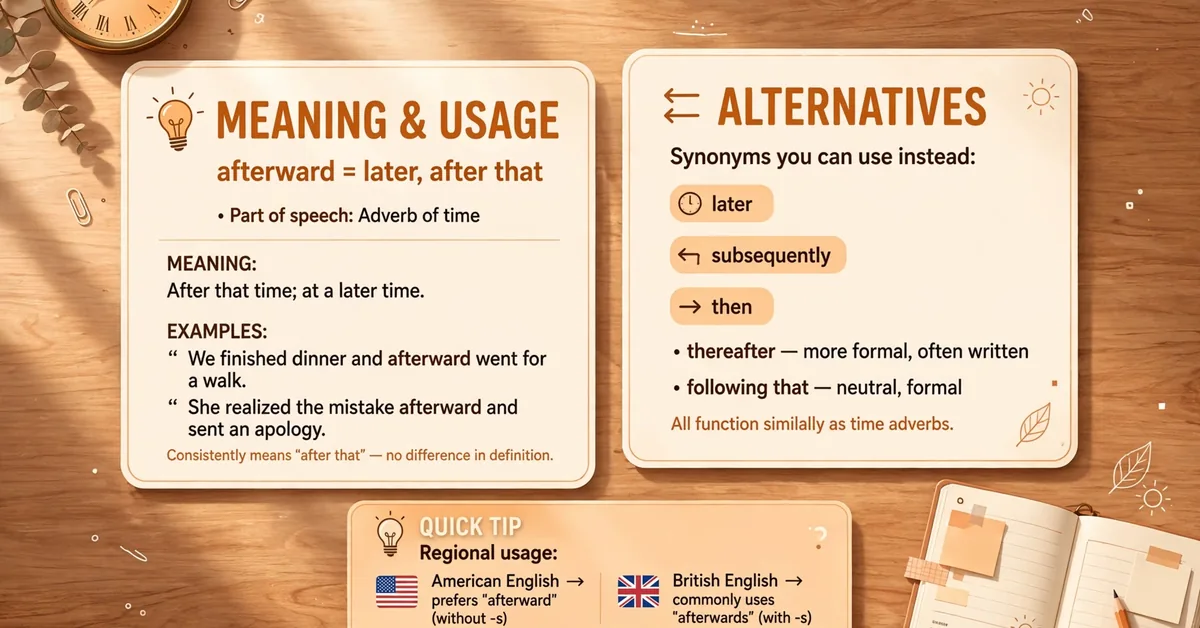
Afterward is an adverb of time. It tells you when something happened — specifically, at a later time than something already mentioned. In the sentence We finished dinner, and afterward we watched a movie, the word afterward places the movie-watching after the dinner in the sequence of events. It modifies the verb by answering the question when?, and it always points forward in time to something that follows. Other ways to say the same thing include later, subsequently, after that, and then.
One thing that makes afterward simple to use is that it never changes its grammatical job. It is always an adverb, never a noun, an adjective, or a verb. It does not take different forms for different subjects or tenses — there is no afterwardsing or afterwarded, and it never needs an apostrophe. It can sit in several positions in a sentence: at the start (Afterward, the team celebrated their victory), in the middle (The team afterward celebrated their victory), or at the end (The team celebrated their victory afterward). The end position is the most common in everyday writing, while the front position adds a touch of emphasis to the time sequence.
Afterward is the preferred spelling in American English. It dominates in US newspapers, books, magazines, and online writing, and it is the form American style guides recommend. If you are writing for an American audience — a US college essay, a business report for an American company, a blog aimed at American readers — afterward is the natural default. That said, an American reader will understand afterwards perfectly well; the preference is a matter of convention, not comprehension. The two forms are fully mutually intelligible across every variety of English.
Afterward also pairs naturally with adverbs that sharpen the timing. Writers often reach for combinations like shortly afterward, immediately afterward, and soon afterward to make the sequence of events more precise. These collocations are extremely common in news reporting and storytelling: The alarm rang, and shortly afterward the building was evacuated tells the reader not just that the evacuation came later, but that it came quickly. The same pairings work identically with afterwards — shortly afterwards, immediately afterwards — and the choice between the two spellings in these phrases follows the same regional pattern as everywhere else.
What Does “Afterwards” Mean?
Afterwards means precisely the same thing as afterward: at a later time, following an event, after that. The final s adds no meaning, no nuance, and no grammatical function. In the sentence We finished dinner, and afterwards we watched a movie, the word does exactly the same job as afterward in the parallel sentence — it places the movie after the dinner. If you swapped one spelling for the other in any sentence, the meaning would stay identical. Dictionaries define both words with the same definition, and grammarians treat them as full synonyms.
Like its counterpart, afterwards functions only as an adverb. It modifies verbs by telling you when an action happened, and it never acts as a noun, adjective, or verb. It takes the same sentence positions — beginning, middle, or end — and follows the same patterns: Afterwards, everyone went home, She felt nervous afterwards but relieved, They cleaned the kitchen, and afterwards they relaxed. There is no hidden difference in emphasis, formality, or tone between the two spellings. Any difference a reader feels comes from familiarity with one form over the other, not from anything the word itself carries.
Afterwards is the preferred spelling in British English and in most varieties of English outside North America — the United Kingdom, Ireland, Australia, New Zealand, South Africa, and India, among others. It is the form you will find in British newspapers, novels, and formal writing, and it is what British style guides recommend. If you are writing for a British or international audience, afterwards is the safer default. As with the American preference, this is convention rather than law: a British reader understands afterward without any trouble, and many writers use both forms without realizing it.
It is worth knowing that both spellings have deep historical roots. The -wards forms are actually the older ones in many cases, appearing in Old English with the suffix -weardes, while the shorter -ward forms gained ground later. Neither spelling is a modern invention or a corruption of the other, which is why claims that one is “lazy” or “wrong” have no historical basis. For centuries, writers on both sides of the Atlantic used both forms freely. The modern regional split — -ward in America, -wards in Britain — only hardened in the nineteenth and twentieth centuries as dictionaries and style guides began standardizing national preferences.
The Key Differences Between Afterward and Afterwards
Since the two words share the same meaning, the same part of speech, and the same sentence patterns, the differences between them are not grammatical — they are geographical and stylistic. The comparison below lays them out plainly:
| Feature | Afterward | Afterwards |
|---|---|---|
| Meaning | Later; after that; subsequently | Later; after that; subsequently (identical) |
| Part of speech | Adverb only | Adverb only |
| Regional preference | American English (US, and largely Canada) | British English (UK, Australia, and most other regions) |
| Formality | Neutral — works in all registers | Neutral — works in all registers |
| Example | He apologized and felt better afterward. | He apologized and felt better afterwards. |
| Rule of thumb | Default for American audiences | Default for British and international audiences |
The -ward versus -wards split is one of the oldest patterns in English spelling. Every directional adverb ending in -ward has a parallel -wards form: toward and towards, backward and backwards, upward and upwards, downward and downwards. In modern usage, North American writing leans toward the shorter -ward forms, while writing elsewhere leans toward the -wards forms. In nearly every pair, the two spellings are interchangeable in meaning — afterward and afterwards included. The practical rule is consistency: pick the form that matches your audience and stick with it throughout a document.
Usage Rules: When to Use Afterward or Afterwards
The first rule is the simplest: match your spelling to your audience. Writing for Americans? Use afterward. Writing for a British, Australian, or international audience? Use afterwards. Writing for a mixed or global audience, such as a website read around the world? Either form works — pick one and use it consistently. Most readers will not notice which form you chose, because both are correct everywhere; they will only notice if you switch back and forth within the same article, which looks sloppy even though it is not technically wrong.
The second rule is consistency within a document. Once you choose afterward or afterwards, keep that choice from the first paragraph to the last. This matters most in formal and professional writing — reports, essays, books, and published articles — where editors treat mixed -ward and -wards spellings as an inconsistency to fix. It is worth extending the same consistency to the whole -ward family: if you write afterward, pair it with toward, backward, and forward rather than towards, backwards, and forwards. A document that mixes afterward with towards sends a confused signal about which variety of English it follows.
The third rule concerns sentence placement. Both words work at the beginning, middle, or end of a sentence, but the end position is the most natural in everyday English: We talked for hours and went home afterward. The front position — Afterward, we went home — puts extra weight on the time sequence and works well when you are narrating a series of events. The middle position — We afterward went home — is grammatically fine but sounds stiff and old-fashioned, and most modern writers avoid it. In practice, choose the end for casual flow and the front for narrative emphasis.
The fourth rule is about what not to do. Never add an apostrophe: afterward’s is not a word. Never use either form as a noun — you cannot write the afterward of the party the way you might write the aftermath. And never treat them as adjectives: the afterward events is wrong; write the later events or the subsequent events instead. Both words have exactly one job — adverb of time — and they do it without any inflections, so resist the urge to dress them up.
A final practical tip: when you are unsure which form a publication or institution prefers, look at its other -ward words. A style guide that prescribes toward will almost certainly prescribe afterward, and one that prescribes towards will prescribe afterwards. Major American publications and the Chicago Manual of Style lean toward the shorter forms, while British publications and Oxford style lean toward the longer ones. Matching the house style is the fastest way to get this decision right without thinking about it twice.
Common Mistakes With Afterward and Afterwards
The most common mistake is believing that one spelling is correct and the other is wrong. Language forums are full of confident claims that afterwards is a mistake, or that afterward is lazy American slang. Both claims are false. Every major dictionary lists both spellings as standard, and both have been in continuous use for centuries. If a spellchecker flags one of them, the problem is the spellchecker’s dictionary setting — usually set to the other regional variety — not your spelling. Check which English your tools are set to before you let them “correct” you.
A second common mistake is mixing the two spellings in the same piece of writing. This usually happens when a writer drafts quickly, or when a document passes through multiple editors on different continents. The result — afterward in paragraph two and afterwards in paragraph five — does not confuse readers, but it does look unpolished, and a careful editor will standardize it. The fix is a simple find-and-replace pass before publishing: decide which form matches your audience, search for the other, and replace every instance. Do the same check for toward and towards while you are at it.
A third mistake involves the lookalike word afterword — spelled with a w-o-r-d ending instead of w-a-r-d. An afterword is a noun: a short closing section at the end of a book, usually written by someone other than the author, offering commentary or context. It is the counterpart of a foreword. Confusing the two is easy when typing quickly, but the meanings are unrelated: afterward is about time, afterword is about words. A simple memory aid helps — an afterword contains the word word, and it is literally words that come after the main text. If your sentence is about when something happened, you want afterward or afterwards; if it is about a section of a book, you want afterword.
A fourth mistake is forcing the word into a grammatical role it cannot fill. Because afterward feels substantial, writers sometimes press it into service as a noun or adjective: in the afterward, an afterward meeting. Both are wrong. English already has words for those jobs — aftermath, later, subsequent — so use them instead. Similarly, do not pluralize or possessivize the adverb: afterwards’s and afterwardses are never correct. The word is invariable, and it stays exactly as it is in every sentence.
The fifth mistake is overthinking the choice. Some writers stall for minutes deciding between afterward and afterwards, or rewrite sentences to dodge the word entirely. That hesitation is unnecessary. Pick the spelling that matches your audience, use it consistently, and move on. No reader has ever misunderstood a sentence because the writer chose afterward instead of afterwards. The energy spent agonizing over the final s is better spent on the ideas around it.
In storytelling and narrative writing, afterward and afterwards do quiet but important work as transition signals. A novelist might write Afterwards, nothing was ever the same to mark a turning point, or a memoirist might use Years afterward, I finally understood what she meant to bridge a long gap in time. These transitional uses are where the front-of-sentence position shines: placing the adverb first gives the time shift emphasis and orients the reader before the new event arrives. Whether you choose afterward or afterwards in these moments is purely a matter of the voice and audience you are writing for.
Frequently Asked Questions
Is there any difference in meaning between afterward and afterwards?
No. Afterward and afterwards mean exactly the same thing — at a later time, after that, subsequently. Both are adverbs of time, both are correct in every variety of English, and they can be swapped in any sentence without changing its meaning. The only real difference is regional preference: American English favors afterward, while British English and most other varieties favor afterwards. Choose the form that matches your audience and use it consistently.
Which is correct: afterward or afterwards?
Both are correct. This is not a case of one right answer and one common error — every major dictionary lists both spellings as standard English. Afterward is the more common form in American writing, and afterwards is the more common form in British and international writing, but neither is wrong anywhere. If your spellchecker flags one of them, check which regional dictionary your software is using; the flag reflects your settings, not a real spelling error.
Can I use afterward and afterwards in the same document?
You can, but you should not. Mixing the two spellings does not change the meaning or confuse readers, but it looks inconsistent and unpolished — especially in formal, academic, or professional writing, where editors will standardize it. Pick one form before you start writing (or during editing), then use find-and-replace to make every instance match. For the most consistent result, align the rest of the -ward family too: pair afterward with toward and backward, or afterwards with towards and backwards.
What is the difference between afterward and afterword?
They are completely different words. Afterward (and afterwards) is an adverb meaning at a later time — it is about when something happened. Afterword is a noun meaning a short closing section at the end of a book, usually written by someone other than the author — it is about words that come after the main text, and it is the counterpart of a foreword. An easy way to remember: afterword contains the word word. If your sentence is about timing, use afterward or afterwards; if it is about a section of a book, use afterword.
Is afterwards more formal than afterward?
No. Both spellings are neutral in register and work equally well in casual and formal writing. Afterwards can sound slightly more formal to American ears simply because it is less familiar in the US, and afterward can sound slightly more casual to British ears for the same reason — but these are impressions based on familiarity, not real differences in formality. Formality in your writing comes from word choice, sentence structure, and tone, not from which regional spelling of this adverb you choose.
Conclusion
Afterward and afterwards are the rare confusing word pair with nothing to be confused about. They share one meaning, one grammatical role, and one job in the sentence — placing an event later in time than something already mentioned. The final s changes nothing about what the word says; it only hints at where the writer learned English, with afterward leaning American and afterwards leaning British. Neither spelling is wrong, neither is more formal, and neither carries a shade of meaning the other lacks.
The practical takeaway is refreshingly simple. Match the spelling to your audience, keep it consistent through the whole document, and keep it in its lane as an adverb of time — no apostrophes, no plural forms, no adjective duty. Watch out for the one genuine trap, the noun afterword, which looks similar but means something entirely different. Do those few things and you will never need to hesitate over this word again; the only decision left is which correct spelling you prefer.
Explore more on Synonynmsof.