
Few grammar mix-ups are as famous as this one. Whether you are texting a friend, writing a job application, or posting online, the “your or you’re” question pops up constantly — and it trips up native English speakers just as often as learners. The two words sound identical when spoken, which is exactly why they cause so much trouble in writing.
What makes this pair especially sneaky is that spell check will never save you. Both “your” and “you’re” are perfectly valid English words, so your computer or phone will happily let the wrong one through. That is why this mistake is not really about spelling at all — it is about understanding what each word actually does in a sentence.
In this guide, you will learn exactly what “your” means, exactly what “you’re” means, how to tell them apart every single time, and how to use both correctly in casual texts, professional emails, and formal writing. Let us settle this confusion once and for all.

What Does “Your” Mean?
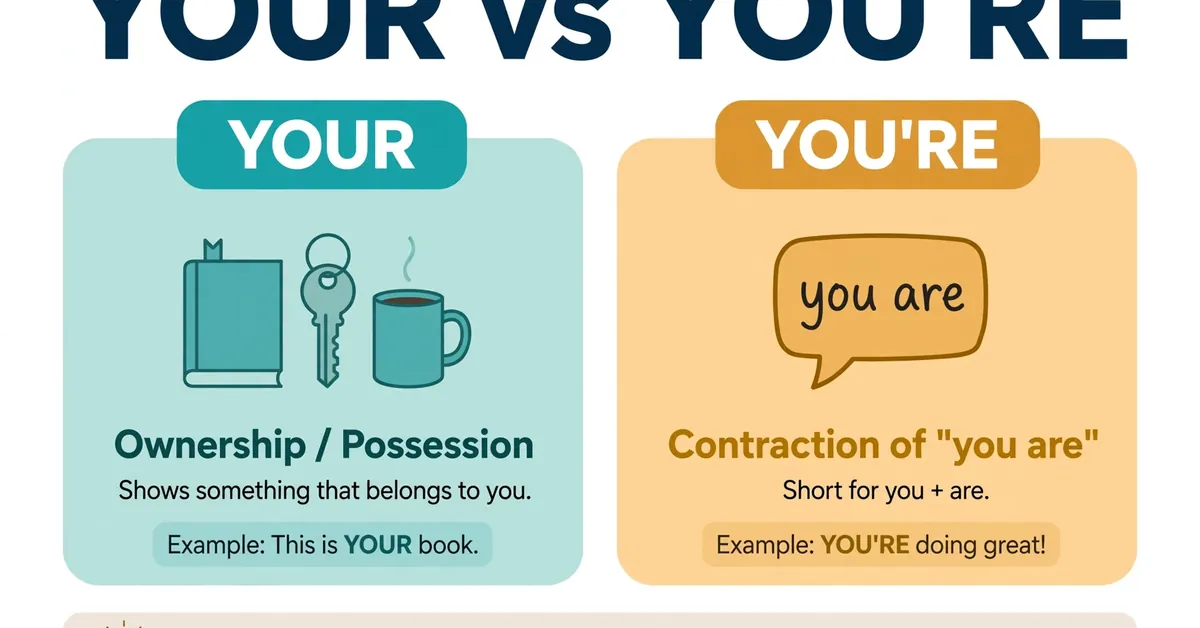
“Your” is a possessive determiner. That is the grammar term, but the idea is simple: “your” shows that something belongs to or is connected with the person you are talking to. It points at ownership, association, or relationship. Whenever you use “your,” you are answering the question “whose is it?” — and the answer is always “yours.”
Think of “your” as a member of a family of words that includes “my,” “his,” “her,” “its,” “our,” and “their.” They all behave the same way: they sit in front of a noun and tell you whose thing it is. My book, his car, her idea, their house, and — your opinion. The structure never changes.
One rule you can rely on completely: “your” is always followed by a noun or a noun phrase. It can never stand alone at the end of a sentence. If you find yourself writing “your” with nothing after it, something has gone wrong. For those stand-alone situations, English has a separate word: “yours,” as in “This seat is yours.”
How “Your” Works in a Sentence
The grammar of “your” is refreshingly consistent. It comes before the noun it describes, and it never changes form — no plural version, no apostrophe, no exceptions. “Your dog,” “your opinions,” “your decision,” “your responsibility.” The word stays exactly the same every time.
“Your” can also describe things that are not physically owned. We say “your turn” at a board game, “your idea” in a meeting, “your health” in a doctor’s office, and “your response” in a letter. None of these are objects you can hold, but all of them are connected to you — and that connection is exactly what “your” expresses.
Everyday Examples of “Your”
Here are some common sentences where “your” is the correct and only choice:
- Is this your jacket or mine?
- I really admire your patience.
- Please bring your notebook to class.
- Your flight leaves at seven in the morning.
- Don’t forget your keys — you left them on the counter yesterday too.
- Your feedback helped us improve the project.
- What is your favorite part of the weekend?
- Your kindness made a real difference to everyone involved.
In every one of these sentences, try replacing “your” with “my” or “his.” If the sentence still makes sense — “my jacket,” “his patience,” “my notebook” — then “your” is correct. That is a handy backup test you can use whenever you are unsure.
What Does “You’re” Mean?
“You’re” is a contraction — a shortened form — of the two words “you are.” Whenever you see the apostrophe in “you’re,” it is doing a real job: it marks the spot where the letter “a” from “are” was dropped. Say “you are” quickly a few times, and you can hear why English speakers naturally squashed the two words into one.
Unlike “your,” which points at ownership, “you’re” contains two grammatical ideas in a single word: a subject (“you”) and a verb (“are”). Because of that, it always says something about the person being addressed — what they are doing, what they are feeling, or what they are like. “You’re smiling,” “you’re tired,” “you’re the best person for the job.”
The one-word test is all you need: if you can expand it back to “you are” and the sentence still works, “you’re” is correct. This single rule resolves nearly every “your or you’re” dilemma you will ever face.
What the Apostrophe Really Does
English contractions follow a consistent pattern, and once you see it, “you’re” feels much less mysterious. The apostrophe always stands in for the missing letters:
- You’re = you are (the “a” is dropped)
- It’s = it is (the “i” is dropped)
- They’re = they are (the “a” is dropped)
- Don’t = do not (the “o” is dropped)
- I’m = I am (the “a” is dropped)
Notice something important: apostrophes in contractions never signal possession here. That is a separate job for the apostrophe, and confusing the two is exactly what creates mistakes like “your’s.” With “you’re,” the apostrophe always means “letters are missing,” nothing more.
Everyday Examples of “You’re”
Here are sentences where “you’re” is the correct choice — each one expands cleanly to “you are”:
- You’re going to love this movie. (You are going to love this movie.)
- I think you’re right about the schedule. (I think you are right about the schedule.)
- You’re welcome to join us anytime. (You are welcome to join us anytime.)
- Are you’re sure about that? — no wait, that one is wrong. The correct form is: Are you sure about that? (This is the trap we will cover later.)
- You’re making excellent progress. (You are making excellent progress.)
- Whenever you’re ready, we can start. (Whenever you are ready, we can start.)
- I hope you’re feeling better today. (I hope you are feeling better today.)
- You’re the reason this team works so well. (You are the reason this team works so well.)
The Key Difference Between “Your” and “You’re”
So far we have looked at each word on its own. On the other hand, seeing them side by side makes the distinction impossible to miss. The difference comes down to one question: are you talking about something that belongs to someone, or are you saying what someone is or is doing?
| Feature | Your | You’re |
|---|---|---|
| Meaning | Belongs to you / connected with you | You are (contraction) |
| Part of speech | Possessive determiner | Subject + verb (pronoun + “are”) |
| Followed by | A noun or noun phrase | An adjective, verb, or noun phrase describing you |
| The expansion test | Cannot be replaced with “you are” | Can always be replaced with “you are” |
| Example | That is your decision. | You’re making a good decision. |
| Wrong version fails because | “That is you are decision” is nonsense | “You are making a good decision” still works |
Read any row of that table and the rule snaps into focus. “Your decision” works because “decision” is a thing connected to you. “You’re making” works because the sentence is describing what you are doing. Swap them — “that is you’re decision” or “your making a good decision” — and the grammar collapses immediately.
Here is one more way to feel the difference: put the two words in the same sentence. “Your friend is here, and you’re going to be thrilled to see her.” The first word points at a relationship (your friend), the second describes a state of being (you are going to be thrilled). Once you can read a sentence like that and explain why each word is correct, you have truly mastered the pair.
The “You Are” Replacement Test
If this guide left you with only one tool, it should be this test. It takes about three seconds, it works in nearly every situation, and it never requires you to remember any grammar terms. Here is exactly how to use it.
Step 1: Find the spot in your sentence where you are unsure which word to use.
Step 2: Mentally replace the word with “you are.”
Step 3: Read the sentence back to yourself.
- If the sentence still makes sense with “you are” in it, the answer is you’re.
- If the sentence falls apart with “you are” in it, the answer is your.
Step 4: Then write the correct word with confidence and move on.
Let us walk through a few real examples together.
Example 1: “___ going to be late for the meeting.”
Replace: “You are going to be late for the meeting.” That sounds perfectly natural, so the answer is you’re. Final sentence: “You’re going to be late for the meeting.”
Example 2: “Is that ___ umbrella on the floor?”
Replace: “Is that you are umbrella on the floor?” That is clearly nonsense, so the answer is your. Final sentence: “Is that your umbrella on the floor?”
Example 3: “I believe ___ the right person for this role.”
Replace: “I believe you are the right person for this role.” Natural and correct, so the answer is you’re. Final sentence: “I believe you’re the right person for this role.”
Example 4: “Please send me ___ report by Friday.”
Replace: “Please send me you are report by Friday.” Nonsense again, so the answer is your. Final sentence: “Please send me your report by Friday.”
Practice this test on a few of your own sentences and it will become automatic within days. Many strong writers run it silently in their heads every time they type one of these words — it is not a beginner’s crutch, it is a professional habit.
Using “Your” and “You’re” in Different Contexts
The grammar rules never change, but the stakes and the style do. How “your” and “you’re” show up in a casual text is different from how they show up in a cover letter, and knowing the expectations of each setting helps you write with the right tone.
Everyday Conversation and Texting
In texts, chats, and social media posts, people write quickly and informally — which is exactly when these two words get tangled. “Your the best!!!” and “your welcome lol” are everywhere online, and most people will understand what you meant. But even in casual writing, getting it right makes your message look sharper and more thoughtful.
That said, contractions like “you’re” are completely natural in informal writing. Nobody texts “you are coming to the party, right?” — they text “you’re coming to the party, right?” Using “you’re” is not sloppy; it is how real people actually write. The only thing that looks off is using the wrong one.
Work and Business Emails
This is where the distinction starts to matter professionally. A message that says “I have attached you’re invoice” tells your client or manager something you did not intend — that the details were not checked. In a job application or a client proposal, a single “your/you’re” slip can quietly undermine the credibility of everything around it.
The good news is that business emails are the easiest place to get this right, because you can slow down and run the replacement test before hitting send. A practical tip: search your draft for “your” and “you’re” before sending anything important, and test each one. It takes thirty seconds and it catches mistakes that rereading often misses, because your eyes tend to skip over familiar words.
Also note that in very formal business writing, many style guides recommend avoiding contractions altogether — writing “you are” instead of “you’re.” That does not make “you’re” wrong in a normal professional email, but in a legal document or an academic paper, the uncontracted form is the safer choice.
Formal and Academic Writing
In academic essays, reports, and official documents, the expectation is full grammatical precision. Use “your” for possession and “you are” (usually uncontracted) for the verb form. Since readers in these contexts judge the writing closely, this is the last place you want a homophone error.
One subtle academic point: “your” can also be used in a general, impersonal sense, as in “In your average experiment, the control group stays unchanged.” Here it does not mean “belonging to the reader” — it means something like “a typical” or “anyone’s.” This usage is standard and correct, so do not let it confuse you.
Common Mistakes to Avoid
Let us look at the errors that show up most often, why they happen, and how to fix them for good.
1. “Your welcome” instead of “You’re welcome.”
This is probably the single most common “your/you’re” mistake in English. The phrase means “you are welcome,” so the apostrophe version is required. Test it: “You are welcome to join us” works; “Your welcome to join us” does not. Whenever you write this polite phrase, write you’re welcome.
2. “Your going to love this” instead of “You’re going to love this.”
Any sentence about what someone is doing or is about to do needs the contraction. “You are going to love this” passes the test, so it must be you’re going to love this. The same fix applies to “your invited,” “your hired,” and “your doing great” — all of these need “you’re.”
3. “I like you’re car” instead of “I like your car.”
This is the reverse error: using the contraction where possession is needed. “I like you are car” is nonsense, this shows the answer must be “your.” Whenever the word sits directly in front of a thing — your car, your idea, your turn — the apostrophe-free version is the only correct one.
4. “Your the best” instead of “You’re the best.”
A compliment gone grammatically wrong. “You are the best” is what the sentence means, so the contraction is required: You’re the best. Fast typing causes this one, not ignorance — but the fix is the same replacement test.
5. Why autocorrect never catches these.
It is worth understanding why technology cannot rescue you here. Spell checkers flag words that are not in the dictionary, and both “your” and “you’re” are legitimate words. Grammar checkers have improved and now catch many of these errors, but they are unreliable with complex sentences and they cannot read your intention. The human brain, armed with the replacement test, remains the most reliable checker available.
Tricky Cases and Edge Cases
Most sentences are straightforward, but a few situations deserve special attention because they confuse even careful writers.
“Your’s” Is Never Correct
This deserves its own section because the error is so common: “your’s” is not a word in English. The possessive form of “you” is “your” before a noun (“your book”) and “yours” when it stands alone (“the book is yours”). There is no apostrophe in either one.
The confusion is understandable — we add apostrophe-s for possession with nouns (“the dog’s bone,” “Maria’s car”), so it feels logical to write “your’s.” But pronouns play by different rules: his, hers, its, ours, theirs, and yours never take apostrophes. If you catch yourself typing “your’s,” simply delete the apostrophe.
Using “You’re” in Questions
“You’re” works in questions just like it does in statements, and this is where some writers hesitate. Both of these are perfectly correct:
- You’re coming to dinner, aren’t you? (You are coming to dinner, aren’t you?)
- When are you leaving? (Here the answer is “you,” not “you’re” — “when are you are leaving” fails the test, which is exactly how the test protects you.)
The second example is the trap: because the sentence already contains “are,” adding “you’re” would create “you are are,” which is obviously wrong. Running the replacement test makes the right choice obvious every time.
Homophone-Adjacent Confusions
The “your/you’re” problem belongs to a bigger family of sound-alike mix-ups, and they all respond to the same kind of thinking. The most famous relative is their / there / they’re: “their” shows possession (their car), “there” points to a place (over there), and “they’re” contracts “they are.” If you can master “your/you’re,” you already have the mental tools for that trio too.
Another close cousin is its vs. it’s. The pattern is identical: “its” shows possession without an apostrophe (the dog wagged its tail), while “it’s” contracts “it is” (it’s raining). Once you internalize the rule — apostrophe means missing letters, no apostrophe means possession — a whole category of English errors disappears at once.
Frequently Asked Questions
What is the difference between your and you’re?
“Your” is a possessive determiner that shows ownership or connection — as in “your book,” “your idea,” or “your turn.” “You’re” is a contraction of “you are” — as in “you’re welcome” or “you’re right.” The quickest way to tell them apart is the replacement test: if “you are” fits in the sentence, use “you’re”; if it does not, use “your.”
How can I remember when to use your vs. you’re?
Use the “you are” replacement test every time you hesitate. Replace the word with “you are” and read the sentence aloud. “You’re going to love it” becomes “You are going to love it,” which works — so “you’re” is correct. “Is that your bag?” becomes “Is that you are bag?” which is nonsense — so “your” is correct. After a week of doing this consciously, the right choice starts to feel automatic.
Is “your’s” ever correct in English?
No, never. “Your’s” is not a valid English word. The possessive forms of “you” are “your” (used before a noun, as in “your house”) and “yours” (used on its own, as in “the house is yours”). Pronouns like his, hers, its, ours, theirs, and yours never take apostrophes for possession — that rule is reserved for nouns, as in “the cat’s whiskers.”
Why doesn’t spell check catch your/you’re mistakes?
Spell checkers only flag words that are misspelled or missing from the dictionary, and both “your” and “you’re” are correct English words. To the software, “your the best” looks like a valid sentence because every word in it is spelled correctly — the error is grammatical, not spelling. Modern grammar checkers catch some of these mistakes, but they are inconsistent, so the replacement test remains the most dependable method.
Can I use “you’re” in formal writing?
It depends on how formal. In a normal professional email, “you’re” is perfectly acceptable — it is natural, clear, and correct. In highly formal documents such as legal writing, academic papers, or official reports, style guides generally recommend avoiding all contractions and writing “you are” in full. When in doubt, the uncontracted form is always the safer choice in formal contexts.
Conclusion
The “your or you’re” confusion looks intimidating only because the two words sound identical. Once you see that one shows possession and the other is simply “you are” squeezed together, the mystery dissolves — and the replacement test gives you a three-second tool that works in every sentence you will ever write.
So the next time your fingers hesitate over these two words, pause, expand the word to “you are,” and let the sentence itself tell you the answer. It is a small habit, but it is the difference between writing that looks careless and writing that reads with total confidence.
Explore more on Synonynmsof.