
The phrase “with that being said” shows up everywhere. You will hear it in corporate boardrooms, layout syncs, weekly stand-ups, high-production podcasts, viral YouTube essays, professional email threads, and casual coffee chats. Once you train your ears to spot it, you realize just how ubiquitous it truly is.
Sometimes it fits perfectly into a conversation. Other times, it is used as a verbal crutch to fill dead air.
The interesting thing about “with that being said” is that it is far more than just a functional transition phrase; it acts as a complex tool for social communication. People intuitively lean on it to shift tones, introduce stark contrasts, soften disagreements, inject critical nuance, and bridge the gap between two opposing ideas. It makes the speaker sound thoughtful while keeping the conversation flowing smoothly.
However, a serious problem arises when this phrase is overused. When repeated endlessly within a single meeting or document, your communication begins to sound generic, overly scripted, robotic, and excessively corporate. It strips away the human element of your speech and replaces it with artificial filler.
The good news? You do not need to banish this phrase from your vocabulary entirely. Instead, you need to understand exactly what it means, why people lean on it so heavily, when it truly shines, and how to swap it out for cleaner options.
This comprehensive guide breaks down the core psychology of this transitional workhorse, provides structural blueprints for your writing, and delivers exactly 28 distinct, professional alternatives to elevate your communication and keep your style fresh, confident, and distinctively human.
1. Demystifying the Phrase: Meaning and Mechanics
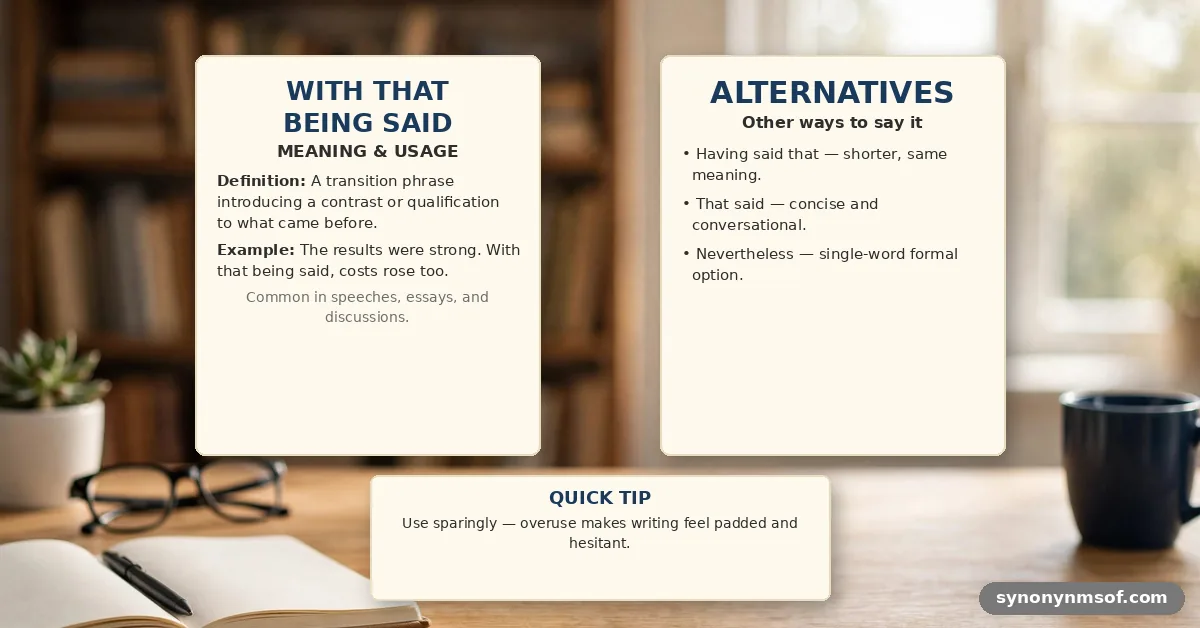
At its structural root, the phrase “with that being said” functions as a transitional adverbial phrase. It translates directly to:
“Now that we have acknowledged and fully considered the preceding statement, we must immediately introduce a contrasting, qualifying, or pivoting point that modifies it.”
It serves as a mental signaling device for your audience. It tells their brains: “Hold onto the information I just gave you, because I am about to hand you a second piece of information that changes how you should view the first.”
Consider this basic workplace dynamic:
- The Set-up: “Our development team hit every single milestone ahead of schedule this quarter.” (This is positive news, establishing a baseline of success).
- The Pivot: “With that being said, our customer acquisition costs have spiked by 15%, which means we cannot afford to celebrate just yet.” (This introduces critical, contrasting pressure).
Without that transition, jumping directly from the praise to the critique feels incredibly jarring: “Our development team hit every single milestone ahead of schedule this quarter. Our customer acquisition costs spiked by 15%.”
By using a transitional bridge, you prepare the listener emotionally and intellectually for the shift in direction, preserving the relationship between both facts.
2. Quick Comparison Guide: Key Transitions at a Glance
Before exploring the expanded list of alternatives, use this reference table to evaluate how different transitions alter the tone and structural impact of your sentences.
| Alternative Phrase | Editorial Tone | Optimal Context | Structural Impact |
|---|---|---|---|
| That said | Clean, minimalist | Fast-paced executive briefs | Strips out unnecessary syllables while maintaining an elegant contrast. |
| However | Traditional, authoritative | Academic papers, formal business cases | Signals a definitive, logical counter-argument with absolute clarity. |
| Even so | Empathetic, resilient | Team alignment meetings, sensitive feedback | Validates the preceding premise completely before introducing a hurdle. |
| Still | Punchy, conversational | Direct Slack messages, informal emails | Cuts through corporate fluff to deliver an immediate, focused reality check. |
| At the same time | Balanced, multi-dimensional | Strategic planning, risk assessment | Highlights two competing truths that must coexist simultaneously. |
| Nevertheless | Sophisticated, formal | Annual reports, legal or board correspondence | Adds dramatic weight and polish to a stubborn, unchanging conclusion. |
| On the other hand | Analytical, comparative | Comparative market analysis, option testing | Clearly divides two distinct pathways, scenarios, or viewpoints. |
| Despite that | Resolute, direct | Project management recovery plans | Emphasizes that the second point actively defies the obstacles of the first. |
3. 28 Alternative Ways to Say “With That Being Said”
To stop relying on a single overused phrase, you need a diverse toolkit of expressions. Here are 28 distinct alternatives, categorized by communication style, so you can find the exact match for your specific context.
The Ultra-Concise Minimalists
These alternatives keep your sentences lean, punchy, and modern. They strip away corporate fluff and deliver your message with high clarity.
- 1. That said
- Why it works: It is the direct, younger sibling of the primary phrase. It slashes three unnecessary words while retaining the exact same logical function.
- Example: “The production timeline for this project is incredibly tight. That said, I have complete faith in our engineering team’s ability to deliver.”
- 2. Still
- Why it works: Monosyllabic, sharp, and highly effective. It commands attention without wasting time.
- Example: “We missed our initial sales targets for the first half of Q3. Still, the pipeline for Q4 looks stronger than it ever has.”
- 3. Yet
- Why it works: Perfect for tight, impactful written structures where you need to introduce an immediate counter-point.
- Example: “The software update patch resolves the primary security vulnerability. Yet, user experience testing shows it introduces minor interface lag.”
- 4. But
- Why it works: The ultimate minimalist transition. While old-school grammar rules discouraged starting sentences with a coordinating conjunction, modern business communication embraces it for its direct energy.
- Example: “We could theoretically invest our remaining budget into paid ads. But we might see a much higher long-term ROI by focusing entirely on organic content.”
The Formal Corporate Standards
Use these options when writing formal documentation, pitching to external stakeholders, or communicating with executive leadership teams where an authoritative tone is essential.
- 5. However
- Why it works: The gold standard of professional transitions. It clearly signals a logical turn without adding emotional weight.
- Example: “The initial demographic data indicates a strong preference for our legacy interface. However, younger users are actively demanding a mobile-first overhaul.”
- 6. Nevertheless
- Why it works: It carries an elegant, formal weight that signals resolve and determination in the face of challenges.
- Example: “The logistical disruptions disrupted our supply chain for nearly three weeks. Nevertheless, our distribution network managed to fulfill every backorder on time.”
- 7. Nonetheless
- Why it works: Virtually identical to nevertheless, but offers a slight variation in syllable cadence to keep your prose from sounding repetitive.
- Example: “The marketing campaign did not achieve the viral reach we initially projected. Nonetheless, it generated highly qualified leads that converted at a record rate.”
- 8. In spite of this
- Why it works: Explicitly draws attention to the obstacle mentioned in the first point, demonstrating that the upcoming point succeeds because it overcame that hurdle.
- Example: “Interest rates have continued to climb over the last fiscal year. In spite of this, our real estate portfolio has expanded steadily.”
- 9. Despite this fact
- Why it works: Adds strong emphasis, rooting the transition in objective reality before introducing a contrasting point.
- Example: “The competitor launched a copycat product with a much lower price point. Despite this fact, our user retention metrics remained completely stable.”
See Also: 35+ Other Ways to Say “I’m Proud of You” (With Meaning, Examples, and When to Use Them)
The Multi-Dimensional Evaluators
These choices shine when you are managing complex strategies, analyzing nuanced metrics, or dealing with situations where two conflicting realities must be weighed against one another.
- 10. At the same time
- Why it works: It reminds the audience that business environments are rarely black and white; multiple variables can run parallel to each other.
- Example: “We need to aggressively scale our engineering headcount to meet user demands. At the same time, we must protect our unique company culture from diluting too quickly.”
- 11. On the other hand
- Why it works: The classic comparative tool, ideal for laying out two distinct strategic pathways during a presentation or proposal.
- Example: “Choosing the proprietary software package gives us immediate, out-of-the-box functionality. On the other hand, building an in-house solution grants us complete creative control.”
- 12. Conversely
- Why it works: A highly intellectual transition that tells the reader you are about to look at the exact mirror image or opposite side of the current point.
- Example: “An excessive abundance of features can overwhelm a novice user. Conversely, a bare-bones interface might completely alienate your power users.”
- 13. In contrast
- Why it works: Clean and analytical, this phrase sets up an objective comparison between two distinct data sets, teams, or timeframes.
- Example: “Our European division saw an unprecedented surge in organic winter traffic. In contrast, our North American division experienced a minor plateau.”
- 14. Mind you
- Why it works: Adds a touch of conversational sophistication. It urges the listener to keep an important caveat in mind so they don’t misinterpret the primary message.
- Example: “Our new automation workflow cuts down manual data entry hours by half. Mind you, our operations team will still need to perform weekly quality checks.”
The Empathetic Diplomat Options
These phrases are perfect for performance reviews, delicate strategic pivots, or any scenario where you must deliver constructive criticism without damaging morale.
- 15. Even so
- Why it works: This phrase shows deep empathy. It signals that you fully hear, respect, and validate the first point, even though circumstances force you to pivot.
- Example: “I know the entire creative team pulled all-nighters to get this mock-up finalized. Even so, the client has fundamentally changed their brand direction, requiring a full rewrite.”
- 16. Having said that
- Why it works: A smooth, human alternative that feels natural in speech. It acknowledges your own active role in stating the initial fact before expanding upon it.
- Example: “We certainly have the capital reserves required to acquire this smaller studio. Having said that, we must ask ourselves if we have the management bandwidth to integrate them.”
- 17. All the same
- Why it works: Carries a gentle, grounded tone that helps de-escalate tension or panic during a crisis.
- Example: “The server migration went smoothly and resulted in zero data loss. All the same, I want our IT team on high alert for the next 48 hours.”
- 18. Vis-à-vis this point
- Why it works: A sophisticated, highly targeted way to pivot by looking directly at the relationship between the previous concept and the next action item.
- Example: “Our user acquisition has plateaued over the last quarter. Vis-à-vis this point, we need to completely reallocate our budget toward retention marketing.”
- 19. That fact notwithstanding
- Why it works: A highly professional, legalistic turn of phrase that adds serious authority to a conclusion.
- Example: “The regional branch faced unprecedented weather disruptions this month. That fact notwithstanding, the quarterly revenue targets must still be met.”
Must read : 35+ other ways to say “I Hope You Had a Great Weekend” (With Examples)
The Direct Realists
When you need to cut through a long debate, stop over-analyzing a problem, and ground the room in pragmatic reality, use these direct alternatives.
- 20. Regardless
- Why it works: Drops a clean barrier behind the previous discussion, signaling that no matter what happened in the past, the next point is what requires immediate action.
- Example: “We can spend weeks debating whether the algorithm update was fair or unfair. Regardless, we need to adjust our current SEO metadata strategy today.”
- 21. Even with that context
- Why it works: Explicitly acknowledges the nuance or excuses provided in the first part of the sentence, but firmly notes that the operational reality remains unchanged.
- Example: “Our vendor experienced unexpected shipping delays due to global customs backlogs. Even with that context, our retail partners expect their shelves stocked by Friday.”
- 22. Looked at another way
- Why it works: Reframes the issue entirely. It encourages a team to step away from a negative outlook and view the problem as a hidden opportunity.
- Example: “Losing our primary enterprise account is a massive hit to our short-term MRR. Looked at another way, it frees up our support staff to focus on hundreds of scaling mid-market clients.”
- 23. Then again
- Why it works: Adds an approachable, self-correcting quality to your speech. It mimics natural thought patterns, making you sound transparent and relatable.
- Example: “We could choose to play it completely safe and stick with our legacy product line indefinitely. Then again, sitting still in this fast-moving tech landscape is a massive risk in itself.”
- 24. That point accepted
- Why it works: Highly collaborative. It acts as a verbal nod of agreement, telling your conversation partner that their point is completely accepted before you offer a vital counter-argument.
- Example: “I agree that expanding into the APAC market will require a massive upfront capital investment. That point accepted, the long-term growth potential makes it an option we cannot ignore.”
The Analytical Finishers
These options are ideal for wrap-up presentations, executive summaries, or data-driven conclusions where you need to state a final, balancing reality.
- 25. On the flip side
- Why it works: A casual yet professional idiom that lightens the mood of a presentation while clearly setting up a sharp contrast.
- Example: “Adopting this strict security framework will naturally slow down our internal deployment speeds. On the flip side, it guarantees our enterprise customer data remains entirely secure.”
- 26. With this in mind
- Why it works: Functions less as a direct opposition and more as a logical stepping stone, using the context of the first point to justify the strategy of the second point.
- Example: “Our core target demographic is rapidly moving away from desktop applications. With this in mind, our engineering roadmap for the next two years must prioritize mobile-first development.”
- 27. Against that background
- Why it works: Highly descriptive. It transforms the first point into a historical backdrop, allowing the second point to stand out clearly in the foreground.
- Example: “The industry is experiencing a widespread venture capital slowdown. Against that background, our ability to secure an independent seed funding round is a massive win.”
- 28. Alternately
- Why it works: Clean, decisive, and efficient. It tells your reader that you are presenting a distinct, competing option or outcome for their immediate consideration.
- Example: “We could invest heavily in traditional PR campaigns to rebuild our brand authority. Alternately, we could partner directly with trusted micro-influencers within our niche.”
4. The Deep Psychology of Corporate Transitions
Why do human beings lean so heavily on phrases like “with that being said”? The answer lies deep within interpersonal communication psychology and emotional diplomacy.
When you work within a team, directly contradicting someone or shifting a conversation too abruptly can feel jarring. If a manager says, “Your report was incredibly detailed. You completely missed the core revenue projections,” it sounds sharp and aggressive. The brain registers it as an attack.
By inserting an intentional transition, you create a conversational buffer zone:
[Positive Validation] ➔ ➔ ➔ ➔ [Transitional Buffer Zone] ➔ ➔ ➔ ➔ [Constructive Critique]
"Your report was detailed."    "With that being said..."            "We must fix the revenue numbers."
This buffer gives the listener a brief moment to process the initial praise before adjusting to the critique. It signals that you are not dismissing their hard work; rather, you are adding an important second layer to the conversation.
However, this verbal safety net becomes a problem when used unconsciously as a filler phrase. Much like “um,” “uh,” or “like,” corporate professionals often use “with that being said” to buy time while their brain figures out what to say next.
When you rely on it as a filler phrase, it loses all its psychological power and starts to signal hesitation rather than careful thought.
5. Structural Blueprints: Real-World Communication Makeovers
To understand the difference these alternatives can make, let’s look at a few common communication channels and see how swapping out this overused phrase improves clarity and impact.
Scenario A: The High-Stakes Project Status Update Email
The Original Wordy Version
Hi Leadership Team,
I wanted to provide a quick update on our infrastructure migration. The engineering team has successfully migrated 85% of our core user databases to the new cloud server architecture without experiencing any critical downtime.
With that being said, we have run into unexpected configuration errors regarding our legacy API keys. This will likely delay the final wrap-up phase by roughly four business days. With that being said, our core application remains entirely functional for our daily users.
Best regards,
Project Lead
The Refined Professional Version
Hi Leadership Team,
I wanted to provide a quick update on our infrastructure migration. The engineering team has successfully migrated 85% of our core user databases to the new cloud server architecture without experiencing any critical downtime.
However, we have run into unexpected configuration errors regarding our legacy API keys, which will likely delay the final wrap-up phase by roughly four business days. That said, our core application remains entirely functional for our daily users, and there is zero impact on the end-user experience.
Best regards,
Project Lead
Why this makeover works: The original email felt incredibly repetitive because it used the exact same long phrase twice in just two paragraphs. The refined version uses “However” to introduce the technical hurdle and swaps in “That said” for a quick, confident conclusion.
Scenario B: Constructive Feedback During a Performance Review
The Original Wordy Version
“Sarah, you did an absolutely incredible job leading the client onboarding sprint this past month, and the client explicitly praised your responsiveness. With that being said, I noticed that your internal documentation updates fell behind during the rush. With that being said, I need you to prioritize cleaning up those shared files this week so the rest of the support team can stay aligned.”
The Refined Professional Version
“Sarah, you did an absolutely incredible job leading the client onboarding sprint this past month, and the client explicitly praised your responsiveness. At the same time, I noticed that your internal documentation updates fell behind during the rush. Still, I want to make sure the rest of the support team stays aligned, so let’s prioritize cleaning up those shared files before Friday.”
Why this makeover works: In spoken reviews, using corporate clichés can make your feedback feel cold and scripted. By swapping those out for “At the same time” and “Still,” the manager sounds supportive, human, and direct, ensuring the employee feels valued while receiving clear guidance.
6. How to Build Long-Term Natural Flow
If you want to sound authentic, build professional trust, and break free from repetitive corporate speech patterns, focus on these three practical strategies:
1. Embrace the Power of the Pause
When you feel the urge to say “with that being said” just to buy time while thinking, pause instead. A deliberate, two-second silence signals confidence, comfort, and control. It gives the room a moment to absorb your last point before you deliver the next one.
2. Vary Your Structural Pace
Mix up short and long sentences to keep your writing engaging. If you use a long, complex sentence to explain a piece of data, follow it with a short transition.
Instead of writing:
“Our user churn rate dropped significantly after the patch; with that being said, we need to monitor it.”
Try writing:
“Our user churn rate dropped significantly after the product patch. Still, we must monitor it.”
3. Review Your Communication Analytics
Take a look at your sent email folder or review a transcript of your recent presentations. Highlight every time you used repetitive phrases like “with that being said,” “circle back,” or “at the end of the day.”
Identifying your personal verbal habits is the single fastest way to replace them with cleaner, more effective alternatives.
Frequently Asked Questions
What exactly does “with that being said” mean?
It means “after fully considering the point that was just made, we must now introduce a contrasting or qualifying fact.” It is a transition phrase used to connect two opposing ideas without completely dismissing the first point.
Is using “with that being said” considered professional?
Yes, it is entirely professional and widely accepted in business, academic, and public speaking environments. However, it only sounds professional when used in moderation. If you repeat it multiple times in a single meeting or document, it can sound repetitive and scripted.
What is the absolute best alternative to “with that being said”?
The best direct alternative is “That said.” It serves the exact same logical purpose, maintains a professional tone, and trims out three unnecessary words, making your sentences cleaner and faster to read.
Why do corporate professionals overuse transition phrases so often?
People often use long transition phrases as a verbal safety net. It gives them a moment to think about what to say next during a live meeting, helps soften disagreements, and can be an unconscious habit picked up from corporate speech patterns.
Does shortening your transition phrases make you sound aggressive?
Not at all. Shortening your transitions actually helps you sound more confident, focused, and clear. Using phrases like “However,” “Still,” or “Even so” keeps your tone polite and professional without cluttering your message with unnecessary words.
Should I completely remove “with that being said” from my vocabulary?
No, you do not need to banish it entirely. It is still a useful phrase that works well when you want to soften a difficult conversation or introduce an important caveat. The goal is to use it intentionally alongside other alternatives so your communication stays fresh and natural.
How do I sound more natural in professional emails?
To sound more natural, write the way you actually speak. Swap out overused corporate jargon for direct, everyday words, break up long walls of text with bullet points, and use short, punchy transitions to keep your ideas moving forward smoothly.
Small details matter too — learning when to use maam or ma’am keeps your greetings polished and respectful. Watching out for plural traps like mangoes or mangos sharpens your everyday spelling. Getting possessives right, as in masters or master’s, adds a professional finish to your writing. And clearing up confusions such as monkies or monkeys helps your messages read smoothly.