
Few word pairs trip up writers as often as past or passed. The two sound exactly alike, they both connect to ideas of movement and time, and they show up in nearly identical sentences. That is why even careful writers hesitate before typing: is it “the bus passed us” or “the bus past us”? Pick the wrong spelling and the sentence still sounds fine when read aloud, but on the page it quietly marks the writing as careless.
The good news is that this confusion has a clean, permanent fix. Passed is always a verb — the past tense and past participle of pass. Past is everything else: a noun, an adjective, a preposition, or an adverb, but never a verb. Once you learn which job each word does in a sentence, the choice becomes automatic.
In this guide, you will find the meaning of each word with examples from real writing, a side-by-side comparison, the future-tense test that settles any doubt in seconds, common mistakes to watch for, and the tricky edge cases that fool even experienced writers.
What Does “Past” Mean?
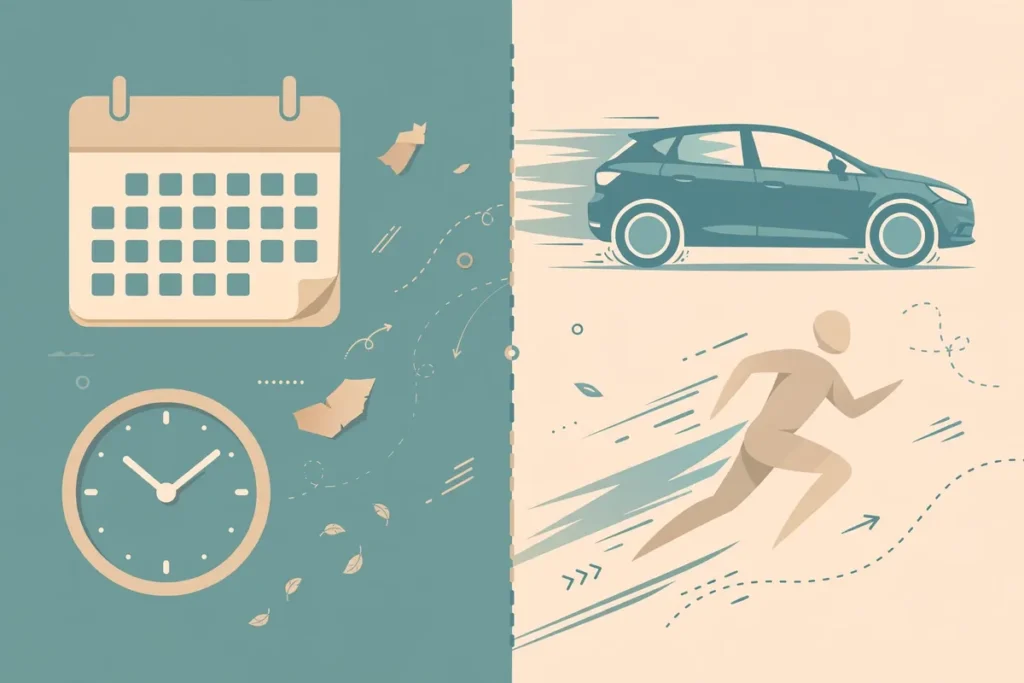
Past is one of the busiest little words in English. It works as four different parts of speech, and it always points to one of two big ideas: time that has already gone by, or a place, point, or limit you have moved beyond. What it never does is act as a verb.
Past as a Noun
As a noun, past means the time before now, or the history of a person or place. You can put “the” in front of it, which is something you can never do with passed.
- “We can learn a lot from the past.”
- “She rarely talks about her past.”
- “The city has a fascinating past.”
- “Let us leave that argument in the past.”
Past as an Adjective
As an adjective, past describes something that has gone by in time or belongs to an earlier period. It sits in front of a noun and tells you when that noun happened.
- “Sales improved over the past year.”
- “He apologized for his past mistakes.”
- “We reviewed the past three quarters of data.”
- “Those traditions belong to past generations.”
Past as a Preposition
As a preposition, past links a verb to a place, a time, or a limit — always with the sense of “beyond” or “later than.”
- “She walked past the bakery without stopping.” (beyond a place)
- “The store is just past the bridge.” (beyond a point)
- “It is half past ten.” (later than a time)
- “We are already past the deadline.” (beyond a limit)
Past as an Adverb
As an adverb, past describes movement from one side of something to the other, or time slipping away.
- “A taxi sped past and splashed the curb.”
- “The weeks flew past before the launch.”
- “He waved as he strolled past.”
- “A month went past with no reply.”
What Does “Passed” Mean?
Passed is much simpler than past because it has only one job: it is the past tense and past participle of the verb to pass. Whenever something or someone moved, succeeded, transferred, ended, or went by, and the action already happened, passed is your word. Unlike past, which changes its role from sentence to sentence, passed never surprises you — if it is not an action, it is not passed.
Passed for Physical Movement
When a person, vehicle, or object moved by, ahead of, or through something, use passed.
- “The train passed through our town at dawn.”
- “She passed me on the stairs without noticing.”
- “A shadow passed across the window.”
- “They passed three small villages before noon.”
Passed for Success and Approval
One of the most common uses of passed has nothing to do with motion at all — it means succeeding at a test or getting something formally approved.
- “He passed his driving test on the second try.”
- “Only four students passed the final exam.”
- “The bill was passed by a narrow vote.”
- “The new policy passed without any objections.”
Passed for Time Going By
When time itself is the thing that moved, passed is the verb doing the work.
- “Three hours passed before she finally called.”
- “The deadline has already passed.”
- “Another year passed, and the shop was still empty.”
- “The pain slowly passed after the medicine kicked in.”
Passed in Everyday Phrases and Idioms
Passed shows up in several fixed expressions worth knowing:
- “Please pass the salt” becomes “He passed me the salt.” (transferring something)
- “They passed away last winter.” (a gentle way of saying someone died)
- “The kids were passed out on the couch.” (fast asleep or unconscious — from the phrasal verb pass out)
- “She passed up a great opportunity.” (chose not to take it — from pass up)
The Key Difference Between Past and Passed
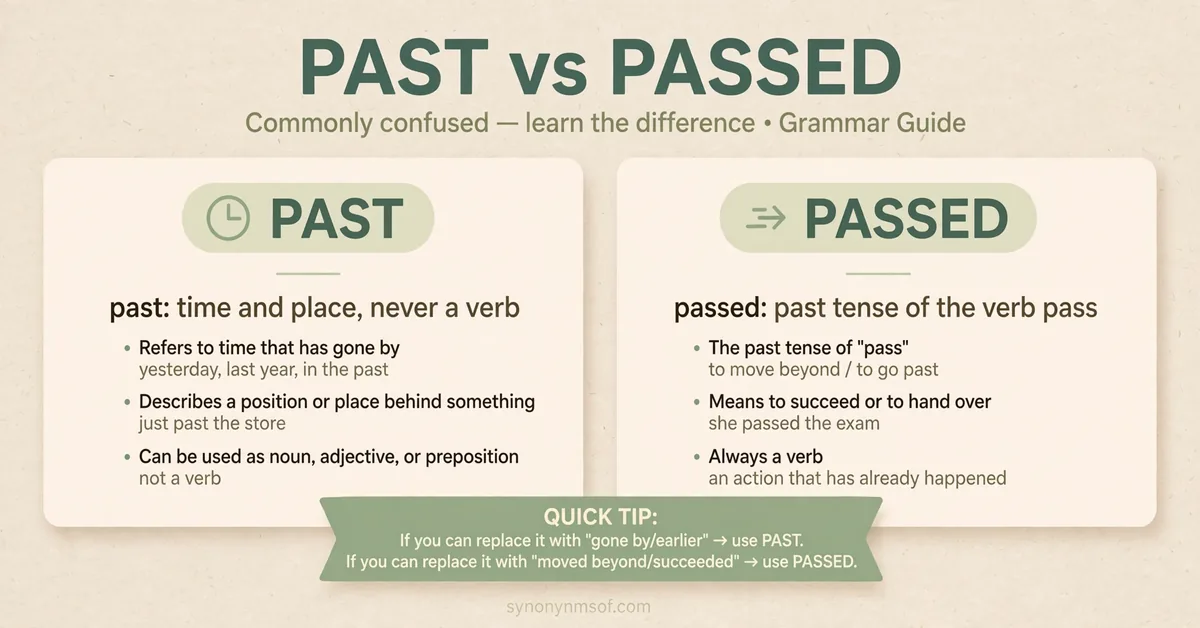
Here is the one rule that ends the confusion: passed is always a verb, and past is never a verb. If the word in your sentence is doing an action — moving, succeeding, transferring, ending — spell it with two s’s: passed. For time, place, position, and description, use past. On the other hand, if nothing in the sentence is acting or happening, past is almost certainly the answer.
The Future-Tense Test
When you are unsure, rephrase the sentence in the future tense and watch what happens to the word. Past stays exactly the same, because it is not a verb and cannot change. Passed turns back into pass, because it is just the past-tense form of that verb.
- “I drove past the park.” → “I will drive past the park.” (unchanged, so past)
- “We passed the entrance.” → “We will pass the entrance.” (changes, so passed)
- “The storm has passed.” → “The storm will pass.” (changes, so passed)
- “It is half past nine.” → “It will be half past nine.” (unchanged, so past)
This trick works on every sentence, every time.
A Simple Memory Trick
Past ends with the letter T, and past is the word for time. Passed is the longer word, and it carries the heavier job of being an action verb. Another quick check: if you can swap the word for “went by” or “moved by” and the sentence still works, you need passed.
| Feature | Past | Passed |
|---|---|---|
| Part of speech | Noun, adjective, preposition, or adverb | Verb only (past tense and past participle of pass) |
| Core meaning | Time gone by; beyond a place, point, or limit | An action: moved, succeeded, transferred, ended |
| Can it be a verb? | Never | Always |
| Future-tense test | Stays the same | Changes back to “pass” |
| Example | “We walked past the lake.” | “We passed the lake on our walk.” |
| Common phrases | In the past, half past ten, past due | Passed away, passed the test, passed out |
Why Is This Pair So Confusing?
The confusion around past or passed is not a sign of weak English — it comes from how the two words overlap in real life. First, they are homophones: they sound exactly the same, so your ear cannot help you choose. Spellcheckers are no rescue either, because both are valid English words and the spellchecker has no idea which job the word is doing in your sentence.
Second, both words live in the same mental neighborhood. Past is the word for time gone by, and passed is the verb you use when time goes by. “The past year” and “the year passed” feel nearly identical in meaning, and both are correct — the difference is only in the grammar underneath. This overlap is what makes the pair harder than most homophones, where the meanings are usually far apart.
Third, past does four different jobs, which makes it the word writers reach for by default. When you are writing fast and need a word that vaguely relates to “before” or “by,” past is the familiar choice — and that is how sentences like “he walked passed the door” get flipped the wrong way around. Writers default to the word they use most often and end up with the wrong one.
Finally, some common phrases blur the line on purpose. “Time passed” and “past time” are both grammatical but mean different things, and hearing them spoken gives you no clue about the spelling. The only reliable way out is the grammar test: ask whether the word is acting as a verb. Everything else — sound, familiarity, spellcheck — will mislead you.
One more source of trouble is how often the correct answer switches inside a single sentence. “We drove past the exit we should have passed” uses both words correctly side by side: the first is position, the second is a missed action. Sentences like this are the real test of whether you have mastered the pair.
Past or Passed in Everyday Usage
In Everyday Conversation
Spoken English mixes these two constantly, which is exactly why the spelling trips people up. In casual talk, you will hear past for time and position and passed for things that happened:
- “We drove past the stadium twice and still passed the exit.” (position, then an action)
- “It is past my bedtime.” (beyond a time — never “passed my bedtime”)
- “He passed the ball to his teammate.” (action, like throwing)
- “In the past, we always met on Sundays.” (time gone by)
- “Just go past the gas station; you cannot miss it.” (beyond a place)
In Work and Business Writing
Professional writing is where this pair matters most, because a wrong spelling in a report or email is easy to spot. Use past when you describe time periods and limits, and passed when you describe completed actions.
- “Revenue grew 12% over the past quarter.” (time period)
- “The motion was passed unanimously by the board.” (an action of approval)
- “These invoices are past due.” (beyond the limit — note this is an adjective phrase)
- “We are past the point of small fixes.” (beyond a limit)
- “She passed the certification exam last Friday.” (an action of succeeding)
- “If time permits, we can review the agenda items we passed over last week.” (skipped — pass over is a verb phrase)
Notice the last example: “passed over” means skipped, and because it is an action, it takes the double-s spelling.
In Formal and Academic Writing
In essays, research, and formal documents, past does most of the heavy lifting as a noun and adjective, while passed appears as a precise verb.
- “Scholars in the past argued that trade shaped the region.”
- “Data from the past decade supports this finding.”
- “The era in question has long since passed.” (the verb: time went by)
- “The amendment was passed in 1998.” (formally approved)
- “Beyond the past lies territory this paper cannot cover.” (the noun form, poetic and formal)
Common Mistakes to Avoid
Even strong writers slip on these. Here are the errors that show up most often, with the correct version beside each one.
- ❌ “He walked passed the store.” → ✅ “He walked past the store.” (preposition of place)
- ❌ “The time has past.” → ✅ “The time has passed.” (verb — time moved)
- ❌ “It is half passed two.” → ✅ “It is half past two.” (telling the time)
- ❌ “Amelia past me before the finish line.” → ✅ “Amelia passed me before the finish line.” (verb — an action)
- ❌ “The bill was past by the Senate.” → ✅ “The bill was passed by the Senate.” (passive verb)
- ❌ “We have gone passed the turn.” → ✅ “We have gone past the turn.” (adverb of movement)
- ❌ “It is passed your bedtime.” → ✅ “It is past your bedtime.” (beyond a time)
- ❌ “In the passed, things were simpler.” → ✅ “In the past, things were simpler.” (noun — “the” can never precede passed)
- ❌ “He past the ball to his teammate.” → ✅ “He passed the ball to his teammate.” (verb — an action, like throwing)
- ❌ “The pain will past eventually.” → ✅ “The pain will pass eventually.” (the verb form changes; past cannot)
- ❌ “She has a colorful passed.” → ✅ “She has a colorful past.” (noun — a person’s history)
A handy shortcut: if the word follows “the,” “a,” “this,” “that,” “my,” or “your,” it is a noun or adjective, so it must be past. You would never write “the passed” or “my passed.”
“Pastime” Is One Word
A related spelling trap: a hobby or way of spending free time is a pastime — one word, with past at the front, not “pass time” or “passed time.” It literally means “passing time,” but the spelling froze centuries ago. If you mean the noun (a hobby), write pastime; if you mean the verb phrase, write “passing the time.”
Watch Out for “Past” With -ed Endings
Sometimes writers add -ed to past by analogy with verbs, producing non-words like “pasted” in the wrong place or “pastt.” Remember: past never changes its form. It is past in every tense, every sentence, every context. Only the verb pass grows an -ed, and when it does, it becomes passed.
Tricky Cases and Edge Cases
“Passed By” vs. “Went Past”
Both of these are correct, but they use different grammar. In “He passed by the window,” passed is the verb and “by” is a preposition — he performed the action of passing. In “He went past the window,” the verb is “went” and past is an adverb describing the movement. Same meaning, different sentence structure. Mixing them into “he passed past the window” is always wrong.
“The Past Week” vs. “The Week Passed”
“The past week was exhausting” uses past as an adjective describing which week. “The week passed slowly” uses passed as the verb — the week itself did the action of going by. When the time phrase comes before the noun, it is past; when the time word is the subject doing something, it is passed.
The Past Participle Trap
Here is a fun one: the past participle of the verb pass is passed, never past. So “the bill has passed” is correct, and “the bill has past” is not. Learners sometimes reason that since it is “the past tense,” the word should be spelled past — but the spelling follows the verb, not the grammar label.
Time Expressions
Clock times always use past: “half past two,” “a quarter past six,” “ten minutes past midnight.” There is no action happening, just a position in time, so the double-s spelling never belongs there.
“Passed Away” and “Passed Out”
These idioms always use passed because they come from verb phrases: pass away (to die) and pass out (to faint or fall asleep). “My grandfather passed away peacefully” and “she passed out from the heat” describe things that happened — actions — so the verb spelling is required.
“Past Due”
“Your payment is past due” looks odd to many writers, but it is correct: past is an adjective here meaning “beyond the due date.” Do not write “passed due.” Similarly, “the time for debate is past” is correct, while “the time for debate has passed” is also correct — in the first, past describes a state; in the second, passed is the verb.
Frequently Asked Questions
Is it “the past week” or “the passed week”?
It is “the past week.” Here past is an adjective describing which week you mean. Passed is a verb and can never sit in front of a noun as a describer, so “the passed week” is always wrong.
Which is correct: “time passed” or “time past”?
Both word orders appear, but in different structures. “Time passed slowly” uses passed as the verb — time did the moving. “A past time” uses past as an adjective before a noun, as in “a past time of plenty.” You would never write “time past slowly.”
Can “passed” ever be used as a noun or adjective?
No. Passed is only ever a form of the verb pass — its past tense and past participle. It cannot be a noun, adjective, preposition, or adverb. If your sentence needs anything other than a verb, you need past.
Is it “half past two” or “half passed two”?
It is “half past two.” Telling the time uses past as a preposition meaning “later than.” Since no action is taking place, the verb spelling passed does not belong in clock times.
How can I quickly check which one to use in a sentence?
Ask two questions. First: is the word doing an action — moving, succeeding, transferring, ending? If yes, use passed. Second, if you are still unsure, rephrase the sentence in the future tense: if the word changes to “pass,” you need passed; if it stays the same, you need past.
Final Thoughts
The past or passed mix-up survives because the words sound identical and share the territory of movement and time. But the rule underneath them is simple and has no exceptions: passed is always a verb, and past is never a verb. Check whether your sentence needs an action, run the future-tense test when in doubt, and the right spelling will follow on its own.
This shows why these two small words deserve a permanent place in your editing checklist — a quick scan for action words versus time words catches the error in seconds. In the end, past and passed ask you only one question: is something happening, or are you talking about time? Answer that, and the spelling answers itself, and this classic mix-up will never slow your writing down again.
Explore more on Synonynmsof.