
Few mix-ups embarrass writers faster than there, their, and they’re. The three words sound exactly the same, spell-checkers glide right past them, and one wrong letter can turn a polished sentence into a joke. Add “thier” — the spelling that pops up in fast typing and autocorrect slip-ups — and you have four shapes of a single sound that trip up native speakers and learners alike.
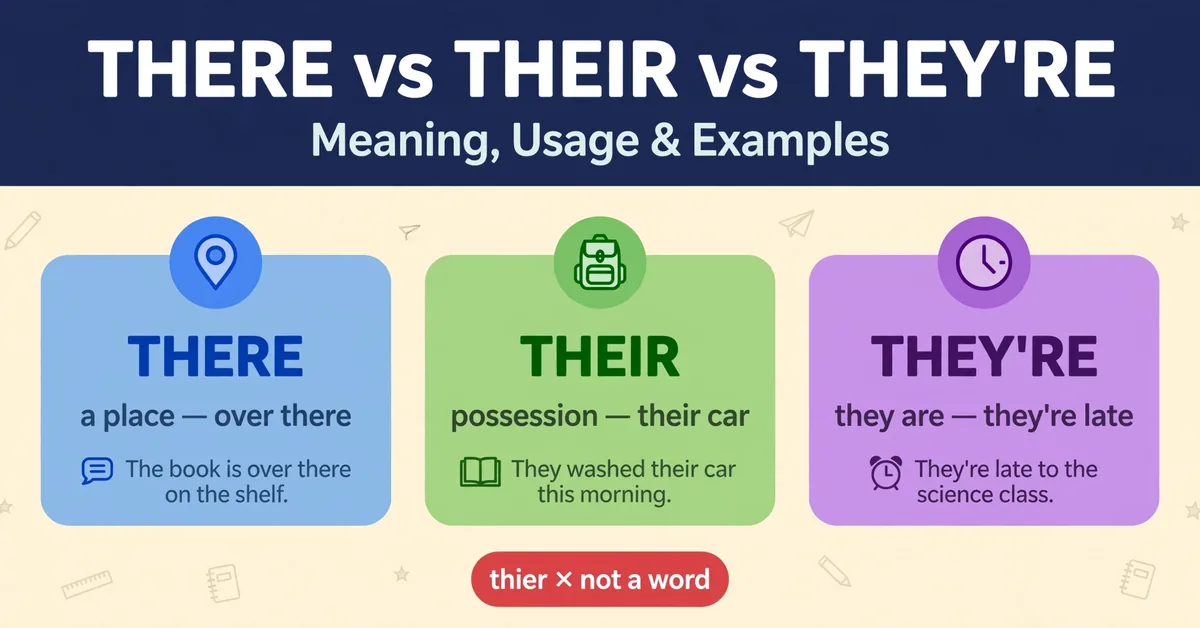
The fix is simpler than most people expect. Each of these words has exactly one job, and once you attach the spelling to the job, the choice becomes automatic. There points to a place or introduces something that exists. Their shows that something belongs to a group. They’re is just “they are” wearing a coat. And “thier”? It is not a word at all — it is the most common typo of the bunch.
In this guide, you will learn what each word means, how the three real ones differ, and how to use them in casual chats, work emails, and formal writing. You will also get a comparison table, plenty of usage examples, the most common mistakes, and memory tricks so the rules stick.
What Does “There” Mean?
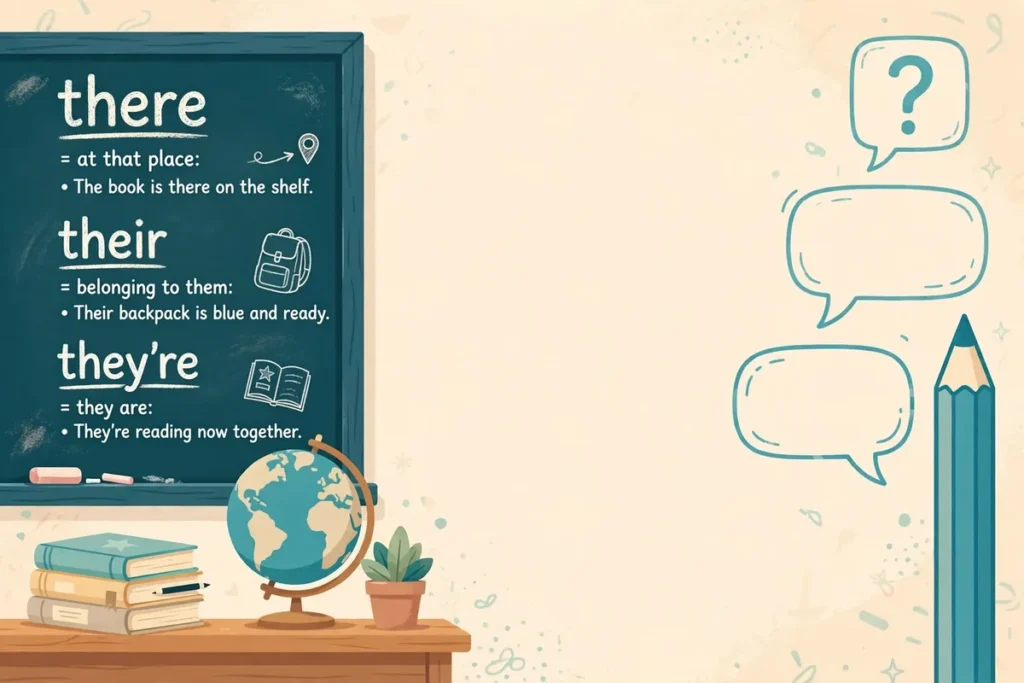
“There” is the busiest word of the group. It does more jobs than the other two combined, and most of those jobs have something to do with pointing — either at a physical place or at the bare fact that something exists.
There as a Place
At its most basic, “there” is an adverb of place. It means “in that place,” and it is the direct opposite of “here.” If you can point a finger at the spot, “there” is probably the word you want.
- “Put the box over there by the door.”
- “I was there last summer, and the beach was beautiful.”
- “There it is! I found your missing key under the couch.”
- “Do not stand there; the paint is still wet.”
- “We could meet there, or we could meet at the cafe.”
Notice the memory trick hiding inside the spelling: the word “here” sits inside “there.” When you mean the location version, think of where you are not — over here, or over there. That tiny visual clue resolves most doubts on its own.
There as an Existence Marker
“There” also appears at the start of sentences that introduce something new, as in “there is” and “there are.” Grammarians call this the existential “there.” It is a placeholder subject that fills the slot before the verb while the real subject comes later.
- “There is a letter on the desk for you.”
- “There are twelve people waiting outside.”
- “Is there anything I can do to help?”
- “There seems to be a delay with our shipment.”
- “There must be a simpler way to do this.”
A common trap lives in this construction: verb agreement. The verb agrees with the noun that follows, not with “there.” That is why “there are twelve people” is right and “there is twelve people” is wrong. In writing, keep the agreement clean: “there is” before a singular noun, “there are” before a plural one.
There in Everyday Expressions
“There” appears in fixed phrases where it no longer points anywhere. Learn these as whole chunks:
- “There you go!” (said when handing someone something, or to mean “exactly right”)
- “There, there.” (said to comfort someone who is upset)
- “Hi there!” (a friendly greeting)
- “There goes my weekend.” (something is about to be lost or spent)
- “Been there, done that.” (expressing familiar experience)
None of these can swap in “their” or “they’re” without breaking. If you catch yourself writing “their you go,” the expression should snap you back to “there” immediately.
What Does “Their” Mean?
“Their” has exactly one job: it shows possession. It is the plural possessive adjective — the form you use when something belongs to a group of people, animals, or things. If the sentence is about whose it is, and the answer is “theirs,” use “their.”
Their as a Possessive
The rule is simple: “their” always sits in front of a noun, and it tells you who owns or is connected to that noun.
- “The kids forgot their jackets at school.”
- “Our neighbors just renovated their kitchen.”
- “The bees returned to their hive before the rain.”
- “Both teams played their best match of the season.”
- “I asked the authors about their research.”
Two quick checks prove you have the right word. First, can you swap in “them” or “theirs” and keep the meaning? (“Their jackets” = “the jackets that belong to them.”) Second, does the sentence break if you expand the word to “they are”? If possession is the point, “their” is the answer.
Their With a Singular “They”
Modern English also uses “their” with the singular “they,” the gender-neutral pronoun. This is standard in business and academic writing when the person’s gender is unknown or irrelevant.
- “Every employee should lock their computer before lunch.”
- “If a customer forgets their password, the reset link goes to their email.”
- “The driver will call you when they’re five minutes away.”
- “Someone left their umbrella in the hallway.”
Major style guides accept this usage, so do not let an outdated grammar checker bully you into “his or her” when “their” reads more naturally. Note the third example above: singular “they” works with “they’re” too, because “they are” is still the expansion.
What Does “They’re” Mean?
“They’re” is the easiest of the three to verify, because it is not really its own word — it is a contraction of “they” + “are.” The apostrophe marks the spot where the letter “a” was dropped.
A Simple Contraction
Whenever you mean “they are,” you can compress it into “they’re.” The sentence must make sense with the two words expanded; if it does not, the contraction does not belong.
- “They’re arriving at noon, so we should order lunch early.”
- “I can’t believe they’re already finished.”
- “They’re the ones who designed the new logo.”
- “Tell them they’re welcome to join us anytime.”
- “The results show they’re right about the trend.”
The expansion test is your single best defense against this mix-up. Cover the apostrophe with your thumb, read “they are,” and ask whether the sentence survives. “They are arriving at noon” works, so “they’re” is correct. “They are car is parked outside” is nonsense, so “their car” is the right choice.
When to Avoid Contractions
“They’re” is informal by nature. In contracts, academic papers, formal reports, and some cover letters, spell out “they are” instead. The rule is about tone, not correctness — “they’re” is never wrong as grammar, but it can be wrong as register. Match the formality of the document you are writing, and expand contractions in formal prose.
What Is “Thier”? (The Misspelling You Should Know)
Let us settle this plainly: “thier” is not an English word. It has no meaning, no part of speech, and no entry in any dictionary. It is simply the most common misspelling of “their” — the letters “i” and “e” swapped by fingers that type faster than the brain checks.
Why does it happen so often? The English “i before e except after c” pattern makes the sequence “ie” feel natural, and “their” violates it. Your hands want to fix what looks wrong, so they produce “thier” without asking. Autocorrect sometimes bakes the mistake in if it learned from your earlier typing, which is why the error repeats for the same people.
The cure is deliberate practice. Every time you write “their,” pause for one second and confirm the order: t-h-e-i-r. The “ei” sequence is unusual, and that unusualness is exactly the hook your memory needs. Once you accept that “their” looks slightly odd, “thier” starts to look wrong — which is exactly the instinct you want.
The Difference Between There, Their, and They’re
If the last three sections blurred together, here is the whole system in one place. Three real words, one job each, one common typo.
- There answers “where?” or introduces existence. If you can point to a spot or start a sentence with “there is/there are,” this is your word.
- Their answers “whose?” It marks possession by a group.
- They’re always expands to “they are.” If the expansion works, the contraction works.
- Thier is never correct. It is a misspelling of “their.”
| Word | Type | Meaning | Quick Test | Example |
|---|---|---|---|---|
| There | Adverb / pronoun | A place, or the existence of something | Can you point at it? Can you say “there is / there are”? | “The keys are over there.” |
| Their | Possessive adjective | Belonging to them | Can you replace it with “their stuff” or “theirs”? | “Their flight was delayed.” |
| They’re | Contraction | Short for “they are” | Expand to “they are” — does the sentence still work? | “They’re landing in an hour.” |
| Thier | Not a word | Common misspelling of “their” | Always wrong — rewrite it as “their” | “ |
Read the table row by row until the pattern clicks: job first, spelling second. Sound cannot help you with homophones, so look at what the word does in the sentence instead of how it sounds. That shift from ear to eye is the whole skill.
Usage Examples Across Contexts
The same rules apply everywhere, but the pressure to get them right changes by context. A text to a friend tolerates almost anything; a job application tolerates almost nothing. Here is how each word behaves across the three registers where most people write.
Everyday Conversation
Casual writing is where the words blur — and where “they’re” lives most comfortably. Nobody proofreads a text message, so these examples show the correct forms you should aim for even when nobody is grading.
- “Are they there yet? I’ve been waiting outside for ten minutes.”
- “They’re running late, so let’s grab coffee without them.”
- “I love their new apartment — the view is incredible.”
- “Leave your shoes there by the door, please.”
- “Their dog is the friendliest one at the park.”
Notice how often all three appear in the same exchange. “Are they there yet? They’re running late, and I hope their driver knows the route.” Four slots, three words, one sound — and every choice is checkable with the tests from the table above.
Work and Business Writing
In professional writing, these mix-ups do real damage: they signal carelessness to managers, clients, and recruiters. Expand contractions when the document is formal, and give every “there/their/they’re” a second glance before you send.
- “There will be a short delay while we finalize their contracts.”
- “The clients confirmed they’re satisfied with the proposal.” (or “they are satisfied” in formal versions)
- “Please store the files there, in the shared drive.”
- “Their team delivered the report two days early.”
- “There are three action items from today’s meeting.”
Formal and Academic Writing
Academic style keeps “there” for existence statements and avoids contractions entirely. “Their” appears often with collective nouns and with singular “they,” both accepted in modern style guides.
- “There is strong evidence that sleep improves memory consolidation.”
- “The authors present their findings in the third chapter.”
- “There were several limitations to the original study.”
- “They are expected to submit their revisions by Friday.” (note: “they’re” expanded for formality)
In academic prose, the existential “there” is so frequent that it becomes invisible — which is exactly when “their” sneaks in by typo. A final proofread pass dedicated to this trio is cheap insurance on any paper or thesis.
Common Mistakes to Avoid
Most errors with this trio fall into a handful of patterns. Learn the pattern, and you will spot the mistake even in other people’s writing.
Mistake 1: “Their” before “is” or “are.” Wrong: “Their is a problem with the printer.” Right: “There is a problem with the printer.” Possessives never introduce existence statements; only “there” does that job.
Mistake 2: “There” before a noun it does not locate. Wrong: “There house has a red door.” Right: “Their house has a red door.” If the word names the owner, it must be “their.”
Mistake 3: “Their” where “they are” fits. Wrong: “Their going to love this.” Right: “They’re going to love this.” Run the expansion test: “They are going to love this” works perfectly, so the contraction is the word you need.
Mistake 4: Typing “thier” on autopilot. Wrong: “We reviewed thier proposal.” Right: “We reviewed their proposal.” Slow down for half a second on this word and do not blindly accept autocorrect suggestions.
Mistake 5: “There” for “they’re” after an introductory word. Wrong: “Well, there excited about the news.” Right: “Well, they’re excited about the news.” The sentence means “they are excited,” so the contraction applies.
Mistake 6: Agreement errors with existential “there.” Wrong: “There’s three reasons for this decision.” Right: “There are three reasons for this decision.” In formal writing, “there’s” is singular — pair it with singular nouns (“there’s a reason”) and use “there are” with plurals.
Mistake 7: Swapping in a rush during editing. People often “fix” a correct “there” into “their” because the sentence sounds possessive in their head. When proofreading, test each word fresh instead of trusting your first instinct.
This shows the simplest proofreading workflow that actually works: finish the draft, then search the document for “there,” “their,” “they’re,” and “thier” one at a time, checking each hit against its job description. Five minutes of targeted searching beats an hour of vague rereading.Tricky Cases and Edge Cases
Once the basics are solid, a few edge cases still catch experienced writers.
“There” as a dummy subject vs. real subject. In “There are cookies in the jar,” the real subject is “cookies,” and “there” is just holding the subject’s seat. That is why the verb agrees with what follows. Do not let the placeholder fool you into singular verbs with plural nouns.
“Their” vs. “theirs.” “Their” is an adjective and needs a noun after it (“their car”). “Theirs” is a pronoun and stands alone (“the car is theirs”). You will never write “theirs car” or “the car is their.” If no noun follows, drop the noun from the word too.
“They’re” in questions. Contractions work in questions the same way: “Are they coming?” becomes the statement “They’re coming.” But watch the word order — “They’re they ready?” is scrambled nonsense; the correct question is “Are they ready?”
Stacked homophones. Sentences can legally contain all three: “They’re going to love their new seats over there.” Read such sentences twice when editing, because your eyes will try to “correct” one instance into another.
The singular “they” + “they’re.” “If anyone calls, tell them they’re on the list.” Singular “they” takes “are,” so “they’re” is correct even though the person is one individual. The contraction follows the pronoun’s verb, not the headcount.
Autocorrect betrayals. Some keyboards learn “thier” if you typed it once and accepted it. If your phone keeps suggesting it, delete the learned word in your keyboard settings and retype “their” a few times to retrain the suggestion. Technology should reduce your errors, not archive them.
Memory Tricks That Actually Work
- There = here with a T. The word “here” lives inside “there.” Place words point at places.
- Their = the one with “heir.” “Their” contains “heir,” the person who inherits. Heirs own things; owners need “their.” (Embrace the odd-looking “ei” — that is the hook your memory needs.)
- They’re = the one with the apostrophe. The apostrophe is a scar where the “a” was removed. If you cannot find the missing letter, use the full “they are” instead.
- Thier = the imposter. It is always a typo. There is no English sentence where it belongs.
One final trick ties them together: ask the word a question. “Where?” → there. “Whose?” → their. “Who is doing what?” → they’re. The question picks the word, not your ear.
Frequently Asked Questions
What is the difference between there, their, and they’re?
“There” refers to a place (“over there”) or introduces existence (“there is a problem”). “Their” shows possession by a group (“their car”). “They’re” is a contraction of “they are” (“they’re late”). Each has one job: place, possession, or “they are” — and the job in your sentence decides the spelling.
Is “thier” a correct spelling of anything?
No. “Thier” is not an English word at all; it is simply a common misspelling of “their,” caused by swapping the “i” and “e.” Spell-checkers usually flag it, but it slips through when people accept autocorrect suggestions or type quickly. Always rewrite it as “their.”
How can I remember which one to use?
Attach a question to each word: “where?” means there, “whose?” means their, and “can I expand it to ‘they are’?” means they’re. The expansion test is the most reliable — if “they are” fits the sentence, write “they’re”; if it sounds wrong, pick one of the other two based on meaning.
Can “their” be used for one person?
Yes. The singular “they” (“their” with it) is standard modern English when gender is unknown or irrelevant, as in “Every employee should update their profile.” Major style guides accept this, and it reads more naturally than “his or her.” Just keep the rest of the sentence consistent with plural verb forms.
Why do spell-checkers miss these mistakes?
Because all three are real words — checkers verify spelling, not meaning. “Their going to the store” is spelled perfectly and means nothing. Grammar apps catch some cases, but the reliable fix is human: proofread with the expansion test and the where/whose questions, or search your document for each spelling and verify every hit.
Final Thoughts
There, their, and they’re are only confusing while you let sound do the deciding. The moment you switch from ear to eye — from how the word sounds to what the word does — the choice becomes mechanical. Place gets “there,” ownership gets “their,” “they are” gets “they’re,” and “thier” gets deleted on sight.
Build the habit in layers. Start with the expansion test for “they’re,” since it resolves itself in one step. Then check possession: if the word sits before a noun and names the owner, it is “their.” Whatever remains — locations, existence statements, fixed expressions — belongs to “there.” Three checks, three words, no guesswork.
Explore more on Synonynmsof.