
Few English word pairs cause as much quiet embarrassment as “complement” and “compliment.” They are pronounced exactly the same way, they differ by a single vowel buried in the middle, and they both function as nouns and verbs. Yet their meanings have nothing in common. One is about completing something; the other is about praising someone. In this guide, we will untangle the pair once and for all, so you never have to second-guess yourself again when choosing between “complement or compliment.”
The confusion is understandable, and it is far more common than most people admit. Even confident writers occasionally type “compliment” when they mean “complement,” especially in work emails and essays where the stakes feel highest. The two words share a Latin ancestor, which explains why they look and sound so alike, but modern English has pulled them into completely separate jobs. Once you understand what each word actually does in a sentence, the choice becomes almost automatic.
By the end of this article, you will know the exact meaning of each word as both a noun and a verb, a simple memory trick that locks the spelling in your head, the difference laid out side by side in a comparison table, real usage examples for conversation, business writing, and academic work, the most common mistakes to avoid, and tricky edge cases like “complimentary” versus “complementary.”
What Does “Complement” Mean?
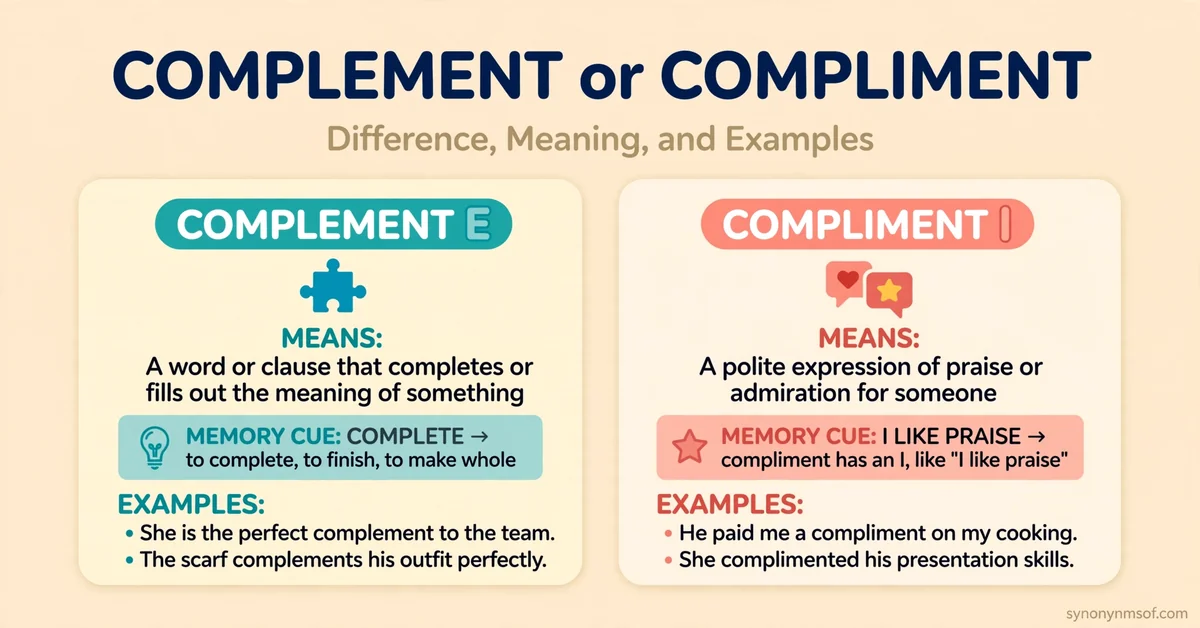
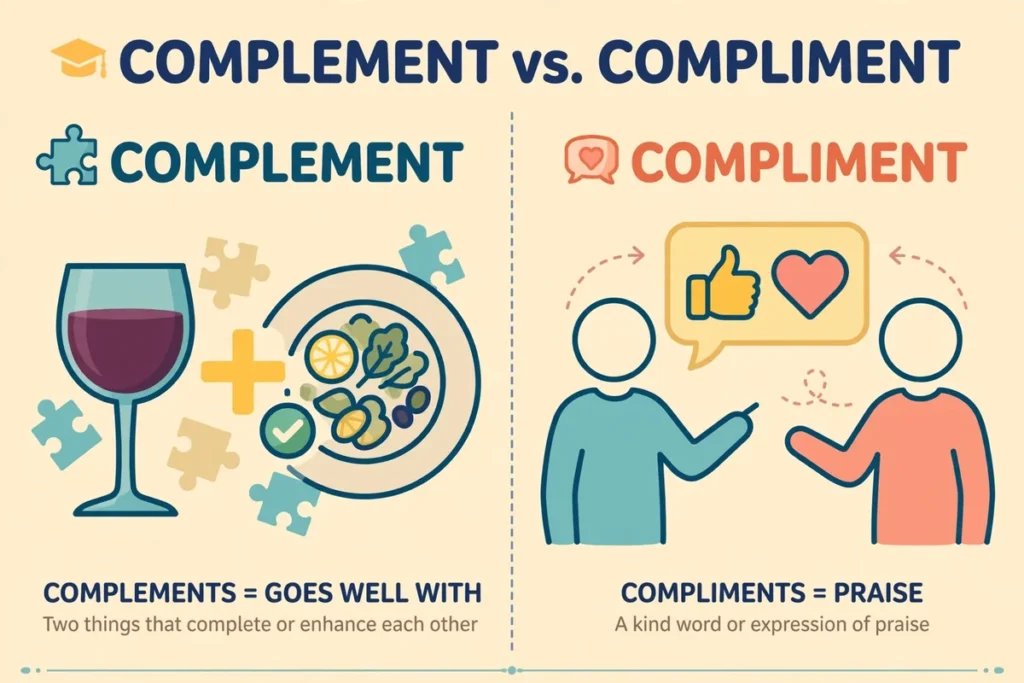
“Complement,” spelled with an e in the middle, is all about completion. Something that is a complement finishes another thing, makes it whole, or pairs with it so well that the combination feels right. Think of a missing puzzle piece sliding into place, or a sauce that seems made for a particular dish. The word works as both a noun and a verb, and in both cases the core idea is the same: two things going together to form something better or more complete.
“Complement” as a Noun
As a noun, a complement is a thing that completes or enhances something else when combined with it. A necklace can be the perfect complement to a dress. A soft cheese can be an ideal complement to a crisp cracker. A quiet colleague can be the perfect complement to a loud, energetic team leader, because their styles balance each other out.
There are also a few fixed expressions worth knowing. A “full complement” means a complete set of something, as in a ship sailing with a full complement of crew members. In grammar, a “complement” is a word or group of words that completes the meaning of an expression, and we will look at the famous “subject complement” in the formal writing section below.
Notice how in every one of these uses, the emphasis is on wholeness and fit. A complement does not praise anything. It completes, balances, or harmonizes. If you can replace the word with “completion,” “match,” or “perfect partner,” you are almost certainly dealing with the noun “complement.”
“Complement” as a Verb
As a verb, “complement” means to complete something, to enhance it, or to go well with it. The wine complements the meal. The blue curtains complement the warm tones of the wooden floor. Her calm approach complements his intensity, and together they make a strong management team.
This verb often appears in descriptions of food, design, fashion, music, and teamwork, because all of these involve elements that either work well together or do not. A bass line can complement a melody. A new software feature can complement an existing system. A colleague’s skills can complement your own, which is a polite and professional way of saying you are stronger together.
One detail that helps in real sentences: the verb “complement” is usually followed directly by its object, with no extra preposition in between. You say “the scarf complements her coat,” not “complements to her coat.” Keeping this pattern in mind makes your sentences sound natural and confident.
What Does “Compliment” Mean?
“Compliment,” spelled with an i in the middle, is all about praise. A compliment is a remark that expresses admiration, approval, respect, or affection for someone or something. When you tell a friend their presentation was brilliant, compliment a chef on a wonderful meal, or receive praise from your manager, you are firmly in compliment territory. Like its look-alike, it works as both a noun and a verb.
“Compliment” as a Noun
As a noun, a compliment is the kind remark itself. “She paid him a lovely compliment about his singing.” “He took her words as a compliment.” Compliments can be about appearance, work, character, achievements, or almost anything else worth admiring.
English has a handful of fixed phrases built on this noun that are worth memorizing. “Compliments of the chef” means a small dish or drink sent by the chef free of charge. “With my compliments” on a note or a gift means you are sending it along with your kind regards. “Return the compliment” means to praise someone back after they praised you. And “fishing for compliments” describes the habit of saying things just to prompt other people to praise you.
There is also the well-known adjective “complimentary,” which carries two meanings: given free of charge (“complimentary drinks in the lobby”) and expressing praise (“a complimentary review”). This double meaning is one of the trickiest parts of the whole topic, so we will examine it closely in the edge cases section later.
“Compliment” as a Verb
As a verb, “compliment” means to express praise or admiration toward someone, or to present someone with something as a mark of respect. “She complimented him on his cooking.” “The manager complimented the whole team on their hard work.” “The university complimented her with an honorary degree.”
Notice the typical structure: you compliment someone on something. The preposition “on” introduces the thing being praised. “They complimented her on her presentation” is the natural pattern, and getting this structure right makes your English sound polished. You can also compliment someone “for” something in some contexts, but “on” is the most common and the safest choice.
Because complimenting is a social act, this verb appears constantly in everyday conversation, customer service, performance reviews, and letters of recommendation. It is one of the most useful social verbs in English, which is probably why it shows up more often than “complement” in daily speech.
The Difference Between Complement and Compliment
Strip away everything else, and the difference is simple. “Complement” with an e means to complete or to go well with something. “Compliment” with an i means to praise or admire someone. The words sound identical, they share a Latin root connected to the idea of completion, but in modern English they do completely different jobs. Mixing them up changes your meaning entirely: “the sauce compliments the fish” says the sauce is praising the fish, which is not what you meant at all.
If time permits, read your sentence back to yourself before you send it and ask a single question: do I mean praise, or do I mean completion? If the answer is praise, you want the “i” word. If the answer is completion, matching, or enhancing, you want the “e” word. This one-second check catches the vast majority of mistakes, and it works in emails, essays, texts, and reports alike.
Remember the Difference: A Simple Mnemonic
Memory tricks work because they connect a spelling to an idea you cannot forget. For this pair, you get two tricks for the price of one, and together they cover every situation.
First, “complement” shares its first letters with “complete.” C-O-M-P-L-E. If something complements something else, it completes it. The “e” in the middle of “complement” matches the “e” in “complete,” so the spelling itself reminds you of the meaning.
Second, “I” like compliments. The sentence “I like compliments” contains the letter “i” twice, which mirrors the “i” in the middle of “compliment.” Everyone likes to be praised, and the “i” stands for that personal, people-focused act of admiration. If you remember that “I” goes with praise, you will never put the wrong vowel in the middle again.
Some people combine the two tricks into a single test sentence: “I will compliment my friend, and the colors will complement each other.” Praise takes the “i,” matching takes the “e.” Say it a few times and it sticks.
Complement or Compliment: A Side-by-Side Comparison
| Aspect | Complement (with E) | Compliment (with I) |
|---|---|---|
| Core meaning | To complete or enhance something | To praise or admire someone |
| Noun example | “The scarf is a perfect complement to her dress.” | “He gave her a warm compliment on her speech.” |
| Verb example | “The wine complements the meal.” | “She complimented his cooking.” |
| Memory hook | E for “enhance” and “complete” | I for “I like praise” |
| Common collocations | complement each other, full complement | pay a compliment, take as a compliment |
| Grammar term | Subject complement | No special grammar term |
| Adjective form | Complementary (matching, going well together) | Complimentary (free of charge, or expressing praise) |
This shows how the two words live in entirely different neighborhoods of meaning. One belongs to the world of fit, balance, and wholeness; the other belongs to the world of people, kindness, and admiration. Keep the table’s memory hooks in mind, and the right spelling will usually come to you on its own.
Usage Examples Across Contexts
Knowing the definitions is only half the battle. The real test is using each word correctly in the situations you actually face, from casual chats to formal documents. The sections below walk through the pair in three everyday contexts, with examples you can borrow and adapt.
Everyday Conversation
In daily speech, “compliment” is the word you will reach for most often, because praising people is a constant part of social life. “I have to compliment you on this dinner, it is amazing.” “She got so many compliments on her new haircut.” “He complimented the kids on how well they behaved.”
“Complement” shows up in conversation whenever you talk about things that go well together, especially food, clothes, and home decor. “These earrings really complement your dress.” “The lemon complements the fish perfectly.” “I think the blue cushions complement the grey sofa.”
On the other hand, mixing them in speech is rarely a disaster, because listeners hear the same sound either way and usually understand from context. In writing, though, the wrong spelling is fully visible, which is why text messages, captions, and social media posts deserve the same care as formal writing.
Work and Business Writing
Professional writing is where this word pair causes the most damage, because a spelling mistake in a report or a client email can quietly undermine your credibility. In business contexts, “complement” often describes how products, skills, or strategies fit together. “Our new service complements our existing product line.” “Her analytical skills complement his creative approach.” “The marketing campaign was designed to complement the product launch.”
“Compliment” in business writing usually appears in feedback, reviews, and customer relations. “The client complimented our team on the fast delivery.” “Please pass my compliments to the chef.” “She received several compliments on her presentation from senior management.”
Pay special attention to performance reviews and recommendation letters. Writing that a candidate’s “skills compliment the role” accidentally says the skills are praising the role, which makes no sense. What you mean is that the skills “complement” the role, meaning they complete what the role requires. This single error is one of the most common in professional English, and now you know how to avoid it.
Formal and Academic Writing
In academic writing, precision matters even more, and “complement” carries an additional technical meaning that students of English must master: the subject complement. A subject complement is a word or phrase that follows a linking verb and renames or describes the subject. In the sentence “She is a doctor,” the phrase “a doctor” is the subject complement because it completes the meaning of the subject “she” by renaming her. In “The soup smells delicious,” the word “delicious” is the subject complement describing the soup.
Subject complements are not objects. They do not receive an action; they complete the subject. This is why the grammar term uses “complement” with an “e”: it literally completes the meaning of the sentence. You will also meet “object complements” in more advanced grammar, which work the same way for the object of a sentence, as in “They elected her president,” where “president” completes “her.”
In essays and research papers, both words appear in their ordinary senses too. A literature student might write that “the imagery complements the poem’s melancholy tone,” while a history student might note that “the ambassador complimented the delegation on their hospitality.” In each case, the e/i test decides the spelling, and academic readers will notice when it is wrong.
Common Mistakes to Avoid
The number one mistake is also the most obvious: using “compliment” when you mean “complement,” and vice versa. “The curtains compliment the furniture” is wrong, because curtains do not praise furniture; they complete the look of the room, so “complement” is correct. “She complemented him on his speech” is wrong for the opposite reason: she praised him, so “complimented” is the word you want.
A second common mistake is dropping the preposition or using the wrong one with the verb “compliment.” The natural pattern is “compliment someone on something.” Writing “she complimented his cooking” is perfectly fine because the verb can take a direct object, but “she complimented on his cooking” is broken English. Learn the two clean patterns, “compliment someone” and “compliment someone on something,” and stick to them.
A third mistake involves the adjectives. “Complimentary” and “complementary” look almost identical, and many writers swap them. A “complimentary breakfast” is a free breakfast. A “complementary breakfast” would be a breakfast that goes well with something else, which is rarely what anyone means. We will dig deeper into this pair in the edge cases section, because it deserves special attention.
Finally, do not trust spellcheckers to save you. Both “complement” and “compliment” are real dictionary words, so no spelling checker will flag the wrong one. Only your understanding of the meaning can catch the error, which is exactly why this pair rewards a few minutes of study.
Tricky Cases and Edge Cases
Some situations blur the line between the two words, or at least appear to. The trickiest of all is the adjective pair “complimentary” versus “complementary.” “Complimentary” (with an i) has two meanings: expressing praise, as in “a complimentary review,” and given free of charge, as in “complimentary parking.” The free-of-charge meaning comes from the idea of something given “with our compliments,” a courteous gift. “Complementary” (with an e) means matching or going well together, as in “complementary colors” in art, or “two complementary skill sets” on a team.
Here is a practical way to keep them apart: if you can substitute the word “free,” you want “complimentary” with an i. “Complimentary tickets” are free tickets. If you can substitute “matching” or “harmonizing,” you want “complementary” with an e. “Complementary tickets” would mean tickets that go well with something else, which is almost never the intended meaning. Hotel websites and restaurant menus mix these up constantly, so spotting the error is a genuine mark of a careful reader.
Another subtle case is the phrase “compliments of the chef” or “with the compliments of the house.” Here “compliments” always takes the i, because the phrase is about courtesy: the chef is graciously offering something free as a gesture of goodwill. It never means the chef is completing anything.
One last edge case: plural forms. “Compliments” with an i can be a sincere plural (“she received many compliments”) or part of the fixed gift phrase (“compliments of the season”). “Complements” with an e is simply the plural of the completing thing or the third-person verb form (“the colors complement each other”). When in doubt, run the praise-or-completion test, and the plural will sort itself out.
Frequently Asked Questions
Is it “complement or compliment” when I want to praise someone?
When you want to praise someone, the correct word is “compliment” with an i. You pay someone a compliment, you compliment them on their work, and you take kind words as a compliment. Remember the trick: “I” like compliments, and the “i” in the middle of the word matches the “I” in that sentence. Praise always takes the i.
What is the difference between “complementary” and “complimentary”?
“Complementary” with an e means matching or going well together, like complementary colors or complementary skills. “Complimentary” with an i means either expressing praise, like a complimentary comment, or given free of charge, like complimentary drinks. The quick test is substitution: if “free” fits, use the i; if “matching” fits, use the e.
Can “complement” and “compliment” ever be used interchangeably?
No. In modern English, the two words are never interchangeable. “Complement” is about completing or enhancing something, while “compliment” is about praising someone. Swapping them always changes the meaning of your sentence. Keep the two meanings strictly separate.
What is a subject complement in grammar?
A subject complement is a word or phrase that follows a linking verb and renames or describes the subject of the sentence. In “He became a teacher,” the phrase “a teacher” is the subject complement because it completes the subject “he.” In “The sky looks clear,” the word “clear” is the subject complement. It uses the e spelling because it completes the meaning, just like every other use of “complement.”
How can I remember the spelling difference easily?
Use the two-part mnemonic. “Complement” shares its opening letters with “complete,” and both have an e, because a complement completes something. “Compliment” contains an i, and the sentence “I like compliments” reminds you that praise is personal and takes the i. Ask yourself whether you mean praise or completion, apply the matching trick, and you will spell it right every time.
Conclusion
The “complement or compliment” confusion looks intimidating, but it collapses into a single, reliable question: am I talking about praise, or am I talking about completion? Praise always takes the “i,” as in “I like compliments.” Completion always takes the “e,” as in “complement” matching “complete.” With that distinction in place, every sentence sorts itself out, from a quick text message to a formal report.
Master this pair and you gain more than one correct spelling. You sharpen the exactness of your writing, you avoid the quiet embarrassment of a visible error in professional documents, and you build the habit of choosing words by meaning rather than by sound. That habit will serve you well far beyond these two words.
Explore more on Synonynmsof.