
Few English word pairs trip up writers as often as “weather or whether.” They sound exactly the same, they look nearly identical, and both show up constantly in everyday writing — in text messages, emails, essays, and work reports. Pick the wrong spelling and your sentence instantly looks careless, even when the idea behind it is perfectly clear.
The mix-up is completely understandable. These two words are homophones: words that are pronounced identically but spelled differently and carry completely different meanings. Native speakers misspell them all the time, and spell-checkers often fail to help, because both spellings are real words — the software has no idea which one you actually meant.
The good news is that the difference is simple once you learn it, and there is a third, lesser-known spelling — “wether” — that is worth knowing about so it never surprises you. This guide breaks down each word’s meaning, shows you exactly how to use them, and gives you practical memory tricks so you never mix them up again.
What Does “Weather” Mean?
“Weather” is the word you reach for when you are talking about the world outside your window. It is one of the most common nouns in English, and it also has a second life as a verb that many learners never learn.
“Weather” as a Noun: Atmospheric Conditions
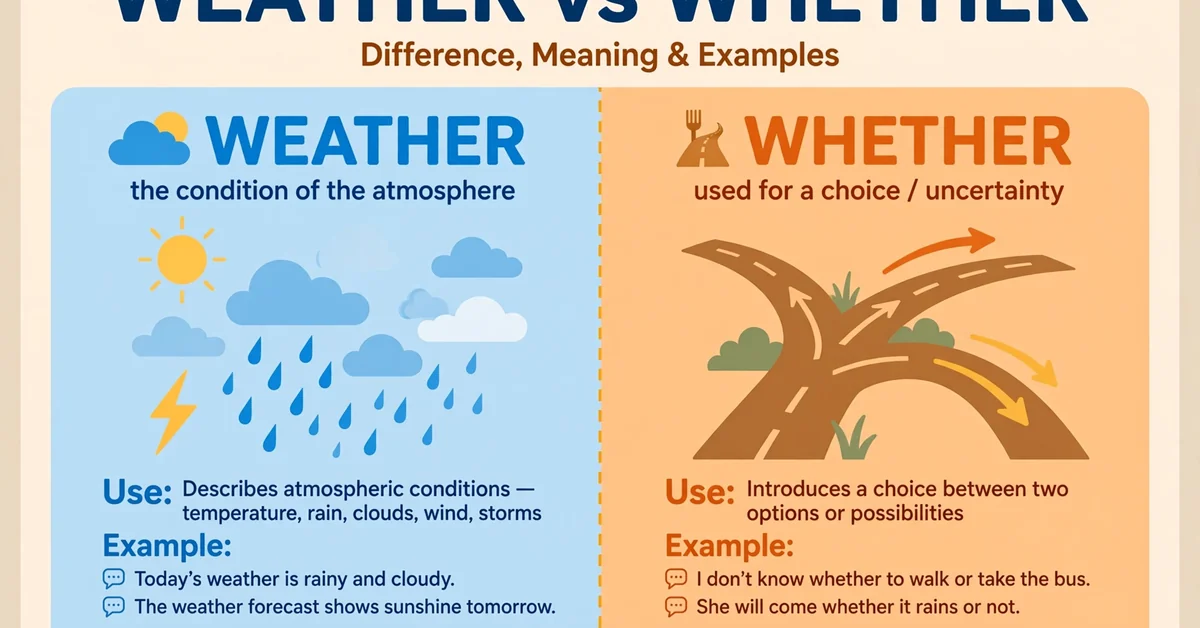
As a noun, “weather” means the state of the atmosphere at a particular place and time — rain, sunshine, wind, snow, humidity, temperature, storms, and everything in between. When you check the forecast on your phone, complain about the heat, or pack an umbrella, you are dealing with weather.
Notice that “weather” is an uncountable noun. You cannot say “a weather” or “weathers” in standard English. You say “bad weather,” “the weather,” or “some lovely weather” — never “a bad weather.”
Typical noun uses: the weather turned cold overnight; we cancelled the outdoor event because of the severe weather; the pilot delayed the flight until the weather cleared.
The word also appears in countless everyday phrases: weather forecast, weather report, weather conditions, severe weather warnings, and the idiom “under the weather,” which means feeling slightly ill or unwell. (“She stayed home from work because she was feeling under the weather.”) That last one has nothing to do with rain or sunshine, but the spelling is still “weather.”
“Weather” as a Verb: To Endure or Wear Away
“Weather” works as a verb too, and this is where many learners get caught off guard. As a verb, “to weather” means to come through something difficult safely — to endure or survive a hardship. The image is of a ship riding out a storm at sea: battered, but still afloat.
- The company weathered the recession and came out stronger.
- Their friendship weathered years of distance and change.
- The old lighthouse has weathered a century of Atlantic storms.
- She weathered the criticism with remarkable calm.
In a related sense, “weather” as a verb can also mean to be physically worn down or changed by exposure to the elements over time. Wood weathers to a silvery gray; stone cliffs are weathered by wind and rain. From this comes the adjective “weathered,” describing something aged or worn in a way that often looks characterful — a weathered barn, a weathered face, a weathered pair of boots.
One more common idiom uses this verb form: “weather the storm.” It can mean surviving literal rough seas, but it almost always means surviving a difficult period in life or business: “The team weathered the storm of layoffs and kept working.” If you ever see this phrase spelled “whether the storm,” that is always wrong.
What Does “Whether” Mean?
“Whether” is a completely different kind of word. It is a conjunction — a connecting word — and it has nothing whatsoever to do with rain or sunshine. You use “whether” when a sentence involves choices, alternatives, doubt, or uncertainty.
Think of “whether” as the word of decisions. It introduces two or more possibilities and signals that someone is considering, questioning, or choosing between them. A handy test: if you can replace the word with “if” or add “or not” after it, “whether” is almost certainly the right spelling.
- I don’t know whether to take the job or stay where I am.
- She asked whether I wanted coffee or tea.
- They will play the match whether it rains or shines.
“Whether” for Choices and Alternatives
The most common job “whether” does is presenting a fork in the road. It sets up two possibilities — go or stay, rain or shine, yes or no — and tells the reader that a decision or outcome hangs between them.
- We haven’t decided whether to travel by train or fly.
- It made no difference whether she arrived early or late.
- Please confirm whether you will attend the ceremony.
Notice the pattern: “whether” is usually followed (sooner or later) by “or,” which introduces the alternative. Sometimes the second option is just the implied “or not”: “I wonder whether he remembers me (or not).” This built-in sense of alternatives is exactly why the word exists, and it is the fastest way to tell it apart from “weather.”
“Whether” for Indirect Questions
“Whether” also introduces indirect questions — questions reported inside a statement rather than asked directly. These sentences express uncertainty or a desire to find something out, and they typically follow verbs like ask, wonder, know, doubt, check, find out, or decide.
- The manager asked whether the report was finished.
- I wonder whether the package has arrived yet.
- She wasn’t sure whether she had locked the door.
- Could you check whether the printer has paper?
If you find yourself wondering whether a sentence needs “whether” or “weather,” try the direct-question test: can you rephrase the clause as a yes-or-no question? “Is the report finished?” works — so “whether” is correct. “Is the rain finished?” does not work in that sentence, which tells you “weather” would be wrong. By the way, if you want a deeper look at that particular phrasing, our guide on I was wondering explores the polite “wonder” construction in detail.
Weather vs Whether: The Key Difference
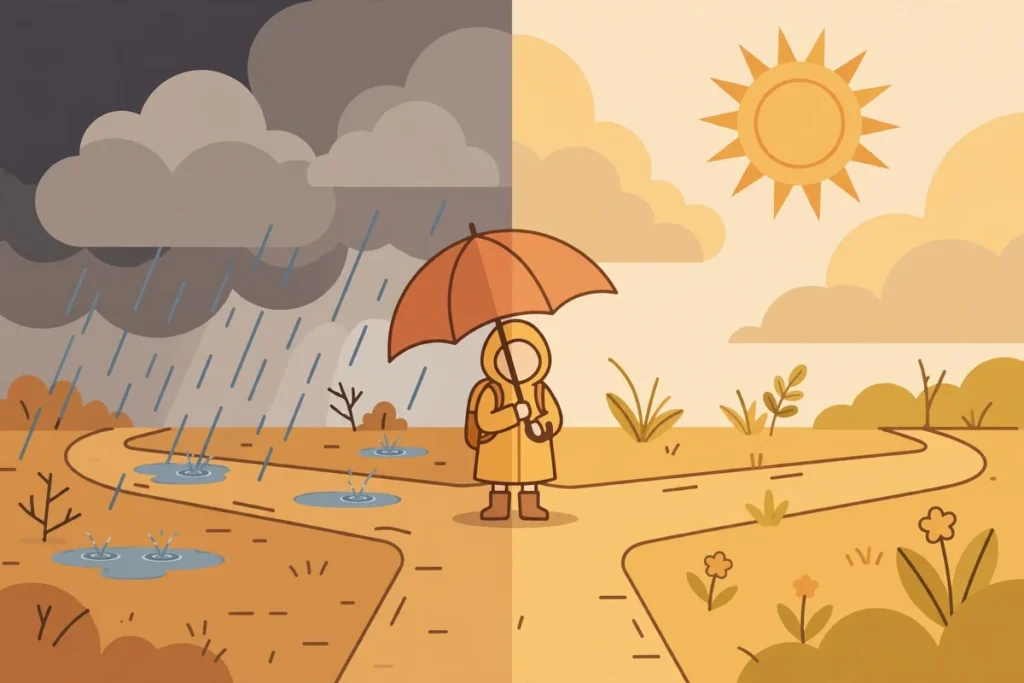
Now that you have seen each word in action, the contrast should be clear. “Weather” belongs to the physical world — skies, storms, temperature, endurance. “Whether” belongs to the world of thought — choices, doubts, and questions. They share a pronunciation, but nothing else.
The single most reliable way to choose between them is the “sky test”: if the sentence is about the atmosphere, the outdoors, or surviving difficulty, write “weather.” If the sentence is about a choice between possibilities or an indirect question, write “whether.”
| Feature | Weather | Whether |
|---|---|---|
| Pronunciation | /ˈwɛðər/ — identical | /ˈwɛðər/ — identical |
| Part of speech | Noun (usually); also a verb | Conjunction only |
| Core meaning | Atmospheric conditions; to endure or wear away | Introduces choices, alternatives, or indirect questions |
| Used for | Rain, sun, wind, storms, forecasts, surviving hardship | Decisions, doubt, options, reported questions |
| Test | Can you point at the sky? | Can you say “if” or add “or not”? |
| Example (noun) | The weather is perfect today. | — |
| Example (verb) | They weathered the crisis well. | — |
| Example (conjunction) | — | I don’t know whether to laugh or cry. |
Keep in mind that “whether” is actually the more common of the two in written English — corpus studies suggest it appears several times more often than “weather.” That surprises many learners, but it makes sense: we write about decisions, questions, and alternatives constantly, while we mention the literal atmosphere only when it matters.
Usage Examples Across Contexts
Seeing words in real-life contexts cements the difference far better than definitions alone. Here is how “weather” and “whether” behave in everyday conversation, professional writing, and formal academic prose.
Everyday Conversation
In casual speech and texting, these words fly by fast, and the spelling matters most in writing. Here are sentences you might actually say or type:
- “The weather looks great — should we go hiking?”
- “I can’t decide whether to order pizza or cook.”
- “Did you see the weather report? It might snow tonight.”
- “She asked whether I was coming to the party.”
- “We got caught in terrible weather on the drive home.”
- “It depends on whether the kids finish their homework — and we will only leave if time permits.”
Notice how naturally the two words can appear side by side: “Whether we go hiking depends on the weather.” Sentences like this are where the homophone trap snaps shut, so slow down and check each spelling when both ideas appear in one sentence.
Work and Business Writing
In professional emails and reports, a weather/whether mix-up looks sloppy, because readers expect precision. These words appear often in business contexts — project decisions, client questions, and yes, actual weather affecting operations.
- Please advise whether the client has approved the proposal.
- The shipment was delayed due to adverse weather conditions.
- We need to determine whether to renew the contract or renegotiate.
- The outdoor launch event is weather-dependent, so we booked a backup venue.
- The team weathered a difficult quarter and still hit its targets.
- I am writing to confirm whether you received the invoice.
A note on tone: in formal business writing, “whether” is generally preferred over “if” when presenting two alternatives, because it sounds more precise. “Let me know whether you agree” reads slightly more professional than “Let me know if you agree” — though both are acceptable in most workplaces.
Formal and Academic Writing
Academic and formal writing leans heavily on “whether,” because research and argument constantly weigh alternatives, test hypotheses, and report findings. “Weather” appears mainly in scientific or geographical writing, where it means exactly what it says.
- The study examined whether sleep quality affects academic performance.
- Researchers remain divided on whether the policy achieved its goals.
- This essay considers whether economic growth reduces inequality.
- The experiment tested whether participants could detect the difference.
- The data on coastal weather patterns spans three decades.
In academic prose, “whether or not” constructions are common when the writer wants to emphasize that an outcome holds regardless of the condition: “The results were consistent whether or not participants had prior training.” Just be careful not to stack it redundantly — “whether or not or not” style tangles are a classic editing slip.
Common Mistakes to Avoid
Even confident writers slip on this pair, especially when typing quickly. Here are the most frequent errors and how to fix them.
1. Writing “weather” when you mean “whether.” This is by far the most common mistake, probably because “weather” is the spelling people learn first as children.
- Wrong: I don’t know weather she will come.
- Right: I don’t know whether she will come.
The fix: run the “or not” test. “I don’t know whether or not she will come” works perfectly — so “whether” is correct.
2. Writing “whether” when you mean “weather.” Less common, but it happens, especially in sentences about forecasts and climate.
- Wrong: The whether forecast says it will rain tomorrow.
- Right: The weather forecast says it will rain tomorrow.
The fix: run the sky test. A forecast describes the atmosphere, so “weather” is the only option.
3. Treating “weather” as countable. Remember, “weather” is uncountable — you cannot put “a” in front of it or make it plural.
- Wrong: We had a terrible weather on our trip.
- Right: We had terrible weather on our trip.
4. Misspelling the idioms. Fixed expressions must be memorized as units: “weather the storm” (never “whether the storm”), “under the weather” (never “under the whether”), and “fair-weather friend” (a friend who is only around in good times — never “fair-whether friend”). These trip up even native speakers, so they are worth learning deliberately.
5. Confusing “whether” with “if.” The two overlap, but they are not identical. Use “whether” (not “if”) after prepositions — “a discussion about whether to expand” — and before infinitives — “deciding whether to go.” Also prefer “whether” when the alternatives are stated with “or”: “whether it rains or shines,” not “if it rains or shines.” In everyday speech “if” often slips into these slots, but careful writing keeps “whether.” When the two alternatives genuinely contrast, on the other hand is the phrase that introduces the flip side.
6. Relying on spell-check. This is the meta-mistake behind all the others. Because both “weather” and “whether” are valid dictionary words, a spell-checker will wave through the wrong one without a blink. Only your own judgment — the sky test, the or-not test — can catch these errors. When in doubt, read the sentence aloud and ask what role the word is playing.
Tricky Cases and Edge Cases
Beyond the basics, a few special cases deserve attention. Handle these and you will be ahead of the vast majority of writers.
The “Wether” Variant: The Third Homophone
Yes, there is a third spelling: “wether” — with no “a” after the “w.” A wether is a castrated male sheep (or sometimes goat), a term used in farming and livestock management. It is a genuine English word, pronounced exactly like the other two.
You will almost never need it unless you work with farm animals or read agricultural writing. Its main relevance to you is as a spelling trap: “wether” is one of the most common misspellings of both “weather” and “whether.” If you type quickly and drop the “a,” you may accidentally write about livestock.
- The farmer separated the wethers from the rams. (Correct — farm animals.)
- Wrong: The wether is nice today. (You meant weather.)
- Wrong: I don’t know wether to go. (You meant whether.)
A fun memory sentence that uses all three: “The shepherd wondered whether the wether could weather the storm.” It means the shepherd was unsure if the sheep could survive bad conditions. You will probably never write this sentence, but it proves the three words live in completely separate worlds.
“Whether or Not”: When Is “Or Not” Needed?
“Whether or not” is a common and correct construction, but the “or not” is sometimes redundant. Compare:
- “I don’t know whether to go.” (Clean — “or not” is implied.)
- “I don’t know whether or not to go.” (Also fine, slightly more emphatic.)
The “or not” earns its place when you mean “regardless of which alternative is true”: “We will proceed whether or not the funding arrives.” It is redundant when only one alternative is stated and no contrast is intended: “Whether or not it rains” is fine, but plain “whether it rains” usually suffices. As a rule, keep “or not” when the emphasis matters and drop it when it doesn’t — and never write “whether or not or not,” which is a genuine error some writers produce under pressure.
“Weather” as a Verb: The Hidden Trap
Many learners know “weather” only as a noun, so the verb form blindsides them. If you see “weathered” or “weathering” in a sentence about endurance, erosion, or exposure, it is correct — not a typo.
- The statue had weathered centuries of wind and rain.
- Startups must weather periods of low revenue.
The tricky part is that the verb “weather” and the conjunction “whether” can appear in similar-looking sentences. Compare “They weathered the changes well” (they endured the changes) with “They wondered whether the changes would last” (they questioned the changes). The meanings are far apart, so context is your guide: endurance means “weather,” questioning means “whether.”
Quick Memory Tricks
If you want shortcuts that actually stick, use these:
- Weather = sea. “Weather” is spelled with “ea,” just like “sea” — and weather affects the sea. If it is about the sky, the climate, or the outdoors, pick the “ea” spelling.
- Whether = wh- question words. “Whether” starts with “wh,” like who, what, when, where, and why. These are question words, and “whether” introduces questions and choices.
- The replacement test. If you can swap in “if” without breaking the sentence, you want “whether.” (“I don’t know if he’ll come” → “whether” is correct.)
- Wether = neither. If your sentence is not about farm animals, “wether” is never the answer. When you spot it in your writing, you have simply dropped an “a.”
Frequently Asked Questions
Is “weather” or “whether” correct in “I don’t know ___ to go?”
“Whether” is correct: “I don’t know whether to go.” The sentence presents a choice — to go or not to go — so you need the conjunction, not the noun about atmospheric conditions. The “or not” test confirms it: “I don’t know whether or not to go” reads perfectly.
What is the difference between “weather” and “whether”?
“Weather” refers to atmospheric conditions like rain, sunshine, and temperature (noun), or to enduring hardship and wearing away over time (verb). “Whether” is a conjunction that introduces choices, alternatives, or indirect questions. They are homophones — pronounced identically — but they share nothing else.
Is “wether” a real word?
Yes. A “wether” is a castrated male sheep, a term used in farming and livestock contexts. It is pronounced exactly like “weather” and “whether.” Most of the time when you see “wether” in ordinary writing, though, it is simply a misspelling of one of the other two words — the writer dropped the “a.”
Can “weather” be used as a verb?
Yes. As a verb, “to weather” means to survive or endure something difficult (“The business weathered the downturn”) or to be worn away by long exposure to the elements (“The cliffs were weathered by the sea”). This is also the source of the idiom “weather the storm” and the adjective “weathered.”
How do you remember the difference between “weather” and “whether”?
Use the “ea” = “sea” trick for weather: both are spelled with “ea,” and weather affects the sea, so the atmospheric word takes the “ea” spelling. For “whether,” notice the “wh” opening, shared with question words like what, when, and why — “whether” introduces questions and choices. And if you can substitute “if,” choose “whether” every time.
Final Thoughts
“Weather or whether” stops being confusing the moment you stop treating the two words as rivals and start seeing them as tools for completely different jobs. One describes the sky above you and your ability to endure what it brings; the other maps the choices in front of you and the questions you still need answered. The sky test and the or-not test will resolve nearly every case in seconds.
If you take one habit from this guide, make it this: slow down whenever these homophones appear together, and never trust the spell-checker to choose for you. A writer who pauses to pick the right “weather or whether” is a writer whose readers never have to pause at all — and that small act of care is what separates polished writing from the rest.