
Every few months, somewhere in an airport or a dentist’s waiting room, a traveler stares at a phone notification and wonders: is it “cancelation” or “cancellation”? One L or two? The doubt lasts only seconds, but it shows up constantly — in emails to clients, in refund forms, in school essays.
The short answer is that cancellation with two Ls is the safe, standard spelling everywhere — the United States, the United Kingdom, Canada, Australia, everywhere. Cancelation with one L is not exactly a typo, but it is a rare variant that most dictionaries treat as second best and many spellcheckers flag outright. If you remember one thing from this article, let it be the double L.
The longer answer is more interesting than a simple right-or-wrong verdict. This pair sits at the crossing point of two competing English spelling traditions: the British habit of doubling consonants before suffixes, and the American habit of simplifying them. Understanding why the double L won in both countries — even in America — will fix this spelling in your memory for good, and it will help you get right a whole family of related words like canceled/cancelled and traveler/traveller.
What Does “Cancelation” Mean?
The word “cancelation” means exactly the same thing as “cancellation”: the act of calling off, ending, or revoking something that was planned, scheduled, or agreed upon. A flight’s cancelation, a subscription’s cancelation, an event’s cancelation — all refer to the same idea. There is no difference in meaning, no difference in pronunciation, and no hidden nuance that one spelling carries and the other doesn’t. The entire question is about form, not content.
Where does the single-L spelling come from? It follows the general American English pattern of not doubling a final consonant when adding a suffix that starts with a vowel: cancel + ation gives “cancelation,” the way “traveled” became the American standard while “travelled” stayed British. Logically, “cancelation” looks like it ought to be the American form. And indeed, a handful of American dictionaries — most notably Merriam-Webster — list “cancelation” as an accepted variant spelling. That single line in a dictionary entry is the entire basis for its legitimacy. No major style guide recommends it, no major publication uses it as its house spelling, and in edited American prose it is rare.
In practice, “cancelation” shows up in informal American writing (texts, casual emails, forum posts), brand names that strip letters for style, and the occasional business document from a writer who guessed wrong. Spellcheckers are inconsistent about it — some pass it, some flag it — and that inconsistency is exactly why the word keeps causing trouble: people see it somewhere, assume it must be the American spelling, and repeat it.
So the meaning is simple and undisputed: cancelation is the act of canceling, spelled with one L, recognized as a secondary American variant. It is not wrong in the way a typo is wrong, but it is not the spelling anyone recommends.
What Does “Cancellation” Mean?
“Cancellation” is the standard noun for the act of canceling something: a decision or event that ends a prior arrangement. When a concert is called off, that’s a cancellation. When you end a gym membership, the confirmation email is about your cancellation. When an airline scrubs a flight, passengers receive a cancellation notice. The word covers everything from formal contract terminations to a friend texting “rain check.”
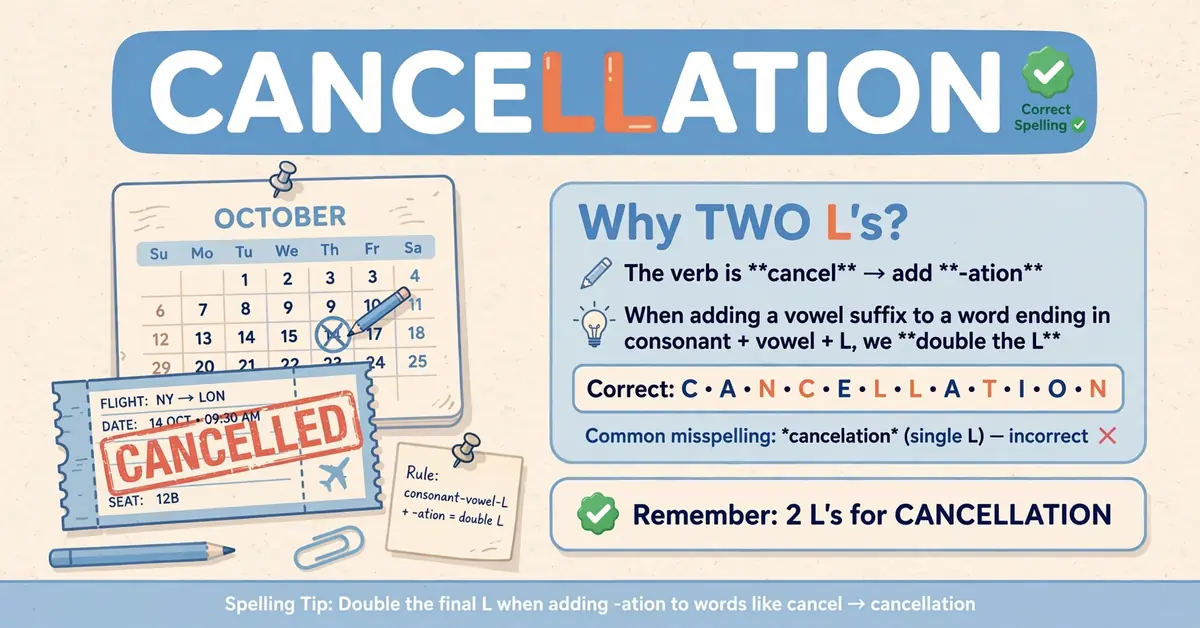
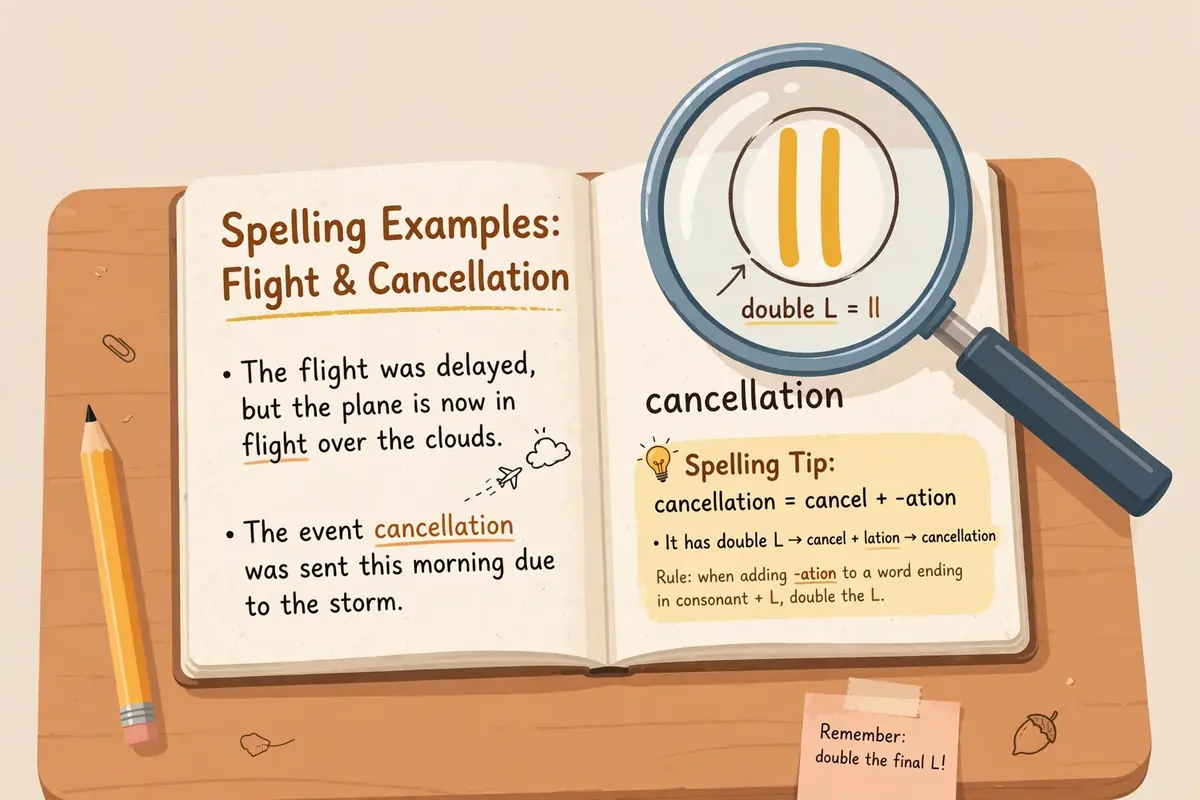
The spelling comes down to a single, old rule: when a verb ends in a single consonant preceded by a short vowel, and you add a suffix that begins with a vowel, you double the final consonant. Cancel ends in L, the vowel before it is short and unstressed, and “-ation” starts with a vowel — so the L doubles: cancell + ation = cancellation. The same pattern gives us “rebellion” from rebel and “compelling” from compel.
What makes cancellation special is that, unlike its siblings “canceled/cancelled” and “canceling/cancelling,” the double-L noun form won everywhere — including the United States. American English happily simplified the verb (“canceled,” “canceling”) but kept the noun doubled. Spelling conventions grow by habit and editorial consensus more than by logic, but the practical result is unusually clean: one spelling, cancellation, is correct in every English-speaking country and every register.
That is why every major dictionary lists “cancellation” as the main entry, why the AP, Chicago, and MLA style guides use it exclusively, and why it is the form you see on airline websites and booking pages around the world.
The Difference Between Cancelation and Cancellation
If the meanings are identical, why does English maintain both spellings? Three things explain it: the consonant-doubling rule, the verb forms that surround the noun, and the false pattern most people assume.
The Consonant-Doubling Rule
British English has a long-standing rule: when you add a vowel-starting suffix to a word ending in a consonant preceded by a single vowel, you double that final consonant. Travel becomes travelled, cancel becomes cancelled, and cancel + ation becomes cancellation. The rule applies even when the final syllable is unstressed — which is why British English doubles the L in “cancelled” even though the stress sits on the first syllable.
American English, shaped by Noah Webster’s spelling reforms in the early 1800s, broke with this rule for unstressed final syllables: traveled, canceled, canceling. But — and this is the quirk behind our whole topic — the reform never fully reached the noun “cancellation.” Even in the most aggressively simplified American publications, you will find “cancellation” with two Ls. The single-L “cancelation” is a logical extension of Webster’s rule that the language simply never adopted.
Learn the doubling rule and you get “cancellation” right automatically — along with “rebellion,” “compelling,” and “controlled” for free.
Canceled/Cancelled and Canceling/Cancelling
The verb forms are where the American–British split actually lives, and they are the reason people get confused about the noun. In American English, the standard past tense is “canceled” (one L) and the present participle is “canceling” (one L). In British English, they are “cancelled” and “cancelling” (two Ls). Both pairs are fully correct within their dialects — a genuine regional difference, like color/colour or organize/organise.
The confusion happens because people apply the verb pattern to the noun by analogy: if Americans write “canceled,” surely they write “cancelation.” It feels logical. But English does not run on clean analogies, and the noun kept its double L in both dialects. English spelling is a museum of half-finished reforms, and “cancellation” is one of the exhibits.
A useful memory hook: the verb bends with the dialect, but the noun stands firm. Canceled, cancelled, canceling, cancelling — choose by country. Cancellation — always two Ls, everywhere.
Why This Pair Confuses Even Good Spellers
Most spelling questions have a clear regional answer: color is American, colour is British, and you pick your team. “Cancelation or cancellation” breaks that comforting pattern because there is no team. Americans do not own the single L; they overwhelmingly use the double L too. Corpus studies of published books and edited text put “cancellation” at roughly nine out of ten uses even in American English, while in British, Canadian, and Australian English the single-L form is essentially absent.
The result is a question that feels like it should have a dialect-based answer but doesn’t. Add in the fact that Merriam-Webster lists “cancelation” as a variant — which some readers misread as an endorsement — and that other single-L American forms (canceled, canceling, traveler) are perfectly legitimate, and you get a genuinely confusing word. The confusion is structural, not a sign of bad spelling habits.
Cancelation vs Cancellation: Side-by-Side Comparison
| Feature | Cancellation | Cancelation |
|---|---|---|
| Spelling | Two Ls (cancell-ation) | One L (cancel-ation) |
| Meaning | The act of canceling something | Identical — the act of canceling something |
| US English | Standard; about 9 in 10 uses in published text | Rare variant; Merriam-Webster lists it second |
| UK / Canada / Australia / NZ English | Standard; essentially universal | Almost never used |
| Dictionaries | Main entry everywhere (Oxford, Cambridge, Merriam-Webster, Collins) | Variant entry only in some American dictionaries |
| Style guides (AP, Chicago, MLA) | The only accepted form | Not used |
| Spellcheck | Passes everywhere | Often flagged |
| Formal and legal writing | Correct | Avoid |
| Pronunciation | Same for both spellings | Same for both spellings |
Using Cancelation and Cancellation in Real Contexts
Spelling rules stick better when you see the word doing real work. Here is how “cancellation” — the spelling you should use — appears across the situations where people actually need it. Every example below uses the double L; that is the point.
Everyday Conversation
In daily life, “cancellation” shows up in texts, social media posts, and casual speech about plans falling through. Nobody in a group chat is consulting a style guide, but the standard spelling still matters.
- “The airline sent a cancellation email an hour before boarding.”
- “We got a full refund after the event cancellation.”
- “Sorry for the late cancellation — something came up at work.”
- “Her subscription cancellation took three phone calls to complete.”
- “The weather caused a wave of flight cancellations across the country.”
In speech the spelling is invisible — which is exactly why people only discover the question when they have to write the word down. I was wondering whether the hotel would charge a fee, so I checked the cancellation policy before booking — sentences like that are where the spelling actually gets tested.
Work and Business
This is where the spelling carries real weight. Cancellation policies, refund terms, contract clauses, and customer-service emails are read by clients, lawyers, and regulators. A single-L “cancelation” in a terms-of-service document won’t void the contract, but it signals carelessness — and in competitive business writing, small signals add up.
- “Please review our cancellation policy: full refunds are available up to 48 hours before the event.”
- “The client requested a cancellation of the order due to budget changes.”
- “All cancellations must be submitted in writing to the accounts department.”
- “The vendor confirmed the cancellation and issued a credit note.”
One practical tip: search your company’s templates and email signatures for “cancelation” with one L. It hides in policy footers, auto-reply texts, and CRM templates more often than anyone expects. And if you draft policies for an international audience, the double-L form is doubly valuable — it is correct for American, British, Canadian, and Australian readers alike, so one template serves everyone.
Formal and Academic Writing
In academic papers, legal documents, and official reports, there is exactly one acceptable spelling: cancellation. Journals, university style sheets, and courts all treat the double-L form as standard, and the single-L variant reads as an error in these contexts regardless of what any dictionary’s variant list says.
- “The study excluded participants who requested cancellation of their enrollment.”
- “The cancellation of the treaty required ratification by both parties.”
- “Insurance policies typically include a cancellation clause with a notice period.”
- “The committee recorded three cancellations before reaching a quorum.”
Academic writers should also watch the related forms: a paper that uses “canceled” (American verb) alongside “cancellation” (universal noun) is perfectly consistent — do not “correct” the noun to match the verb.
Common Mistakes to Avoid
Knowing the right spelling is half the battle; the other half is dodging the traps around this word. Here are the mistakes people make most often.
Using “cancelation” in formal writing. This is the big one. The single-L form might slide by in a text message, but in a job application, a contract, or a published article it reads as a mistake. When in doubt — especially with an international audience — default to “cancellation.” On the other hand, deliberately using “cancelation” to sound American is a misfire: Americans overwhelmingly write “cancellation” too.
Mixing both spellings in the same document. Few things undermine writing faster than spelling the same word two ways. Pick “cancellation” and use it everywhere — body, headings, footers, subject lines.
Assuming the noun follows the verb. “I write ‘canceled’ with one L, so the noun must be ‘cancelation.'” The most logical mistake in English spelling — and wrong. The verb forms split by dialect; the noun does not. Memorize the exception instead of reasoning your way to it.
Overcorrecting in the other direction. Some writers, burned once by “cancellation,” start doubling consonants everywhere. The doubling already happened when “-ation” was added — the finished form is “cancellation,” and it needs no further fixing. Learn the finished forms instead of reapplying the rule.
Trusting spellcheck as the final judge. Spellcheckers disagree about “cancelation” — some flag it, some don’t — because dictionaries disagree about its status. The absence of a red squiggle is not a ruling. For this word, the ruling comes from usage data and style guides, and both say: double L.
Confusing “cancellation” with “cancel culture.” The slang phrase “cancel culture” (publicly withdrawing support from a person or brand) belongs to a different conversation. The shared root causes occasional mix-ups, but the spelling question and the culture-war phrase are separate topics.
Tricky Cases and Edge Cases
The straightforward advice — always write “cancellation” — covers nearly every real situation. The rest is dictionary fine print, style-guide consensus, cousin words that behave differently, and the rare moments when the single L is defensible.
What the Dictionaries Actually Say
Open Merriam-Webster and you will find “cancelation” listed — as a variant of “cancellation,” given second billing. That listing is descriptive, not prescriptive: it records that some Americans write it this way; it does not recommend the spelling. This shows how dictionaries actually work — they document usage, including minority usage, rather than handing down laws.
Oxford, Cambridge, and Collins take a harder line: “cancelation” does not appear as a headword at all. The variant is an American phenomenon, but even in America it remains a small minority spelling in edited prose. The practical takeaway: a dictionary listing is not a permission slip. “Ain’t” is in the dictionary too.
What the Style Guides Say
Every major style guide that addresses the question lands on the same side. The AP Stylebook — the bible of American journalism — uses “cancellation.” The Chicago Manual of Style, the default for American book publishing, uses “cancellation.” MLA, used across the humanities, uses “cancellation.” British guides (Oxford style, The Economist, The Guardian) never had a question to answer; the double L was always their form.
Style guides matter because they represent editorial consensus — thousands of professional editors agreeing on one form. When every guide in both countries agrees, the debate is effectively over.
Cousin Words That Behave Differently
Part of what makes “cancellation” tricky is that its relatives don’t all follow the same pattern, which scrambles the intuition:
- Canceled/cancelled, canceling/cancelling — a genuine US/UK split. Single L is standard in America, double L in Britain.
- Traveler/traveller, traveling/travelling — the same genuine split. American “traveler” with one L is fully correct.
- Enrollment/enrolment — American “enrollment” (double L) versus British “enrolment” (single L). This one reverses the usual pattern and surprises everyone.
- Controller, compelling, rebellion — doubled consonant in all dialects, no controversy at all.
The lesson: English spelling reforms were applied word by word, not by grand design. You cannot derive “cancellation” from “canceled” any more than you can derive “enrollment” from “enroll.” Learn the standard form of each word rather than trusting the pattern.
When Is the Single-L Spelling Acceptable?
Honesty requires admitting the narrow cases where “cancelation” won’t get you in trouble. In informal American writing — texts, personal emails, social media — nobody will notice or care. Some older American legal and insurance forms use “cancelation,” and brand names sometimes drop the second L for style. That is a creative choice, not an error.
But notice what all these cases have in common: they are informal, private, or deliberately stylized. The moment writing becomes public, professional, or permanent, the double L is the expectation. And since “cancellation” is correct even in the informal cases, there is never a situation where you actually need the single L. The variant is survivable, never superior. The simplest rule remains the best one: always write “cancellation.”
Frequently Asked Questions
Is “cancelation” a real word?
Yes, technically — Merriam-Webster lists “cancelation” as a variant spelling of “cancellation.” But “listed in the dictionary” and “recommended” are different things. It is a rare, secondary American variant that most style guides ignore, most spellcheckers flag, and most readers outside the US won’t recognize. In any writing that matters, treat it as a spelling to avoid.
Which is correct: “cancelation” or “cancellation”?
“Cancellation” with two Ls is correct in every variety of English — American, British, Canadian, Australian, and beyond. It is the main dictionary entry everywhere, the only form recognized by the major style guides (AP, Chicago, MLA), and the overwhelmingly dominant spelling in published text, accounting for roughly nine in ten uses even in American English.
Why do Americans write “canceled” with one L but “cancellation” with two?
Because Noah Webster’s spelling reforms simplified the verb forms (canceled, canceling) but never caught on for the noun. English spelling evolved word by word rather than by consistent rules, so the noun kept its traditional double L in both countries while the verb split by dialect. It is an inconsistency, but it is the settled one — memorize it rather than trying to reason it out.
Is “cancelation” the American spelling and “cancellation” the British spelling?
No — this is the most common misconception about the pair. Unlike color/colour or canceled/cancelled, where each dialect owns one form, “cancellation” with two Ls is the standard spelling in both American and British English. The single-L “cancelation” is merely a minority American variant, not the American standard.
How can I remember to spell “cancellation” correctly?
Remember that the noun never follows the verb: “canceled” takes one L, but “cancellation” takes two. A handy mnemonic is to picture the double L holding the word together — “cancel” plus “ll” plus “ation.” Or keep the family rule in mind: verbs bend by country, but this noun stands firm with two Ls everywhere.
Conclusion
The cancelation-or-cancellation question looks like a coin flip but resolves into one of the clearest answers in English spelling: write “cancellation” with two Ls, always, everywhere. The single-L form is a real variant with a dictionary entry to its name, but it is nobody’s standard — not America’s, not Britain’s, not any style guide’s. The double L survived in both countries because the noun resisted the American simplification that reshaped its verb cousins.
Carry the lesson beyond this one word and you get a sharper instinct for all of English spelling: learn the standard form of each word instead of trusting neat patterns, because the patterns are full of exceptions history never cleaned up. Proofread for the single L — especially in templates and policy documents where it loves to hide — and when someone asks which spelling is right, answer with confidence: cancellation, two Ls.