
You have probably seen it in a text message, a social media comment, or even a work email: “I am loosing my mind today.” The writer means they are stressed and frazzled, but the sentence says something completely different — that they are setting their mind free, like untying a dog from its leash and letting it run. A single extra vowel flips the meaning of the whole sentence, and almost nobody who makes the mistake ever notices.
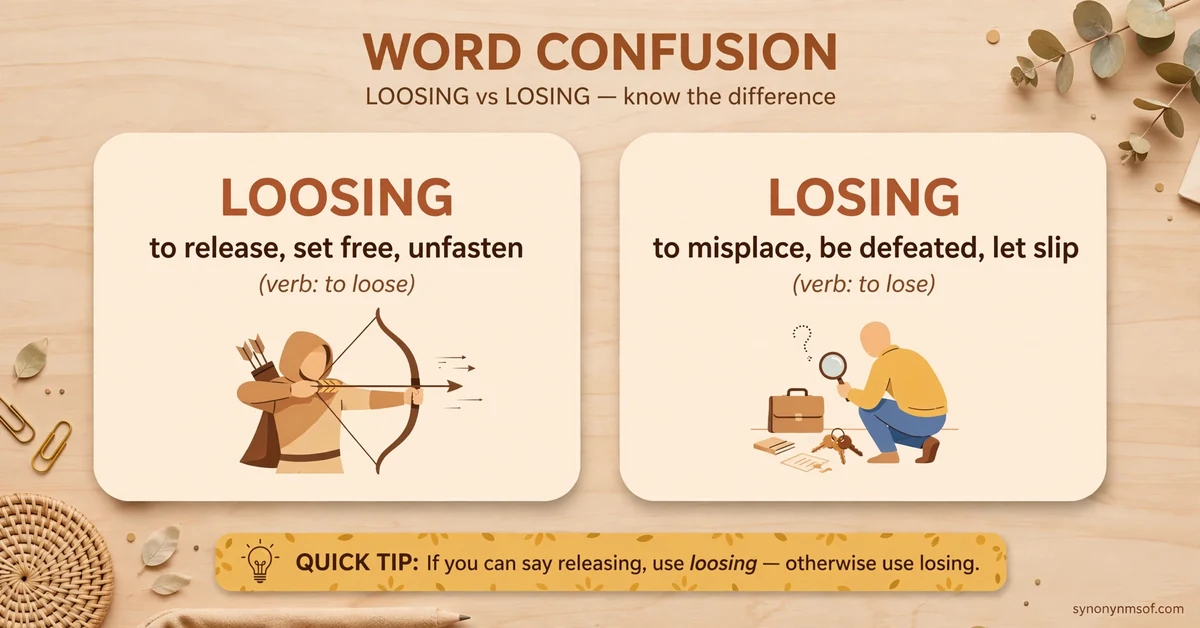
The confusion happens because two different verbs are fighting for the same slot in people’s memory. Lose (one “o”) means to misplace something, to be defeated, or to let something slip away: you lose your keys, you lose a game, you lose your temper. Loose (two “o”s) is an entirely different verb — it means to release, unfasten, or set free: you loose an arrow from a bow, you loose the dogs from their pen. Add “-ing” to each one and you get losing and loosing — two spellings that look almost identical but belong to completely separate word families with completely separate meanings.
In real-world writing, losing is the word you want more than 99 percent of the time, which is why “loosing” usually appears as an accident rather than a choice. This guide covers both words from the ground up: what “loosing” actually means, what “losing” means across its many senses, the key difference, a comparison table, examples in everyday, business, and formal contexts, common mistakes, edge cases, and quick answers to the questions people ask most.
What Does “Loosing” Mean?
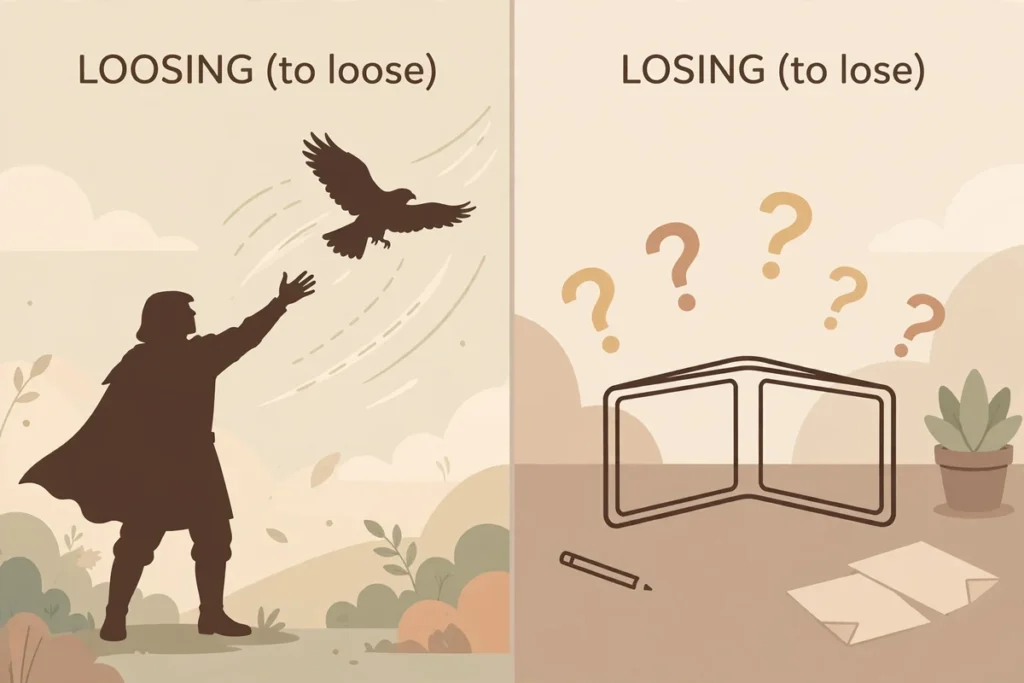
Loosing is the present participle of the verb to loose, which means to set free, release, or unfasten something that was tied, held, or restrained. It is a real, legitimate English word — not a typo in every case — but it is rare, formal, and mostly confined to specific situations like historical writing, hunting, archery, sailing, or ceremonial language. The subject of the sentence is actively freeing something: hands untie, a commander gives an order, a handler opens a gate.
The Verb “To Loose”: To Release or Set Free
As a verb, “loose” (pronounced /luːs/, rhyming with “goose”) describes the act of letting something go from restraint. Think of it as the opposite of binding, tying, or holding back. Because the action is deliberate and physical, “loosing” tends to show up where someone is releasing something with intent.
- The falconer is loosing the hawk for its first flight of the season.
- The archers are loosing their arrows at the distant targets.
- She is loosing the knot so the cargo net can be lifted away.
- At dawn, the crew began loosing the mooring lines from the dock.
Notice the pattern in every example: something was confined or fastened, and someone is now setting it free. If you can substitute “releasing,” “unfastening,” or “setting free” without changing the meaning, loosing is the correct spelling.
The “Loose” Family: Adjective, Verb, and Noun
Most of the confusion starts with the adjective loose, which is far more common than the verb and means “not tight, not firmly fixed, or not exact.” A loose tooth wobbles, loose clothing hangs freely, a loose translation is approximate, and loose change rattles in a pocket. From the same root you get related forms and idioms:
- Loosen (verb): to make less tight — “loosen the lid,” “loosen your grip.”
- Looseness (noun): the state of being loose.
- Let loose: to unleash or allow free expression — “The kids were let loose on the playground.”
- Cut loose: to break free from restraint — “After graduation, she cut loose and traveled for a year.”
- On the loose: escaped and at large — “The suspect is still on the loose.”
- Hang loose: stay relaxed and easygoing.
The adjective “loose” does almost all the heavy lifting in modern English. The verb “loose” — and therefore “loosing” — is its quiet, formal cousin, appearing only when someone is literally releasing or unfastening something. Keeping that family tree in mind makes the spelling much easier: the double “o” belongs to the whole loose family, including “loosing.”
What Does “Losing” Mean?
Losing is the present participle of the verb to lose (pronounced /luːz/, rhyming with “booze” — note the buzzing “z” sound, not a hissing “s”). It is one of the most common “-ing” verbs in English because it covers several everyday ideas: misplacing something, being defeated, and letting something slip away. Whenever you are describing a loss of any kind — an object, a contest, an opportunity, a quality — “losing” is the spelling you want.
Losing as Misplacing or Failing to Keep
The most literal sense of “lose” is to be unable to find something you once had, or to fail to retain possession of it. This is the meaning behind the everyday complaints we all make:
- I am losing my keys at least twice a week.
- She kept losing her place in the report during the long meeting.
- He is losing his voice after shouting over the crowd.
- We are losing daylight, so let’s walk faster.
In each case, something that was held or available is slipping out of reach. Nothing is being released or unfastened — it is simply getting away.
Losing as Being Defeated or Failing to Win
The second major sense is failing to win a contest, argument, or struggle:
- Our team is losing the championship match.
- The candidate is losing ground in the latest polls.
- He hates losing an argument, even a friendly one.
- The startup is losing the race to launch first.
Here “losing” is the opposite of winning, and it has nothing to do with loosening or releasing anything. If a sports fan writes “we are loosing again,” they are accidentally saying their team is busy untying something — which is why the misspelling is so noticeable to careful readers.
Losing as Shedding, Declining, or Letting Slip Away
The third sense covers gradual decline or something fading over time — weight, interest, patience, time, money, or an abstract quality:
- She is losing weight through diet and exercise.
- He is losing interest in the project.
- The teacher was losing her patience with the noisy class.
- We are losing time — the deadline is tomorrow.
- They are losing touch with their college friends.
- I am losing sleep over the decision.
This is the sense people reach for most often in writing, and it is also where the “loosing” misspelling strikes hardest. “Losing weight,” “losing patience,” and “losing track of time” are always spelled with one “o.”
Loosing vs Losing: The Key Difference
Strip away the examples and the difference is simple: losing comes from “lose” (to misplace, be defeated, or let slip), while loosing comes from “loose” (to release or unfasten). They are two different verbs with two different meanings, and the “-ing” forms inherit those meanings exactly. There is no overlap and no situation where both spellings are acceptable for the same sentence.
Loosing is correct but rare, living mostly in formal, historical, or technical contexts where someone is literally setting something free; on the other hand, losing is one of the most common “-ing” forms in the language, covering everything from misplaced keys to lost elections to fading patience. When you are unsure — and statistically you will be right almost every time — choose losing.
A practical swap test settles any doubtful sentence in seconds. Try replacing the word with “releasing”: if the sentence still makes sense, write loosing. Try replacing it with “misplacing” or “failing to win”: if that fits instead, write losing. “They are loosing the horses” becomes “they are releasing the horses” — correct. “I am loosing my wallet” becomes “I am releasing my wallet” — nonsense, so it must be “losing my wallet.”
Loosing or Losing: Side-by-Side Comparison
| Feature | Loosing | Losing |
|---|---|---|
| Root verb | to loose | to lose |
| Core meaning | to release, unfasten, or set free | to misplace, be defeated, or let slip away |
| Part of speech | verb (present participle) | verb (present participle) |
| Pronunciation | /ˈluːsɪŋ/ — hissing “s,” like “hiss” | /ˈluːzɪŋ/ — buzzing “z,” like “buzz” |
| Spelling clue | two “o”s, matching “loose” | one “o,” matching “loss” |
| Frequency | rare; formal, literary, or technical | extremely common in all registers |
| Typical contexts | archery, falconry, sailing, orders to release | daily life, sports, business, emotions |
| Example sentence | “The crew is loosing the sails.” | “The crew is losing the race.” |
| If you are unsure | almost never the right choice | almost always the right choice |
Usage Examples Across Contexts
Everyday Conversation
In casual speech and texting, “losing” does nearly all the work. These are the sentences people actually say, and every one of them uses the one-“o” spelling:
- “I keep losing my phone in this apartment.”
- “We’re losing the game — it’s the fourth quarter.”
- “I’m losing my patience with this traffic.”
- “She’s losing sleep over the exam tomorrow.”
You will essentially never hear “loosing” in everyday conversation unless someone is joking about archery or quoting an old movie. If a friend texts “I’m loosing it,” they mean “losing it” — and now you know exactly why the extra “o” changes the joke.
Work and Business
Professional writing is full of “losing” in its competitive and financial senses. Getting this spelling right matters because business readers notice errors, and “loosing” in a report reads as careless:
- The firm is losing market share to new competitors.
- We are losing money on every unit sold at this price.
- The team is losing momentum after the delayed launch.
- She worried about losing the client after the missed deadline.
- The department is losing focus during the restructuring.
“Loosing” has no natural home in business writing. There is no deal being unfastened and no contract being set free from a pen, so the double-“o” spelling should never appear in a memo, email, or presentation.
Formal and Academic Writing
Academic and formal prose uses “losing” for decline, erosion, and failure to retain — ideas that come up constantly in history, science, and social commentary. “Loosing” can appear in formal writing, but only in its literal release sense, usually in historical or literary passages: “The chronicle describes the general loosing the war dogs upon the fleeing army.” Outside of such deliberate, old-fashioned contexts, formal writers stick with “losing.”
Common Mistakes to Avoid
Mistake 1: Writing “Loosing” When You Mean “Losing”
This is the classic error and it accounts for nearly every “loosing” you will see online. People type “loosing” when they mean misplacing, failing, or declining:
- ❌ “I am loosing my keys again.” → ✅ “I am losing my keys again.”
- ❌ “Our team keeps loosing.” → ✅ “Our team keeps losing.”
- ❌ “She is loosing weight.” → ✅ “She is losing weight.”
- ❌ “We are loosing time.” → ✅ “We are losing time.”
Why does it happen? Two reasons. First, the adjective “loose” is common, so the double-“o” pattern feels familiar and safe. Second, English has lookalike verbs that keep their double “o” before “-ing” — choose becomes choosing, freeze becomes freezing — so the brain assumes “lose” should become “loosing” by the same rule. Learn the two base verbs first, and then the correct spelling follows automatically: “lose” gives “losing,” “loose” gives “loosing.”
Mistake 2: The Reverse — Writing “Losing” When You Mean Releasing
Far rarer, but it happens in historical fiction, fantasy writing, and anywhere someone is describing a release: “The captain gave the order, and the archers began losing their arrows.” That sentence says the archers were misplacing their arrows or being defeated by them. The intended meaning — firing the arrows — needs loosing: “the archers began loosing their arrows.” If your scene involves bows, hawks, hounds, sails, or anything being set free, double-check that you haven’t defaulted to the common spelling.
Mistake 3: Mixing Up the Adjective “Loose” with the Verb “Lose”
The confusion runs in both directions, and the adjective gets pulled into the mess too:
- ❌ “This screw is lose.” → ✅ “This screw is loose.” (not tight)
- ❌ “I need to lose this knot.” → ✅ “I need to loosen this knot.” (make it less tight)
- ❌ “The dog got lose.” → ✅ “The dog got loose.” (free, unconfined)
- ❌ “These pants are too lose.” → ✅ “These pants are too loose.”
The pattern is consistent: when you mean “not tight” or “free,” the word is loose with two “o”s. When you mean “misplace” or “be defeated,” it is lose with one. The “-ing” forms follow their parents exactly.
Mistake 4: Trusting Autocorrect to Catch the Error
Spellcheckers will not save you here. Both “losing” and “loosing” are valid dictionary words, so no red squiggle appears under either one. Grammar tools sometimes catch the mistake from context, but many don’t — especially in short sentences. This is a meaning error, not a spelling error in the technical sense, so the only reliable fix is knowing the difference yourself. Read the sentence back and run the swap test: “releasing” or “misplacing”? Ten seconds of checking beats an embarrassing “loosing” in a published post or a job application.
Tricky Cases and Edge Cases
“Losing My Mind” — Why the Extra O Changes Everything
“I’m losing my mind” is one of the most common phrases in English, meaning “I’m going crazy” or “I can’t think straight.” Write it as “I’m loosing my mind” and the meaning becomes surreal: you are releasing your mind from its restraints, as if your brain were a caged animal you just set free. The sentence is still grammatical — that is what makes the mistake so sneaky — but it says the opposite of what you feel. One vowel turns a relatable complaint into accidental poetry, which this shows just how much meaning rides on a single letter in this pair.
Pronunciation: /ˈluːzɪŋ/ vs /ˈluːsɪŋ/
The spoken difference mirrors the spelling difference. Losing is pronounced with a buzzing “z” (/ˈluːzɪŋ/), inherited from “lose” (/luːz/). Loosing has a hissing “s” (/ˈluːsɪŋ/), inherited from “loose” (/luːs/). Many people say “losing” with a soft “s” in fast speech — harmless in conversation, but it trains the hand to write the double-“o” version. If you catch yourself pronouncing it “loo-sing,” pause and ask which verb you mean.
Phrases Built on “Loose”: Let Loose, Cut Loose, On the Loose
A handful of idioms use the adjective “loose,” and they occasionally tempt writers into “-ing” forms that don’t exist or don’t fit:
- Let loose (to unleash): “The band really let loose in the second set.” The “-ing” form “letting loose” is fine — it still uses the adjective.
- Cut loose (to break free): “He cut loose from his old routine.” Again, “cutting loose” keeps the adjective.
- On the loose (escaped): “The parrot is on the loose.” This one never takes “-ing” at all.
None of these should be rewritten with “loosing.” They are adjective phrases, not the verb “to loose,” so the present participle never enters the picture.
The Few Times “Loosing” Is Genuinely Correct
“Loosing” is rare, but it is not wrong — and knowing its real habitats protects you from “correcting” it by mistake. Reach for the double “o” when the sentence is about physically releasing or unfastening:
- Archery and hunting: “loosing arrows,” “loosing the hounds.”
- Falconry: “loosing the falcon” for a flight.
- Sailing: “loosing the sails” or “loosing the mooring lines.”
- Ceremonial orders: “loose the doves” at a memorial; the “-ing” form appears in narration of such scenes.
- Literary and historical prose: “loosing the floodgates of criticism” — a mixed metaphor, but an attested one.
The test never changes: if “releasing” fits in the sentence, “loosing” is correct. In every other situation — every misplaced key, every lost game, every fading memory — the answer is “losing.”
Frequently Asked Questions
Should I write “loosing weight” or “losing weight”?
Always write “losing weight” with one “o.” Shedding pounds is a form of letting something go in the “lose” sense — you are gradually being deprived of the weight — so it takes the present participle of “lose.” “Loosing weight” would mean unfastening weight, which makes no sense as a fitness goal.
Is “I’m loosing my mind” correct?
No. The idiom is “I’m losing my mind,” meaning you feel confused, overwhelmed, or unable to think clearly. “Loosing my mind” would literally mean setting your mind free from restraint, like releasing a captive animal. It is one of the most visible versions of this spelling mistake because the phrase is so common.
Is “loosing” ever the correct word?
Yes, but only in its literal sense of releasing or unfastening something. Correct uses include “loosing the arrows” (archery), “loosing the hounds” (hunting), and “loosing the sails” (sailing). If you can replace the word with “releasing” and the sentence still works, “loosing” is right; otherwise, you want “losing.”
What is the difference between “lose” and “loose”?
“Lose” (one “o,” pronounced /luːz/) is a verb meaning to misplace something, be defeated, or let something slip away: “lose your keys,” “lose a game.” “Loose” (two “o”s, pronounced /luːs/) is mainly an adjective meaning not tight or not confined — “a loose tooth,” “loose clothing” — and secondarily a verb meaning to release or set free: “loose the dogs.” Their “-ing” forms, “losing” and “loosing,” inherit these meanings exactly.
How can I remember the difference between “losing” and “loosing”?
Use the letter-count trick: “losing” has one “o,” just like “loss” — both are about something being gone. “Loosing” has two “o”s, just like “loose” — both are about something being set free. Then run the swap test: if “releasing” fits, write “loosing”; if “misplacing” or “failing to win” fits, write “losing.” When in doubt, “losing” is correct more than 99 percent of the time.
Conclusion
Loosing and losing look like twins, but they come from two different verbs with two different jobs: “loose” releases and unfastens, while “lose” misplaces, fails, and lets slip away. Because losing covers the everyday meanings — misplaced keys, lost games, fading patience — it is the spelling you need in virtually every sentence you will ever write, while loosing waits quietly for archers, sailors, falconers, and historical narrators.
The next time your fingers reach for that second “o,” pause for the two-second swap test: can you say “releasing” instead? If yes, write “loosing” with confidence. If not, “losing” is your word. Master that one habit, and this famously tricky pair stops being tricky for good.