
Few spelling mix-ups are as common, or as embarrassing, as getting “to” and “too” wrong. The two words sound identical in everyday speech, so nobody can hear the difference when you say them. But the moment your writing lands on someone’s screen — a job email, a school essay, a social media post — the wrong choice jumps right out. “I want too go home” looks careless, even when the writer knows exactly what they meant.
What makes this pair tricky is that the distinction has nothing to do with pronunciation and everything to do with grammar. “To” and “too” belong to different parts of speech, do different jobs in a sentence, and cannot be swapped for each other. Once you understand the job each word is doing, the choice becomes almost automatic.
This guide breaks the whole thing down step by step: what “to” means in its two main roles, what “too” means in its two main roles, the core difference between them, and how both words behave in everyday conversation, business writing, and academic work. Along the way, you’ll see the most common mistakes, the tricky edge cases that fool even advanced writers, and a quick-reference comparison table you can bookmark and return to whenever you need it.
What Does “To” Mean?
The word “to” is one of the busiest small words in English. It shows up in almost every paragraph you read, yet it rarely gets noticed — which is exactly why people mistype it as “too” without thinking. “To” has two distinct jobs: it works as a preposition, and it works as a marker for the infinitive form of a verb.
“To” as a Preposition
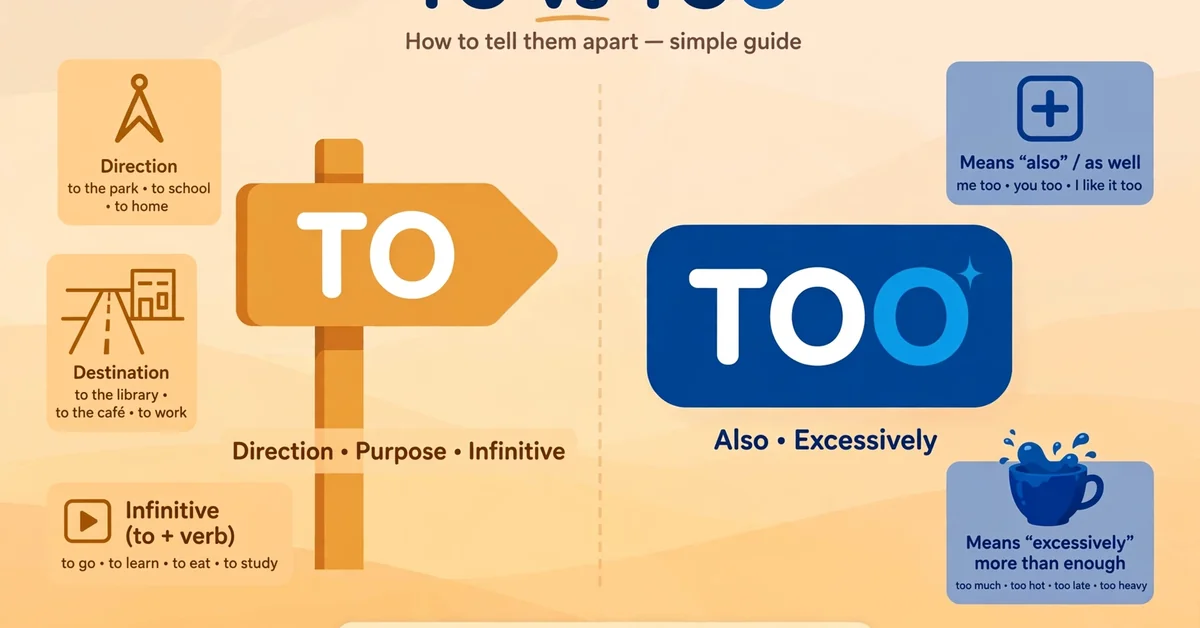
As a preposition, “to” connects a noun or pronoun to the rest of the sentence. Its most common job is showing direction or movement toward something: “We walked to the park,” “She flew to New York,” “He ran to the door.” In each case, “to” points from one place to another.
But the preposition “to” does much more than talk about travel. It can mark the receiver of an action (“Give the keys to me”), show a limit or endpoint (“The temperature dropped from 40 to 25 degrees”), express a relationship (“She is married to a doctor”), or indicate purpose (“He went to the store to buy milk” — note the first “to” is the preposition, attached to “the store”). It also appears in expressions of time (“from Monday to Friday”), comparison (“I prefer tea to coffee”), and attachment (“Tie the rope to the post”). In all of these uses, “to” is glued to a noun or pronoun phrase, never to a bare verb.
“To” as an Infinitive Marker
The second job of “to” is to introduce the infinitive — the base form of a verb. In “I want to eat,” “to” sits in front of the verb “eat” and together they form the infinitive phrase “to eat.” This little word is how English signals that a verb is acting as a noun, an adjective, or an adverb rather than as the main action of the sentence.
You’ll see infinitive “to” everywhere: after certain verbs (“She decided to stay,” “They agreed to help”), after adjectives (“It is hard to believe,” “She was happy to hear the news”), and after nouns (“He has a desire to succeed,” “This is the best way to learn”). A simple test: if the word right after it is a verb in its base form — go, eat, learn, decide, write — the word you want is “to.” This test alone fixes the single most common “to/too” error in English writing.
What Does “Too” Mean?
While “to” is a preposition, “too” is an adverb, and it carries just two meanings. The extra “o” is not random — it signals that the word is doing something “extra”: adding something more, or describing something that has gone past a limit.
“Too” Meaning “Also” or “As Well”
The first meaning of “too” is “also” or “in addition.” It usually appears at the end of a sentence or clause: “I love Italian food. My brother does too.” “She is coming to the meeting, and I am coming too.” It can also appear after the subject: “I, too, was surprised by the announcement.” In formal writing you will often see a comma before it (“I agree, too”), though in casual writing the comma is frequently dropped.
A helpful substitution test: if you can replace the word with “also” and the sentence still makes sense, “too” is the right spelling. “I want to go too” becomes “I want to go also” — that works, so “too” is correct. But “I want too go” becomes “I want also go” — which is nonsense, so you know “to” was needed there.
“Too” Meaning “Excessively” or “More Than Enough”
The second meaning of “too” is “excessively,” “overly,” or “more than is good or necessary.” It comes before an adjective or adverb: “The soup is too hot,” “He drives too fast,” “This bag is too heavy to carry.” In each case, “too” points at an amount that has crossed a line — the soup is not just hot, it is hotter than it should be for eating.
This “too” very often pairs with a “to”-infinitive that names the consequence: “She is too tired to work” (her tiredness is excessive, so working is impossible), “The box is too heavy to lift” (its weight is excessive, so lifting is impossible). The pairing is one reason learners mix the two spellings up — the sentence contains both “too” and “to” in close quarters. Just remember: “too” is the one doing the judging, and “to” is the one introducing the verb.
To vs Too: The Core Difference at a Glance
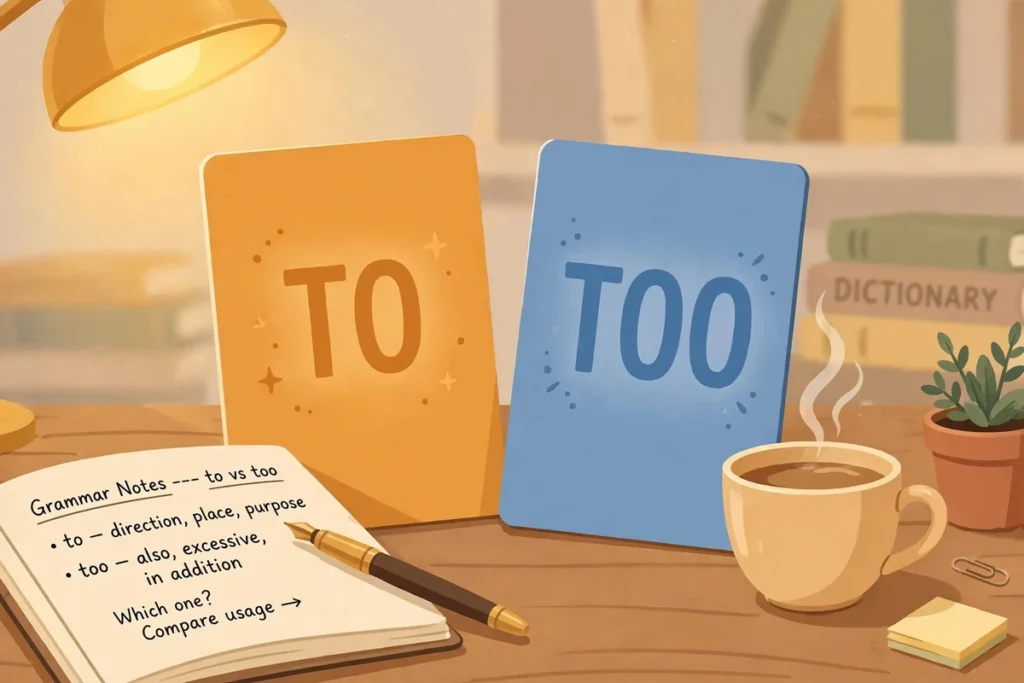
The simplest way to keep the pair straight is to remember their different jobs. “To” is a connector and a verb-introducer — it links things together or sets up an action. “Too” is a comment on quantity — it either adds one more thing (“also”) or flags that something has gone past the acceptable amount (“excessively”). Here is a side-by-side comparison you can use as a quick reference.
| Feature | To | Too |
|---|---|---|
| Part of speech | Preposition / infinitive marker | Adverb |
| Core meaning | Direction, connection, purpose; introduces a verb | “Also” or “excessively” |
| Comes before | Nouns, pronouns, or base-form verbs | Adjectives, adverbs, or at the end of a clause |
| Pronunciation | /tuː/ — identical | /tuː/ — identical |
| Quick test | Can it be followed by a noun phrase or a bare verb? | Can it be replaced with “also” or “very”? |
| Example (direction) | She walked to the station. | — |
| Example (also) | — | She walked there, and I did too. |
| Example (excess) | — | The line was too long to wait in. |
One more memory aid that never fails: “too” has an extra “o,” which stands for “extra” — extra meaning (“also”) or extra amount (“excessively”). Everything else — direction, purpose, verb infinitives — belongs to “to.”
“To” and “Too” in Everyday Conversation
In casual speech, the distinction barely matters because the words sound the same, but it matters the moment you text, post, or message. Everyday writing is where most “to/too” mistakes actually happen, because people type fast and don’t reread.
Consider these normal daily exchanges. “Want to grab coffee?” — the “to” introduces the verb “grab.” “I want to come too!” — the “too” adds “also” to the end. “This traffic is too much” — “too” flags the excessive amount. “Give it to me when you’re done” — “to” marks the receiver. Native speakers produce all of these correctly by feel, but learners who write them out should slow down and check the word’s job.
Texting culture has added a twist: people often drop the extra “o” to save time, writing “me to” instead of “me too.” In a chat with a friend, nobody cares. But that habit leaks into emails and applications, where “I would like to join your team to” reads as a typo. Keep the casual shortcuts in your chats and the correct spelling in everything that matters.
Using “To” and “Too” in Work and Business Writing
Professional writing is where a “to/too” slip costs the most, because readers judge competence from small details. A cover letter that says “I am excited too join your company” can sink an application before the reader reaches the second paragraph. The good news is that business English uses both words in predictable patterns.
“To” appears constantly in routine phrases: “Please send the report to the manager,” “I am writing to confirm our meeting,” “We look forward to working with you.” Infinitive “to” is especially common after verbs like hope, expect, plan, need, and want: “We plan to launch in March,” “I need to review the contract.” When drafting, it can help to ask yourself directly what you’re trying to say — I was wondering whether that word introduces a verb or adds “also” to the sentence, because that single question resolves nearly every case.
“Too” in business writing usually shows up in its “also” sense: “Thank you for the update. I will attend the briefing too.” It also appears in diplomatic softening: “The timeline may be too ambitious” is a polite way of saying a deadline is unrealistic. And in scheduling, you might close with something like, “Feel free to call me too, if time permits, and we can walk through the details together.” Notice how “too” (also) and the infinitive “to” (in “to call”) sit in the same sentence without conflict — each is doing its own clearly different job.
One business-writing trap: the phrase “too to” itself. “The fee is too high to justify” is perfectly correct — “too” judges the fee, “to” introduces “justify.” Reading the sentence aloud won’t help you here since they sound identical, so rely on the substitution tests instead.
Using “To” and “Too” in Formal and Academic Writing
Academic writing raises the stakes further. Reviewers, examiners, and editors treat “to/too” errors as basic literacy failures, and in a thesis or published paper there is no excuse for them. Formal style also brings out uses of both words that rarely appear in conversation.
“To” as a preposition carries heavy weight in academic prose: “according to the data,” “in contrast to earlier studies,” “with reference to the previous chapter.” Infinitive “to” structures entire arguments: “This study aims to demonstrate,” “The results tend to support the hypothesis.” The infamous split infinitive — “to boldly go” — is a style question, not a “to/too” question, but it reminds you how central infinitive “to” is to formal English.
“Too” appears in academic writing mostly as “also”: “The second experiment, too, produced significant results.” Note the commas setting it off — formal style favors “I, too,” over “I too” at the start of a clause. The “excessively” sense shows up in evaluations: “The sample size was too small to generalize from,” “The model is too sensitive to initial conditions.” In every case, the same tests apply. If the word modifies an adjective or means “also,” it gets two o’s; everything else gets one.
Common Mistakes to Avoid
Most “to/too” errors fall into a handful of patterns. Learning to spot these patterns is faster than memorizing rules, because your eye will start catching the wrong shape automatically.
The number-one mistake is writing “too” before a verb: “I want too eat,” “She needs too study,” “They decided too leave.” A verb in its base form can never follow “too” — only infinitive “to” can introduce a verb. If you catch yourself typing “too” and the next word is an action, delete an “o” immediately.
The mirror-image mistake is writing “to” where “also” belongs: “I like pizza to,” “He is coming to.” Read the sentence with “also” in the slot. If “I like pizza also” sounds right, the spelling is “too.” This error is especially common at the ends of sentences, where writers are rushing to finish.
A subtler error involves the “excessively” sense: “The test was to difficult,” “She spoke to quietly.” Ask whether you mean “very” or “overly.” If “the test was very difficult” works as a paraphrase, you need “too.” The single “o” version — “to difficult” — is never correct, because “to” cannot modify an adjective.
Finally, watch out for autocorrect and muscle memory. Phone keyboards learn your habits, and if you once typed “too” in a “to” slot, your keyboard may keep suggesting it. When you proofread, give every “to” and “too” a one-second grammar check: preposition or infinitive, or “also/excessively”? That tiny pause catches nearly everything.
Tricky Cases and Edge Cases
“To” vs “Too” vs “Two”
The full trio is “to,” “too,” and “two” — three homophones that all sound like /tuː/. “Two” is the easy one: it is always the number 2. “I have two brothers,” “Give me two minutes.” The confusion almost never involves “two” in practice, but teachers bundle the three together because learners benefit from sorting the whole set at once: “to” for direction and verbs, “too” for “also” and “excess,” “two” for the number.
“Too” at the Start of a Sentence
“Too” can open a sentence when it means “also,” and this is where formal punctuation matters. “The manager approved the budget. I, too, supported the decision.” Starting with bare “Too, I supported…” is awkward; the standard formal pattern places “too” right after the subject with commas on both sides: “She, too, was invited.” In casual writing, people often just put “too” at the end instead, which is simpler and always safe.
Infinitive “To” vs Preposition “To”
This distinction doesn’t change the spelling — it’s “to” either way — but it matters for understanding. Compare “I am used to cold weather” (preposition: “to” attaches to the noun phrase “cold weather”) with “I used to swim daily” (infinitive marker: “to” attaches to the verb “swim”). The meanings differ — “be used to” means accustomed, “used to” means a past habit — but both take the single-o spelling. Confusing the two senses won’t cause a “to/too” error, yet recognizing the difference sharpens the instinct that “to” is the word that bonds with verbs and nouns, never the word that judges amounts.
“To” and “Too” in the Same Sentence
English happily puts both spellings in one sentence, and these are the sentences that look scariest but are actually straightforward once you see each word’s job. “I want to go to the concert too” contains three relevant words: infinitive “to” before “go,” preposition “to” before “the concert,” and “too” meaning “also” at the end. Or the classic pairing: “The movie was too long to sit through” — “too” judges the length, “to” introduces “sit.” Infinitive “to” attaches to a verb, on the other hand, preposition “to” attaches to a noun phrase — and in sentences like these, both appear side by side without any conflict. Parse each word separately and the spelling chooses itself.
“Too” vs “Very” and “So”
Learners sometimes wonder whether “too” and “very” are interchangeable. They overlap but differ in an important way: “very” intensifies neutrally (“very hot” = hot to a high degree), while “too” adds a judgment that the degree is excessive (“too hot” = hotter than it should be). Saying “the soup is too hot” implies you can’t eat it; “the soup is very hot” just describes it. In formal writing, don’t use “too” when you only mean “very” — the excess meaning will sneak in and change your message.
Frequently Asked Questions
Is it “to” or “too” in “I want to go too”?
It is “too” with two o’s at the end. The sentence contains both spellings doing different jobs: “to go” uses infinitive “to” before the verb “go,” and the final “too” means “also” — as in “I want to go also.” Whenever the word at the end of the sentence can be swapped with “also,” it needs the double “o.”
Can “too” ever come before a verb?
No. “Too” is an adverb meaning “also” or “excessively,” and it never introduces a verb. If the next word is a base-form verb — go, eat, learn, be, have — the spelling is always “to.” Sentences like “I want too eat” or “she needs too sleep” are always wrong; remove one “o” and they become correct.
What’s the easiest trick to remember the difference between “to” and “too”?
Remember that “too” has an extra “o” for something “extra”: extra people (“me too” = also me) or an extra amount (“too much” = excessively much). Then use the substitution test: if “also” or “very/excessively” fits, write “too”; if the word sits before a verb or a noun phrase showing direction, purpose, or connection, write “to.” Between the extra-“o” trick and the substitution test, nearly every case resolves in seconds.
Is “to” a preposition or something else?
It is both, depending on the sentence. “To” works as a preposition when it connects to a noun or pronoun (“go to school,” “give it to her”), and it works as an infinitive marker when it introduces a verb (“to learn,” “to decide”). Either way it is spelled with one “o.” “Too” with two o’s is always an adverb and never a preposition, so the two spellings never overlap in function.
Why do even native speakers mix up “to” and “too”?
Because the words are perfect homophones — they sound exactly the same in every accent — so the ear offers no clue and the brain has to rely on grammar instead. Fast typing makes it worse: fingers type the more common “to” or the recently used “too” on autopilot. Even professionals slip, which is why proofreading specifically for small function words is a standard editing habit, not a sign of weak English.
Conclusion
The “to” vs “too” confusion looks intimidating only because the two words sound identical. Underneath, the rule is one of the cleanest in English: “to” connects and introduces — direction, purpose, verb infinitives — while “too” comments on quantity, meaning either “also” or “excessively.” Two quick tools, the extra-“o” memory trick and the also/very substitution test, settle almost every sentence you’ll ever write.
Like most small-word errors, this one disappears with a little deliberate practice. Slow down on the final proofread, check each “to” and “too” against its job in the sentence, and within a few weeks the correct spelling will feel as automatic as the words sound. Your emails, essays, and messages will read exactly as polished as you intend them to.
Precise word choice builds reader trust — see our guide to amid or amidst for another tricky pair. Small distinctions matter in professional writing, as our note on among or amongst shows. Everyday usage questions deserve clear answers, like our entry on aunty or auntie. And when spelling trips you up, our breakdown of ax or axe keeps things consistent.