
Is it “toward” or “towards”? If you have ever hesitated between these two, you are not alone. This pair splits English speakers along regional lines, confuses style guides, and divides even native writers who have been using both forms for years. The good news is that the answer is simpler than it looks — and once you understand it, you will never second-guess yourself again.
In this guide, you will learn exactly what “toward” and “towards” mean, the real difference between them, which form to use depending on where your readers are, and how to handle both in everyday conversation, business writing, and formal documents. You will also see the most common mistakes writers make with this pair and the tricky edge cases that trip people up.
Before we dive in, a quick note on the site’s own house style: synonynmsof.com uses American English conventions throughout, so this article defaults to “toward” — except when showing the British form for comparison.
What Does “Toward” Mean?
“Toward” is a preposition that expresses direction, movement, or orientation in relation to something. When you walk toward the door, your movement is directed at the door. When you lean toward an idea, your thinking is oriented in that direction. The word positions one thing in relation to another — spatially, temporally, or figuratively.
Toward as Direction and Movement
In its most literal sense, “toward” describes physical movement in the direction of a target. “She walked toward the station.” “The ship sailed toward the harbor.” “He turned toward the window.” In each case, the subject is moving or oriented in the direction of the object that follows the preposition. Note that “toward” does not promise arrival — you can walk toward the station and stop halfway. It only describes the direction of travel.
Toward as Orientation and Attitude
“Toward” also describes attitudes, feelings, and tendencies. “He felt warmly toward his new colleagues.” “Public opinion shifted toward reform.” “She has a talent toward music.” Here the word points at a mental or emotional direction rather than a physical one. This figurative use is just as common as the literal one, especially in business and academic writing, where arguments lean toward conclusions and evidence points toward outcomes.
Toward in Time and Purpose
A third use marks time or purpose: “toward the end of the year,” “contributions toward the project,” “steps toward a resolution.” In these phrases, “toward” signals progress along a timeline or toward a goal. “Working toward a deadline” means your effort is directed at meeting it. These uses are idiomatic and fixed — “steps towards a resolution” works identically, but within American style the “toward” form is expected.
What Does “Towards” Mean?
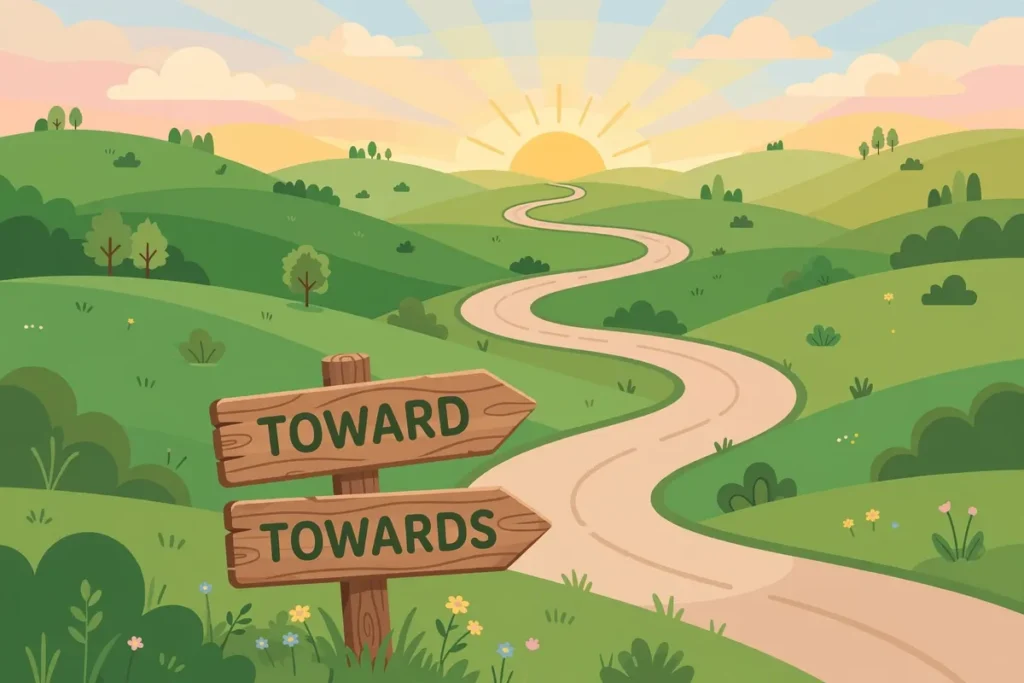
“Towards” means exactly the same thing as “toward.” It is the same preposition, with the same definitions, the same grammar, and the same range of uses. The only difference is the final “s” — and that “s” carries no meaning of its own.
The British Preference
In British English, “towards” is the dominant form by a wide margin — roughly nine to one in published writing. If you are writing for a UK audience, a British publication, or an international organization that uses British conventions, “towards” is the natural choice. “She walked towards the station” reads as perfectly standard in London, Sydney, or Toronto (Canadian English leans British here).
The Same Word, Same Rules
Everything true of “toward” is true of “towards.” It takes the same objects, appears in the same idioms (“steps towards a resolution”), and follows the same grammar. The two forms are interchangeable in meaning — the choice between them is purely a matter of regional convention and consistency, never a matter of correctness of sense.
Toward vs Towards: The Real Difference
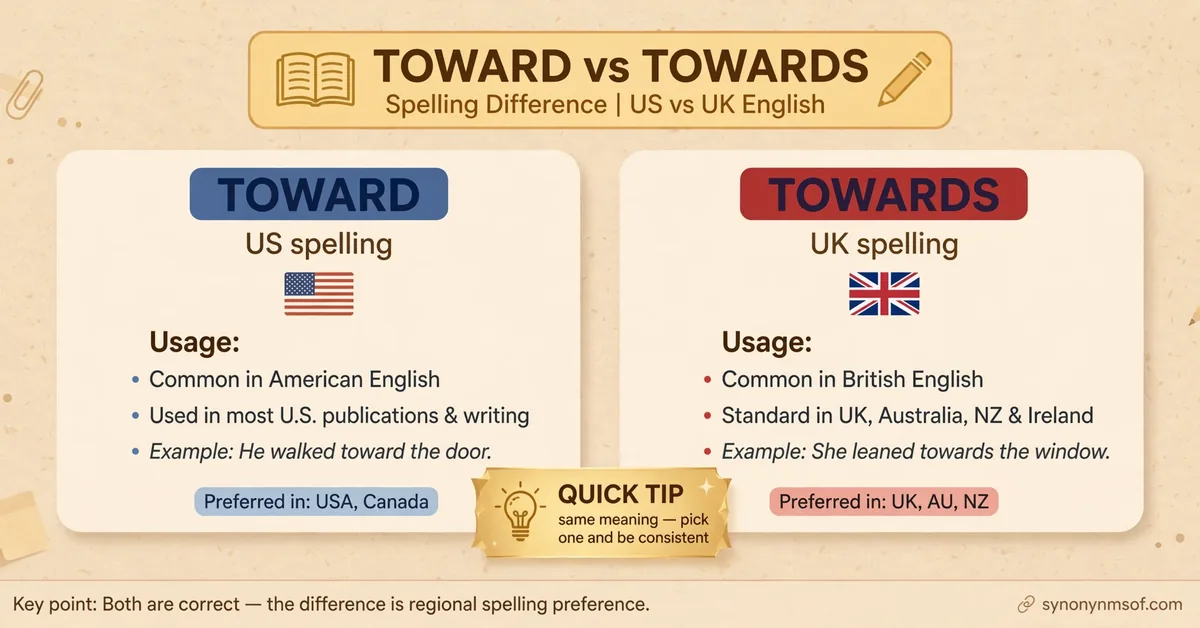
Strip away the geography and there is no difference in meaning, grammar, or pronunciation. Both are pronounced /tɔːrd/ (the “s” is silent in the sense that it adds no syllable in normal speech — “towards” is still one syllable in most accents, or a quick two at most). The difference is purely orthographic convention: American style guides prescribe “toward,” British style guides prescribe “towards.”
The most useful way to think about it is as a mirror of other transatlantic spelling pairs: “toward/towards” works like “color/colour” or “organize/organise,” except that in this case the longer form belongs to the British side. American English trimmed the “s”; British English kept it.
| Feature | Toward | Towards |
|---|---|---|
| Part of speech | Preposition | Preposition |
| Meaning | Direction, orientation, tendency | Identical — direction, orientation, tendency |
| Regional preference | American English | British English (+ Commonwealth) |
| Pronunciation | /tɔːrd/ | /tɔːrdz/ — same word in practice |
| Style guides | AP, Chicago prescribe “toward” | Oxford, Cambridge prefer “towards” |
| Example | She walked toward the door. | She walked towards the door. |
Using “Toward” and “Towards” Across Contexts
Everyday Conversation
In speech, the distinction barely exists — most people cannot hear the difference between “toward” and “towards” at normal talking speed. Regional accent matters more than the final “s.” An American saying “toward” and a Brit saying “towards” are saying the same word for all practical purposes. In writing to friends or on social media, either form is fine; nobody will judge the choice.
Work and Business Writing
Professional writing is where consistency starts to matter. If your company uses American English, use “toward” everywhere. If it uses British English, use “towards.” The one thing to avoid is mixing them in the same document — “steps toward the launch” in paragraph two and “steps towards the launch” in paragraph five looks sloppy, even though neither is wrong on its own. Many corporate style guides pick one form explicitly; when in doubt, match your audience’s country. If time permits, add the form to your team’s style sheet so everyone stays aligned — see if time permits for a natural example of how the phrase fits into professional writing.
Formal and Academic Writing
Academic style is the strictest context. Journals specify a house style, and copyeditors will normalize every instance to the prescribed form. The APA Publication Manual (American) uses “toward”; British journals use “towards.” Theses and dissertations should pick the form matching their institution’s country and apply it relentlessly. Examiners do notice inconsistency here, because it signals inattention to detail — the very quality academic writing is meant to demonstrate.
Common Mistakes to Avoid
The number-one mistake is not choosing the wrong form — it is mixing both forms in one document. A report that uses “toward” on page one and “towards” on page three looks unedited. Pick one and run a find-and-replace at the end.
The second mistake is assuming the “s” adds formality or emphasis. It does not. “Towards” is not fancier than “toward,” and adding the “s” to sound more proper in American writing backfires — it reads as a Britishism in a US document, which is a consistency error, not an upgrade.
The third mistake is overcorrecting in the other direction: Americans writing for British publications who strip every “s” and end up with “toward” in a UK journal. Match the publication, not your passport.
Tricky Cases and Edge Cases
Toward(s) With Verbs of Motion vs. Stative Verbs
Some writers wonder whether the form changes with the verb — “ran towards” but “leaned toward”? It does not. The regional rule is the only rule. “Ran toward the exit” (US) and “ran towards the exit” (UK) are both correct; the verb makes no difference.
“Toward” in Idioms and Fixed Phrases
Fixed phrases keep the regional form of their context, not a frozen historical spelling. “Steps toward peace” and “steps towards peace” are the same idiom in different dress. There is no idiom that requires one form in both regions — which is convenient, because it means you never have to memorize exceptions.
The Adjective Question: Is There a “Towardly”?
No. Neither form produces a standard adjective. “A toward motion” is not idiomatic English; use “forward” or rephrase. This is worth knowing because learners sometimes try to build words from the preposition the way they would from a noun.
What About “To”? When Is the Shorter Word Better?
“To” and “toward” overlap in direction uses — “walk to the store” vs. “walk toward the store” — but they differ in a key way: “to” implies arrival or destination, while “toward” implies direction only. “She walked to the bank” means she arrived; “she walked toward the bank” means she headed that way. Then consider purpose: “to” also marks infinitives and recipients, jobs “toward” never does. The two words are neighbors, not twins.
Frequently Asked Questions
What is the difference between toward and towards?
There is no difference in meaning, grammar, or pronunciation. “Toward” is the preferred form in American English; “towards” is preferred in British English and across the Commonwealth (UK, Australia, New Zealand, South Africa, and largely Canada). They are regional spelling variants of the same preposition. Choose the form that matches your audience and use it consistently throughout your document.
Is it “toward” or “towards” in American English?
Use “toward” — without the “s.” The AP Stylebook and the Chicago Manual of Style both prescribe “toward,” and it is the dominant form in American books, newspapers, and websites. “Towards” does appear in casual American writing, but it is the non-standard form in the US.
Is it “toward” or “towards” in British English?
Use “towards” — with the “s.” It is the overwhelmingly dominant form in British publishing (roughly nine to one over “toward”), and the same preference holds in Australia, New Zealand, and South Africa.
Does the “s” in “towards” change the meaning?
No. The “-s” is a historical leftover from an old adverbial ending (the same “-s” seen in “besides” and “amongst”). It does not make the word plural — prepositions cannot be plural — and it does not add formality, emphasis, or any shade of meaning. “Toward” and “towards” are fully interchangeable in sense.
Can I mix “toward” and “towards” in the same document?
Grammatically you can, but stylistically you should not. Mixing the two forms looks inconsistent and unprofessional, even though neither instance is wrong on its own. Pick one form per document based on your audience or style guide and apply it everywhere. On the other hand, quoting a source that uses the other form is fine — never alter quoted text to match your style.
Conclusion
“Toward” and “towards” are the same word in different regional dress. American English prefers “toward,” British English prefers “towards,” and the meaning never changes between them. The entire rule fits in one sentence: match your audience, then stay consistent.
Once that habit is in place, the pair stops being a source of hesitation and becomes what it really is — a small, solved detail of English spelling. Pick your form, apply it everywhere, and move on to the parts of writing that actually deserve your attention.
Small word choices affect how polished your writing feels — see anyway or anyways for a common example. Doubling rules trip up many writers, as our note on benefitting or benefiting explains. When you proofread, watch for tricky spellings like bingeing or binging. Descriptive words need care too — our entry on blond or blonde clears up the distinction.