
Whether you’re sending a workplace email, posting in a team chat, welcoming attendees to a meeting, or sharing an announcement with a group, your opening greeting shapes the tone of the entire conversation.
One of the most common greetings people use is “Hello all.”
It’s simple, inclusive, and instantly lets readers know you’re addressing everyone. But because it’s used so often, many people wonder:
- Is “Hello all” professional?
- Does it sound too generic?
- Should you use “Hi everyone” instead?
- Is “Dear all” more appropriate in formal emails?
- What are some better alternatives?
The truth is that “Hello all” isn’t wrong—it remains a perfectly acceptable greeting in most professional and casual settings. However, using the same opening in every email can make your communication feel repetitive and impersonal.
Fortunately, there are plenty of natural alternatives that can help you sound warmer, friendlier, more polished, or more formal depending on your audience.
In this guide, you’ll learn:
- The meaning of “Hello all.”
- Whether it’s considered professional.
- When to use it (and when to avoid it).
- 45+ alternatives with tone, best use, and examples.
- Email etiquette and workplace tips.
- Common mistakes to avoid.
- Frequently asked questions.
Let’s begin with what the phrase actually means.
What Does “Hello All” Mean?
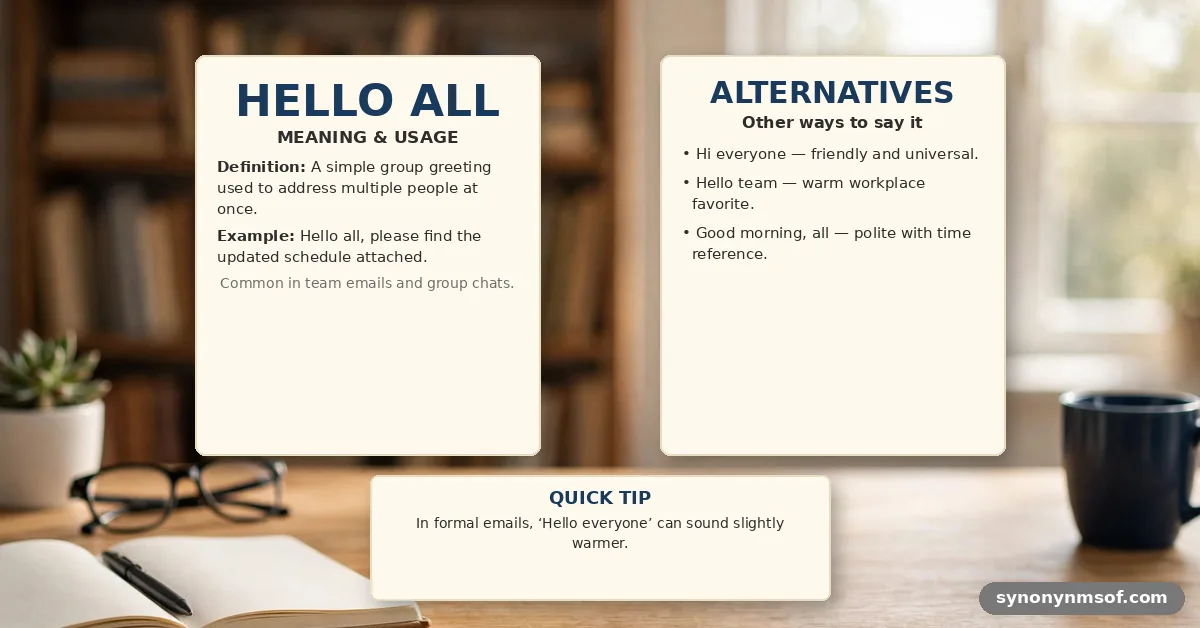
“Hello all” is a greeting used when addressing more than one person at the same time.
Instead of greeting individuals by name, you’re acknowledging the entire group with a single, inclusive phrase.
It essentially means:
- Hello everyone
- Hi everybody
- Greetings to everyone present
You’ll commonly see it in:
- Workplace emails
- Team chats
- Slack or Microsoft Teams messages
- Group announcements
- Project updates
- Academic discussions
- Community forums
- Volunteer organizations
Because it’s short and neutral, it works well in many different situations.
See Also: 45 Ways to Say “Does That Work for You?” Professionally
Is “Hello All” Professional?
Yes.
In most workplaces, “Hello all” is considered a professional and respectful way to begin a message addressed to multiple recipients.
It’s especially common for:
- Internal company emails
- Department announcements
- Team updates
- Meeting invitations
- Project discussions
- Group reminders
- Collaboration platforms
However, professionalism isn’t determined by the greeting alone.
The rest of your message matters just as much.
For example:
Professional
Hello all,
Attached is the revised project timeline. Please let me know if you have any questions.
Less Effective
Hello all.
Need this ASAP.
A warm, respectful tone makes even a simple greeting feel more thoughtful.
Why Greetings Matter More Than You Think
Many people focus on the body of an email and overlook the opening.
But greetings create an immediate first impression.
Within just a few seconds, readers begin forming opinions about your message.
A thoughtful greeting can communicate:
- Respect
- Professionalism
- Friendliness
- Inclusiveness
- Confidence
- Collaboration
Compare these openings:
Without a Greeting
Attached is the report.
With a Greeting
Hello all,
Attached is the updated report for your review.
The second version feels noticeably more welcoming, even though the difference is only two words.
Small details often have a surprisingly large impact.
Quick Comparison Table: Alternatives to “Hello All”
| Greeting | Tone | Best For |
| Hi everyone | Friendly | Team communication |
| Hello everyone | Neutral | Professional emails |
| Hi all | Casual professional | Internal chats |
| Dear all | Formal | Business correspondence |
| Greetings everyone | Polished | Announcements |
| Good morning, team | Warm | Daily meetings |
| Hello team | Friendly | Project updates |
| Hi team | Casual | Workplace messaging |
| Welcome everyone | Inviting | Events and webinars |
| Dear colleagues | Respectful | Corporate communication |
45+ Professional Alternatives to “Hello All”
Below are some of the best alternatives you can use depending on your audience and the tone you want to create.
1. Hi Everyone
Tone: Friendly, warm, and professional
Best for: Workplace emails, team chats, project updates
One of the most popular replacements for “Hello all,” this greeting sounds approachable without sacrificing professionalism.
Example
Hi everyone,
Thanks for joining today’s meeting. I wanted to share a quick update on the project timeline.
2. Hello Everyone
Tone: Neutral and professional
Best for: Formal and informal communication
This version feels slightly softer than “Hello all” and works well in almost every professional setting.
Example
Hello everyone,
Please review the attached proposal before Friday.
3. Hi All
Tone: Casual professional
Best for: Internal communication
Short, efficient, and widely used, “Hi all” is perfect for everyday workplace conversations.
Example
Hi all,
The meeting has been moved to 2:00 PM.
Must Read : 45+ Other Ways to Say “I Look Forward to Meeting You” (With Meaning, Tone & Examples)
4. Dear All
Tone: Formal and respectful
Best for: Official emails
This greeting is common in corporate environments and international business communication.
Example
Dear all,
Please find the updated policy attached for your review.
5. Greetings Everyone
Tone: Formal yet welcoming
Best for: Announcements, presentations, newsletters
If you want a polished opening, this is an excellent choice.
Example
Greetings everyone,
Thank you for attending today’s training session.
6. Good Morning, Team
Tone: Friendly and motivating
Best for: Morning meetings and daily updates
Adding the time of day makes your greeting feel more personal.
Example
Good morning, team,
I appreciate everyone’s hard work this week.
7. Good Afternoon, Everyone
Tone: Professional
Best for: Afternoon meetings
Acknowledging the time of day creates a natural conversational flow.
Example
Good afternoon, everyone,
Here’s today’s progress update.
8. Good Evening, Everyone
Tone: Polite and respectful
Best for: Evening meetings or international teams
This greeting works well when communicating across different time zones.
Example
Good evening, everyone,
Thank you for making time to attend today’s discussion.
See Also: 55+ Other Ways to Say “Thank You for the Update” in 2026
9. Hello Team
Tone: Collaborative
Best for: Internal departments
Using “team” reinforces unity and shared goals.
Example
Hello team,
Let’s review our priorities for the upcoming sprint.
10. Hi Team
Tone: Friendly
Best for: Daily workplace communication
This is one of the most common greetings in modern offices.
Example
Hi team,
Just a reminder that tomorrow’s presentation starts at 10 a.m.
11. Welcome Everyone
Tone: Warm and inviting
Best for: Events, webinars, and onboarding
Ideal when greeting participants at the beginning of a session.
Example
Welcome everyone,
We’re excited to have you here today.
12. Hi Everybody
Tone: Casual and cheerful
Best for: Informal groups
Although slightly less formal, it’s excellent for relaxed workplace cultures.
Example
Hi everybody,
Hope you’re having a great week so far.
13. Hello Everybody
Tone: Friendly and conversational
Best for: Community groups and informal meetings
This greeting feels welcoming while remaining respectful.
Example
Hello everybody,
Thanks for joining today’s discussion.
14. Dear Colleagues
Tone: Respectful and professional
Best for: Academic institutions and corporate organizations
This greeting acknowledges the professionalism of your audience.
Example
Dear colleagues,
I would like to share an important departmental update.
15. Hello Colleagues
Tone: Professional yet approachable
Best for: Workplace communication
Slightly less formal than “Dear colleagues,” this greeting still conveys respect.
Example
Hello colleagues,
Thank you for your continued support on this initiative.
16. Team
Tone: Direct and efficient
Best for: Quick workplace updates, project channels, and internal announcements
Using “Team,” as a standalone greeting is common in fast-paced workplaces. It’s concise while still acknowledging the group.
Example
Team,
Please submit your weekly progress reports by 4:00 PM today.
17. Greetings, Team
Tone: Professional and welcoming
Best for: Leadership emails, departmental updates, and formal team communication
This greeting combines professionalism with a friendly touch, making it suitable for both managers and team leaders.
Example
Greetings, team,
Thank you for your dedication during this busy project phase.
18. Welcome All
Tone: Warm and inclusive
Best for: Meetings, webinars, training sessions, and community events
If you’re welcoming people to an event rather than starting a conversation, this greeting feels inviting and enthusiastic.
Example
Welcome all,
We’re delighted you’ve joined today’s workshop.
19. Good Day, Everyone
Tone: Polite and professional
Best for: Formal business communication and international audiences
This greeting works well when you aren’t sure of your recipients’ time zones or simply want a timeless, courteous opening.
Example
Good day, everyone,
I hope this message finds you well.
20. Good Morning, Everyone
Tone: Friendly and professional
Best for: Morning emails, meetings, and daily check-ins
Acknowledging the time of day helps your message feel more personal.
Example
Good morning, everyone,
Here’s a quick overview of today’s agenda.
21. Good Afternoon, Team
Tone: Professional and collaborative
Best for: Afternoon meetings and project updates
This greeting is especially useful when communicating with your immediate team.
Example
Good afternoon, team,
Thank you for your prompt responses this week.
22. Good Evening, Team
Tone: Respectful and considerate
Best for: Remote teams and international collaboration
When colleagues work across multiple time zones, acknowledging the time appropriately can make your message feel more thoughtful.
Example
Good evening, team,
I’d like to share tomorrow’s meeting agenda.
23. Hi Folks
Tone: Relaxed and conversational
Best for: Creative teams, startups, and informal workplaces
“Hi folks” creates an approachable atmosphere while still sounding respectful.
Example
Hi folks,
Just wanted to remind everyone about Friday’s deadline.
24. Fellow Team Members
Tone: Inclusive and respectful
Best for: Collaborative projects and organizational communication
This greeting emphasizes equality and teamwork.
Example
Fellow team members,
Your feedback has been incredibly valuable throughout this project.
25. Esteemed Colleagues
Tone: Highly formal and respectful
Best for: Academic institutions, executive communication, and professional organizations
If you’re addressing senior professionals or writing a formal announcement, this greeting conveys appreciation and respect.
Example
Esteemed colleagues,
It is my pleasure to announce the launch of our new initiative.
26. Hope Everyone Is Doing Well
Tone: Warm and conversational
Best for: Friendly workplace emails and client communication
Although it’s technically more than a greeting, this opening immediately creates a positive tone.
Example
Hope everyone is doing well.
I wanted to share an update regarding our upcoming launch.
27. Hope You’re All Having a Great Day
Tone: Friendly and optimistic
Best for: Internal emails, newsletters, and team chats
This greeting feels genuine without being overly casual.
Example
Hope you’re all having a great day!
Here’s a quick reminder about tomorrow’s meeting.
28. Warm Greetings
Tone: Courteous and polished
Best for: Formal correspondence, holiday messages, and international communication
“Warm greetings” adds a touch of elegance while remaining professional.
Example
Warm greetings,
Thank you for your continued partnership and support.
29. Greetings to All
Tone: Formal and inclusive
Best for: Company-wide announcements and official communications
This variation is less common than “Hello all,” making it feel fresh without sounding unusual.
Example
Greetings to all,
We’re pleased to announce the successful completion of the project.
30. Good to See Everyone
Tone: Friendly and engaging
Best for: Virtual meetings, presentations, and team gatherings
This greeting acknowledges the audience in a warm, conversational way.
Example
Good to see everyone.
Let’s begin today’s meeting with a quick project update.
Hello All vs. Hi All vs. Hello Everyone
These greetings are often used interchangeably, but each creates a slightly different impression.
| Greeting | Formality | Warmth | Best For |
| Hello all | Professional | Medium | Group emails and announcements |
| Hi all | Casual professional | High | Internal chats and quick updates |
| Hello everyone | Professional | High | Almost any workplace setting |
| Hi everyone | Friendly | Very High | Team communication and collaboration |
| Dear all | Formal | Medium | Official business correspondence |
| Hello team | Professional | High | Department and project communication |
Which One Should You Choose?
- Choose “Hello all” when you want a simple, neutral greeting.
- Use “Hi everyone” if you want to sound more approachable.
- Select “Dear all” for formal or official correspondence.
- Pick “Hello team” when addressing coworkers on a shared project.
- Use “Hi all” for quick, informal workplace communication.
There isn’t a universally “best” option—the right greeting depends on your audience, your relationship with them, and the tone you want to set.
31. Hello Friends
Tone: Warm and conversational
Best for: Community groups, volunteer organizations, clubs, and informal newsletters
“Hello friends” creates an immediate sense of connection. While it’s generally too casual for corporate communication, it’s an excellent choice for audiences where relationships are central.
Example
Hello friends,
Thank you for being part of our community. We have some exciting updates to share.
32. Happy Monday, Everyone
Tone: Cheerful and encouraging
Best for: Weekly updates, Monday check-ins, and team newsletters
Starting the week with a positive greeting can boost morale and make your message feel more engaging.
Example
Happy Monday, everyone!
Let’s kick off the week by reviewing our priorities.
33. Happy Friday, Team
Tone: Friendly and appreciative
Best for: End-of-week updates and team celebrations
This greeting works particularly well when recognizing achievements or wrapping up the week’s work.
Example
Happy Friday, team!
Thank you for all your hard work this week.
34. Welcome, Team
Tone: Supportive and inclusive
Best for: Onboarding sessions, workshops, and project kickoffs
This greeting immediately creates a welcoming environment.
Example
Welcome, team,
We’re excited to begin this new project together.
35. Hello Everyone, Hope You’re Doing Well
Tone: Warm and professional
Best for: Client emails, professional follow-ups, and workplace communication
Adding a brief well-wish makes your greeting feel more human without becoming overly personal.
Example
Hello everyone,
Hope you’re doing well.
I’d like to share an important project update.
36. Hi Everyone, Quick Update
Tone: Direct yet friendly
Best for: Internal announcements and project updates
If your message is brief, this greeting smoothly transitions into the purpose of your email.
Example
Hi everyone,
Quick update: tomorrow’s meeting will begin at 11:00 a.m.
37. Hello Everyone, Just a Reminder
Tone: Helpful and polite
Best for: Reminder emails and recurring announcements
This opening feels natural while immediately setting expectations.
Example
Hello everyone,
Just a reminder that expense reports are due on Friday.
38. To Everyone
Tone: Neutral and straightforward
Best for: Notices, announcements, and public messages
Although less conversational, this greeting works well for informational communication.
Example
To everyone,
Thank you for your patience during today’s scheduled maintenance.
39. Everyone
Tone: Very concise
Best for: Internal chats and quick workplace messages
Simply writing “Everyone,” is increasingly common in messaging platforms where brevity is valued.
Example
Everyone,
Please join the conference room in five minutes.
40. Dear Team
Tone: Professional and supportive
Best for: Leadership communication and department-wide emails
This greeting combines professionalism with a strong sense of teamwork.
Example
Dear team,
I sincerely appreciate everyone’s dedication over the past quarter.
41. A Warm Welcome to Everyone
Tone: Inviting and enthusiastic
Best for: Conferences, webinars, workshops, and orientation sessions
This greeting is ideal when introducing attendees to an event.
Example
A warm welcome to everyone!
We’re delighted you could join today’s session.
42. Warm Greetings, Everyone
Tone: Polished and gracious
Best for: Holiday messages, professional newsletters, and formal announcements
This greeting conveys appreciation while maintaining professionalism.
Example
Warm greetings, everyone.
We wish you continued success throughout the coming year.
43. Thanks for Joining, Everyone
Tone: Appreciative and engaging
Best for: Meetings, webinars, and virtual events
Rather than simply saying hello, this greeting immediately expresses gratitude.
Example
Thanks for joining, everyone.
Let’s begin today’s presentation.
44. Great to Have You All Here
Tone: Friendly and welcoming
Best for: Workshops, team meetings, and training sessions
This greeting creates a positive atmosphere from the very beginning.
Example
Great to have you all here.
Today we’ll explore our new product launch strategy.
45. Hello Everyone, Thank You for Being Here
Tone: Appreciative and professional
Best for: Presentations, conferences, and leadership communication
Expressing gratitude in your greeting helps strengthen relationships with your audience.
Example
Hello everyone,
Thank you for being here today. Your participation is greatly appreciated.
46. Hope You’re All Having a Productive Week
Tone: Friendly and encouraging
Best for: Midweek updates and client communication
This greeting feels thoughtful while remaining professional.
Example
Hope you’re all having a productive week.
I wanted to share a few updates regarding our upcoming deadline.
47. Greetings, Everyone!
Tone: Classic and polished
Best for: Formal emails, newsletters, and announcements
A simple exclamation mark adds warmth without reducing professionalism.
Example
Greetings, everyone!
We’re pleased to announce several exciting improvements to our services.
48. Welcome, Everyone!
Tone: Warm, positive, and inclusive
Best for: Events, webinars, community gatherings, and presentations
This is one of the most welcoming alternatives to “Hello all,” especially when introducing people to a new experience.
Example
Welcome, everyone!
Thank you for joining today’s workshop. Let’s get started.
How to Choose the Best Alternative to “Hello All”
With so many options available, how do you know which greeting to use?
The answer depends on three things:
1. Consider Your Audience
Your relationship with your readers should guide your greeting.
For example:
| Audience | Recommended Greeting |
| Coworkers | Hi everyone |
| Management | Hello everyone |
| Clients | Dear all |
| Students | Hello everyone |
| Volunteers | Hello friends |
| Webinar attendees | Welcome everyone |
| Community members | Greetings everyone |
Always choose a greeting that matches your audience’s expectations.
2. Match the Level of Formality
Different situations require different tones.
Formal
- Dear all
- Dear colleagues
- Greetings everyone
- Warm greetings
Professional
- Hello everyone
- Hello all
- Hello team
- Good morning, team
Casual Professional
- Hi everyone
- Hi all
- Hi team
- Hi folks
The closer your relationship with the audience, the more conversational your greeting can be.
3. Think About the Purpose of Your Message
Ask yourself why you’re writing.
If you’re:
- announcing important news, choose a professional greeting.
- welcoming attendees, choose a warm greeting.
- sending a quick reminder, keep it concise.
- leading a meeting, acknowledge the group naturally.
Your greeting should support—not distract from—the message that follows.
Why Varying Your Greetings Improves Communication
Using “Hello all” every day isn’t incorrect, but repetition can make your communication feel routine.
Rotating between different greetings helps you:
- Sound more natural.
- Avoid repetitive writing.
- Match different audiences.
- Create stronger first impressions.
- Build rapport with readers.
- Keep workplace communication engaging.
Even a small change like switching from “Hello all” to “Hi everyone” can make an email feel noticeably more conversational.
When Should You Use “Hello All”?
Although “Hello all” is a versatile greeting, it’s not the best choice for every situation. Knowing when to use it—and when to choose a different greeting—can make your communication more effective.
Use “Hello All” When:
- You’re emailing multiple coworkers.
- You’re sending project updates to a team.
- You’re posting in a workplace chat.
- You’re sharing company announcements.
- You’re leading a virtual meeting.
- You’re communicating with a committee or department.
- You’re writing to a group of classmates or students.
- You’re addressing a volunteer or community group.
Because it’s inclusive and neutral, it works well whenever you need to greet multiple people without calling out individuals by name.
Avoid “Hello All” When:
There are situations where another greeting may be a better fit.
Consider using a different opening if:
- You’re writing to a single person.
- You know all recipients and want to personalize the message.
- You’re emailing a valued client or customer.
- You’re writing to senior executives in a highly formal organization.
- Your organization has preferred email etiquette guidelines.
For example:
Less Personal
Hello all,
More Personal
Hello Sarah, David, and Emily,
Whenever possible, a personalized greeting can strengthen relationships and show greater attention to your audience.
Professional Email Examples
Here are several examples showing how different greetings work in real workplace situations.
1. Project Update
Hi everyone,
I wanted to share a quick update on the marketing campaign. We’ve completed the first phase ahead of schedule, and the client has approved the initial designs. Thank you for your continued collaboration.
2. Team Reminder
Hello team,
Just a friendly reminder that tomorrow’s meeting will begin at 9:30 a.m. Please review the agenda beforehand.
3. Formal Announcement
Dear all,
Please find attached the revised employee handbook. The updated policies will take effect next month.
4. Meeting Invitation
Good afternoon, everyone,
You’re invited to attend our quarterly planning meeting on Thursday at 2:00 p.m. We look forward to discussing our goals for the upcoming quarter.
5. Welcoming New Members
Welcome everyone!
We’re excited to have you join our team. We hope your onboarding experience is both enjoyable and informative.
“Hello All” vs. Other Common Greetings
Many greetings seem similar, but each creates a slightly different impression.
| Greeting | Best For | Tone |
| Hello all | General group emails | Neutral |
| Hi everyone | Everyday workplace communication | Friendly |
| Hello everyone | Professional emails | Warm |
| Hi all | Internal chats | Casual professional |
| Dear all | Formal correspondence | Respectful |
| Hello team | Department communication | Collaborative |
| Welcome everyone | Meetings and events | Inviting |
There isn’t a universally “correct” choice. The best greeting depends on your audience, your relationship with them, and the purpose of your message.
Common Mistakes to Avoid
Even simple greetings can become less effective if they’re used carelessly. Here are some common mistakes to watch for.
1. Using the Same Greeting Every Time
If every email begins with “Hello all,” your writing may start to feel repetitive.
Rotate between different greetings to keep your communication fresh.
2. Choosing the Wrong Level of Formality
A greeting that works for coworkers may not be suitable for clients or executives.
Always consider who will read your message before deciding how to begin.
3. Forgetting the Human Element
Many workplace emails jump straight into business.
Compare these examples:
Less Engaging
Hello all,
Please review the attached document.
More Engaging
Hello everyone,
I hope you’re having a productive week. Please review the attached document when you have a moment.
That small touch of warmth makes the message feel more considerate.
4. Overusing Formal Language
Greetings like “Esteemed colleagues” or “Greetings to all” are appropriate in some settings, but using them in everyday communication can sound overly formal.
Match your tone to your workplace culture.
5. Ignoring Company Culture
Every organization has its own communication style.
Some companies encourage casual greetings such as:
- Hi team
- Hi everyone
- Morning, everyone
Others prefer more formal openings like:
- Dear all
- Good morning, everyone
- Greetings everyone
Observe how colleagues communicate and adapt accordingly.
Tips for Sounding More Natural
A great greeting isn’t just about the words you choose—it’s about the overall tone of your message.
Here are a few simple ways to make your communication feel more genuine.
Keep It Appropriate
Choose a greeting that fits your audience and the occasion.
Add a Friendly Transition
A short phrase can make your message feel more personal.
For example:
- Hope you’re doing well.
- I hope everyone had a great weekend.
- Thank you for joining today.
- I appreciate everyone’s continued support.
Avoid Unnecessary Formality
Unless you’re writing an official announcement, simple greetings often feel more natural.
Personalize When Possible
If you’re writing to a small group, mentioning names can be more meaningful than using a generic group greeting.
Focus on Clarity
The purpose of a greeting is to welcome readers—not distract them. Keep it concise and let your message flow naturally.
Why Greetings Matter in Digital Communication
With so much communication happening through email, messaging apps, and virtual meetings, greetings have become more important than ever.
Unlike face-to-face conversations, digital communication lacks:
- Facial expressions
- Tone of voice
- Eye contact
- Body language
That means your opening words carry more weight.
A thoughtful greeting can help readers feel:
- Acknowledged
- Respected
- Included
- Comfortable
- Ready to engage
Even something as simple as “Hi everyone” can create a more positive atmosphere than jumping straight into the message.
Professional communication isn’t just about sharing information—it’s also about building relationships.
Frequently Asked Questions
Is “Hello all” professional?
Yes. It’s widely accepted in workplaces, schools, nonprofit organizations, and professional groups as a respectful way to greet multiple people.
Is “Hello all” grammatically correct?
Yes. The phrase is grammatically correct and commonly used in both spoken and written English.
Is “Hi all” better than “Hello all”?
Neither is inherently better. “Hi all” feels slightly more casual and conversational, while “Hello all” sounds a bit more formal.
Is “Dear all” more formal?
Yes. “Dear all” is generally considered more formal than “Hello all” and is often used in official business correspondence.
Can I use “Hello all” in client emails?
Yes, if you’re addressing a group of clients. However, when writing to one client—or a small group whose names you know—a personalized greeting is usually more effective.
Is “Hello all” appropriate for Slack or Microsoft Teams?
Absolutely. It’s commonly used in workplace messaging platforms for group conversations.
Should I capitalize “All” in “Hello all”?
No. In standard sentence case, write “Hello all,” with a lowercase “all.”
Can “Hello all” sound impersonal?
Sometimes. If you use it repeatedly without varying your greetings or adding a friendly opening, it may begin to feel generic.
What’s the friendliest alternative?
Many people prefer:
- Hi everyone
- Hello everyone
- Hello team
- Welcome everyone
These greetings often feel warmer while remaining professional.
What’s the most formal alternative?
Good options include:
- Dear all
- Dear colleagues
- Greetings everyone
- Warm greetings
These work well for official announcements and formal business communication.
Is “Hello all” suitable for presentations?
Yes. It’s a natural way to greet an audience at the beginning of a presentation or webinar, though “Welcome, everyone” may feel even more engaging.
Can I use emojis after “Hello all”?
In casual workplace chats, an occasional emoji may be acceptable if it matches your company culture. In formal emails, it’s generally best to avoid them.
How can I make my greeting sound warmer?
Add a brief personal touch, such as:
- Hope you’re all doing well.
- Thanks for joining today.
- I hope you’re having a great week.
These simple additions help your message feel more genuine.
What greeting should I use for remote teams?
Options like “Hi everyone,” “Hello team,” and “Good morning, team” work particularly well because they create a sense of connection despite the physical distance.
Is “Hello everyone” more inclusive than “Hello all”?
Both are inclusive, but many people feel that “Hello everyone” sounds slightly more natural and conversational.
Final Thoughts
“Hello all” has remained one of the most popular group greetings because it’s simple, respectful, and versatile. Whether you’re writing a workplace email, sending a team update, or welcoming attendees to a meeting, it provides a professional way to acknowledge everyone at once.
That said, effective communication isn’t about relying on a single phrase. Varying your greetings helps your messages feel more personal, engaging, and suited to different audiences. A friendly “Hi everyone,” a polished “Dear all,” or a welcoming “Hello team” can all set the right tone when used in the appropriate context.
Ultimately, the best greeting is the one that fits your audience, reflects your purpose, and supports the conversation that follows. By choosing your opening thoughtfully—and rotating among the many alternatives in this guide—you’ll create messages that feel both professional and genuinely human.
Professional writing demands correct spelling — our entry on moulding or molding clears up a tricky pair. Sensitive terms need extra care, as our note on natzi or nazi explains. Numbers trip up many writers — see ninety or ninty for a quick check. And for a classic mix-up, review patient or patience before you hit send.