
Whether you’re scheduling a meeting, confirming an appointment, or proposing an idea, you’ve probably asked someone, “Does that work for you?”
It’s one of the most common phrases in professional and everyday communication because it does more than ask for confirmation—it shows respect for the other person’s time, preferences, and availability.
Rather than sounding demanding or making assumptions, this simple question invites collaboration. It gives the other person the opportunity to agree, suggest another option, or explain any conflicts without feeling pressured.
That said, using the same phrase repeatedly can make your emails and conversations feel repetitive. Expanding your vocabulary with natural alternatives helps you sound more polished, confident, and engaging.
In this guide, you’ll learn:
- The meaning of “does that work for you”
- Whether it’s professional
- When to use it
- 45 better ways to say it
- Tone differences
- Practical examples
- Best situations for each alternative
- Tips for sounding more natural
What Does “Does That Work for You” Mean?
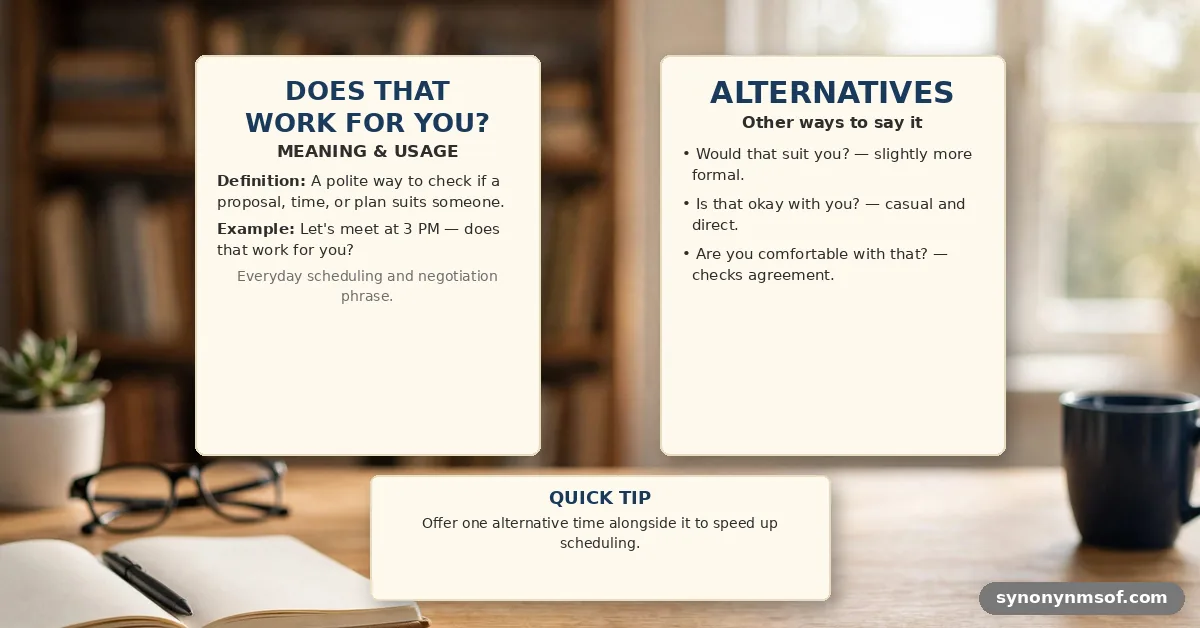
The phrase “does that work for you?” is a polite way of asking whether a suggestion, plan, time, or arrangement is suitable for someone else.
Instead of assuming the other person is available, you’re giving them the opportunity to confirm or propose another option.
People commonly use it when discussing:
- Meeting times
- Project deadlines
- Interviews
- Appointments
- Travel plans
- Client discussions
- Team collaboration
- Everyday plans with friends or family
For example:
“I’m available Thursday afternoon. Does that work for you?”
Here, you’re simply asking if Thursday afternoon fits the other person’s schedule.
See Also: 45+ Other Ways to Say “I Look Forward to Meeting You” (With Meaning, Tone & Examples)
Is “Does That Work for You” Professional?
Absolutely.
In fact, it’s one of the most common scheduling phrases used in business communication because it sounds respectful without being overly formal.
It’s appropriate for:
- Business emails
- Client communication
- Team meetings
- Interview scheduling
- Customer service
- Networking
- Internal workplace conversations
The phrase works well because it balances confidence with flexibility. You’re suggesting a plan while remaining open to adjustments if needed.
Quick Comparison Table: 45 Alternatives to “Does That Work for You”
| Alternative | Tone | Best Used For |
| Would that work for you? | Neutral | Everyday communication |
| Would that be okay with you? | Polite | Emails |
| Does this time suit you? | Formal | Meetings |
| Is that convenient for you? | Professional | Scheduling |
| How does that sound? | Friendly | Team discussions |
| Are you available then? | Direct | Appointments |
| Does that fit your schedule? | Professional | Calendar planning |
| Would this arrangement work? | Business | Projects |
| Does that timeline work for you? | Formal | Deadlines |
| Are you comfortable with that? | Supportive | Sensitive discussions |
| Is that acceptable to you? | Formal | Business decisions |
| Does that meet your needs? | Professional | Client communication |
| Would that suit your schedule? | Professional | Scheduling |
| Can you make that time? | Casual | Everyday plans |
| Does that align with your availability? | Formal | Workplace communication |
1. Would That Work for You?
Tone: Neutral, Professional
Meaning
This is the closest alternative and sounds slightly smoother in conversation.
Example
“We can meet on Friday morning. Would that work for you?”
Best Used For
- Meetings
- Emails
- Everyday scheduling
2. Would That Be Okay With You?
Tone: Polite
Meaning
Shows consideration before finalizing a decision.
Example
“I’ll send the report tomorrow afternoon. Would that be okay with you?”
Best Used For
- Professional emails
- Client conversations
- Team discussions
3. Does This Time Suit You?
Tone: Formal
Meaning
A polished phrase often used for appointments and interviews.
Example
“Does this time suit you for our interview?”
Best Used For
- Interviews
- Appointments
- Business meetings
4. Is That Convenient for You?
Tone: Thoughtful
Meaning
Focuses on the other person’s convenience rather than your own.
Example
“Would 2:00 PM be convenient for you?”
Best Used For
- Scheduling
- Clients
- Managers
5. How Does That Sound?
Tone: Friendly and Collaborative
Meaning
Invites feedback while keeping the conversation relaxed.
Example
“We could launch the project next Monday. How does that sound?”
Best Used For
- Brainstorming
- Team meetings
- Casual work conversations
See Also: 55+ Other Ways to Say “Thank You for the Update” in 2026
6. Are You Available Then?
Tone: Direct
Meaning
Simply asks whether someone is free at a particular time.
Example
“I’m free after lunch. Are you available then?”
Best Used For
- Appointments
- Meetings
- Phone calls
7. Does That Fit Your Schedule?
Tone: Professional
Meaning
Acknowledges that the other person may already have commitments.
Example
“We’re planning the workshop for Wednesday. Does that fit your schedule?”
Best Used For
- Calendar planning
- Workplace communication
- Clients
8. Would This Arrangement Work?
Tone: Business Professional
Meaning
Useful when discussing plans rather than specific times.
Example
“We’ll complete the design first and begin development next week. Would this arrangement work?”
Best Used For
- Projects
- Contracts
- Team planning
9. Does That Timeline Work for You?
Tone: Professional
Meaning
Specifically asks whether a proposed deadline is realistic.
Example
“We expect to finish by Friday. Does that timeline work for you?”
Best Used For
- Projects
- Deadlines
- Client work
10. Are You Comfortable With That?
Tone: Supportive
Meaning
Shows respect for someone’s feelings or preferences, not just their schedule.
Example
“We can move ahead with that plan if you’re comfortable with it.”
Best Used For
- Sensitive discussions
- Leadership
- HR conversations
11. Is That Acceptable to You?
Tone: Formal
Meaning
Often used when confirming agreements or policies.
Example
“We’ll deliver the revised proposal next Tuesday. Is that acceptable to you?”
Best Used For
- Contracts
- Formal business communication
- Clients
12. Does That Meet Your Needs?
Tone: Professional
Meaning
Checks whether your proposal satisfies the other person’s requirements.
Example
“We’ll provide weekly progress reports. Does that meet your needs?”
Best Used For
- Customer service
- Sales
- Client communication
13. Would That Suit Your Schedule?
Tone: Professional
Meaning
A polished alternative that’s especially common in emails.
Example
“Would Thursday afternoon suit your schedule?”
Best Used For
- Formal emails
- Scheduling meetings
- Appointments
14. Can You Make That Time?
Tone: Casual
Meaning
A relaxed way to ask if someone can attend.
Example
“We’re meeting at six tonight. Can you make that time?”
Best Used For
- Friends
- Informal meetings
- Team chats
15. Does That Align With Your Availability?
Tone: Very Professional
Meaning
A refined phrase often used in corporate communication.
Example
“We’re looking at Tuesday morning. Does that align with your availability?”
Best Used For
- Executive communication
- Client meetings
- Formal scheduling
16. Are You Free Then?
Tone: Casual and Friendly
Meaning
A simple, conversational way to check someone’s availability. It’s less formal but still polite.
Example
“I’m planning to stop by around 4 PM. Are you free then?”
Best Used For
- Casual meetings
- Friends and colleagues
- Quick messages
- Team chats
17. Is That a Good Time for You?
Tone: Warm and Professional
Meaning
This phrase focuses on whether the proposed time is convenient rather than merely available.
Example
“Would Tuesday at 10 AM be a good time for you?”
Best Used For
- Phone calls
- Client meetings
- Interviews
- Appointments
18. Would Another Time Be Better?
Tone: Flexible and Considerate
Meaning
This alternative immediately gives the other person permission to suggest a different time.
Example
“We can meet tomorrow afternoon, but would another time be better?”
Best Used For
- Busy clients
- Executives
- Scheduling conflicts
- Customer service
19. Does That Plan Sound Good?
Tone: Friendly and Collaborative
Meaning
Instead of asking about availability alone, this phrase asks for agreement with the overall plan.
Example
“We’ll review the proposal today and finalize it tomorrow. Does that plan sound good?”
Best Used For
- Team projects
- Planning sessions
- Group discussions
20. Are You Okay With This Plan?
Tone: Casual but Respectful
Meaning
A straightforward way to confirm someone’s approval before moving forward.
Example
“We’ll divide the work into two phases. Are you okay with this plan?”
Best Used For
- Workplace discussions
- Family plans
- Small team projects
21. Does That Make Sense for You?
Tone: Supportive
Meaning
Checks whether your suggestion is practical and easy to follow from the other person’s perspective.
Example
“We’ll start with the research before writing. Does that make sense for you?”
Best Used For
- Training
- Coaching
- Client onboarding
- Project discussions
22. Would You Prefer Another Option?
Tone: Thoughtful
Meaning
Shows flexibility by inviting the other person to choose a different solution if needed.
Example
“We can meet virtually or in person. Would you prefer another option?”
Best Used For
- Customer service
- Client communication
- Scheduling
- Sales
23. Shall We Go With That?
Tone: Collaborative
Meaning
A gentle way to confirm a decision after discussing several possibilities.
Example
“Since everyone is available on Thursday, shall we go with that?”
Best Used For
- Team meetings
- Brainstorming sessions
- Group decisions
24. Can We Proceed With This?
Tone: Confident and Professional
Meaning
Rather than asking only about availability, this phrase confirms readiness to move forward.
Example
“The final draft is complete. Can we proceed with this?”
Best Used For
- Project approvals
- Client work
- Leadership communication
25. Does That Seem Reasonable?
Tone: Diplomatic
Meaning
Invites feedback while showing you’re open to adjustments.
Example
“We’ll extend the deadline by three days. Does that seem reasonable?”
Best Used For
- Negotiations
- Policy discussions
- Workplace planning
26. Are You Happy With That?
Tone: Friendly and Positive
Meaning
Checks whether someone is satisfied with the proposed arrangement.
Example
“We’ll schedule monthly progress meetings instead of weekly ones. Are you happy with that?”
Best Used For
- Customer support
- Team discussions
- Personal conversations
27. Would You Be Able to Join Then?
Tone: Professional
Meaning
Focuses specifically on attendance rather than agreement.
Example
“The webinar starts at 2 PM. Would you be able to join then?”
Best Used For
- Meetings
- Webinars
- Events
- Interviews
28. Is This Schedule Manageable?
Tone: Supportive
Meaning
Shows concern for someone’s workload and capacity instead of simply asking for availability.
Example
“You’ll complete the first draft this week and revisions next week. Is this schedule manageable?”
Best Used For
- Managers
- Team leaders
- Project planning
- Performance discussions
29. Does That Fit Into Your Day?
Tone: Friendly and Considerate
Meaning
Acknowledges that the other person may already have a full schedule.
Example
“The meeting should only take thirty minutes. Does that fit into your day?”
Best Used For
- Busy professionals
- Clients
- Colleagues
- Appointments
30. Would That Be Convenient?
Tone: Polite and Professional
Meaning
One of the most versatile alternatives, emphasizing convenience without sounding demanding.
Example
“I can call you after lunch. Would that be convenient?”
Best Used For
- Business emails
- Client communication
- Phone calls
- Appointments
45 Professional Alternatives to “Does That Work for You” (Continued)
31. Can We Lock That In?
Tone: Confident and Professional
Meaning
Use this phrase when you’re ready to confirm a time or decision after discussing the available options.
Example
“Since everyone is available on Thursday, can we lock that in?”
Best Used For
- Confirming meetings
- Project planning
- Team schedules
- Client appointments
32. Does That Arrangement Suit You?
Tone: Formal and Professional
Meaning
This alternative focuses on whether the overall arrangement—not just the timing—is acceptable.
Example
“We’ll meet online first and then schedule an in-person session next week. Does that arrangement suit you?”
Best Used For
- Business negotiations
- Client discussions
- Formal emails
33. Is This Workable for You?
Tone: Practical
Meaning
Asks whether the proposal is realistic and manageable for the other person.
Example
“We’ll need your feedback by Wednesday. Is this workable for you?”
Best Used For
- Deadlines
- Project planning
- Team collaboration
34. Would This Option Be Suitable?
Tone: Formal
Meaning
A polite way to present one possible solution while remaining open to alternatives.
Example
“We can hold the training session virtually. Would this option be suitable?”
Best Used For
- Professional emails
- Client communication
- Customer service
35. Is This Timing Okay?
Tone: Neutral
Meaning
A simple, natural question that works in almost any conversation.
Example
“I’ll call you around 11 AM. Is this timing okay?”
Best Used For
- Everyday scheduling
- Work chats
- Phone calls
- Appointments
36. Can You Accommodate That?
Tone: Professional
Meaning
Often used when asking whether someone can adjust their schedule to meet a request.
Example
“The presentation has been moved to Friday morning. Can you accommodate that?”
Best Used For
- Workplace communication
- Client scheduling
- Project management
37. Does This Plan Fit Your Priorities?
Tone: Strategic
Meaning
Shows respect for the other person’s workload and objectives before moving forward.
Example
“We’re planning to begin the redesign next month. Does this plan fit your priorities?”
Best Used For
- Leadership
- Managers
- Business planning
- Executive meetings
38. Would That Timing Be Acceptable?
Tone: Formal
Meaning
A polished alternative commonly used in professional correspondence.
Example
“We’ll deliver the revised proposal by Friday afternoon. Would that timing be acceptable?”
Best Used For
- Client communication
- Business proposals
- Formal emails
39. Are You On Board With That?
Tone: Collaborative and Friendly
Meaning
Checks whether everyone agrees with a proposal before proceeding.
Example
“We’ll divide the project into three phases. Are you on board with that?”
Best Used For
- Team meetings
- Group discussions
- Project planning
40. Does That Sound Fair?
Tone: Diplomatic
Meaning
Useful when discussing compromises, negotiations, or shared responsibilities.
Example
“You’ll handle the presentation while I’ll prepare the report. Does that sound fair?”
Best Used For
- Negotiations
- Teamwork
- Conflict resolution
- Delegating tasks
41. Is There a Better Time for You?
Tone: Flexible and Considerate
Meaning
Shows genuine willingness to adjust your schedule for the other person.
Example
“I’m available Wednesday afternoon, but is there a better time for you?”
Best Used For
- Clients
- Interviews
- Appointments
- Networking
42. Would You Like to Suggest Another Time?
Tone: Warm and Respectful
Meaning
Encourages the other person to propose a more convenient option.
Example
“If Friday doesn’t work, would you like to suggest another time?”
Best Used For
- Scheduling
- Customer service
- Professional emails
43. Does That Align With Your Plans?
Tone: Professional
Meaning
Asks whether your suggestion fits with someone’s existing commitments or goals.
Example
“We’re hoping to begin implementation next week. Does that align with your plans?”
Best Used For
- Business planning
- Long-term projects
- Client communication
44. Can We Make That Work?
Tone: Collaborative
Meaning
Rather than asking for a simple yes or no, this phrase invites both people to find a solution together.
Example
“The only available slot is Thursday afternoon. Can we make that work?”
Best Used For
- Busy schedules
- Team coordination
- Negotiations
- Workplace communication
45. Does This Approach Work for You?
Tone: Professional and Solution-Oriented
Meaning
Focuses on the method or strategy instead of the schedule alone.
Example
“We’ll review each section before moving on to the next. Does this approach work for you?”
Best Used For
- Project planning
- Coaching
- Client strategy sessions
- Team collaboration
Tone Guide: Choosing the Right Alternative
Different situations call for different levels of formality. Here’s a quick guide to help you choose the most appropriate phrase.
| Tone | Recommended Alternatives |
| Formal | Does this time suit you? · Would that timing be acceptable? · Is that acceptable to you? |
| Professional | Is that convenient for you? · Would this arrangement work? · Does that timeline work for you? |
| Friendly | How does that sound? · Are you free then? · Are you happy with that? |
| Collaborative | Can we make that work? · Shall we go with that? · Are you on board with that? |
| Supportive | Are you comfortable with that? · Is this schedule manageable? · Does that make sense for you? |
| Leadership | Can we proceed with this? · Does this plan fit your priorities? · Does this approach work for you? |
Professional Email Examples
1. Meeting Invitation
Subject: Project Discussion
Hi Sarah,
I’m available on Tuesday at 2:00 PM to discuss the proposal. Would that work for you? If another time is more convenient, I’d be happy to adjust.
Best,
James
2. Client Follow-Up
Hello Michael,
We’ve completed the first round of revisions and can deliver the updated version by Friday afternoon. Does that timeline work for you?
Looking forward to your feedback.
Kind regards,
Emma
3. Interview Scheduling
Dear Ms. Khan,
Thank you for your application.
We’d like to schedule your interview for Wednesday at 10:00 AM. Does this time suit you?
Please let us know if another time would be more convenient.
Best regards,
Recruitment Team
4. Team Collaboration
Hi Team,
To keep the project on track, we’ll begin testing on Monday and review the results on Wednesday. How does that sound?
Please let me know if you have any concerns.
5. Customer Support
Hello David,
We can arrange a support session tomorrow afternoon. Would that be convenient?
We’re happy to work around your schedule.
Workplace Examples
Manager → Employee
“I’d like to move our one-on-one meeting to Thursday afternoon. Does that work for you?”
Employee → Manager
“I’ve completed the first draft and can present it tomorrow morning. Would that be okay with you?”
Recruiter → Candidate
“Would Friday at 11:00 AM be a good time for your interview?”
Sales Representative → Client
“We can demonstrate the software next Tuesday. Does that fit your schedule?”
Project Manager → Team
“We’ll divide the work into two phases. Are you on board with that?”
Casual Conversation Examples
Friends
“I’m thinking of grabbing coffee around six. Are you free then?”
Family
“We’ll have dinner at seven tonight. Does that work for everyone?”
Group Chat
“How about meeting at the park tomorrow morning? How does that sound?”
Neighbor
“I can help you move on Saturday morning. Would that work for you?”
Gym Partner
“Let’s train after work tomorrow. Is that a good time for you?”
Common Mistakes to Avoid
1. Sounding Too Demanding
❌ “This is the meeting time.”
✔ “Would Thursday at 2 PM work for you?”
2. Being Too Vague
❌ “Can we meet sometime?”
✔ “Would Thursday afternoon work for you?”
Specific requests are easier to answer.
3. Overusing the Same Phrase
Repeating “Does that work for you?” in every email can make your writing feel repetitive.
Instead, rotate between several natural alternatives.
4. Offering Only One Option
If possible, provide flexibility.
Instead of:
“Can you meet Friday?”
Try:
“Would Friday afternoon work for you, or would Monday morning be better?”
5. Forgetting the Other Person’s Schedule
Always consider time zones, workloads, and existing commitments—especially when working with remote teams or international clients.
Tips to Sound More Natural
Instead of saying:
Does that work for you?
Try:
Would Thursday afternoon work for you, or is another time easier?
Instead of:
Is that convenient?
Try:
If another time suits you better, I’m happy to adjust.
Instead of:
Does this time suit you?
Try:
Let me know what works best for your schedule.
Small changes like these make your communication feel warmer, more personal, and genuinely collaborative.
Frequently Asked Questions
Is “Does that work for you” polite?
Yes. It’s a respectful and collaborative way to ask whether a suggestion or arrangement is suitable.
Is it professional?
Absolutely. It’s commonly used in business emails, meetings, client communication, and workplace conversations.
Is it grammatically correct?
Yes. The phrase is grammatically correct and natural in both spoken and written English.
What’s the most formal alternative?
Options such as “Does this time suit you?”, “Would that timing be acceptable?”, and “Is that acceptable to you?” are more formal.
Can I use it in business emails?
Yes. It’s one of the safest and most widely accepted scheduling phrases in professional communication.
Is it appropriate for clients?
Definitely. It shows flexibility, respect, and a willingness to accommodate the client’s schedule.
What’s the difference between “Does this time suit you?” and “Does that work for you?”
“Does this time suit you?” is slightly more formal, while “Does that work for you?” is more conversational and versatile.
Can it sound too informal?
Not usually. However, in highly formal settings, phrases like “Would that timing be acceptable?” may sound more polished.
How can I sound warmer?
Add flexibility by saying:
“If another time works better for you, I’m happy to adjust.”
This shows genuine consideration for the other person’s schedule.
Which alternative is best for scheduling meetings?
Some of the best choices include:
- Would that work for you?
- Is that convenient for you?
- Does this time suit you?
- Is that a good time for you?
- Would another time be better?
Final Thoughts
The phrase “Does that work for you?” remains one of the most effective ways to ask for someone’s agreement without sounding demanding. It communicates respect, flexibility, and professionalism—qualities that strengthen workplace relationships and everyday conversations alike.
Still, variety matters. By choosing alternatives that match the situation, whether you’re writing to a client, coordinating with colleagues, or making plans with friends, you can make your communication feel more natural and engaging.
The key isn’t simply replacing one phrase with another. It’s selecting language that reflects the right tone, shows consideration for the other person’s perspective, and encourages genuine collaboration. Master these alternatives, and you’ll communicate with greater confidence, warmth, and professionalism in every interaction.