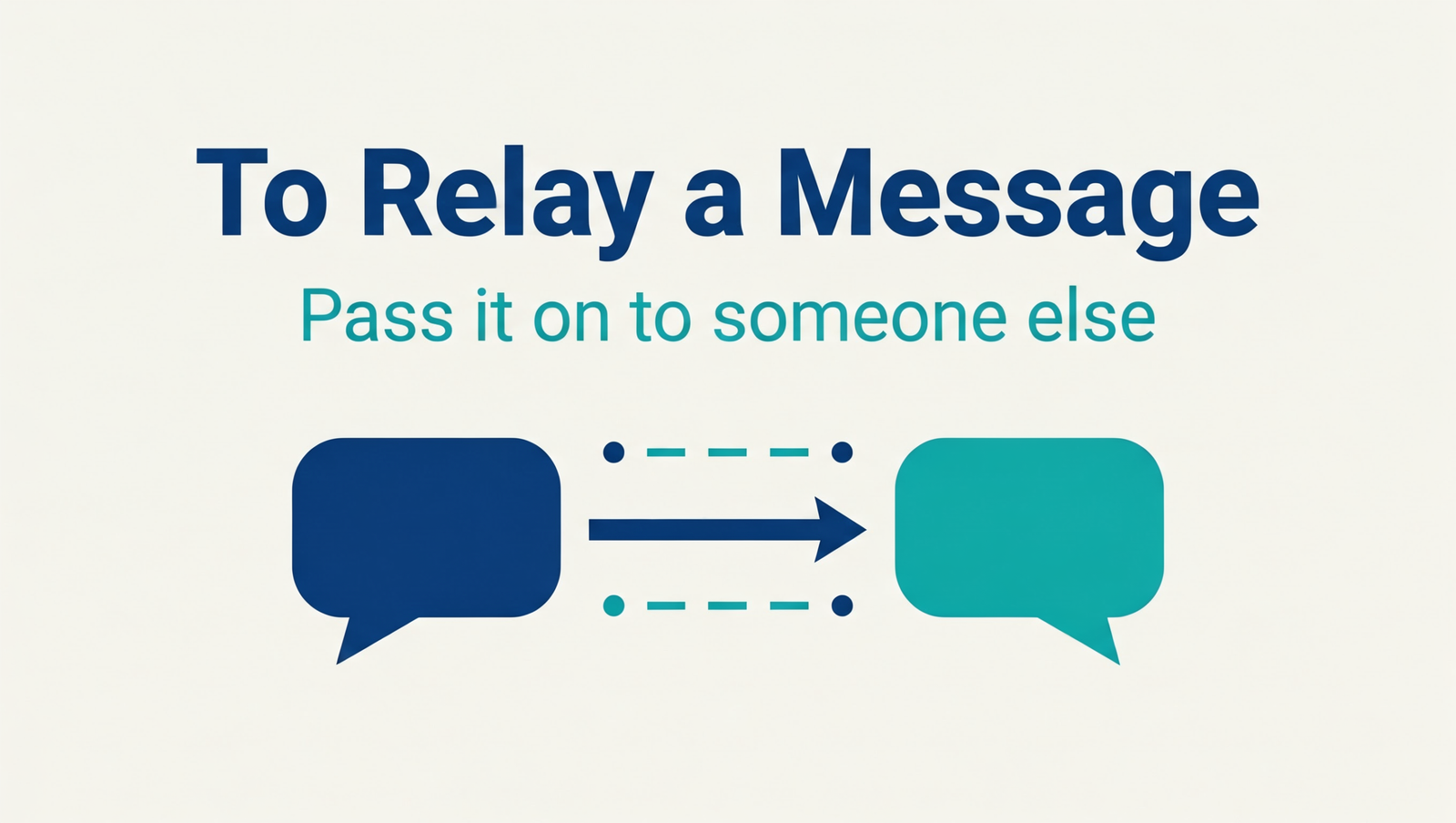

“To relay a message” means carry someone’s words to another person. You are not the first speaker. You are not the last listener. You are the link between them.
This phrase is common at work. Bosses, teachers, and receptionists use it. It is polite and clear. It keeps people connected.
To Relay a Message — Short Answer
“To relay a message” means to pass a message on to someone else.
You hear a message from one person, and you give it to another person — usually because the first person cannot reach them directly.
Example:
“Can you relay a message to Sara? Tell her the meeting is at 3.”
That means: please pass my words on to Sara.
What Does “To Relay a Message” Mean?
Break the phrase down:
- To relay — to pass something on, like a runner passing a baton to the next runner.
- A message — words, news, or information for someone.
Put together, “to relay a message” means to act as the middle person. You are not the one who first said it, and you are not the one it is finally for — you carry it from one person to another.
It is often used when someone is busy, away, or hard to reach:
- “He was in a meeting, so I relayed the message to his assistant.”
- “Please relay this message to your teacher: I will be late today.”
The word “relay” comes from the idea of a relay race, where each runner passes the baton to the next. A message works the same way — it moves from person to person until it reaches the right one.
The Grammar: How to Use It
The pattern is:
Relay + a message + to + someone
- “Can you relay a message to Ali?”
- “She relayed the message to her boss.”
- “Please relay my message to the team.”
You can also say “relay a message” without “to” when the person is clear from the context:
- “I will relay the message.” (we already know who it is for)
- “He relayed my message word for word.”
Common forms:
- Present: “I relay messages for my boss every day.”
- Past: “She relayed the message yesterday.”
- Future: “I will relay your message as soon as I see him.”
- As a request: “Could you relay a message for me?”
Note the past form: “relayed”, not “relaid”. The verb is regular — add “-ed”.
A common mistake is to say “relay a message for someone” when you mean “to someone”. Both can be correct, but they mean different things:
- “Relay a message to Sara” — Sara is the one who must receive it.
- “Relay a message for Sara” — Sara asked you to pass it on; the receiver may be someone else.
How to Use “To Relay a Message” in a Sentence
Use it when you cannot speak to the person directly, or when you are helping two people talk to each other:
- “My phone was off, so my sister relayed the message to me.”
- “Can you relay a message to the doctor? Tell him I need a new appointment.”
- “The secretary relayed the message that the flight was delayed.”
You can also use it for a short note, a phone call, or a text:
- “He left a note to relay the message.”
- “She called to relay the message that school was closed.”
Do not use it when you are speaking to the person yourself. If you tell Sara the news face to face, you are not relaying it — you are just telling her. Relay needs a middle person.
“To Relay a Message” in Everyday Examples
Everyday life:
- “Mum asked me to relay a message to Dad: dinner is ready.”
- “Can you relay a message to your brother? Tell him to call me back.”
- “The neighbour relayed the message that the parcel had arrived.”
- “I was out, so my friend relayed the message that the class was cancelled.”
- “Please relay this message to Sara: her book is at my house.”
At work:
- “The receptionist relayed the message that the client was waiting downstairs.”
- “Could you relay a message to the manager? The printer is not working.”
- “She relayed the message from the head office to the whole team.”
- “I will relay your message to HR as soon as the meeting ends.”
Notice the tone: each example is helpful and polite. The person relaying the message is doing a small favour — carrying words that would otherwise not arrive.
Synonyms and Other Ways to Say It
Here are other ways to say “to relay a message”, from most common to most formal:
| Phrase | Tone | Example |
|---|---|---|
| Pass on a message | Everyday, most common | “Can you pass on a message to Ali?” |
| Pass a message along | Casual | “Please pass this message along.” |
| Deliver a message | Neutral | “She delivered the message to him.” |
| Convey a message | Formal | “Please convey my message to the manager.” |
| Forward a message | For texts and emails | “Please forward my message to Sara.” |
| Tell someone for me | Very casual | “Tell Sara for me: I will be late.” |
| Give someone a message | Simple, everyday | “Can you give Ali a message?” |
“Pass on a message” is the closest everyday synonym — use it in conversation. Use “convey a message” in formal writing, and “forward a message” when the message is a text, an email, or a chat.
The opposite is to keep a message to yourself, or to forget to pass it on:
- “I forgot to relay the message, and Sara never knew about the meeting.”
- “He kept the news to himself.”
“To Relay a Message” vs “To Send a Message”
These two look similar, but the middle person makes the difference:
- To send a message — you write or say it yourself, directly to the other person.
“I sent Sara a text: the meeting is at 3.” - To relay a message — you pass on words that came from someone else.
“Ali asked me to relay a message to Sara: the meeting is at 3.”
If you are the first speaker, you send it. If you are carrying someone else’s words, you relay it.
Common Mistakes
1. Using it when you speak directly
Wrong: “I relayed a message to Sara, and I told her myself.”
Right: “I told Sara myself.” or “Ali asked me to relay a message to Sara.”
If you told her yourself, there was no relaying.
2. Wrong past form
Wrong: “She relaid the message yesterday.”
Right: “She relayed the message yesterday.”
“Relay” is regular: relay, relayed, relayed.
3. Forgetting “to” before the receiver
Wrong: “Can you relay a message Sara?”
Right: “Can you relay a message to Sara?”
The receiver needs “to” — just like “give a message to Sara”.
4. Mixing up “to” and “for”
Wrong (if Sara must receive it): “Relay a message for Sara.” — when you mean Sara is the receiver.
Right: “Relay a message to Sara.”
Use “for” only when Sara is the one who asked you to pass it on.
Formal vs Informal
- Informal (friends, family, chat): “Can you relay a message to Mum?” — fine, but in casual talk people more often say “Can you tell Mum for me?”
- Neutral (work chat, email, school): “Please relay this message to the team.” — polite and professional, and very common in offices.
- Formal (letters, reports, official notes): “Kindly relay the message to the director.” — fine, or use “Please convey this message to the director” for a more formal tone.
The phrase works in every situation, but in everyday talk, “pass on a message” sounds more natural than “relay a message”.
Quick Check: Did You Get It?
Try these in your head:
- Ali cannot reach Sara, so you tell Sara what Ali said. What did you do? You relayed a message.
- You text Sara yourself with the news. Did you relay a message? No — you sent it directly.
- Fill the blank: Can you ___ a message to the manager? Tell him the printer is broken. Relay.
FAQs
What does “to relay a message” mean?
It means to pass a message on to someone else. You hear words from one person and give them to another, usually because the first person cannot reach them directly.
Is “to relay a message” correct English?
Yes. It is correct and common, especially at work and in formal situations. In everyday talk, people also say “pass on a message”.
What is the past tense of “relay”?
“Relayed”. For example: “She relayed the message to her boss yesterday.”
What is the difference between “relay a message” and “send a message”?
When you send a message, you are the first speaker and you contact the person directly. When you relay a message, you carry someone else’s words to the person.
Can I say “relay a message for me”?
Yes, when you are asking someone to pass your words on. For example: “Can you relay a message for me to Sara? Tell her I will be late.”
Final Reminder
“To relay a message” means to pass someone else’s words on to the person they are for.
Remember the pattern: relay a message to someone. The past form is relayed. And if you are speaking to the person yourself, you are not relaying — you are just telling them. Next time someone asks you to carry their words, you know the phrase: relay a message.