
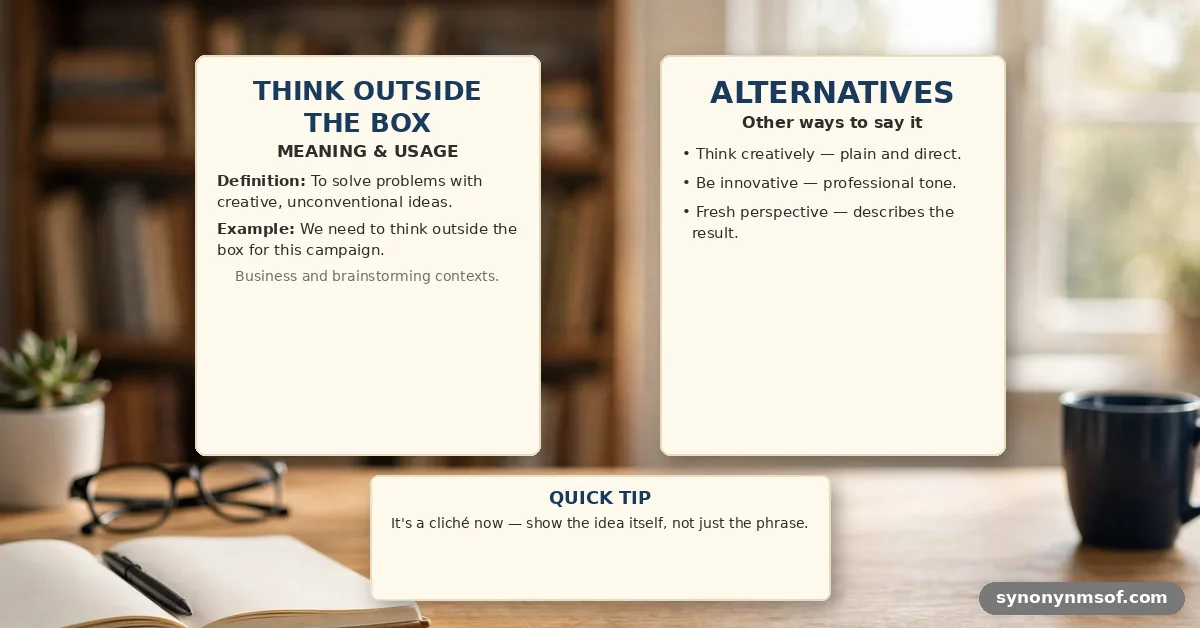

When you hear someone tell you to think outside the box, they are asking you to move past conventional logic. It is a common idiom in business and creative circles, urging people to abandon the safety of standard patterns to find a better solution. While the phrase can sometimes feel like a corporate cliché, its core intention remains powerful.
By shifting your perspective, you can uncover hidden paths and innovative answers that others might miss entirely. This article explores the origin of this concept and provides practical examples of how to apply it to your own challenges in the workplace and beyond.
The phrase finds its roots in a classic lateral thinking puzzle called the nine dots. This visual challenge requires you to connect nine dots arranged in a square using only four straight lines without lifting your pen from the paper.
Most people fail because they subconsciously draw an imaginary boundary around the dots. They assume they must stay within the perimeter of the square, which is exactly what traps them.
To solve the puzzle, you must extend your lines beyond the physical grid. By drawing lines outside the box, you create the angles necessary to hit every dot. This is the literal birthplace of the modern idiom.
It serves as a reminder that our greatest obstacles are often the constraints we impose upon ourselves. When you stop assuming that current rules are permanent, you gain the freedom to redefine the problem.
What Thinking Outside the Box Really Means
At its core, to think outside the box means to approach a situation from a different angle. It is not about ignoring reality or abandoning logic.
Instead, it involves questioning the assumptions that govern your decision-making process. We often rely on past experiences to dictate future choices, but this can lead to stagnation.
When you engage in this type of thinking, you look for connections between unrelated fields. You might take a process from manufacturing and apply it to customer service. Or, you might look at a failed product and see a different market opportunity.
This practice helps you break free from the mental ruts that prevent true innovation. It is a deliberate choice to prioritize fresh ideas over the path of least resistance.
Practical Examples of Creative Problem Solving
Innovation rarely happens by accident; it usually follows a shift in perspective. Consider how businesses have successfully applied this mindset to overcome common hurdles. The following table illustrates how shifting one’s focus changes the outcome of a typical professional challenge.
| Conventional Approach | Outside the Box Strategy |
|---|---|
| Lower prices to gain more customers | Improve brand experience to build loyalty |
| Work more hours to finish a project | Automate the repetitive parts of the task |
| Follow the industry standard process | Combine two unrelated services into one |
| Hire specialists for every new role | Cross-train existing staff to solve gaps |
These examples show that success often comes from refusing to accept the status quo. When you stop asking how things have always been done, you can begin to ask how they could be done differently. This list of strategies can help you initiate your own brainstorming sessions when you feel stuck:
- Challenge every assumption you have about the project at hand.
- Invite someone from an entirely different department to join your meeting.
- Set a timer and list twenty terrible ideas to clear out the obvious ones.
- Look at competitors not in your industry to see how they handle similar issues.
- Reverse the problem to see what would cause the exact opposite of your goal.
The Dangers of Thinking Inside the Box
If you only rely on traditional methods, you risk becoming irrelevant. Thinking inside the box is comfortable because it feels safe, but it often leads to diminishing returns.
When everyone in your industry follows the same playbook, you end up competing solely on price rather than value. This is a race to the bottom that few companies survive for long.
Furthermore, staying inside the box blinds you to disruption. Many legacy companies failed because they were too busy optimizing their current model to notice a shift in how customers wanted to interact with them.
By refusing to think outside, they ignored the signs of change until it was too late. Staying rigid is a significant risk in any modern market.
How to Cultivate a Creative Mindset
You can train your brain to spot new opportunities by intentionally changing your routine. When you always take the same route to work or use the same software tools, your brain goes on autopilot.
To spark better ideas, you must force yourself into new environments. Even small changes can help you see your work with fresh eyes.
Try to practice curiosity as a daily habit. Read books about topics you know nothing about, or watch documentaries on obscure historical events.
The more diverse your mental log of information is, the more likely you are to make a unique connection. Creativity is often just the ability to synthesize existing ideas in a new way.
Overcoming Resistance to Change
One of the biggest hurdles to this way of thinking is the fear of failure. People often stay inside the box because it is easier to defend a standard decision than a bold one.
If you try something new and it fails, you may have to answer for it. If you follow the standard path and it fails, you can blame the system.
You must foster an environment where trying something new is encouraged rather than penalized. When you lead a team, reward the effort to find a unique solution even if the result isn’t perfect.
This builds the confidence needed to tackle the next big puzzle. Without this psychological safety, people will always choose the safe, conventional path.
The Role of Collaboration
Diverse teams are naturally better at this than isolated individuals. When you put five people with the same background in a room, they will likely arrive at the same conclusion.
When you bring together people with different skills, ages, and perspectives, they act as a mirror for each other’s assumptions. They will challenge the invisible walls that you don’t even know you are building.
Effective collaboration requires active listening. You must be willing to let go of your own ideas if someone else presents a better, more radical option.
This is where the magic happens. By combining your ideas with those of others, you can create something that none of you could have imagined on your own.
Common Idioms Related to Creativity
There are many ways to describe this mindset using the English language. While some are overused, they all point toward the same goal of breaking traditional patterns. Here are a few ways to express the need for a fresh perspective:
Thinking outside the lines

This suggests that you are not just ignoring the box, but you are also ignoring the boundaries set by standard expectations. It is a bit more rebellious and implies a willingness to disrupt the status quo completely.
Fresh eyes
This refers to bringing in someone who has not been involved in the project to see things you might have missed. It is a humble admission that you have become too close to the work to see it objectively.
Lateral thinking
This is a more academic term for the same process. It describes the act of moving sideways to find an alternative solution rather than just digging deeper into the current one.
FAQ
Is thinking outside the box just a buzzword?
It has become a bit of a cliché, but the underlying concept is essential for problem-solving. While the phrase itself might sound tired, the act of questioning assumptions is a vital business skill that never goes out of style.
How can I be more creative if I am not a creative person?
Creativity is not a gift you are born with; it is a muscle you exercise. Start by asking why things are done a certain way and look for small inefficiencies in your daily work. The more you question the status quo, the better you will get at spotting new ideas.
What if my manager hates it when I try new things?
Frame your ideas around results rather than just innovation. Instead of saying you want to try something different, explain how the new approach will save time, cut costs, or improve quality. Most managers are open to change if they see a clear path to a better outcome.
Does this mean I should ignore all rules?
Not at all. You need to understand the rules well enough to know which ones are necessary for safety or compliance and which ones are just habits. The goal is to innovate within the necessary constraints, not to create chaos.
Conclusion
Developing the ability to think outside the box is one of the most effective ways to stand out in your career. By learning to identify the invisible barriers that stop others, you open yourself up to possibilities that were previously hidden. It takes practice, patience, and a willingness to be wrong, but the results are worth the effort.
Start by examining one small process in your life or work this week. Ask yourself what would happen if you ignored the standard way of doing it and tried a different approach. You do not need to change everything at once.
Small, deliberate shifts in your perspective will eventually lead to significant breakthroughs. Keep exploring, keep questioning, and do not be afraid to step beyond the lines.
SEO Title: Think Outside the Box: Meaning, Origin & Examples
Meta Description: What does it mean to think outside the box? Learn the origin of this idiom, see practical examples, and discover how to apply it to your work.
Suggested URL Slug: think-outside-the-box-meaning-examples
Primary Keyword: Think Outside the Box
Secondary Keywords: creative, problem, ideas, thinking outside, nine dots, team, new, puzzle