
When you start a message with “sorry to bother you,” you are signaling respect for the other person’s time and mental bandwidth. It is a common social lubricant used to soften the impact of an intrusion, whether you are walking into an office or sending an email to a busy executive. Mastering this phrase helps you initiate contact without appearing demanding or oblivious to the recipient’s workload.
Understanding the nuance behind this expression allows you to build better professional relationships while maintaining your own momentum. By acknowledging that you might be interrupting, you actually make it easier for the other person to engage with you on their own terms. This guide will show you how to use this social tool effectively.
The True Meaning Behind the Phrase

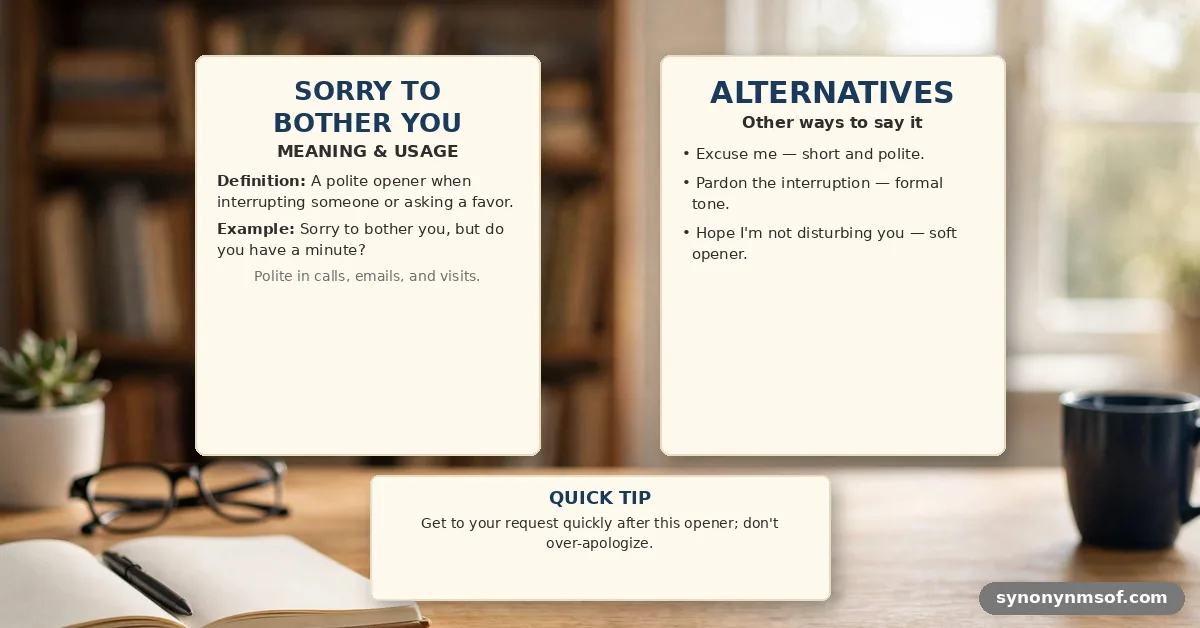
At its core, saying you are sorry to bother someone is an act of social deference. It acknowledges that the recipient has a life, a schedule, and a set of priorities that exist outside of your current request. You are essentially asking for permission to occupy their attention for a few moments.
This phrase functions as a buffer. It lowers the defensive posture that people often adopt when they feel overwhelmed by incoming tasks. When you frame your request this way, you show empathy for their situation, which can often result in a faster or more helpful response.
Recognizing the Social Signal
When someone tells you they are sorry to bother you, they are rarely actually apologetic about the substance of their request. They are expressing a social awareness of the interruption. It is a way of saying, “I know you are busy, but I have something that requires your input.”
This is a standard polite way to open a dialogue. If you feel like a nuisance, this phrase helps you test the waters before diving into a long explanation or a complex demand. It gives the recipient a chance to say, “Not at all, what’s up?” or “Can we talk in an hour?”
Why Context Determines Your Success
Not every situation calls for a soft opening. If you are in a crisis or working under a tight deadline, excessive apologies can make you sound hesitant or unsure of yourself. You must gauge the urgency and the relationship dynamic before you reach for this specific language.
Consider your hierarchy and the medium of communication. A quick Slack message to a close teammate requires less formal cushioning than a cold email to a potential client. You want to sound professional, not overly submissive or apologetic for simply doing your job.
Matching Tone to the Recipient
For a supervisor, you might want to lead with the value of the interaction rather than the interruption. If you have a direct relationship, you can skip the apology entirely and get straight to the point. Saving the “sorry” for when you truly suspect you are catching them at a bad time keeps the phrase meaningful.
If you are reaching out to someone you do not know well, a polite opening is essential. It signals that you are respectful of their professional boundaries. Use the following table to help decide which approach fits your current situation.
| Context | Tone | Recommended Approach |
|---|---|---|
| Close Colleague | Casual | “Hey, got a second?” |
| Direct Manager | Direct | “Do you have a moment to review this?” |
| New Client | Polite | “Sorry to bother you, I have a quick question.” |
| Urgent Crisis | Authoritative | “I need your input on this immediately.” |
Polite Alternatives for Daily Use
Sometimes, the standard phrase feels a bit repetitive or weak. You have plenty of other ways to express that you know you are interrupting someone. Using a variety of expressions keeps your communication fresh and helps you sound more deliberate.
- “I hope you are having a productive day; do you have a moment?”
- “Pardon the interruption, but I have a quick update.”
- “I know you are busy, but I wanted to touch base on this.”
- “If you have a spare minute, I would appreciate your thoughts.”
- “I apologize for reaching out out of the blue.”
Common Mistakes to Avoid
The biggest mistake people make is overusing this language. If you apologize every time you send an email, you start to sound like your work is inherently a burden. This creates a psychological framing where your presence is always an inconvenience.
Another pitfall is being vague about why you are bothering them. If you lead with an apology, always follow it immediately with the purpose of your contact.
Don’t leave them hanging, wondering what the “bother” is actually about. Clarity is the best form of courtesy.
FAQ
Is it professional to say sorry to bother you?
Yes, it is perfectly professional, provided it is not used to excess. It shows that you respect the other person’s time and are mindful of their workload, which is a hallmark of good office etiquette.
What is a better way to say I am sorry for bothering you?
You can try phrases like “I appreciate you taking the time to talk,” or “I know you have a lot on your plate, so I’ll be brief.” These shift the focus from your “bother” to their “time,” which is much more professional.
How should I respond when someone says this to me?
The best response is to immediately put them at ease. Say something like, “No bother at all, I’m happy to help,” or “You aren’t interrupting, what can I do for you?” This confirms that your time is available for them.
What does it mean if someone says sorry to bother you again?
This usually implies they are aware they have reached out to you multiple times recently. It is a sign of self-awareness. They are trying to avoid being perceived as a pest while still getting the information they need.
Navigating Professional Communication
Choosing the right words is about balance. You want to be polite without being apologetic for your professional responsibilities.
Using the phrase “sorry to bother you” is a great way to start a conversation, but ensure your follow-up is clear and concise. By respecting the other person’s time, you earn their respect in return.
Always remember that your time is as valuable as theirs. Use these social signals to open doors, but don’t let them become a habit that diminishes your authority. If you find yourself over-apologizing, look for more direct alternatives that highlight the importance of your request.
Engaging with others effectively is a skill that grows with practice, so stay mindful of how your words land. I hope this helps you communicate with confidence and clarity in your next interaction.
SEO Title: Sorry to Bother You: Meaning, Examples & Alternatives
Meta Description: Learn the professional meaning of “sorry to bother you.” Discover when to use it, how to avoid over-apologizing, and see effective alternatives for email.
Suggested URL Slug: sorry-to-bother-you-meaning-examples
Primary Keyword: sorry to bother you
Primary Keyword: sorry to bother you
Secondary Keywords: sorry bother, sorry bothering, polite, example, interrupting, email, professional, phrase, people