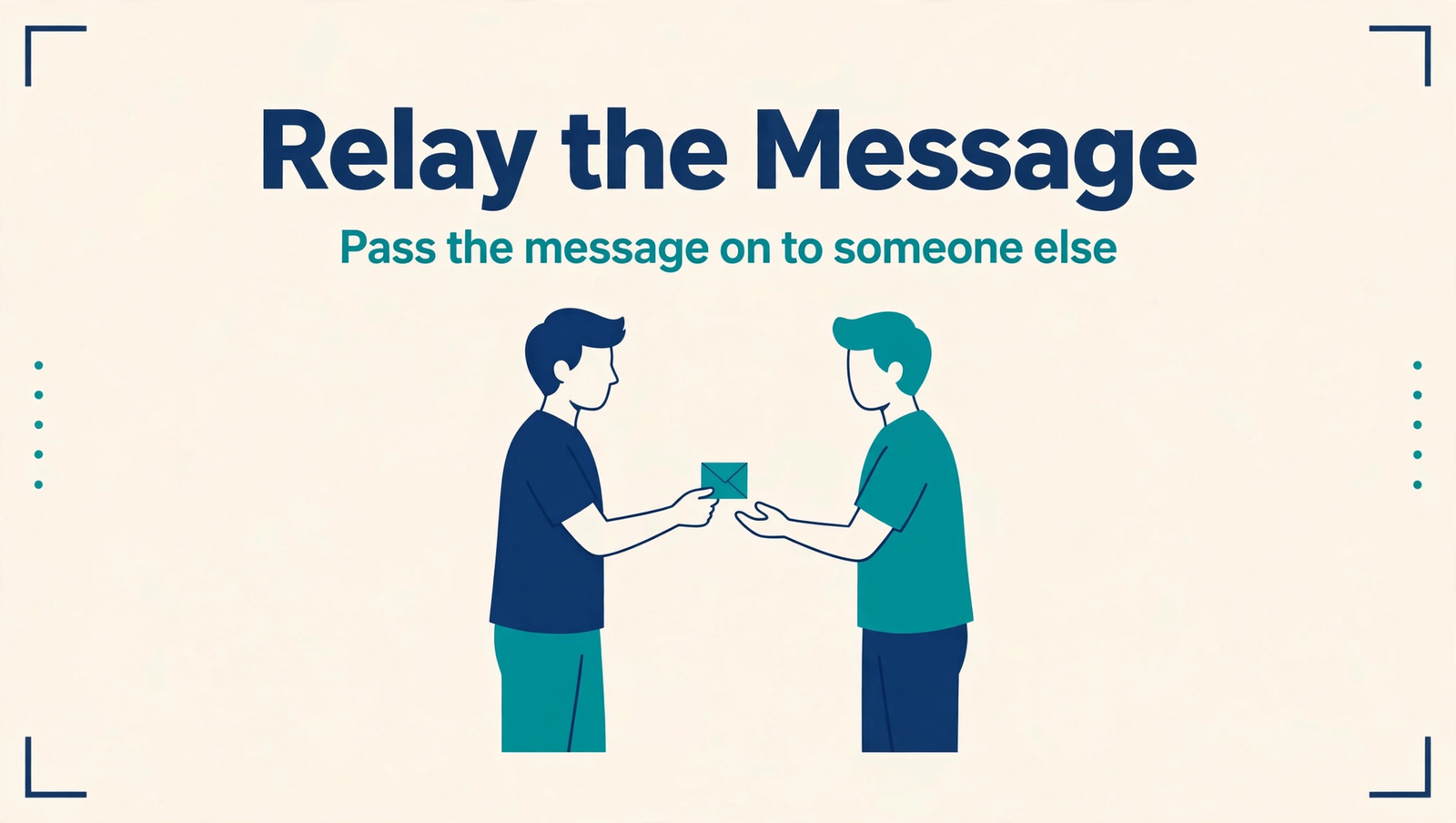

“Relay the message” means pass a message on to someone else. You hear the words from one person. Then you give them to another person. You are the middle person.
People relay messages all the time. They do it at work and at home. It is a small favour. It helps people stay in touch.
Relay the Message — Short Answer
“Relay the message” means pass a message on to someone else.
It is used when one person gives you words for another person, and you must carry those words to them. If your teacher says “Relay the message to the class”, she means: tell the class what I just told you.
Example:
“Please relay the message to your brother that dinner is ready.”
That means: tell your brother the message — dinner is ready.
In this article you will also find the difference between “relay the message” and “send the message”, and other ways to say “relay the message”.
What Does “Relay the Message” Mean?
Break the phrase down:
- Relay — to pass something on, from one person to the next.
- The message — the words, news, or information to pass on.
Put together, “relay the message” means carry a message from the person who gave it to the person who needs it. You are the link in the middle: you hear it, then you tell it to someone else.
You will hear “relay the message” at home, at school, and at work:
- “Can you relay the message to Ali that the meeting moved to 3 pm?”
- “She asked me to relay the message to the whole team.”
- “Please relay the message that the shop will close early today.”
The phrase often comes as a request or an instruction. Someone asks you to do it:
- “Relay the message to your mother, please.”
- “Could you relay the message to the manager?”
It is the same idea as “pass the message on” — the message starts with one person, travels through you, and reaches the person it is for. You can also relay the news or relay the information, not only a message:
- “Please relay the news that the trip is cancelled.”
- “He relayed the information to the whole office.”
In “relay the message”, relay is a verb: the action of passing the words on.
The Grammar: How to Use It
The pattern is:
Relay + the message + to + someone
- “Relay the message to the manager.”
- “Please relay the message to your teacher.”
- “He relayed the message to his sister.”
Note the verb forms of “relay”:
- Base form: “relay” — “Please relay the message.”
- Past form: “relayed” — “She relayed the message yesterday.”
- “-ing” form: “relaying” — “He is relaying the message now.”
The person who receives the message usually comes after “to”:
- “Relay the message to the team.”
- “Relay the message to your brother.”
You can also name the message itself, with “that”:
- “Relay the message that the class is cancelled.”
- “Please relay the message that I will be late.”
Or use “to” plus the person, and “that” plus the news:
- “Relay the message to Ali that the meeting moved to 3 pm.”
- “Can you relay the message to the office that the delivery arrived?”
Do not leave out “the” before “message” when you mean one clear message:
- “Relay the message to her.” (one message, already known)
- “Relay a message to her.” (any message, not one in particular)
How to Use “Relay the Message” in a Sentence
Use it when someone must carry words to another person:
- “Please relay the message to the whole class.”
- “I will relay the message to my father tonight.”
- “She relayed the message exactly as she heard it.”
Do not use it when you speak to the person yourself:
- “I told the manager myself.” (direct)
- “I asked Ali to relay the message to the manager.” (through someone else)
“Relay the Message” in Everyday Examples
At home:
- “Relay the message to your sister that lunch is ready.”
- “Mum asked me to relay the message to Dad.”
- “Please relay the message that Grandma is coming tomorrow.”
At school and work:
- “The teacher asked the monitor to relay the message to the class.”
- “Can you relay the message to the boss that the client called?”
- “She relayed the message to the team about the new timing.”
Notice the feeling: “relay the message” sounds clear and a little formal, and is often used at work or school.
Synonyms and Other Ways to Say It
Here are other ways to say “relay the message”:
| Phrase | Tone | Example |
|---|---|---|
| Pass the message on | Everyday, most common | “Please pass the message on to Ali.” |
| Pass on the message | Everyday, same meaning | “Pass on the message that I called.” |
| Tell them the message | Everyday, direct | “Tell them the message when you see them.” |
| Send word | Neutral, a little formal | “Send word to the manager that I am late.” |
| Let them know | Everyday, friendly | “Let them know the meeting moved.” |
| Convey the message | Formal, careful | “Please convey the message to the team.” |
| Pass the word along | Casual, friendly | “Pass the word along that class is cancelled.” |
“Pass the message on” is the closest everyday synonym. Use “convey the message” when you want a more formal tone, and “let them know” when the message is simple news for a friend.
The opposite is keeping the message to yourself, or telling the person directly:
- “I did not relay the message — I forgot to tell them.”
- “I told her myself, so there was nothing to relay.”
“Relay the Message” vs “Send the Message”
These two look the same, but the middle person makes the difference:
- Relay the message — you pass on words that came from someone else.
“Ali asked me to relay the message to Sara: the meeting is at 3.” - Send the message — you write or say it yourself, directly to the other person.
“I sent Sara a text: the meeting is at 3.”
If you are the first speaker, you send it. If you are carrying someone else’s words, you relay it. That is the whole difference: sending starts with you, relaying passes through you.
A quick test:
- “She sent the message to the team.” — she wrote it herself and sent it.
- “She relayed the message to the team.” — someone else gave her the message, and she passed it on.
Both end with the team knowing the news, but the path is different. Relay always needs a middle person; send does not.
Common Mistakes
1. Leaving out “to” before the person
Wrong: “Relay the message the manager.”
Right: “Relay the message to the manager.”
The person who gets the message needs “to” before them.
2. Using the wrong past form
Wrong: “She relay the message yesterday.”
Right: “She relayed the message yesterday.”
The past form of “relay” is “relayed”, with “-ed”.
3. Saying “relay a message” when the message is already known
Wrong: “Relay a message to Ali that dinner is ready.” (when the message was just given)
Right: “Relay the message to Ali that dinner is ready.”
Use “the message” when both people know which message it is. Use “a message” only when it is not yet known.
4. Using “relay” for a face-to-face message
Wrong: “I relayed the message to her myself, in person.” (when you told her directly)
Right: “I told her the message myself.”
You only relay a message through someone else. If you tell the person directly, you are not relaying — you are just telling.
Formal vs Informal
- Informal (friends, family, chat): “Can you relay the message to Ali?” — natural, though “pass it on to Ali” is more common with friends.
- Neutral (work, school, email): “Please relay the message to the team.” — polite and clear.
- Formal (reports, writing): “The secretary relayed the message to all departments.” — fine, or use “conveyed the message” for a more formal tone.
The phrase works in every situation, but it leans a little formal. With close friends, “pass the message on” usually sounds more natural.
Quick Check: Did You Get It?
Try these in your head:
- Your teacher asks you to tell the class that the test is tomorrow. What is she asking you to do? Relay the message to the class.
- Is this sentence correct: “Relay the message the manager”? No — it should be “Relay the message to the manager”, with “to” before the person.
- True or false: You relay a message when you tell the person yourself, face to face. False — you relay a message when you pass on someone else’s words through yourself to them.
FAQs
What does “relay the message” mean?
It means pass the message on to someone else. You hear the message from one person and tell it to the person it is for.
What is the past form of “relay the message”?
“Relayed the message”: “She relayed the message to the team yesterday.”
What is the difference between “relay the message” and “send the message”?
When you send a message, you are the first speaker and you contact the person directly. When you relay a message, you carry someone else’s words to the person — you are the middle person.
Can I say “relay a message” instead of “relay the message”?
Yes, but the meaning changes a little. “Relay the message” means one clear message that both people know. “Relay a message” means any message, not one in particular.
Can you relay a message by text?
Yes. You can relay a message by text, by phone, or in person — the words just need to reach the person they are for.
Final Reminder
“Relay the message” means pass the message on to someone else.
Remember the pattern: relay + the message + to + the person — “Relay the message to the manager.” The past form is “relayed”, and you only relay through someone else, never face to face. Sending starts with you; relaying passes through you. Next time someone asks you to carry their words to another person, you know the phrase: relay the message.