
Man and men look like two different words, and in a way they are: one names a single person and the other names a group. Yet they are really two forms of the same word, an old irregular pair that has been confusing English learners for centuries. The spelling changes by only one letter, the vowel sound shifts, and the grammar around each form has to change too, which gives this small pair an outsized power to cause mistakes.
There is more to the story than singular and plural. Man is one of the busiest words in English: it names an adult male person, it once stood for all of humanity, it works as a verb meaning to staff or operate something, and it even shows up as an exclamation. Men is simpler, but it hides its own traps, from the temptation to write mans to the compounds like policemen and businessmen that change their vowels in the middle. Knowing which form you need, and why, is a basic skill that shows up in every paragraph you write.
This guide covers the full picture. You will learn what each word means in all its common senses, how the pronunciation shifts between /mæn/ and /mɛn/, the grammar rules that govern singular and plural agreement, and the mistakes learners make most often, with clear corrections. Work through it once, and this ancient irregular pair will stop giving you trouble.

What Does “Man” Mean?
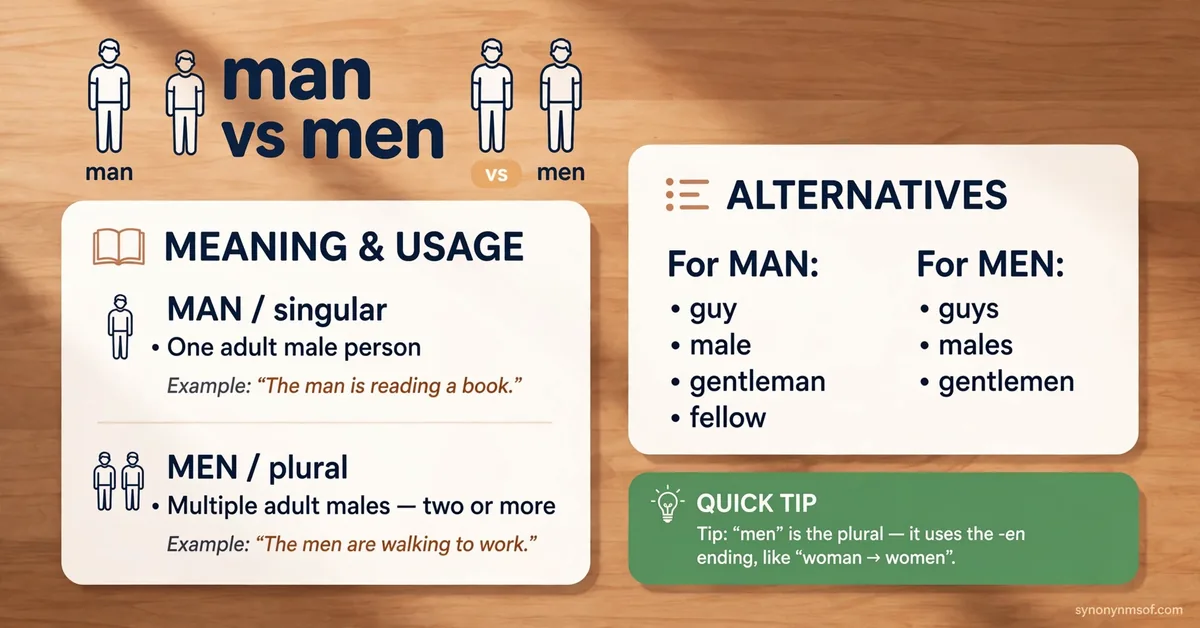
Man is first and foremost a noun meaning one adult male human being. It is the singular form of the pair, used whenever you are talking about exactly one person: A man is waiting at the door, The man lost his keys. It is pronounced man, written /mæn/ in the International Phonetic Alphabet, rhyming with can, pan, and ran.
Historically, man carried a much wider meaning: humankind, the human race, all people. You still meet this sense in old proverbs and formal writing, as in Man must protect nature or the famous phrase man’s inhumanity to man. Modern style guides recommend against using it this way, because it reads as excluding women, and most writers now prefer people, humans, or humanity. You should recognize the old sense when you read it, but avoid it in your own writing.
Man also works as a verb, meaning to staff, operate, or take one’s place at something: Volunteers manned the phones all night, Two guards man the entrance. The past tense keeps the double n: manned. In casual speech it appears as an exclamation or a term of address: Man, that was a great game or Come on, man, you can do it. None of these uses has anything to do with the plural, which is part of why the word needs a full explanation rather than a one-line definition.
Like woman, man can sit in front of another noun as an attributive modifier, though this use is fading: a man nurse is now usually just a nurse, and modern English prefers gender-neutral job titles. You will still see it in older texts and in fixed compounds, which brings us to one of the trickiest corners of this pair, the compound nouns like policeman, fireman, businessman, and gentleman. Their plurals change the vowel in the middle, policemen, firemen, businessmen, gentlemen, following the same ancient pattern as man itself.
The word also lives on in idioms and fixed phrases that color everyday speech. A man of the hour is someone being celebrated right now, while a man of few words is someone who speaks sparingly. In slang, the man can mean authority itself, as in You can’t fight the man, and a yes-man is someone who agrees with everything a superior says. The phrase man up tells someone to be brave, though many speakers now avoid it as old-fashioned. These expressions show how deeply the word is woven into English, far beyond its literal meaning of one adult male.
What Does “Men” Mean?
Men is the plural of man. It refers to two or more adult male human beings and is always plural, never singular: Three men are playing cricket, The men carried the heavy boxes. It is pronounced men, written /mɛn/, rhyming with pen, ten, and when. The vowel is the short e of bed, clearly different from the open a of man.
The plural is irregular. English normally builds plurals by adding -s or -es, but man belongs to a small, ancient group of nouns that form the plural by changing the inner vowel, a process linguists call i-mutation that goes back to Old English, where mann became menn. You cannot guess this pattern from the spelling rules you learned in school; you simply have to know that man becomes men, the way woman becomes women and child becomes children.
Men always takes plural verbs and plural determiners: The men are exhausted, Many men volunteered, These men won the match. It also forms the plural possessive men’s, as in the men’s locker room or men’s fashion, with the apostrophe placed after the n. Because the word is so short and so common, errors with it stand out immediately, which makes the rules in this guide worth learning precisely.
The Key Difference Between Man and Men
The core difference is number, and it is absolute. Man means one adult male person; men means two or more. Every other difference between the two words, in spelling, in sound, and in grammar, exists to mark that distinction. A useful memory aid is the rhyme: man rhymes with can and means one, men rhymes with pen and means many.
The spelling change is minimal but fixed: the a of man becomes an e in men. The sound changes with it, from the open /æ/ of cat to the short /ɛ/ of bed. These two changes travel together, so if you hear the e vowel you should expect the plural meaning, and if you see the e spelling you should expect plural grammar around it.
Grammar makes the difference impossible to ignore. Singular man takes singular articles and determiners: a man, the man, this man, one man, every man, each man. Plural men takes plural determiners: the men, these men, two men, many men, several men, all men. Verbs agree accordingly: The man is tall, never The man are tall; The men were exhausted, never The men was exhausted. The determiner and the verb are your two best clues when you are checking your own writing.
One more distinction matters for careful writers. Man is also the broader, historical word for humanity, while men has no such extended sense; it always means male people. So in a sentence like Man first walked on the moon in 1969, the word means humankind, but Men first walked on the moon in 1969 would specifically mean male astronauts. The two forms are not interchangeable even loosely, and swapping them changes the meaning of the sentence.
How to Pronounce Man and Men Correctly
The pronunciation difference is small but decisive. Man is /mæn/: start with m, open the mouth wide for the a of cat, and finish with n. It rhymes with can, pan, and ran. Men is /mɛn/: start with m, keep the mouth half-open for the e of bed, and finish with n. It rhymes with pen, ten, and when.
Learners whose first language has fewer vowel sounds often merge these two into one sound, saying something between man and men for both. The fix is exaggeration. Say maaan with the jaw dropped low, then mehn with the jaw half-closed, and alternate between them: man, men, man, men. The jaw position is the physical difference, and feeling it makes the sounds easier to produce and to hear.
Minimal-pair sentences are the best drill. Read these aloud, stressing the vowel each time: One man came. Two men came. The man is here. The men are here. A man called. Some men called. Recording yourself and listening back reveals mergers you cannot hear while speaking. Most learners find that a few days of this drill permanently separates the two sounds.
Note that regional accents shade these vowels slightly. In some American accents the a of man sounds a little closer to eh, and in some British accents the e of men is very short and crisp. These are accent flavors, not different words. As long as you keep the singular open and the plural short, you will be understood everywhere English is spoken.
In connected speech, native speakers often reduce unstressed words around the pair, but man and men themselves keep their full vowels because the vowel carries the meaning. That is why mumbling the vowel is riskier here than with most words: a blurred vowel can leave the listener unsure whether one person or several arrived. Keep the vowel clear even when you speak quickly, and the number will come through.
Grammar Rules: When to Use Man vs Men
Rule one is the counting rule. One adult male person takes man: a man, the man, this man, one man, every man, each man. Two or more take men: two men, many men, these men, several men, all men, both men. Count the people first and the word choice follows.
Rule two is verb agreement. Man pairs with singular verbs: The man is waiting, A man has called, This man owns the shop. Men pairs with plural verbs: The men are waiting, Two men have called, These men own the shop. If the verb and the noun disagree, one of them is wrong, and checking the pair is the fastest way to proofread.
Rule three covers possessives. One man’s belonging is written man’s: the man’s hat, a man’s voice. The group’s belonging is men’s: the men’s department, men’s health, the men’s team. The apostrophe goes before the s in both cases, because men is already plural without adding an s.
Rule four is the never-do list. Never write mans as a plural; it is not a standard English word. Never pair a, one, every, or each with men. Never pair many, several, few, or a number above one with man. And never let the verb disagree with the noun. These are the errors that survive spellcheck, because both man and men are correctly spelled words, so only your own knowledge catches them.
Rule five handles the compounds. Nouns ending in -man usually form their plurals as -men: policeman becomes policemen, fireman becomes firemen, businessman becomes businessmen, gentleman becomes gentlemen, sportsman becomes sportsmen. Be aware that many of these are being replaced by gender-neutral terms like police officer and firefighter in modern usage, but the plural pattern remains correct when you do use them.
Example Sentences with “Man” and “Men”
Study how the articles, numbers, and verbs change around the two forms. The pattern repeats in every sentence, and seeing it repeated is what makes it stick.
Sentences with “Man” (Singular)
- I saw a man at the library this morning.
- The man lost his keys on the bus.
- There is a man at the door asking for you.
- The old man told us a fascinating story.
- Every man on the team shook hands after the match.
- A man in a blue jacket waved me over.
- This man has worked here for twenty years.
- One man volunteered to stay late.
- The man is waiting outside the office.
- Each man received a medal for his service.
- No man had attempted the climb in winter before.
- A wise man once said that patience wins.
- The man behind the counter greeted every customer.
- A tall man in a gray suit asked for directions.
Sentences with “Men” (Plural)
- Three men are playing cricket in the park.
- The men carried the heavy boxes upstairs.
- Five men worked on the project all week.
- All the men arrived on time.
- The men from our class won the match.
- Two men were talking outside the shop.
- Many men volunteered for the rescue effort.
- The men were exhausted after the long shift.
- Several men stood up to applaud.
- Both men agreed to sign the contract.
- These men built the bridge in record time.
- The men are waiting for their orders.
- The men on the crew finished ahead of schedule.
- Four men lifted the piano onto the truck.
Common Mistakes to Avoid
Mistake 1: Writing “mans.” The plural of man is men, never mans. Incorrect: Three mans are playing. Correct: Three men are playing. This is the single most common error with this pair, and it comes from applying the regular -s rule to an irregular noun.
Mistake 2: Using “a men” or “one men.” Singular articles and numbers need the singular noun. Incorrect: I met a men at the store. Correct: I met a man at the store. The same applies to one, every, and each.
Mistake 3: Mismatching the verb. Incorrect: The men is my friend. Correct: The man is my friend. Incorrect: The man are ready. Correct: The men are ready. Read the subject and the verb together; they must agree in number.
Mistake 4: Regularizing the compounds. Incorrect: Two policemans arrived. Correct: Two policemen arrived. The vowel change happens inside the compound too: businessmen, firemen, gentlemen, sportsmen.
Mistake 5: Merging the vowel sounds in speech. Saying the same vowel for both words blurs singular and plural for the listener. Keep man open like can and men short like pen, and drill the pair aloud until the jaw positions feel distinct.
Mistake 6: Using “man” for humanity in modern writing. Dated: Man must protect nature. Modern: People must protect nature or Humanity must protect nature. The generic sense is correct in older texts but reads as exclusionary today.
Mistake 7: Misplacing the possessive apostrophe. Incorrect: the mens’ room. Correct: the men’s room. Because men does not end in s, the possessive adds apostrophe plus s, just like any other plural not ending in s.
Mistake 8: Confusing “man” the noun with “man” the verb. In They will man the station, man is a verb meaning to staff, and it has nothing to do with counting people. Do not pluralize it or treat it as the noun form; context tells you which job the word is doing.
Frequently Asked Questions
Is “men” singular or plural?
Men is always plural. It refers to two or more adult male human beings and takes plural verbs, as in The men are here. The singular form is man, which refers to exactly one adult male person. A quick test: if you can replace the word with they, use men; if you can replace it with he, use man.
Is “mans” ever correct?
No, mans is not a correct plural in standard English. The plural of man is men, formed by changing the vowel rather than adding -s. The only standard s-forms are the possessives man’s for one man and men’s for a group. Whenever you are tempted to write mans, write men instead.
Why is the plural “men” and not “mans”?
Because man is an ancient irregular noun. In Old English the word was mann and its plural was menn, formed by a vowel change called i-mutation rather than by adding an ending. English kept this old pattern even as most other nouns switched to the regular -s plural. That is why man becomes men, just as woman becomes women and foot becomes feet.
Can “man” mean people in general?
Yes, but only in older or formal writing. For centuries man was used to mean humankind, as in man’s inhumanity to man. Modern style guides advise against this because it sounds exclusionary, and most writers now use people, humans, or humanity instead. Recognize the old sense when you read classic texts, but do not use it in new writing.
How do you pronounce “men”?
Men is pronounced with the short e of bed: /mɛn/, rhyming with pen and ten. Keep the mouth half-open and the sound short and crisp. The most common error is merging it with man, which has the open a of cat. Exaggerating the jaw position, wide open for man and half-closed for men, separates the two sounds reliably.
Conclusion
Man and men are two forms of one ancient word, split by number: one person versus many, the vowel shifting from /æ/ to /ɛ/, the spelling changing a single letter, and the surrounding grammar rearranging itself to agree. The word also carries extra lives as a verb, an exclamation, and a historical name for humanity, which is why it repays a fuller explanation than a simple singular-plural note. But the everyday rule is beautifully simple: count the people, match the verb, and never add an s.
Practice the counting rule in your writing and the vowel pair in your speech, and this irregular pair will become second nature. It is one of the oldest distinctions in the language, and handling it cleanly is a quiet mark of careful English that readers and listeners notice, even if they never mention it.
Explore more on Synonynmsof.