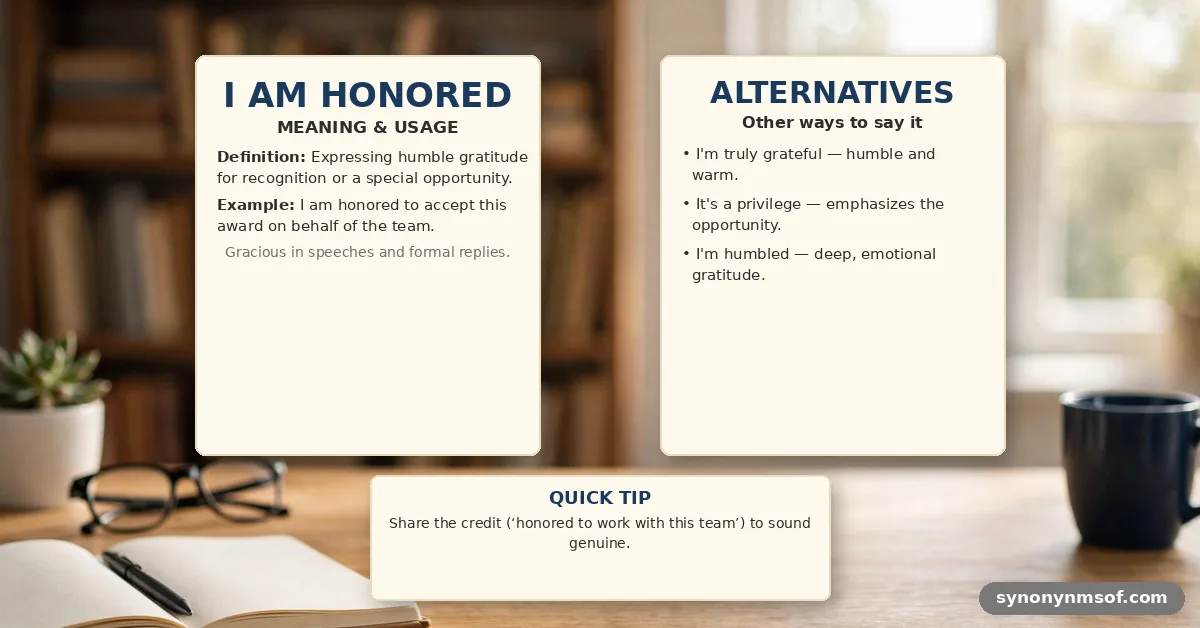

When you say you are honored, you are expressing deep appreciation for a gesture, an award, or an invitation. It signals that you recognize the significance of what has been offered to you. People often use this phrase to show humility and respect toward the person or group providing the recognition.
By understanding exactly how to deploy these words, you can navigate professional and personal milestones with genuine grace. This article breaks down the nuances of the phrase, helping you choose the right moment to express your gratitude effectively.
Defining the Core Meaning

At its heart, the phrase represents a state of being held in high regard or receiving a mark of distinction. When you state that you are honored, you are acknowledging that the situation carries weight.
It goes beyond a simple thank you by adding a layer of gravity and respect. You are effectively saying that the offer or the recognition exceeds your expectations.
This expression is deeply rooted in the concept of social reciprocity. When someone bestows an honor upon you, they are giving you a piece of their trust or their resources.
By responding with this phrase, you acknowledge that you do not take that gift lightly. It serves as a bridge between the giver’s intent and your own sense of professional or personal responsibility.
Professional Applications and Impact
In a workplace setting, the phrase carries specific weight during formal interactions. You might use it when accepting a promotion, a new project, or an industry award.
Using this language demonstrates that you understand the stakes of your new position. It shows that you value the decision-makers who put their faith in your abilities.
However, overusing it can dilute its power. If you claim to be honored by every minor task or routine email, the term loses its impact.
Reserve it for moments that actually involve a selection process, a significant show of support, or an invitation to a closed-door event. In these contexts, it reinforces your professionalism and your ability to read the room.
When to Use It in Business
* Accepting a keynote speaking invitation.
* Receiving a formal commendation for a project.
* Being asked to join a board or committee.
* Accepting a job offer from a highly respected firm.
Comparing Degrees of Gratitude
Choosing the right word depends on the intensity of the situation. While many people use “thankful” and “honored” interchangeably, they possess distinct emotional profiles. A table can help you distinguish between these common expressions of appreciation.
| Phrase | Best Context | Emotional Weight |
|---|---|---|
| Thank you | Casual or routine tasks | Low to Medium |
| I appreciate it | Acknowledging support | Medium |
| I am honored | Significant recognition | High |
| I am humbled | Overwhelming prestige | Very High |
The Nuance of Feeling Honored
The phrase often appears alongside the word “humbled.” While they are similar, they are not identical.
Being honored suggests you are proud to be associated with an opportunity. Being humbled suggests that you feel the honor is perhaps greater than you deserve.
Using these together creates a powerful, balanced statement. For instance, saying “I am honored and humbled by this opportunity” covers both your excitement and your desire to stay grounded.
It is a classic rhetorical move in acceptance speeches. It allows you to shine while keeping your feet firmly on the ground.
Cultural and Linguistic Variations

You might notice the spelling difference between “honored” and “honoured.” This is simply a matter of regional preference.
“Honored” is the standard spelling in American English, while “honoured” is the preferred form in British, Canadian, and Australian English. Both are correct, so choose the one that aligns with your location.
Beyond spelling, the tone of the phrase remains consistent across English-speaking cultures. It is universally understood as a formal, respectful, and sincere sentiment.
Whether you are in a boardroom in New York or a gala in London, the weight of the phrase remains unchanged. Always consider the audience’s cultural expectations before selecting your phrasing.
Avoiding Common Pitfalls
The most common mistake people make is using this language when it is not earned. If you are offered a standard, low-level opportunity, calling yourself honored can sound sarcastic or sycophantic.
It is better to use a simple, direct expression of gratitude in those cases. Save the formal language for when it truly fits the magnitude of the event.
Another trap is the “auto-reply” syndrome. Avoid using the phrase as a filler in email signatures or boilerplate responses.
If you write “I am honored to receive your inquiry” for a cold sales email, you are misusing the term. It should be reserved for genuine human connection and deliberate selection.
Examples in Practice
Learning how to weave this into your own speech requires seeing it in action. You want to sound natural, not like you are reading from a script. Consider how these examples change the tone of a message.
- For a promotion: “I am honored to accept this role and look forward to contributing to the team’s continued success.”
- For an award: “Receiving this recognition is a highlight of my career; I am truly honored by your support.”
- For an invitation: “I am honored to be invited to speak at this year’s conference and appreciate the opportunity.”
- For a recommendation: “I am honored that you would trust me with this responsibility.”
Historical and Linguistic Context
The word traces its roots back to the Latin honor, meaning esteem or public worth. Historically, it was reserved for high-ranking officials or nobility. Over time, the usage democratized, allowing it to apply to any situation where one person provides recognition to another.
In literature and public speaking, the phrase often functions as a buffer. It softens the potential arrogance of accepting a high-status role.
By shifting the focus from yourself to the person offering the honor, you show grace. You can learn more about the evolution of formal English through the Oxford English Dictionary, which provides comprehensive historical context for these terms.
Frequently Asked Questions
Is it okay to say I am honored in a casual text message?
It is usually too formal for a casual text. If you are texting a friend or colleague, a simple “thanks” or “I really appreciate that” is more natural. Save the formal phrasing for emails, letters, or face-to-face interactions.
Can I use the phrase if I am not actually feeling honored?
You should avoid using it if you do not mean it. If you feel indifferent or annoyed, using the phrase can come across as insincere or passive-aggressive. If you must be polite, stick to neutral phrases like “thank you for the invitation.”
What is the difference between feeling honored and feeling privileged?
“Privileged” implies that you have been given a unique advantage or access that others do not have. “Honored” focuses more on the recognition of your character or work. They are often used together, but they address slightly different aspects of an opportunity.
Should I say I am honored to meet you?
This is a polite, albeit very formal, way to greet someone of high status. It is appropriate when meeting dignitaries, mentors, or people you hold in extremely high regard. In most daily interactions, a simple “it is a pleasure to meet you” is more common.
Conclusion
Using the phrase I am honored correctly is an exercise in professional awareness. It serves as a powerful tool to show that you value the recognition you have received.
By reserving these words for significant milestones, you keep your communication authentic and impactful. Remember that the goal is to acknowledge the kindness of others while maintaining your own professional dignity.
Whether you are accepting a new challenge or thanking a mentor, your choice of words defines how you are perceived. Apply the principles discussed here to ensure your expressions of gratitude always land with the right tone.
As you move forward in your career, continue to look for moments where this phrase can genuinely enhance your professional relationships. Your ability to express appreciation with clarity and sincerity will always be a valuable asset.