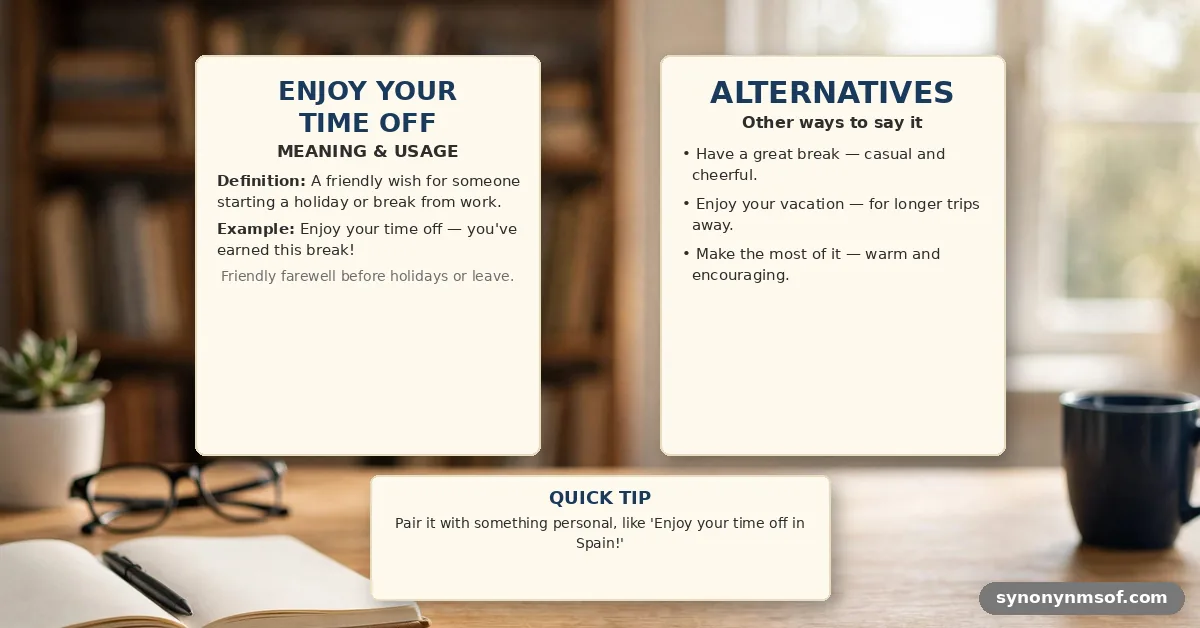

When you look at the phrase “Enjoy Your Time Off: Meaning and Alternative Wishes,” you are really asking about how to communicate warmth and professional respect during a colleague’s or friend’s absence. The core meaning of this expression is a simple, sincere wish for someone to find rest and restoration away from their daily responsibilities. It is a polite way to acknowledge that work is not the entirety of a person’s life.
You can use these words in emails, text messages, or face-to-face conversations to bridge the gap between professional boundaries and personal kindness. Understanding the nuance of these phrases helps you build stronger relationships, as it shows you value the person, not just their output. This guide provides the context and variety you need to make your well-wishes sound authentic.
At its heart, telling someone to enjoy their time off is a recognition of the human need for downtime. It acknowledges that the person has been working hard and deserves a period of detachment from their duties. When you say this, you are implicitly giving them permission to disconnect without guilt.
The phrase functions as a social lubricant in professional environments. It signals that you respect their boundaries and do not expect them to be reachable while they are away. By using this language, you foster a culture of mutual support rather than one of constant availability.
Is It Professional to Say “Enjoy Your Time Off”?

It is perfectly professional to use this phrase, provided the tone is appropriate for your relationship. In most corporate settings, it is seen as a standard, polite closing that maintains a positive rapport. You are acknowledging their departure in a way that is both brief and kind.
If you are worried about the informality of the phrase, consider the following variations for different levels of closeness:
- For formal settings: “I hope you have a restful and productive break.”
- For close colleagues: “Make sure to disconnect and recharge—you’ve earned it.”
- For clients: “We look forward to reconnecting when you return; please enjoy your time away.”
- For short absences: “Have a great couple of days off.”
Alternative Wishes for Different Contexts
Choosing the right words depends heavily on the duration of the leave and the nature of your relationship. A quick weekend break requires a different tone than a two-week sabbatical or a medical leave. You want to match the intensity of your well-wishes to the reality of their absence.
When someone is taking a long vacation, you might pivot toward wishes for adventure or relaxation. If they are taking time off for personal reasons or stress, keep your message simple and supportive without prying. The goal is to make them feel seen, not to add pressure to their time away.
Comparing Common Farewell Phrases
Different phrases carry different connotations depending on how you structure them. The following table breaks down how common expressions compare in terms of professional warmth and intent.
| Phrase | Best Use Case | Tone |
|---|---|---|
| Enjoy your time off | General/Versatile | Neutral/Friendly |
| Have a great break | Casual/Short-term | Warm |
| Wishing you a restful leave | Formal/Extended | Respectful |
| Enjoy your vacation | Personal/Known plans | Enthusiastic |
| Hope you recharge | High-stress/Burnout | Empathetic |
The Importance of Boundaries
When you wish someone a good break, you are reinforcing the importance of work-life balance. According to the American Psychological Association, maintaining clear boundaries is essential for long-term mental health and performance. By not asking for follow-ups, you help them maintain those boundaries.
Respecting time off is a skill that distinguishes effective managers and supportive peers. When you explicitly state that you hope they enjoy their time, you are setting a standard that their personal life matters. This builds loyalty and trust, as they know you aren’t just treating them like a tool for productivity.
When to Avoid “Enjoy”
There are specific scenarios where telling someone to “enjoy” their time away can sound tone-deaf. If a colleague is taking leave to care for a sick relative or for bereavement, the word “enjoy” is entirely inappropriate. In these cases, focus on support instead.
Use phrases like “I am thinking of you” or “Take all the time you need to settle things.” These expressions convey care without the expectation that the person is having a “fun” or “enjoyable” experience. Always evaluate the reason for their absence before you hit send on your email.
Cultural Nuances in Wishing Well
Communication styles vary significantly across different cultures and regions. In some countries, being too direct with “enjoy your time off” might be seen as overly familiar or even intrusive. In others, it is considered the bare minimum of polite office interaction.
Always observe how your colleagues communicate with one another before adopting a specific style. If the office culture is reserved, stick to more formal, standard well-wishes. If the culture is highly collaborative and casual, you have more room to get creative with your language.
Religious and Philosophical Contexts
Reflecting on the value of rest is a practice found in many traditions, often emphasizing the necessity of pausing work. In biblical terms, the idea of a Sabbath is not just about stopping; it is about finding renewal. As noted in Exodus 23:12, the principle of resting allows for refreshing the spirit, which is a concept that transcends modern office dynamics.
Even if you are not religious, the underlying wisdom remains relevant. Human beings are not machines designed for perpetual output. Acknowledging this through your messages helps normalize the human pace of life in an increasingly fast-paced world.
Writing for Email Signatures
If you are the one going on leave, you might be wondering how to phrase your own out-of-office response. Keep it professional but clear about when you will be back. A simple “I am currently away from my desk and will return on [Date]” works better than anything overly clever.
You can add a small, human touch at the end of your auto-reply. Something like “I look forward to catching up when I return” is standard and safe. Avoid over-explaining where you are going or what you are doing, as it is unnecessary for professional correspondence.
Personalizing Your Messages
If you know a coworker well, add a small, specific detail to your well-wishes. Instead of a generic “enjoy your time off,” try “I hope you get some time to hike in the mountains.” This shows you have been listening to them and care about their specific interests.
Small, thoughtful gestures go a long way in building a positive workplace. You don’t need to write a paragraph; one sentence that mentions something unique about them is enough. It transforms a standard interaction into a moment of genuine human connection.
Maintaining Professional Distance
While warmth is good, remember that there is such a thing as over-sharing. You want to be friendly, but you do not need to become a therapist for your colleagues. Keep your wishes focused on their well-being rather than their personal problems.
If you feel like you are stepping over a line, pull back. Stick to the classics like “Have a wonderful break” or “Wishing you a great time away.” These phrases provide the necessary warmth without requiring the other person to divulge details they might prefer to keep private.
The Long-Term Impact of Support
Consistently being the person who encourages others to rest builds your reputation as a team player. People remember how you treated them when they were at their most vulnerable or their most tired. It creates a cycle of reciprocity where others will respect your time off when you need it.
Ultimately, the way we talk about time away reflects our values. By choosing our words carefully, we contribute to a healthier, more sustainable way of working together. Never underestimate the power of a simple, well-intentioned wish for someone to find peace in their time away.
Frequently Asked Questions
Is it ever rude to tell someone to enjoy their time off?
It is generally not rude, but it can be insensitive if you know the person is taking time off for a difficult personal reason, such as a funeral or a medical emergency. Always gauge the situation before using the word “enjoy” to ensure your message aligns with their circumstances.
What is a good alternative for a formal email?
For a formal email, you might say, “I wish you a pleasant and restorative break” or “I look forward to your return upon your leave.” These options are professional, polite, and maintain appropriate boundaries while still offering a kind sentiment.
How can I make my message sound less like a template?
The best way to avoid a robotic feel is to add a brief, personal reference if you have one. Mentioning a specific hobby, a upcoming trip, or even just a shared project you look forward to finishing together adds a layer of authenticity that generic phrases lack.
Should I acknowledge the work they left behind?
Generally, no. When wishing someone a good break, keep the focus on their rest. Bringing up unfinished tasks or the stress of the workplace can undermine the sentiment of your well-wish and make the person feel anxious rather than refreshed.
Conclusion
Finding the right way to express your support during a colleague’s absence is a simple yet effective way to improve your professional relationships. Whether you use the classic approach or choose a more tailored, thoughtful alternative, the core intent remains the same: showing respect for the person’s need to disconnect and recharge.
Understanding the meaning behind these gestures allows you to communicate with greater empathy and clarity. By carefully considering the context, the relationship, and the reason for the leave, you can ensure your words are received with the kindness you intended.
Remember that the goal is always to foster a culture of mutual respect and balance. When you master the nuances of phrases like “Enjoy Your Time Off: Meaning and Alternative Wishes,” you aren’t just sending a message; you are contributing to a healthier environment for everyone you work with. Take the time to be thoughtful, and you will see the difference it makes in your daily interactions.