
Using the phrase by the way is a staple of everyday English, yet many people struggle to identify exactly when it is appropriate to insert into a conversation. It serves as a linguistic bridge, allowing you to pivot to a new thought without jarring your listener or appearing completely disconnected from the current subject. Whether you are chatting with friends at a summer barbecue or sending a quick email, mastering this transition helps you manage the flow of information.
Understanding the nuance behind the words ensures you get your point across while maintaining a natural tone. Here is how you can use it effectively in your daily life.
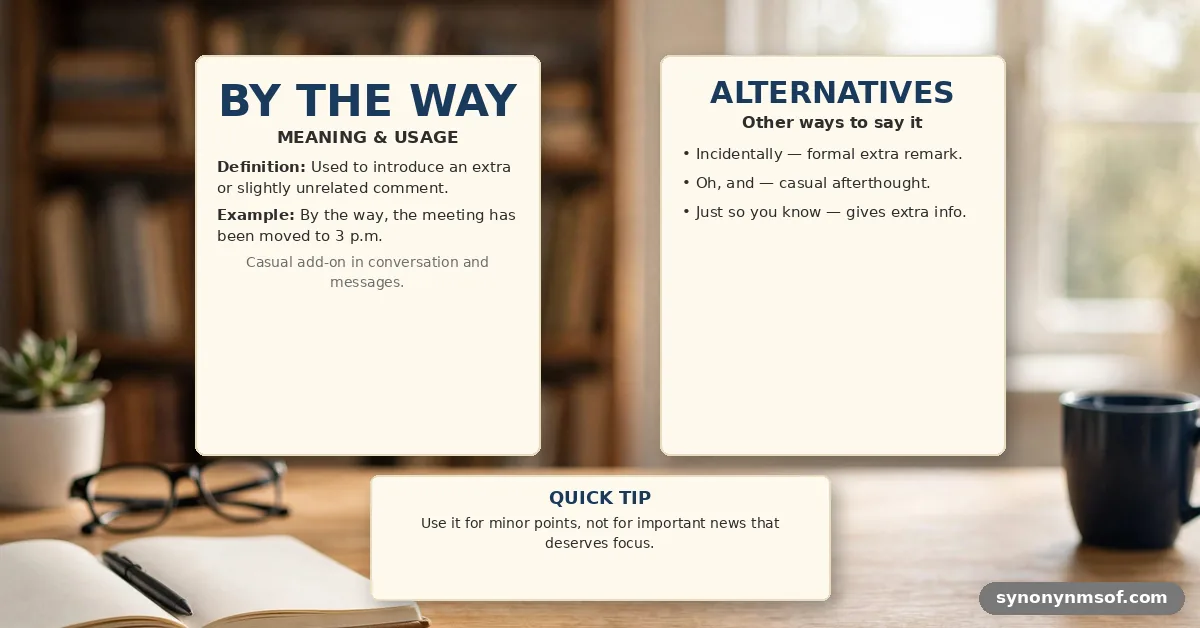
At its core, by the way functions as an introductory marker for a side comment or a secondary piece of information. It signals that you are shifting focus slightly away from the primary topic to add a detail that just crossed your mind. You aren’t necessarily ending the conversation about the first subject, but you are creating a momentary detour.
Think of it as a mental off-ramp on the road of your dialogue. It warns the listener that what follows might be unrelated to what you were just discussing. Because it is so versatile, it works just as well in written text as it does in spoken word.
Proper Usage in Conversation

The most effective way to use this expression is to ensure the new information actually holds some relevance to the context, even if it is a departure. If you are discussing travel plans and suddenly bring up your favorite brand of coffee, the shift might feel too abrupt. However, if you use the phrase to connect a related, albeit secondary, thought, it feels organic.
Consider the rhythm of your speech when you add these words. You should generally pause slightly before saying them to give your listener time to process the previous point. This small gap in time emphasizes that you are introducing something new.
Common Synonyms and Alternatives
If you find yourself using the same transition too often, you might need to vary your vocabulary. There are several other ways to introduce a side note without relying on the same old standby. Choosing the right synonym depends on the level of formality you need for the situation.
- Incidentally: A highly formal option perfect for professional reports or serious discussions.
- As a side note: Useful for clarifying that the information is supplementary and not critical to the main argument.
- Before I forget: Excellent for reminding someone of a task or detail that might otherwise slip through the cracks.
- On a related note: Ideal when you want to bridge two topics that share a common theme.
- By the by: A slightly archaic, whimsical variation that adds a touch of personality to casual conversation.
Formal vs. Informal Contexts
The formality of your setting dictates whether you should stick to the standard phrase or pivot to a more sophisticated alternative. In casual settings like texting or talking to family, the traditional expression is perfectly acceptable and expected. You don’t need to overthink it; it fits the relaxed nature of those interactions.
However, in a professional email or a meeting with a client, you might want to be more intentional. Using “incidentally” or “as a side note” can make you sound more composed and thoughtful. It shows that you respect the listener’s time by clearly marking the transition.
| Phrase | Formality Level | Best Use Case |
|---|---|---|
| By the way | Casual | Friends, family, quick chats |
| Incidentally | High | Reports, formal emails, meetings |
| As a side note | Moderate | Work emails, project updates |
| Before I forget | Low/Moderate | Reminders, follow-ups |
Managing Information Flow
One of the biggest challenges in communication is knowing how much information to provide at once. When you use this phrase, you are essentially asking your listener to store the previous topic in their memory while you introduce a new one. If you stack too many side comments, your listener will get lost.
Keep your digressions brief. If the secondary point requires a long, complex explanation, it is better to finish the first topic entirely before moving on. You want to keep the road of conversation clear so your listener doesn’t feel overwhelmed by disconnected details.
Common Mistakes to Avoid
Many people accidentally use this transition to introduce a topic that is actually the most important part of the message. This can be confusing because the phrase implies that the upcoming information is secondary. If you have an urgent or primary request, put it at the very start of your sentence.
Another error is using the phrase to change the subject too aggressively. If your listener is deeply invested in the current topic, a sudden pivot can feel dismissive. Always gauge the energy of the conversation before you decide to switch gears.
FAQ
Is it professional to use this phrase in business emails?
It is generally acceptable in standard email communication, especially if you have an established relationship with the recipient. For highly formal documents or legal correspondence, you might prefer “incidentally” to maintain a more polished tone.
Can I use this phrase to start a conversation?
No, it does not work well as an opener because it implies there is a preceding context. It is designed to be a transition, so it needs a main topic to pivot away from.
What is the difference between anyway and by the way?
“Anyway” is typically used to return to a previous topic or to wrap up a conversation after a distraction. “By the way” is used to introduce a new, secondary distraction.
Why do people say by the way thanks?
This is often used to add a polite afterthought to a request or a statement. It is a way of showing appreciation while simultaneously moving the conversation toward a different point.
Refining Your Communication
Mastering the use of by the way is a simple but effective way to improve your overall communication style. By understanding when to introduce a side note and when to stick to the main point, you allow your thoughts to flow more clearly. Remember that language is a tool meant to help you connect with others, not just a set of rules to follow.
Use these transitions to make your speech feel more natural and engaging. As you practice these small shifts in your daily interactions, you will find that your ability to manage complex conversations gets significantly better. If you have questions about how to adjust your tone for specific professional scenarios, feel free to share your thoughts and keep the conversation going.
SEO Title: By the Way: Meaning, Usage, and Examples
Meta Description: Learn the meaning of by the way, how to use it in conversation, and when to choose better alternatives for professional situations.
Suggested URL Slug: by-the-way-meaning-usage-examples
Primary Keyword: by the way
Secondary Keywords: words, new, word, use, phrase, road, one, examples, summer, way way, get, need, commonly, interesting, life, let, information