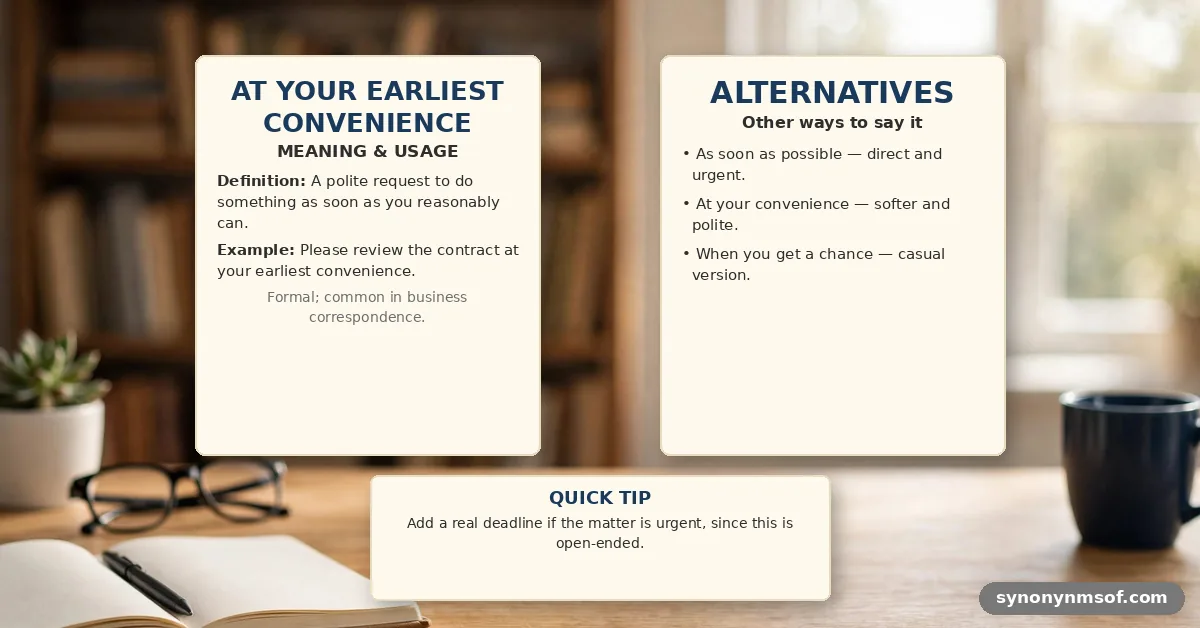

When someone asks you to reply at your earliest convenience, they are requesting a response as soon as your schedule permits. It is a polite, formal way of signaling that while the matter is important, you are not expected to drop everything to address it immediately.
This phrase bridges the gap between professional courtesy and the practical reality of a busy workday. Understanding how to use it correctly—and how to interpret it when you receive it—helps you manage expectations in both written and spoken communication.
The phrase is a staple of office correspondence, but it often lands in a gray area of urgency. Some people interpret it as a gentle nudge, while others treat it as a high-priority demand. By examining the nuance of this expression, you can ensure your tone remains professional while respecting the time of your colleagues and clients.
The Core Meaning and Intent
At its heart, the phrase is an invitation to prioritize a task without imposing a rigid deadline. It grants the recipient a degree of autonomy, acknowledging that they likely have other obligations to attend to first. Unlike a direct command or a fixed deadline, it places the power of time management back in the hands of the person being asked.
However, the intent can change depending on the relationship between the sender and the receiver. In a hierarchical setting, a supervisor might use it to imply that the task should be finished as soon as the current project concludes. Among peers, it functions as a polite buffer that prevents the sender from appearing overly aggressive or demanding.
Why the Phrase Can Be Misleading
One of the main issues with this expression is its inherent ambiguity. Because it lacks a specific time frame, it leaves the recipient guessing about how much urgency is actually attached to the request. A sender might expect a response within an hour, while the recipient assumes they have until the end of the day.
This gap between expectation and reality often leads to unnecessary stress. When you use this language, you are essentially asking the recipient to judge the importance of the task relative to their own workload. If the task is truly critical, using vague language is a strategic error that could result in a delayed response.
Professional Contexts for Usage
You will most often encounter this phrase in formal written communication, such as emails or letters. It serves as a standard sign-off or a closing request. It works well when you want to maintain a respectful distance while still moving a project forward.
Common Scenarios
- Requesting documents from a client during a multi-week project.
- Asking a colleague to review a draft that doesn’t have an immediate deadline.
- Following up on an inquiry where you want to signal interest without appearing desperate.
- Closing a message where you have provided information and want to acknowledge that the recipient may need time to process it.
Comparing Urgency Levels
Understanding where this phrase sits on the spectrum of urgency is vital for effective communication. It is not as forceful as a deadline, but it is more professional than simply saying “whenever you get to it.” The following table illustrates how different phrases signal varying degrees of time sensitivity.
| Phrase | Level of Urgency | Best Used For |
|---|---|---|
| Please reply by 5 PM today | High | Urgent, time-sensitive tasks |
| At your earliest convenience | Moderate | Standard professional requests |
| Whenever you have a moment | Low | Informal or non-essential queries |
| As soon as possible | High/Urgent | Situations requiring immediate action |
Alternatives for Better Clarity
If you find that your requests are often delayed, you might need to move away from using this phrase entirely. Ambiguity is the enemy of efficiency. When you need a specific output, it is always better to provide a concrete date or time.
When to Use Direct Deadlines

Instead of relying on the standard phrase, try being more specific. You can ask for a response by the end of the business day or provide a specific date. This removes the guesswork for the recipient and helps them prioritize their own tasks. According to resources like the Grammarly writing guide, clarity is the most important element of professional correspondence. Being transparent about your timeline is a sign of respect, not a lack of manners.
The Role of Tone in Communication
Your tone of voice—or the tone of your writing—is just as important as the words you choose. When you use this phrase, it should sound helpful rather than passive-aggressive. If you use it while you are feeling frustrated, the recipient will likely pick up on that tension.
Avoiding Passive-Aggressive Traps
Some people use this phrase as a way to mask their impatience. If you are sending a follow-up email, avoid using it if you have already asked for the same thing twice. In those cases, it is better to state clearly that you have not yet received the requested information and need it to proceed.
Cultural and Generational Differences
It is worth noting that the interpretation of this phrase can vary by generation and workplace culture. Younger professionals, who are often accustomed to instant messaging and rapid-fire communication, might view the phrase as an outdated or overly formal way of saying “do this now.” Conversely, in more traditional corporate environments, it is seen as the height of professional etiquette.
Always consider your audience before choosing your language. If you are communicating with a client who values tradition, the phrase is a safe and polite choice. If you are working with a fast-moving creative team, a more direct approach might be better received.
FAQ
Is it rude to use this phrase?
No, it is not inherently rude. It is a standard, polite, and professional way to request a response without imposing a rigid deadline on the recipient.
Does it mean I have to reply immediately?
Not at all. The phrase explicitly gives you permission to address the matter when your schedule allows, provided you don’t delay for an unreasonable amount of time.
What is the best way to respond to this request?
If you can respond quickly, do so. If you are too busy, a short acknowledgment saying you have received the request and will get to it by a specific time is the most professional route.
Should I use this in casual conversation?
It is generally too formal for casual conversation with friends or family. In those settings, “get back to me when you can” is a more natural and less stiff alternative.
How do I make the phrase sound less like a demand?
Frame it within a larger, supportive context. Instead of just saying “please reply at your earliest convenience,” explain why the information is needed and how it will help the project move forward.
Conclusion
Navigating the nuances of professional language requires a balance between politeness and clarity. While asking for a response at your earliest convenience is a time-honored way to request attention without being overbearing, it should not be your default for every interaction. Use it when you want to show respect for someone’s schedule, but pivot to more specific deadlines when a task requires focused, timely action.
By paying attention to the context and the needs of the recipient, you can communicate more effectively and build stronger professional relationships. When you clearly state your needs while remaining mindful of the other person’s workload, you ensure that your message is both heard and respected. Practice being intentional with your words, and you will find that your requests are met with much more consistent and timely results.