
Deciding when is a good time for a meeting, a conversation, or a life event often feels like a guessing game. You want to align your needs with the availability and emotional capacity of others, yet timing is rarely perfect. Mastering the nuance of this phrase helps you navigate professional obligations and personal relationships with greater grace.
Understanding the social weight behind these four words allows you to read between the lines. Whether you are asking a colleague for feedback or planning a social outing, knowing how to interpret and use this expression effectively will save you time and prevent unnecessary friction in your daily interactions.
Defining the Phrase in Context

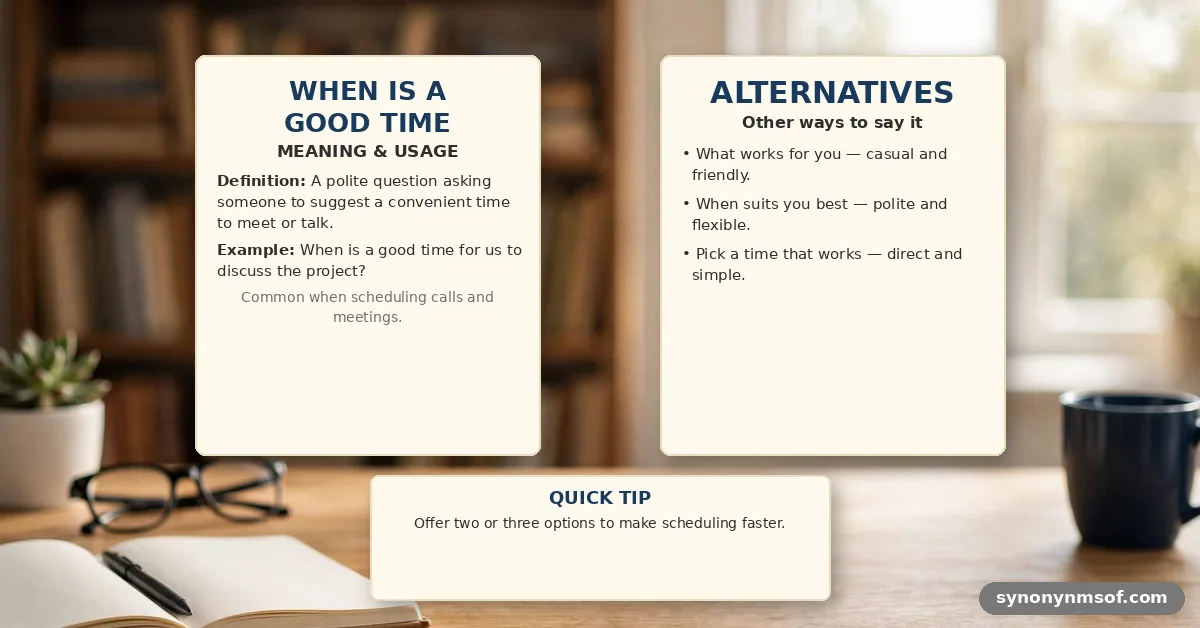
At its core, the expression functions as a request for permission or an inquiry into availability. It isn’t just about the clock; it is about the intersection of convenience, receptivity, and priority. When someone asks when it might be a suitable moment for an interaction, they are implicitly acknowledging that your schedule is valuable.
The term appears frequently in professional correspondence and casual text exchanges. In a business setting, it serves as a polite gatekeeper.
By asking for a window of opportunity, the speaker avoids the common pitfall of interrupting a flow state or catching someone during a stressful period. It transforms a potential demand into a collaborative agreement.
The Social Nuance of Timing
Beyond the literal clock, human receptivity fluctuates based on external pressures. Research from the American Psychological Association suggests that cognitive load significantly impacts how we process requests during the workday.
If you approach someone when their mental energy is depleted, the outcome of your conversation is likely to be less productive. A good time, therefore, is not just when someone is free; it is when they are mentally present.
Recognizing the difference between a neutral moment and an ideal one is a soft skill. A neutral moment is simply a gap in a calendar. An ideal moment is one where the other party has the space to listen, think, and engage without feeling rushed by looming deadlines.
Practical Applications in Daily Life
We use this idiom across a wide spectrum of scenarios. The intent changes significantly depending on whether the setting is formal or informal. Identifying these variations ensures you don’t sound dismissive or overly demanding.
- Professional Requests: Seeking a 15-minute sync to discuss a project.
- Conflict Resolution: Finding a moment to address a sensitive interpersonal issue.
- Social Invitations: Checking if a friend has the energy for a weekend activity.
- Customer Support: Determining when a client prefers a follow-up call.
Each of these requires a different approach to timing. For a sensitive conversation, you might prioritize privacy over speed.
For a routine project update, you might prioritize brevity and efficiency. Always frame your request to reflect the importance of the topic.
How to Gauge the Right Moment
Gauging when to reach out requires active observation. If you are in an office, look for physical cues. Are they wearing headphones?
Is their desk cluttered with urgent files? These are visual indicators that it is not a good time to interrupt.
Digital communication requires a different set of skills. If you send a message, notice the response time.
A rapid reply usually indicates an open window, while a delayed or short response suggests a lack of bandwidth. Respecting these boundaries strengthens your professional reputation.
| Context | Ideal Strategy | Best Practice |
|---|---|---|
| Provide an agenda | Ask for their preference | |
| Instant Messaging | Keep it brief | Use “Is now a good time?” |
| In-Person | Check body language | Wait for a natural pause |
| Phone Call | Schedule ahead | Avoid cold-calling |
Interpreting Social Cues
Sometimes, people use the phrase as a polite way to deflect. If you ask for a meeting and receive a vague “I’ll let you know when is a good time,” take it as a signal to step back. They are likely managing a high workload and cannot commit to an interaction at that moment.
Avoid pushing for an immediate answer when you sense hesitation. Persistent follow-ups in these situations can come across as aggressive. Instead, offer an easy exit or suggest an alternative communication channel like email, which allows them to respond on their own terms.
The Role of Empathy in Scheduling

Effective communication is fundamentally an act of empathy. When you ask if the moment is right, you are signaling that you respect the other person’s agency. It reduces the power imbalance that often exists in hierarchical relationships.
Consider the emotional state of the person you are contacting. If you know they are navigating a major life transition or a high-pressure project, acknowledge that context. A simple sentence like, “I know you’re busy with the launch, so let me know when you have a moment,” goes a long way in building rapport.
Common Misunderstandings
One major pitfall is assuming that your urgency is their urgency. Just because a task is high priority on your list does not mean it occupies the same slot on theirs. Misalignment here is the primary source of workplace friction.
Another issue is the misuse of the phrase as a filler. If you ask the question but don’t actually intend to wait for an answer, you are being disingenuous.
Always be prepared for the answer to be “not right now.” If you aren’t prepared to hear that, don’t ask the question.
Language and Cultural Variations
The way we discuss timing varies by culture. In some high-context cultures, the specific question is rarely asked directly; instead, one observes the social flow to determine the correct moment. In lower-context cultures like the United States, direct inquiry is preferred and often expected.
Language nuances also play a role. Dictionaries often define the term as a period of enjoyment, but in common parlance, it acts as a functional tool. Keeping this duality in mind prevents confusion when reading, as the word “time” can denote both a measurement and an experience.
Refining Your Approach
To improve your success rate, start being more specific with your requests. Instead of asking “When is a good time to talk?” try “Do you have ten minutes this afternoon to discuss the report?” Specificity reduces the cognitive load on the recipient, making it easier for them to say yes.
Consistency is key. If you consistently respect people’s time, they will be more likely to prioritize your requests when you do reach out. You are essentially building a reputation as someone who is mindful and considerate.
FAQ
What does it mean when someone says they are a good time?
When someone says a person is a good time, they mean that the individual is fun, entertaining, or lively to be around. It is a colloquial way of saying that the person brings positive energy to social situations.
How do I respond if someone asks me for a good time to talk?
Be honest about your availability. If you are busy, say, “I’m tied up until 3:00 PM, but I’m free after that.” If you are unsure, suggest a time to follow up later.
Is it rude to say now is not a good time?
It is not rude to protect your schedule. A professional way to decline is to say, “I’m in the middle of a project right now. Could we reconnect later this afternoon?”
Can this phrase be used to express romantic interest?
It is generally too vague for romantic overtures. Asking for a specific activity or a dedicated date is usually more effective than asking for a generic time.
Conclusion
Mastering the art of timing transforms how you interact with the world. Whether you are navigating a busy workday or planning social engagements, knowing when is a good time to communicate shows that you value the people around you. It is a simple linguistic tool that, when used with empathy and clarity, prevents misunderstandings and fosters stronger connections.
Begin by observing the patterns of those you work with and communicate daily. Adjust your requests to match their natural rhythms, and you will find that your interactions become more efficient and pleasant.
Practice patience when you don’t get the answer you want, and always offer flexibility. By treating everyone’s schedule with respect, you ensure that when you do connect, it truly is a good time for everyone involved.