
When you need to confirm that a task is completed correctly, you likely use the phrase “make sure.” It is one of the most common ways to express the need for verification or attention to detail in everyday English. Mastering how to use this phrase effectively helps you communicate clearly, whether you are writing an email to a colleague or explaining a process to a friend.
You will find that understanding its nuances allows you to be more precise in your instructions. This article breaks down exactly how to incorporate this essential expression into your vocabulary with confidence and clarity.
You use this expression to indicate that you are taking action to guarantee a specific outcome. It functions as a phrasal verb that implies foresight, diligence, and accountability. When you tell someone to “make sure” they lock the door, you are shifting the responsibility to them to verify the security of the premise.
This simple construction acts as a bridge between a request and its successful execution. It is widely used because it sounds natural and carries a clear, authoritative intent without being overly aggressive.
Defining the Core Meaning

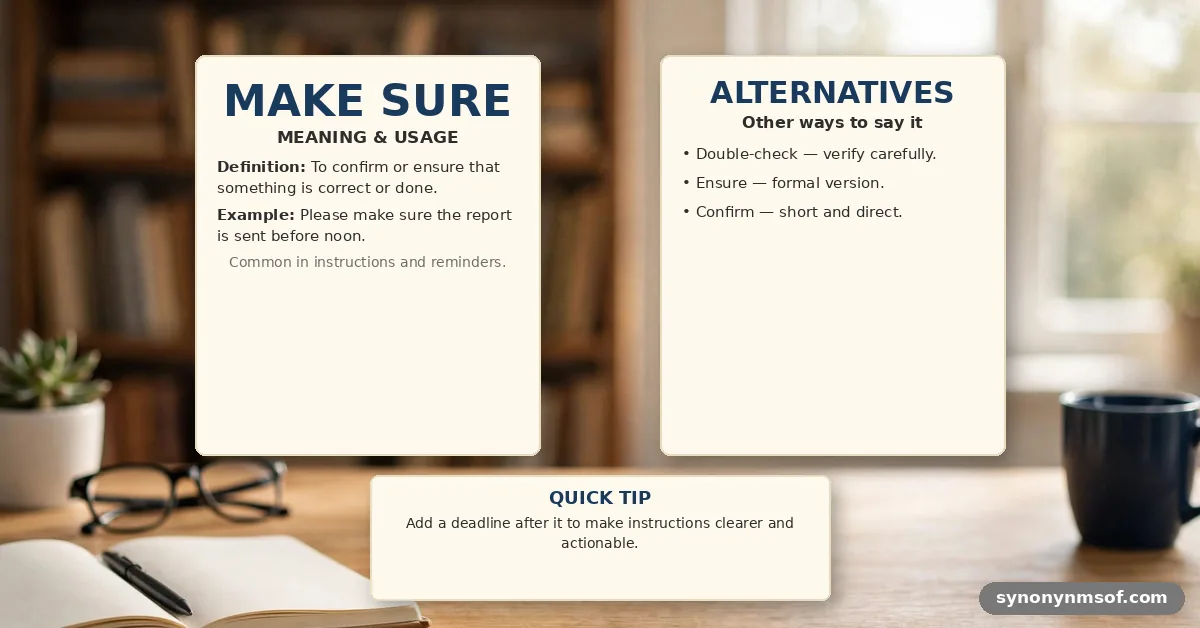
At its heart, the phrase means to establish certainty. You are essentially telling yourself or someone else to check that a condition is met before proceeding to the next step.
It serves as a safeguard against errors, oversights, and forgotten details. In the English language, it is a staple for setting expectations.
Think of it as a proactive measure. You aren’t just hoping that something happens; you are actively confirming that it does.
This distinction is what makes it so valuable in professional and personal settings alike. It transforms vague intentions into concrete actions.
Grammatical Structures and Patterns
You can use this phrase in several ways depending on the complexity of your sentence. Most commonly, you will see it followed by “that” or an infinitive verb. These variations allow for flexibility in how you frame your requests or reminders.
- Followed by “that”: Used when you want to clarify a specific condition. For example: “Please make sure that the report is attached before you send the email.”
- Followed by an infinitive: Used for direct instructions. For example: “Make sure to double-check your calendar for tomorrow.”
- Followed by a noun phrase: Used to confirm the status of an object. For example: “I need to make sure the arrangements are finalized.”
Professional Alternatives for Workplace Communication
While “make sure” is perfectly acceptable in most offices, sometimes you might want a more formal tone. This is particularly true when you are addressing senior management or clients. Swapping the phrase for a more sophisticated alternative can add a layer of polish to your writing.
Polite and Formal Replacements
When you need to sound professional, consider using verbs that imply meticulousness. Words like “verify,” “ensure,” and “confirm” are excellent substitutes. They convey the same sense of responsibility but often feel more structured.
Examples of Formal Usage
Instead of saying “Make sure you read the contract,” you might write, “Please ensure you have reviewed the contract.” This minor adjustment changes the tone from a casual reminder to a professional request. It signals that you value the other person’s time and attention to detail.
| Original Phrasing | Formal Alternative | Context |
|---|---|---|
| Make sure you sign it. | Please ensure the document is signed. | Legal or formal paperwork. |
| Make sure to call me. | Kindly confirm your availability via call. | Client scheduling. |
| Make sure the data is right. | Please verify the accuracy of the data. | Analytical reporting. |
| Make sure it’s done. | Please confirm completion of the task. | Project management. |
Using the Phrase in Daily Conversation
In casual settings, you don’t need to worry about being overly formal. The power of this phrase lies in its simplicity. It is the perfect tool for keeping friends and family on track without sounding like a drill sergeant.
It works exceptionally well when you are coordinating plans. You might say, “Make sure you bring your jacket because it’s cold outside.” It shows that you are thoughtful and looking out for the other person’s comfort.
Avoiding Common Pitfalls
Even though it is easy to use, people sometimes fall into traps that make their speech sound repetitive or confusing. One common mistake is overusing it in every sentence. If you find yourself starting every instruction with “make sure,” your message might lose its impact.
Another error is using it in place of stronger, more specific verbs. If you are instructing a team on a complex technical process, “make sure” might be too vague. In those cases, use “verify” or “validate” to provide clearer guidance on what exactly needs to be checked.
The Importance of Context
Choosing the right language depends heavily on who you are talking to. If you are writing to a close teammate, “make sure” is great. It sounds like a peer-to-peer check-in.
However, if you are writing to someone you don’t know well, consider the tone. A slightly more formal structure can prevent you from sounding demanding. Always read your message aloud to see if it sounds like a request or a command.
FAQ
Is it professional to use “make sure” in emails?
Yes, it is perfectly professional for most workplace correspondence. It is direct and clear, which are both valued traits in business communication. Use it freely with colleagues and managers.
What is a more formal way to say “make sure”?
The most common formal alternatives are “ensure,” “verify,” “confirm,” and “ascertain.” These words often sound more precise and are ideal for high-stakes documents or official communications.
What is the difference between “make sure” and “ensure”?
“Ensure” is generally considered a more formal, single-word synonym for “make sure.” While they share the same meaning, “ensure” is often preferred in written reports, contracts, and formal letters.
How do I make my requests sound less demanding?
To soften the tone, add “please” or frame the sentence as a question. For example, “Could you please make sure the file is updated?” sounds much more collaborative than “Make sure the file is updated.”
Refining Your Communication Style
Mastering the use of this phrase is about more than just vocabulary; it is about understanding the impact of your words. When you learn to balance casual reminders with formal verification, you gain control over how others perceive your professionalism. Whether you are speaking to a supervisor or a peer, your ability to express the need for certainty will serve you well.
Take the time to practice these alternatives in your next few emails or conversations. You will soon notice that your requests are met with better results because your instructions are clearer and more appropriate for the situation.
By paying attention to these small details, you demonstrate a level of care that sets your communication apart. Start using these variations today to see how they change the way your message is received.