
When you encounter the phrase thank you for your understanding, it usually signals that a request or a piece of news involves a slight inconvenience. This common expression serves as a polite buffer, acknowledging that the recipient might be frustrated while simultaneously asking for their patience.
Because it is so widely used in professional correspondence, knowing exactly when and how to deploy it can help you maintain positive relationships with clients and colleagues alike. By mastering the nuances of this specific language, you ensure your messages remain both professional and empathetic, regardless of the situation you are addressing.
The Meaning Behind the Phrase

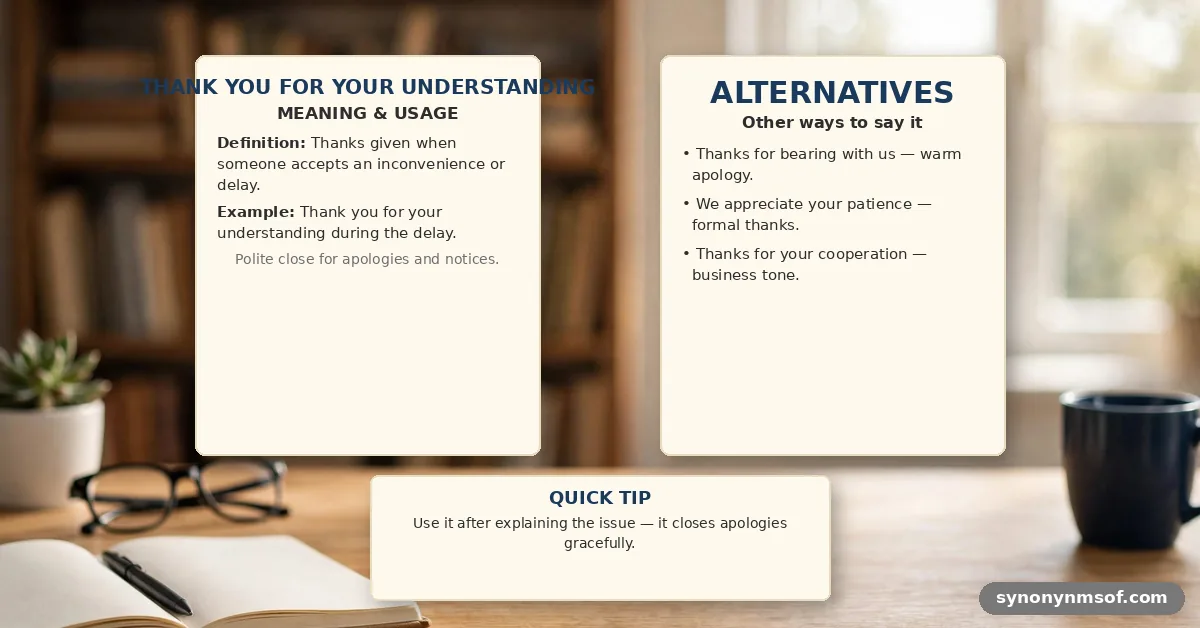
At its core, saying thank you for your understanding is an act of gratitude for the recipient’s tolerance. It functions as a preemptive apology for a change in plans, a delay in service, or a policy update that might not be welcomed. By using this phrase, you are shifting the focus from the inconvenience itself to the recipient’s capacity to handle it gracefully.
It is important to recognize that this is not just a polite filler. It is a way to acknowledge the impact of your words on the other person.
When you use it correctly, you validate their time and effort, which goes a long way in preserving professional trust. It essentially says that you do not take their patience for granted.
When to Use This Expression
You should consider using this phrase whenever you communicate news that might disrupt someone’s workflow or expectations. It is particularly common in customer support scenarios where a delay is unavoidable. For example, if a shipment is running behind schedule, adding this at the end of your explanation helps soften the blow.
Another appropriate time to use it is during internal company transitions. If your team is moving to a new software platform that requires a learning curve, expressing gratitude for their cooperation keeps morale higher. It frames the transition as a shared effort rather than an executive mandate.
- When notifying clients of a project delay.
- When explaining a change in company policy.
- When requesting additional time to complete a complex task.
- When closing a support ticket that remains partially unresolved.
- When informing a team about an upcoming system outage.
Professional Alternatives to Consider
Sometimes, the standard phrase can feel a bit repetitive or insincere if used too often. Depending on the context, you might want to vary your language to keep your communications fresh and genuine. Using a wider vocabulary demonstrates a higher level of professional polish.
Polite and Soft Variations
These options are ideal for sensitive situations where you want to emphasize your appreciation for the other person’s patience. They work well in emails to long-term clients or stakeholders who value a personal touch.
We appreciate your patience is a classic alternative that sounds slightly more active than the standard version. Another excellent choice is we value your flexibility regarding this matter, which highlights the recipient’s positive contribution to the process.
Direct and Neutral Variations
In high-pressure environments where brevity is preferred, you may want to skip the fluff. These options get straight to the point while remaining perfectly polite and respectful of the reader’s time.
Thank you for your cooperation is a strong, neutral alternative that implies a shared goal. You can also use we appreciate your flexibility to acknowledge that you are asking for a concession without being overly apologetic.
Comparison of Common Phrases
Choosing the right phrase depends largely on the level of intimacy you have with the recipient and the severity of the news. The following table provides a quick guide to help you decide which option fits your current communication needs.
| Phrase | Tone | Best Use Case |
|---|---|---|
| Thank you for your understanding | Standard/Professional | General business updates |
| We appreciate your patience | Warm/Empathetic | Service delays or wait times |
| Thank you for your cooperation | Formal/Direct | Policy changes or team tasks |
| We value your flexibility | Respectful/Appreciative | Schedule changes |
Common Pitfalls to Avoid
The biggest mistake people make is using this phrase when it is not actually warranted. If you have made a significant error, saying thank you for your understanding can sound dismissive or arrogant. In those cases, a direct apology is always the superior choice.
Another issue is overuse. If every email you send ends with the same phrase, it becomes white noise. Your readers will eventually stop noticing it, and the gesture of gratitude will lose all its meaning and impact.
FAQ
Is it professional to say thank you for your understanding?
Yes, it is widely accepted as a standard, polite professional phrase. It is appropriate for emails, official letters, and client communications whenever you are asking someone to accommodate an inconvenience.
What is the difference between at your earliest convenience and thank you for your understanding?
The former is a request for action, whereas the latter is an expression of gratitude for a situation already in progress. You use the first to prompt work, and the second to acknowledge patience.
What is the best way to express urgency politely?
If you need something done quickly, it is better to provide a specific deadline rather than using vague phrases. You can combine this with a polite sign-off like, “I appreciate your assistance in prioritizing this by Thursday.”
Can I use this phrase in a text message?
While the phrase is formal, it is acceptable in business texts if the tone is professional. However, for casual internal chats, a simple “Thanks for being flexible” often feels more natural and less robotic.
Final Thoughts
Selecting the right words is a subtle skill that significantly impacts how your messages are received by others. While thank you for your understanding remains a cornerstone of professional English, knowing when to deploy it—and when to choose an alternative—will distinguish your communication style. Whether you are managing a client’s expectations or guiding your team through a difficult change, expressing gratitude for someone’s patience fosters a culture of mutual respect.
I encourage you to review your recent emails and identify where a slightly more tailored expression of appreciation might improve your professional relationships. Consistent attention to these details will serve you well throughout your career.
SEO Title: Thank You for Your Understanding: Meaning & Examples
Meta Description: Learn the meaning of thank you for your understanding and how to use it professionally. Discover alternatives for emails and client communication.
Suggested URL Slug: thank-you-for-your-understanding-meaning-examples
Primary Keyword: thank you for your understanding
Secondary Keywords: professional ways to say
Secondary Keywords: professional ways to say as soon as possible, polite ways to say as soon as possible, gratitude, patience, business communication